Figure AI Unveils Video of Robot Performing Household Chores, Musk Expresses Skepticism
 03/11 2026
 600
600
On March 10, 2026, Figure AI released a video depicting a robot seamlessly navigating between a sofa and coffee table, cleaning the table, picking up building blocks, arranging throw pillows, and finally draping a towel over its shoulder to free its hands for another task—a scene evocative of a science fiction film.
Simultaneously, BMW announced its plans to further expand the deployment of Figure robots on its production lines.
As of now, these robots have logged a total of 1,250 operational hours. One is seen tidying up toys in a living room, while another is hard at work in a factory.
These developments seem to encompass two distinct news stories. Where should humanoid robots initially focus to generate revenue? Will domestic helpers or factory workers be the first to be replaced?
01
Controversy Ignited by a Video
● Figure 03 Embarks on Household Chores
This time, Figure showcased Figure 03 in a real-world living room environment, complete with a sofa, carpet, coffee table, building blocks, and a remote control.
The robot executed a series of tasks: spraying cleaner on the table, picking up scattered building blocks, arranging sofa pillows, and pressing the remote control to turn off the TV.
One notable detail: the robot was holding a towel but needed to grab something else, so it casually tossed the towel over its shoulder.
This is a quintessentially human action. For humans, it's a subconscious behavior. However, for a robot, it necessitates a complex set of decisions:
Understanding the objective: assessing the current situation, planning new actions, and coordinating physical execution. Such actions were nearly impossible to achieve in past robotic systems.
Traditional robots rely on pre-programmed movements crafted by engineers. If the action "place the towel on the shoulder" wasn't pre-programmed, the robot would never perform it.
The core technology demonstrated by Figure this time is known as Helix 02 (a single neural network-driven end-to-end system). In essence, this robot no longer depends on manual programming but instead learns how to complete tasks through an AI model.
● Musk's Skepticism
Shortly after the video's release, Musk questioned on social media: "Is this fully autonomous, or remotely controlled?"
This question strikes a chord.
There has always been an "open secret" in the robotics industry: many seemingly flawless robot demonstrations are actually remotely controlled. Operators observe the environment through cameras and control the robot's movements in real-time. While this method yields impressive video effects, it is vastly different from true autonomy.
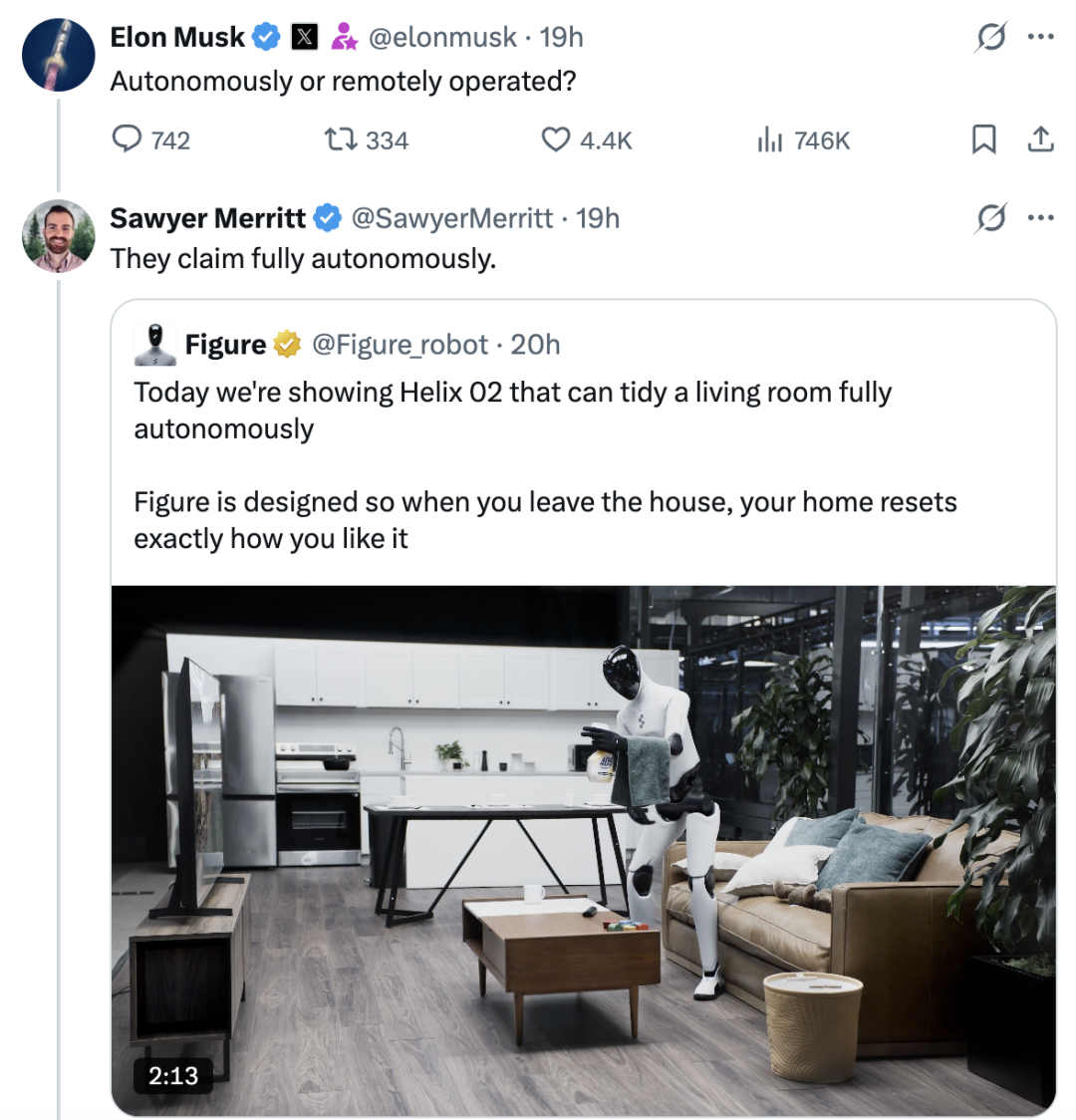
Figure AI responded that the robot was fully autonomous with no remote intervention. However, this cannot be fully verified externally.
Of course, the humanoid robot industry still lacks concrete empirical data. A single video is insufficient to convince everyone. What truly builds trust is something else—operational time.
● BMW's 1,250 Hours
In 2024, BMW announced its collaboration with Figure to test humanoid robots in automotive factories. To date, Figure 02 has accumulated 1,250 operational hours on production lines. While 1,250 hours may not seem exceptionally long, it signifies the entry of humanoid robots into real industrial environments. Moreover, BMW has not halted the project—it is continuing to expand deployment.
Automotive factories have long been considered one of the most promising application scenarios for humanoid robots. Traditional industrial robots excel at repetitive tasks like welding and painting. However, in assembly processes, many tasks still require human workers, as humans can easily adapt to changes, whereas traditional robots often cannot.
Humanoid robots are inherently suited for environments designed for humans. BMW's strategy is to have robots not directly replace entire production lines but first undertake simpler tasks, such as logistics handling and part assembly. Let the robots work first, then gradually optimize efficiency.
02
Household vs. Factory: Two Distinct Commercialization Paths
● Choosing a Path
When viewed holistically, the development of humanoid robots is diverging into two paths.
◎ Tesla represents a vertically integrated model.
Musk's approach is straightforward: build robots in-house, develop AI internally, use them in his own factories, and ultimately achieve mass production. The goal is to reduce the cost of the Optimus robot to below $20,000. With sufficiently low costs, robots could enter households.
◎ Figure AI is taking a different route. Without Tesla's resources or its own automotive factory, Figure chose to first land in industrial scenarios.
Industrial clients are willing to pay for efficiency, making the business model more viable. Once industrial scenarios are proven, costs can be gradually reduced to enter more markets.
To some extent, these two paths resemble the early divergence in the electric vehicle industry: prioritizing scale or market.
● Humanoid Robots Have a Forty-Year History
The current hype surrounding humanoid robots is not new. In the 1980s, Japan began experimenting with humanoid robots.
Honda's ASIMO was once one of the world's most renowned humanoid robots, capable of walking, running, and even climbing stairs. Boston Dynamics' Atlas pushed robotic locomotion to new heights. However, these robots never entered the commercial market.
The reason is simple: they were too expensive and lacked intelligence. Past robots were more akin to precision machinery than intelligent systems. What truly transformed this landscape were recent advancements in AI large models. When robots gained stronger visual understanding, task planning, and motion generation capabilities, they began to truly approach "intelligent machines."
This is why the humanoid robot industry has suddenly regained popularity.
● China's Position in the Race
Chinese companies are rapidly catching up in this race. Companies like UBTECH and Unitree have accumulated years of experience in humanoid robot hardware.
Mechanical structures, motion control, and servo systems are areas where the gaps are not particularly large. The real challenge remains the "robot brain": visual understanding, task planning, and motion generation—capabilities increasingly reliant on large AI models and high-performance computing chips.
In this regard, Tesla and Figure still hold certain advantages. However, the robotics industry is inherently supply-chain-driven. As application scenarios expand, new opportunities will continue to emerge.
In recent years, humanoid robots have often been compared to smartphones or electric vehicles. A more apt reference, however, might be the industrial robotics industry. It took about two decades for industrial robots to move from laboratories to large-scale applications. Humanoid robots may not progress as swiftly, but the industry generally believes that 2025–2027 could be the first critical window.
During this period, AI models will mature, hardware costs will decline, and application scenarios will be validated. Whoever can first achieve a closed loop of mass production—deployment—profitability may become the standard-setter for the next phase.
Summary
The robot video in the living room and BMW's expanded factory deployment represent two distinct worlds: the former is a vision of robots entering households as new smart terminals, while the latter is the reality of robots "earning money" in factories first.
The humanoid robot industry now straddles these two worlds. Technology is advancing rapidly, but business models are not yet fully established. If AI is the brain of this technological revolution, then humanoid robots may well become its most important embodiment.
-
![]()
Doubao Work Unveiled! Domestic AI Leaders Fully Commit to the 'Work' Sector
-
![]()
Who’s Sounding the Alarm on ‘Rushed Vehicles’?
-
![]()
Over 5.3 Billion Yuan in Losses Over Three and a Half Years! Can Yonyou Reverse Its Fortunes Through Streamlining and AI Transformation?
-
![]()
Baidu AI Adopts Free Model: A Strategic Maneuver in Traffic and Monetization
-
![]()
Silicon-Based OLED Pioneer Unveils Financial Results: H1 Shipments Outpace Entire 2025 Volume
-
![]()
AI's First "Lost Summer"
-
![]()
Zeiss Makes Another €2.2 Million Bet: Will Eye Tracking Be the Next Big Thing in the Smart Glasses Industry?
-
![]()
RUNTO Ranking | Global Top TV ODM Factories' Shipment Figures for July 2026