Exploration of Commercialization in Three Major Embodied Scenarios: Unraveling the 'Scale-up' Implementation Paradigm through Similarities and Differences
 03/26 2026
 537
537
The year 2026 has become the 'inaugural year of commercialization' for embodied intelligence, transitioning from laboratories to the real world.
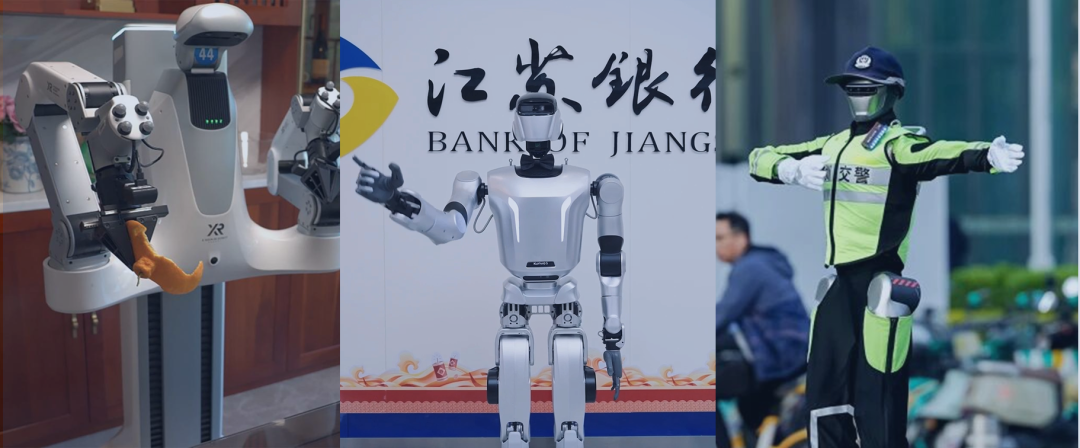
In March, from Autonomous Variable Robotics partnering with '58 Daojia' to serve households, to Legend Robot's Kuafu robot stationed at Jiangsu Bank, and then to SEER Robotics collaborating with Duolun Technology to implement smart transportation in Jianye District, Nanjing, these initiatives span household life, financial services, and urban governance, covering C-end livelihood services, B-end standardized services, and G-end public services, forming a highly representative scenario triangle for embodied intelligence applications.
They not only validate the true value of embodied intelligence but also expose common bottlenecks in technology and industry. However, what is certain and even more important is that these incremental commercialization explorations are laying a solid foundation for the large-scale adoption of embodied intelligence.
Similarities and Differences Among the Three Scenarios: From 'Scenario Adaptation' to 'Scale Value'
While the three implementation scenarios may seem vastly different, their underlying logic is highly unified, and these differences precisely point to the optimal path for commercialization.
Common Characteristics: All three scenarios advocate for 'human-robot collaboration' rather than complete human replacement, applying through core task scenarios characterized by high repetition, high standardization, and low risk. In addition to the embodied intelligent robot itself requiring strong scenario adaptability, multimodal fusion recognition, stable semantic understanding capabilities, and real-time decision-making and execution, it must also rely on vertical industry resources to form a 'technology-real scenario-data-operation closed loop.' All three scenarios prioritize cost reduction and efficiency enhancement, improved experience, and stable supply as their core commercial values.
This represents the most pragmatic implementation strategy for current embodied intelligence technology—not pursuing full autonomy in one step but having robots undertake mechanical tasks while humans focus on decision-making, communication, and complex processing, rapidly forming operable, replicable, and profitable models.
58 Daojia · Autonomous Variable Robotics: C-end Unstructured Household Scenarios. With changeable (diverse) environments, fragmented tasks, and high privacy requirements, the 'cleaning aunt + robot' golden duo is employed, with robots handling basic cleaning and organization while humans handle communication and detailed tasks. The embodied humanoid robot has achieved, for the first time globally, the commercial operation of household service robots, addressing three major challenges of C-end trust, safety, and experience.
Jiangsu Bank · Legend Robot's Kuafu: B-end Semi-Structured Scenarios. With relatively controllable environments, fixed processes, and standardized interactions, the robot focuses on greeting, diversion (diverting), consulting, and guiding, with its core value being service standardization and efficiency enhancement, suitable for rapid large-scale replication, validating the commercial feasibility of lobby service robots.
Nanjing Jianye · SEER Robotics + Duolun Technology: G-end Open Dynamic Scenarios. With complex outdoor environments, disturbances from vehicle and pedestrian flows, and multi-device collaboration, the focus is on public security and traffic management, relying on Duolun's traffic data and dispatching system to integrate embodied intelligence with the foundation of smart cities, providing a model for large-scale public services.
The 'incremental progress' of these three scenarios has also coincidentally completed a critical industry exploration, proving that domestic embodied intelligence is implemented in layers based on environmental differences—from B-end semi-structured to G-end open scenarios, and then to C-end unstructured households, with values amplifying step by step. This differentiated breakthrough may enable the industry to escape the dilemma of 'showcasing technology without implementation' and find a clear path from usability to good usability and then to large-scale adoption.
The Essence of Commercialization Exploration: Validating Scale Value through Scenario Closed Loops
Currently, embodied intelligence is still in its early commercialization phase. Unlike the internet economy, which relies on the data value realization path of scale effects, the value creation of embodied intelligence follows a scenario-driven logic. The exploration of the three cases essentially uses minimum closed loops to complete four key validations, clearing obstacles for large-scale adoption.
First, Demand and Value Validation: Financial outlets alleviate manpower shortages and enhance service consistency; household scenarios supplement domestic staff supply and reduce service costs; smart transportation supplements police force and improves governance precision. They transform robots from exhibits into measurable ROI production tools and service carriers, making customers willing to pay and enterprises willing to invest.
Second, Operation Model Validation: Banking and transportation scenarios adopt a 'joint development + project delivery' model, while households use a platform reservation + human-robot collaborative service model. These two models cover product sales, service sharing, and government-enterprise cooperation, forming replicable commercialization frameworks and avoiding the industry's deadlock of 'having technology but no revenue.'
Third, Data and Iteration Closed Loop: Real scenarios generate full-link data on perception, interaction, operation, and feedback, continuously feeding back into algorithm optimization. Banking service scripts, household cleaning strategies, and traffic dredge logic, through world models, continuously drive robots to evolve in daily operations, prompting the embodied intelligence industry to transition from 'fixed programs' to adaptive intelligence.
Fourth, Industrial Chain Collaboration Validation: Robot enterprises are responsible for the robot body and algorithms, while scenario providers offer industry experience, data, and channels, forming a golden combination of technology and scenarios. This clearly defined industrial boundary greatly accelerates the coordinated maturation of complete machines, components, algorithms, and applications, laying an ecological cooperation foundation for large-scale production and delivery.
From this perspective: The application of embodied intelligent robots in various commercial scenarios in the past and even today is not a small-scale pilot but a prerequisite course for large-scale implementation. Without the refinement of these real operations, there would be no cost reduction, reliability improvement, or user trust establishment, making it impossible to achieve a leap from 'hundred-unit' to 'thousand-unit' or even larger scales.
Similarly, to further unleash the true potential of embodied intelligence in commercial scenarios, technical support in embodied brain, cerebellum, dexterous operation, and data is indispensable.
On the Eve of Large-Scale Adoption: Four Core Capabilities of Embodied Intelligence Need Enhancement
Despite accelerated scenario implementation, embodied intelligent robots are entering commercial scenarios such as banks, households, and roads, completing many complex environmental interaction tasks through hardware performance breakthroughs and software improvements. However, there is still a distance from large-scale commercial use.
Generally, for embodied intelligent robots to be stably applied in real commercial scenarios, their technical core must possess scenario adaptability, Ontology perception complexity (body perception complexity), and decision robustness. This requires coordinated breakthroughs and cooperation in four major directions: the brain (decision-making cognition), cerebellum (motion control), dexterous operation (execution end), and scenario data (generalization ability).
1. 'Brain': Embodied Large Models and Multimodal Cognition
As the decision-making hub of the robot, the 'brain's' core is to understand the environment, understand instructions, and make reasonable decisions. For example, Legend Robot's Kuafu is equipped with a financial-exclusive knowledge base and large model to achieve accurate Q&A and intelligent business diversion (diversion); Autonomous Variable Robotics understands household environments and cleaning tasks; SEER Robotics integrates traffic perception and dispatching logic data to provide strong support for urban public safety governance.
Although the industry has achieved task-level understanding and procedural execution of embodied intelligent robots, their generalization ability is still limited, and robustness in unfamiliar environments is insufficient, which is also the industry's next key focus.
2. 'Cerebellum': Motion Control and Stable Walking
Responsible for balance, gait, and trajectory planning, it is key to the robot's ability to 'stand steadily, walk accurately, and move smoothly.' SEER's T800 and PM01 rely on their Flexible and reliable (flexible and reliable) 'bodies' to easily adapt to full scenarios of 'command, patrol, and service'; Legend Robot's Kuafu provides full-course accompanying guidance in bank branches, responding instantly to emergencies; Autonomous Variable Robotics' safe movement in complex household environments all require hardware performance to match algorithms and the coordinated cooperation of the 'brain' and 'cerebellum.'
Currently, body hardware and motion algorithms are becoming increasingly mature, with continuous operation duration, stability, and environmental adaptability meeting basic commercial requirements.
3. Dexterous Operation: End-Effector and Precision Work
It is the core of the robot's interaction with the physical world, determining its ability to complete tasks such as grasping, wiping, and operating. Whether it's Autonomous Variable Robotics completing desktop organization and basic cleaning, Kuafu assisting in operating intelligent devices at bank branches and guiding customer intelligent interactions, or SEER Robotics completing traffic gesture commands, all rely on a pair of dexterous and suitable hands.
Currently, breakthroughs have been made in the lightweight, flexibility, and low-cost of robot end-effectors (dexterous hands or two-finger grippers), supporting daily service operations. However, complex and precise operations in many scenarios still need improvement.
4. High-Quality Scenario Data: Data Scarcity and Insufficient Generalization
Embodied intelligence requires massive visual, tactile, force control, and operational data to train robots' generalization abilities. However, current training data comes from different forms of carriers, and most data is sourced from stable ideal scenarios. Coupled with high annotation costs and a lack of sharing mechanisms, robots 'fail in new scenarios' and struggle to form general capabilities. Therefore, strengthening data infrastructure and secure sharing mechanisms is urgent to provide core fuel for general embodied intelligence.
Currently, only through coordinated breakthroughs in the four core capabilities of brain cognition, cerebellum control, dexterous execution, and scenario data can robots transition from 'passive execution' to a fully autonomous closed loop of 'autonomous perception-decision-execution-feedback,' becoming truly embodied intelligent robots. This is not only a key path for industrial technological leapfrogging but also the most fundamental difference between embodied intelligence and traditional automated equipment.
Whale Wonders Commentary
The core mission of the current industry is not to pursue science fiction-like full autonomy but to deliver usable robots to real scenarios, establish viable business models, and break through key technological bottlenecks. The implementation of the three scenarios by Legend Robot, Autonomous Variable Robotics, and SEER Robotics is not the endpoint but a new starting point for the embodied intelligence industry. They have proven through practice that the future of embodied intelligence is not about instantly achieving universal robots but about starting from various vertical scenarios, based on human-robot collaboration, using commercialization to feedback technology, and adopting a data-driven iterative path.
When technology matures, costs decrease, standards improve, and ecosystems collaborate, embodied intelligence will fully enter fields such as finance, households, transportation, manufacturing, and elderly care. To date, numerous domestic commercialization explorations, such as accumulating data, refining products, validating models, and cultivating ecosystems, are accumulating strength for the upcoming large-scale implementation, using industrial strength to reconstruct the connection between the physical world and digital intelligence, and ushering in the next golden decade of embodied intelligence.
*Editor's Disclaimer: Original content is not easy; please respect the author. For reprinting, please contact us.
-
![]()
The Allure of 'Acquisition Spree': Li Shufu's Left Turn, Xu Jiayin's Right
-
![]()
Strategic Transformation Yields Results: Phoenix Optics Reports 10.9% YoY Rise in Core Net Profit for H1 2026
-
![]()
Three Key Growth Trajectories Synergize! Crystal-Optech Reports 3.478 Billion Yuan in Revenue for H1 2026
-
![]()
Semi-Annual Report Sparks XPENG Motors Buzz
-
![]()
1.6 Billion Big Order Secured! SeeYA Technology's Revenue Soars by 287.87% in the First Half of the Year
-
![]()
Baidu's Profits Plunge by 68%: Unraveling the Mystery Behind the Numbers
-
![]()
Baidu’s Profits Tumble by 68%! Where Has All the Money Gone?
-
![]()
Hynix’s Taobao Store Shuts Down Abruptly: What Should Customers Do About Warranty Services for Memory Modules?