Doubao Boosts Sales, Qianwen Streamlines Mobile Recharges: Large Models Step into the 'Era of Practical Deployment'
 03/31 2026
 599
599

Large models are evolving from a mere repository of knowledge to actionable tools. Each enhancement in their practical capabilities brings them closer to achieving commercial viability.
Content/YoYo
Edited by/Goose
Proofread by/Rustic
March 30, 2026, marks a significant milestone in the commercial journey of large models.
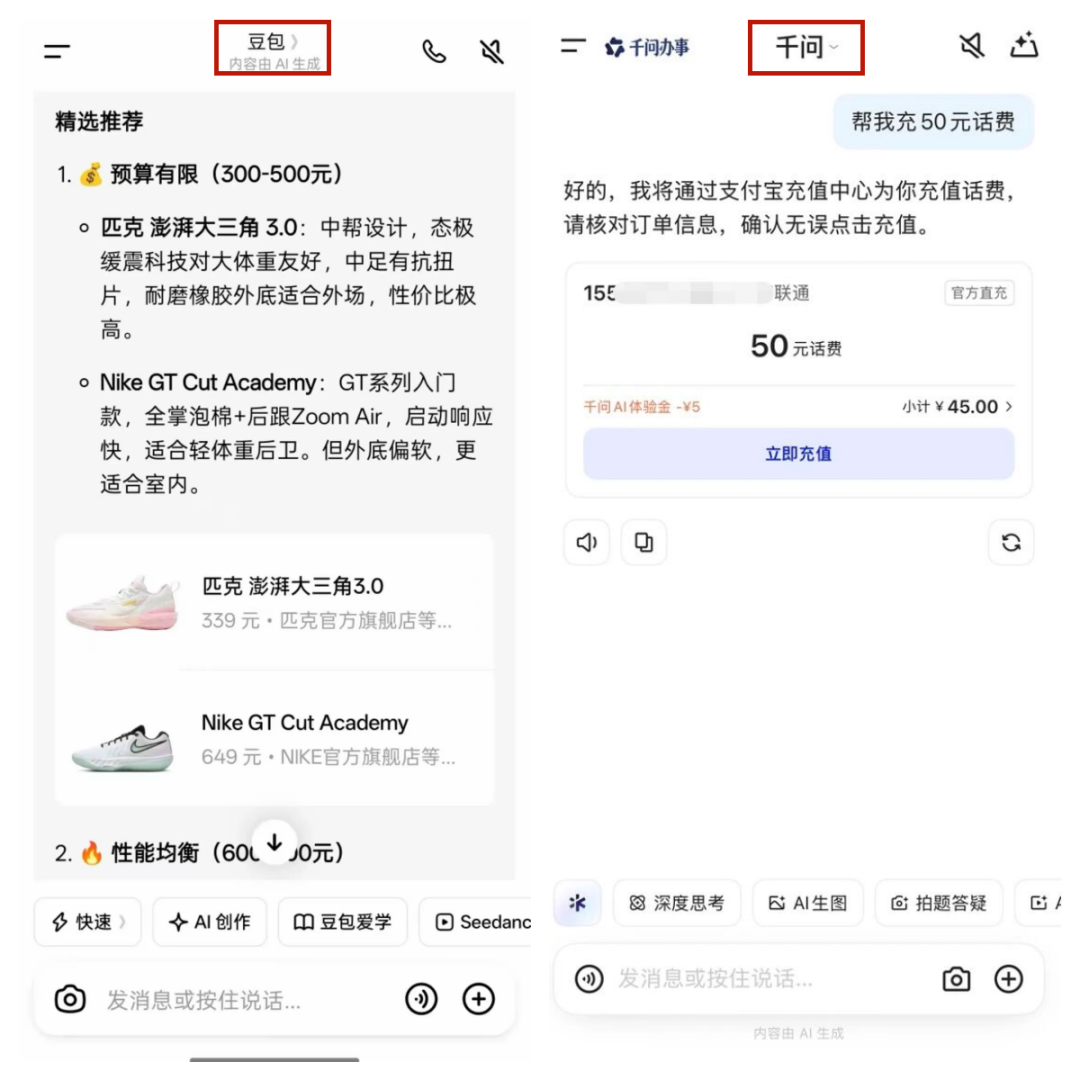
On that morning, media tests unveiled that Doubao had seamlessly integrated with Douyin E-commerce. When users sought product recommendations within Doubao, they not only received AI-generated responses but could also directly click on product links to navigate to Douyin Mall and finalize their purchases.
By the afternoon, Alipay had announced that within the Qianwen App, users could recharge their mobile phones with a simple voice command and pay instantly using Alipay's 'AI Pay' feature.
These sequential developments, akin to firing the starting gun in a race, signify a pivotal historical turning point. The large model industry is rapidly transitioning from the initial phase of technological breakthroughs and parameter competition to the second phase of commercial exploration and practical capability enhancement.
Part.1
Breaking Free from the Chatbox
From Content Creation to Commercial Ecosystems
If 2023 was the year AI assisted humans in crafting poetry, then 2026 is the year AI empowers humans to make purchases. Doubao, Qianwen, and Yuanbao are vigorously breaking free from the confines of the chatbox.
This liberation is evident in the deep integration of these systems with traditional, well-established ecosystems such as e-commerce, payments, lifestyle services, and social media. This integration is not merely a strategy for customer acquisition but a prerequisite for establishing a sustainable business model.
Take ByteDance's Doubao as an illustration. Tests conducted on March 30 revealed that when users input commands like 'recommend a product' in Doubao, the AI not only offered purchase suggestions but also directly displayed product links for one-click navigation to Douyin Mall to complete the transaction. Furthermore, the Doubao APP updated its privacy policy concerning Shanghai Gewuzhipin (a Douyin E-commerce partner) and introduced a 'My Orders' feature within the app, linked to Douyin accounts.
Similarly, Alibaba's Qianwen expanded its reach into the payment domain. The newly introduced 'AI Pay' feature on Alipay is seamlessly integrated into the Qianwen APP interface. Users can instruct Qianwen to 'recharge my phone with 50 yuan' and utilize this process to purchase Luckin Coffee, order food delivery, stock up on snacks, buy movie tickets, and even book flights, hotels, and rides—all within the Qianwen ecosystem.
This may appear to be a mere addition of functional modules, but it represents a fundamental restructuring of the underlying logic.
In the past, the mobile internet revolved around App penetration, with different Apps operating in isolation, creating information silos. Now, AI serves as a cross-app orchestrator, with the parent company's super ecosystem providing the ideal training ground.
Because major corporations understand that relying solely on publicly available internet data will lead to model homogenization. What truly sets them apart is private commercial closed-loop data derived from social graphs, e-commerce transaction chains, and short-video behavior streams.
Large models are transitioning from a state of knowledge-action disconnection to one of unity. Each expansion in their practical capabilities brings them closer to achieving monetization.
Part.2
Metaphor for Organizational Transformation
From Ivory Tower to ROI-Centric Reality
The first to perceive the industry's shifting tides are the once-esteemed technical labs.
Recently, leading domestic large model teams, including Alibaba's Tongyi Qianwen and Tencent's Hunyuan, have undergone organizational restructuring. The ByteSeed team and Huawei's Noah's Ark Lab have also witnessed the departure of key technical personnel.
During the tech hype phase, these scientists and top algorithm engineers were the crown jewels of major corporations, fortifying China's AI defenses against global giants with their code.
But why, at a critical juncture where model capabilities are converging, and Qianwen even surpasses some international counterparts to rank first in China on the LMArena blind test list, are there such intense personnel changes?
Fundamentally, this is the inevitable outcome of technical idealism clashing with commercial reality.
The patience of major corporations is finite. Despite billions in initial computing power investments and substantial user acquisition campaigns during the Spring Festival—such as Yuanbao's 'Share 1 Billion,' Qianwen's 3 billion 'Spring Festival Mega Discounts,' and Doubao's deep involvement in the Spring Festival Gala—the impressive reports of over 100 million daily active users masked the underlying truth.
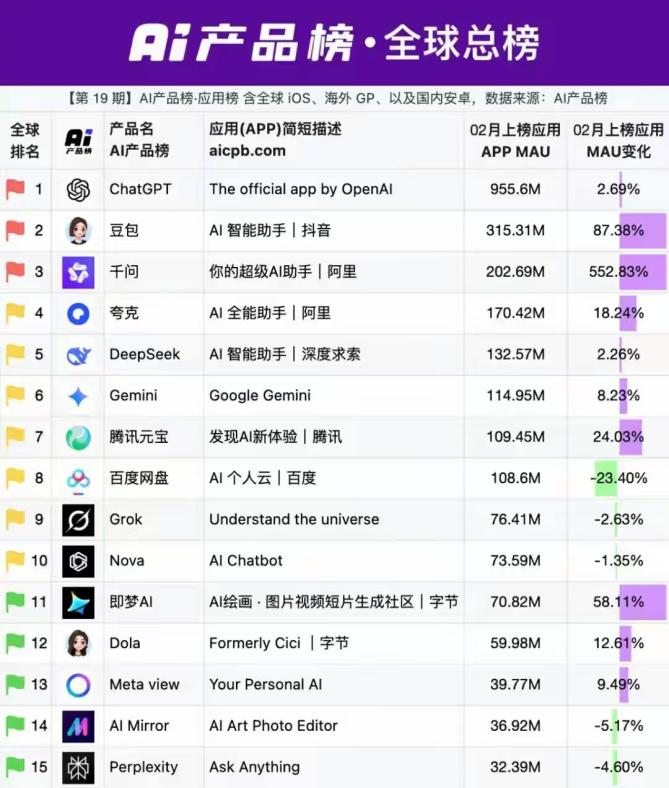
However, survey data from the T-ask platform shattered this illusion of traffic, revealing a retention intention of no more than 50%, with conversations predominantly focused on low-value entertainment and casual chat needs.
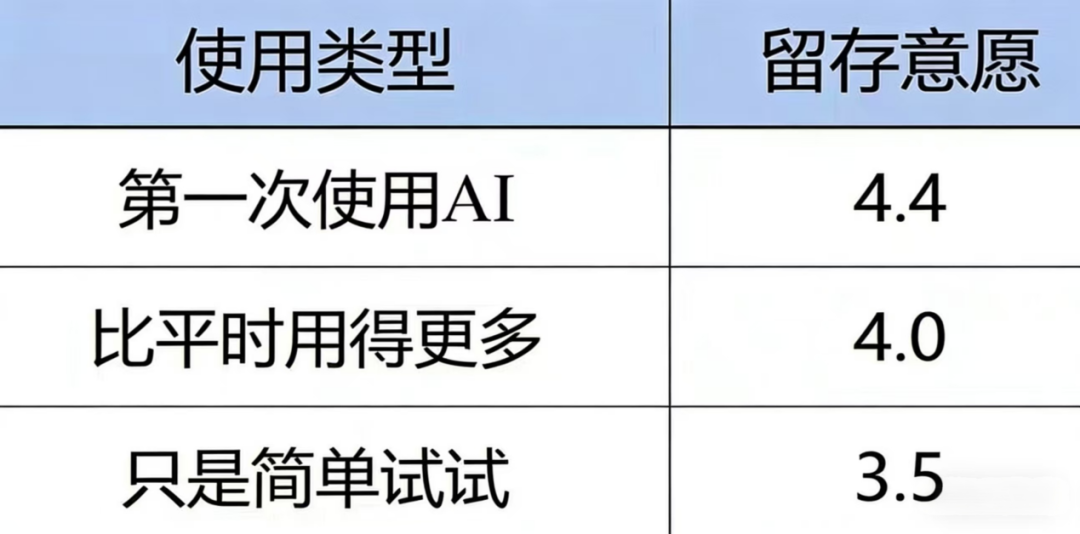
In this context, lab-style structures are no longer suitable for the impending battles. Large model research projects must swiftly transition to serving commercial products. The departure or reassignment of key personnel reflects major corporations reshaping the DNA of their AI teams, shifting from a pure pursuit of model parameters to commercialization, application ecosystems, and ROI.
Scientists lay the groundwork, while product managers and commercialization teams take the reins. In this new era, only those who can translate the intelligence of large models into tangible actions like 'buying a cup of coffee' for users will secure a pass to the next round.
Part.3
Divergent Strategies
Competing for Super Entrances, Betting Big on Agents
In the battle for national-level applications, major corporations' strategies are beginning to diverge significantly. The old playbook of simply throwing money at in-app traffic can no longer uncover the new continent in the AI era.
Besides Doubao and Qianwen, Tencent's Yuanbao, once criticized for its sluggishness and lagging monthly active users, also made a 'proactive move that led to lifelong introspection.' WeChat officially announced the launch of the ClawBot plugin, supporting integration with OpenClaw. However, an OpenClaw update directly thwarted the competition, causing ClawBot to malfunction, with an actual 'lifespan' of less than two days.
As internet traffic pools deplete, the core metrics of large model competition will gradually shift from DAU (Daily Active Users) to API Calls (interface invocation times) and Task Completion Rate.
The evolution of human technological history is a tale of simplifying instructions. From early command-line operations to graphical user interfaces (GUIs), then to multi-touch and swiping, the next frontier will inevitably be natural language interface-driven Agents dominating everything.
The ultimate battle for national-level applications may not even culminate in an 'App' as the victor.
Major corporations are experiencing organizational upheaval, key personnel are on the move, and marketing budgets are burning. All of this merely serves as the prologue to the AI civilization era. The acceleration of large model commercial exploration and the expansion of practical capabilities herald the end of the toy era.
In the long night and dawn that follow, only those who can truly break free from the chatbox and accomplish tasks in the real world will receive the passport to the next cycle.
END
-
![]()
The Allure of 'Acquisition Spree': Li Shufu's Left Turn, Xu Jiayin's Right
-
![]()
Strategic Transformation Yields Results: Phoenix Optics Reports 10.9% YoY Rise in Core Net Profit for H1 2026
-
![]()
Three Key Growth Trajectories Synergize! Crystal-Optech Reports 3.478 Billion Yuan in Revenue for H1 2026
-
![]()
Semi-Annual Report Sparks XPENG Motors Buzz
-
![]()
1.6 Billion Big Order Secured! SeeYA Technology's Revenue Soars by 287.87% in the First Half of the Year
-
![]()
Baidu's Profits Plunge by 68%: Unraveling the Mystery Behind the Numbers
-
![]()
Baidu’s Profits Tumble by 68%! Where Has All the Money Gone?
-
![]()
Hynix’s Taobao Store Shuts Down Abruptly: What Should Customers Do About Warranty Services for Memory Modules?