I did cross-border business overseas alone with AI
 04/01 2026
 693
693

Author|Tang Fei
Editor|Li Xiaotian
“Can one person do cross-border e-commerce? And do it well?”
Three years ago, this question might have been met with a lot of skepticism. But today, the answer has shifted to not only possible but becoming a trend.
Data shows that in the entire cross-border e-commerce sector, the transaction volume of individual cross-border e-commerce is growing rapidly. The numbers clearly illustrate this point: the Belt and Road Initiative website shows that from January to September 2025, China's individual cross-border e-commerce exports totaled $84.35 billion, a year-on-year increase of 36.7%.
At the same time, a new entrepreneurial model called OPC (One Person Company, one-person company ) is on the rise. Multiple regions across the country have even sparked a “race” for one-person companies. Hangzhou allocates 100 million yuan in special funds annually, aiming to build 10 OPC communities, cultivate 100 AI enterprises, and gather 1,000 OPC entrepreneurs by 2026. Hefei has established the city's first OPC entrepreneurial space, providing one-stop ecological services including carrier (platforms), computing power, data, capital, scenarios, and policies. Qingdao has set up 16 OPC professional parks, offering tailored entrepreneurial services across different fields such as audio and video, short dramas, industrial internet, semiconductors, and new energy vehicles.
According to a report by the Zhongguancun Talent Association, the industry distribution of one-person limited companies in China presents two distinct characteristics: they are highly concentrated in the service sector and deeply integrated into the digital economy. Among them, e-commerce has become the largest sub-sector for OPCs, accounting for 16.49%, with significant efficiency improvements in models such as cross-border e-commerce, dropshipping, and private domain operations. With the help of AI digital humans and other tools, one-person companies in the cross-border e-commerce sector can achieve “a 70% reduction in labor costs and a 300% increase in sales.”
In reality, a “one-person company” in the broad sense is not a “company with only one person,” but rather a company led by a core individual, relying on AI agents, a small number of supporting staff, and outsourced collaboration to operate normally.
Compared to traditional companies, “one-person companies” have unique advantages such as fast decision-making, low costs, and flexible transformation, aligning with the demand for lightweight entrepreneurship in the AI era, and are highly favored by entrepreneurs.
Tang Shuyuan, Chief Researcher at the Lingwu Era Digital Research Institute, believes that the core value of OPC lies in its breaking of the iron law of “entrepreneurship as organization” since the industrial era, achieving an atomic reconstruction of productivity. In the past, the invisible barrier to entrepreneurship was resource integration—one had to first build a team and establish a structure, often exhausting individuals with organizational costs. OPC returns entrepreneurship to the “human” essence, reducing the barrier from resource holdings to cognitive depth.
The more profound impact is that “an individual, leveraging AI, can command intelligent agents to complete a full-chain closed loop (closed loop), meaning entrepreneurship is no longer a privilege for elite teams but is open to all individuals with unique talents. This is a structural shock to the entrepreneurial landscape,” Tang pointed out.

In a 30-square-meter apartment in Shenzhen, Lin Yuan's one-person company has been operating for over half a year.
“You ask why I dare to do cross-border business alone? First, because I have three to four years of experience, and second, because AI technology has given me the opportunity.”
Last March, he was still the operations manager at a Shenzhen foreign trade company, leading a small team of four to five people managing three Amazon stores. The products were mainly sold to the Russian market—a place he described as “both near and far.” Near, because logistics from China can reach Moscow by rail in 18-25 days or by air in as fast as 3-7 days; far, because of the language, culture, and consumption habits, separated by a vast expanse of Siberia.
“Back then, when the team created copy, a new product page would take three days to finalize—first translating Chinese into Russian, then refining the Russian to sound natural, and also researching keywords. Because of Russia's vast size, there are dialects within the Russian language, just like in China. The written characters are the same, but when spoken, the accents between northern and southern Russia differ greatly,” Lin said. “Later, when ChatGPT came out, I tried it and was stunned. The Russian copy it wrote was more natural than what I paid part-time translators for.”
In mid-2025, Lin resigned and registered a “one-person company.” Today, he has streamlined all processes with AI: ChatGPT generates Russian product descriptions and ad copy, Midjourney helps design main image concepts, and Amazon's AI tools analyze competitors and keyword trends for product selection and listing. He even uses AI to create several product videos—inputting a Chinese script, the AI digital human delivers it in Russian, with perfectly synced lip movements.
His best-selling product is outdoor heated gloves. “Domestic consumers are relatively unfamiliar with this, only some winter fishing and hunting enthusiasts buy them. But Russia has five months of winter, and Siberia's winter lasts eight months, with -40°C being very common, so heated gloves are essentially a necessity,” Lin said.
This product was also discovered with the help of AI—he had AI scrape 5,000 negative reviews under “warmth”-related categories on Russian sites over three months, finding that “finger dexterity” and “battery life” were the biggest pain points. He then contacted a factory to upgrade the finger sections of existing products, making them more sensitive and easier to operate smartphone screens or other devices.
“Last winter alone, these gloves sold 7,000 units,” Lin said.
TikTok Shop seller PD has also benefited from AI technology.
Early this year, “OpenClaw” went viral, but before it became a nationwide sensation, PD had already started experimenting with using OpenClaw to help operate short videos and drive traffic for sales. “For a standard e-commerce team, daily operations inevitably involve store data analysis, competitor data analysis, listing optimization, ad placement, and optimization. My OpenClaw can currently cover most of these functions.”
Take content generation and placement as an example: PD's workflow is now fixed. First, OpenClaw regularly calls on popular topics from TikTok Trend Radar, Google Trends, and other sources, then directly analyzes trending videos, dissects competitor video strategies, and reverses engineered prompts. It then requests video production from tools like Runway and Seedance, before entering the store backend to issue GMV MAX ad placement instructions for automated delivery.

Behind these cases lies AI's restructuring of efficiency in the cross-border e-commerce industry.
Data from Shopify shows that around 2020, AI penetration in cross-border e-commerce was less than 10%. But after ChatGPT's release in 2022, the curve began to rise sharply. By 2024, AI penetration in cross-border e-commerce reached 72%, and by early 2026, it further reached 78%.
Li Haigang, head of the cross-border e-commerce research team at the Shanghai Jiao Tong University Industry Research Institute, pointed out that AI's deep application is driving three major leaps in cross-border e-commerce: efficiency revolution through automation to unleash human potential, experience upgrades through personalized recommendations to deepen user engagement, and resilience building through predictive technologies to navigate global fluctuations.
He believes that in the future, AI will deeply integrate with blockchain, 5G, and other technologies to make cross-border payments more secure and efficient, enabling real-time global supply chain collaboration. The proliferation of cloud-based AI services and low-code tools will lower technical barriers for small and medium-sized merchants, driving industry-wide intelligent upgrades.

In the past, high barriers to going global kept many small and medium-sized merchants out of global markets. These barriers included a lack of overseas channels, no localized operational capabilities, difficulty in precisely matching global demand, challenges in accounting and tax compliance, and blind spots in relevant laws and regulations.
However, as companies continuously improve their AI products, these barriers are being rapidly leveled, while China's core supply chain advantages are being amplified. For example, Alibaba launched its AI-native work platform “Wukong” a week ago, with skills covering e-commerce, cross-border e-commerce, development, stores, design, legal, finance, and taxation scenarios. At the end of last year, during the 2025 Amazon Global Selling Cross-Border Summit, Amazon rolled out multiple Agents covering areas such as ad intelligence assistants and creative content generation. TikTok's AI-powered automated ad tool, GMV Max, has also gone live globally.
An increasingly rich array of tools has significantly improved operational efficiency in cross-border e-commerce. Lin said his daily work rhythm now is: at 9 a.m., his AI assistant pushes store data summaries and anomaly alerts; in the morning, he handles shipping and supply chain tasks; in the afternoon, he uses AI to generate new marketing content; and in the evening, he “meets” with AI to analyze data and discuss product selection directions for the next stage.
“Many people think AI will replace humans,” he finally said, “but I feel AI is liberating humans. Now it lets me function as a whole team alone. Without AI, doing all these things myself, even without sleeping for 24 hours, would be impossible. So it's not my opponent but my employee—and a very reliable one at that.”
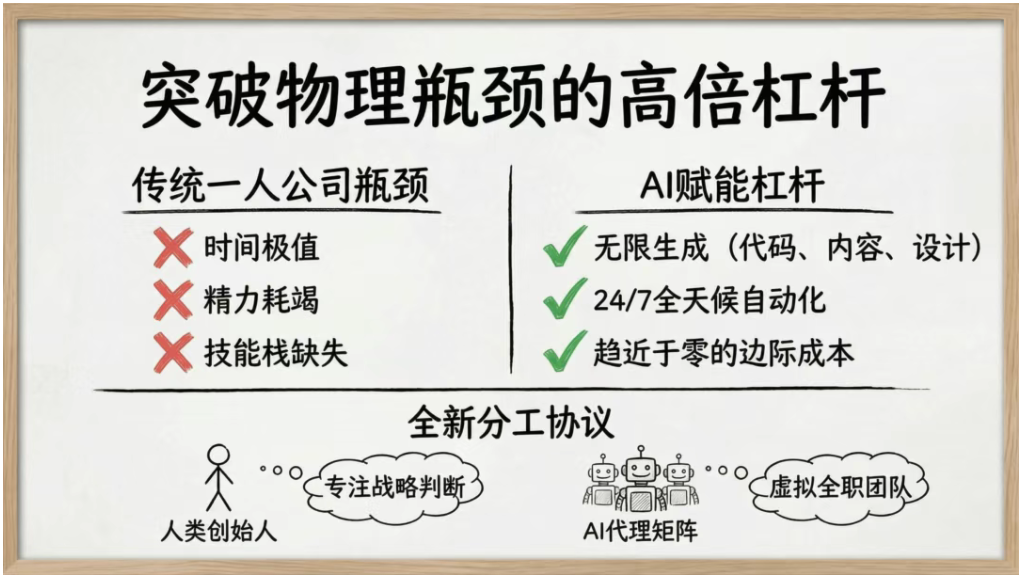
A 2025 McKinsey report noted that a typical future team might consist of only 2 to 5 core members but could simultaneously manage 50 to 100 AI agents. Startup costs have also never been lower, with 90% of one-person company founders starting with less than $500. With just one person and a computer, the entire process from product design and code development to marketing can be completed.
Source: *One-Person Company (OPC) Development Research 1.0*
Gao Chengyuan, chief planner and lead instructor of the *One-Person Company Entrepreneurship Practical Course*, believes that generative AI is “democratizing” high-barrier tasks such as content creation, coding, and customer service, allowing one person to produce what previously required team collaboration. Low-code platforms enable those without technical backgrounds to quickly build product prototypes, compressing development cycles from months to days. Automated agents achieve 7x24 operations, freeing individuals from repetitive labor. This “technology empowerment” essentially reconstructs “labor-intensive” processes into “intelligence-enhanced” ones, where individuals are no longer executors but decision-makers and editors, achieving scalable output with marginal costs approaching zero by leveraging AI toolchains.
A report by Debon Securities shows that integrating AIGC is expected to significantly reduce personnel costs for cross-border e-commerce companies.
Generally, cross-border e-commerce teams include supply chain personnel (accounting for about 30%-40%, covering product development, procurement, production, logistics, warehousing, and management), marketing personnel (about 50%, including customer service, promotion, sales, and management), R&D and technical staff (about 10%), and functional department staff (about 10%).
According to Debon Securities' calculations, AIGC technology can significantly optimize work in multiple core areas such as product development, procurement, customer service, promotion, and sales, effectively lowering operational costs. Taking Saiwei Times as an example, up to 53% of its workforce could be optimized through AIGC, indicating significant cost-saving potential.
Specifically, in 2022, Saiwei Times' business promotion expense rate was 8.61%, sales staff compensation rate was 5.86%, and management staff compensation rate was 1.26%. Assuming revenue and operating costs remain unchanged after integrating AIGC, and these three costs are reduced by 40%, the company's net profit margin could increase by 5.51 percentage points.

While an efficiency revolution is visible, the “lone wolf” nature of one-person companies also exposes them to systemic risks.
Lu Dingliang, a partner lawyer at Beijing Jingsh Law Firm, cautions that OPCs face legal, market, and individual-level risks during rapid expansion and need to build a comprehensive defense system combining compliance, risk control, and capability building.
Especially regarding property mixing and joint liability, one-person company shareholders must prove their personal assets are separate from the company; otherwise, they may face unlimited joint liability. In terms of decision-making procedures, one-person companies lack shareholder meeting checks and balances, often failing to keep written records of major decisions, leading to potential abuse of control. They also face compliance pressures under different legal systems in areas such as finance and taxation (finance and taxation), data privacy, and intellectual property management. In terms of business continuity, personal illness or emergencies could halt operations. Over-reliance on a few clients also leaves them vulnerable to risk.
Lu believes that the rise of one-person companies is not about technology replacing human labor but about individuals reconstructing resource organization through AI, achieving “small but beautiful” innovative breakthroughs with policy and ecological support. In the future, OPCs can complement traditional enterprises—the former serving as agile innovation touchpoints, the latter providing scenarios and resources, jointly driving the development of new quality productive forces.

Image source: 'Research on the Development of One-Person Companies (OPCs) 1.0'
As frontline practitioners, Zhang Xiaoyi and her team deeply understand the importance of relevant laws and regulations for those engaged in cross-border activities.
As a company specializing in providing legal and tax services for enterprises and individuals going overseas, Zhang Xiaoyi and her team have witnessed numerous cases in the past few years where businesses have encountered setbacks due to unfamiliarity with the regulations in their destination markets. She cited the Japanese market as an example, noting that all regulatory documents in Japan are in Japanese and are updated frequently. For instance, in 2024, Japan revised its 'Premiums and Representations Act,' adjusting compliance requirements for promotional statements such as 'lowest price' and 'limited-time offer' in e-commerce listings, and clarifying boundaries regarding inappropriate gifts and false or exaggerated advertising by e-commerce platforms. The following year, these provisions were updated again. Traditionally, many overseas businesses would assign a staff member to regularly check these official websites for updates, a process that, including translation time, would take two to three days. Now, with the integration of AI technology, a Chinese-language summary of key regulatory points can be compiled in just over ten minutes.
'Many of the companies we serve now rely on AI to retrieve this information. They first use AI to scan and extract policy changes relevant to cross-border sellers. However, on the other hand, AI's role is limited to translation and summarization. When it comes to actually understanding the legal provisions and providing guidance, its effectiveness is almost negligible,' Zhang Xiaoyi said.

On the other hand, the amount of Tokens consumed by AI is unpredictable, placing many newly established one-person companies in a difficult position.
One seller told us that their team briefly tried using Longxia but ultimately abandoned it due to its high Token consumption rate and cost, which were disproportionate to the output. They had intended to use Longxia to save time and costs. After debugging, Longxia began handling tasks such as email responses and customer inquiries. However, after just one week of use, the Token consumption exceeded 80 million, incurring fees of nearly 5,000 yuan, far exceeding the team's expectations.
Gartner predicts that by the end of 2027, more than 40% of Agentic AI implementations may be canceled due to rising costs, unclear business value, and inadequate risk control.
Furthermore, from the perspective of industry competition, AI technology itself is inclusive, as is the technology of AI agents. This means that the cost reductions and efficiency gains brought about by AI will quickly become the market norm. When everyone can rely on AI to achieve cross-border operations, competition in the industry will only intensify.
Peng Shengcai, CEO of Shuxin Technology, an Agent Platform vendor, used video marketing as an example, stating that those who use AI effectively can increase video production efficiency tenfold or even a hundredfold with the help of tools. With the same selling price but lower costs, profits will naturally expand.
'However, this dividend is only short-term because the consequences are predictable. As supply continues to grow, competition will naturally intensify. At the same price point, if someone can produce 10 videos, others will soon dare to produce 50 or 100. Therefore, during the window period when most people are not yet proficient in using AI to generate videos, some can indeed make money. However, this window period will not be long—I predict it may last only about six months,' Peng Shengcai forecasted.
Indeed, AI has geometrically enhanced human execution (executive capacity), but when capabilities at the execution level become readily accessible, future human competition will inevitably shift to a higher plane.
As the Tencent Research Institute stated in its article 'AI is an Extension of Humanity, and Humanity is the Measure of AI,' AI is responsible for generating countless possibilities, for divergence, and for providing 'standardized excellence'; while humans are responsible for convergence, for selecting the most compelling option from a vast array of solutions.
Ultimately, in the context of one-person companies, what matters is still human capability—the ability to connect with AI in terms of breadth and depth.
References:
[1] 'Research on the Development of One-Person Companies (OPCs) 1.0,' Tsinghua University's Qingxin Research Team
[2] 'One-Person Enterprise: A New Business Model for Making Money Alone,' Paul Jarvis
[3] 'Exploring the New Transformations Brought by AIGC Applications in the Cross-Border E-Commerce Industry,' Debon Securities
-
![]()
The Allure of 'Acquisition Spree': Li Shufu's Left Turn, Xu Jiayin's Right
-
![]()
Strategic Transformation Yields Results: Phoenix Optics Reports 10.9% YoY Rise in Core Net Profit for H1 2026
-
![]()
Three Key Growth Trajectories Synergize! Crystal-Optech Reports 3.478 Billion Yuan in Revenue for H1 2026
-
![]()
Semi-Annual Report Sparks XPENG Motors Buzz
-
![]()
1.6 Billion Big Order Secured! SeeYA Technology's Revenue Soars by 287.87% in the First Half of the Year
-
![]()
Baidu's Profits Plunge by 68%: Unraveling the Mystery Behind the Numbers
-
![]()
Baidu’s Profits Tumble by 68%! Where Has All the Money Gone?
-
![]()
Hynix’s Taobao Store Shuts Down Abruptly: What Should Customers Do About Warranty Services for Memory Modules?