Popular Science Essay | Harnessing Stillness to Conquer Motion: A Comprehensive Guide to VIPA Spectrometers
 04/01 2026
 508
508
Harnessing Stillness to Conquer Motion: A Comprehensive Guide to VIPA Spectrometers
Introduction: Red, orange, yellow, green, blue, indigo, violet—can anyone truly dissect this intricate spectrum of light? Since its inception in 1996, the VIPA (Virtual Imaged Phased Array) spectrometer has heralded a new era in fields such as Brillouin scattering imaging, astronomical precision measurement, and optical frequency comb spectroscopy. Its hallmark features—ultra-high resolution, snapshot imaging, and operation free from mechanical motion—have made it a game-changer. Consider a simple experiment: when sunlight passes through a prism, it fans out into a rainbow—this is humanity's foundational observation of the spectrum. While a basic prism can separate visible light into its constituent colors, modern science demands far more from spectral measurement. Astronomers need to distinguish light from stars with minuscule wavelength differences; biologists require real-time monitoring of cellular mechanical changes at the millionth level. Traditional grating spectrometers are akin to crude rulers, limited in precision; Fourier transform spectrometers offer high precision but necessitate scanning, thus slowing down the process. The VIPA spectrometer, in contrast, is like a laser rangefinder—precise and swift, harnessing stillness to conquer motion—requiring no moving parts and capable of capturing spectral information in a single image. This article will demystify this cutting-edge technology, from its fundamental principles to its frontier applications.
Principles: The Magic of Virtual Image Arrays and Tilt Angles
Imagine clapping your hands between two parallel walls, producing a series of diminishing echoes. Replace sound with light and walls with mirrors, and you have a Fabry-Pérot etalon—light bounces back and forth between two mirrors, with a faint amount of light escaping from the rear surface after each reflection.
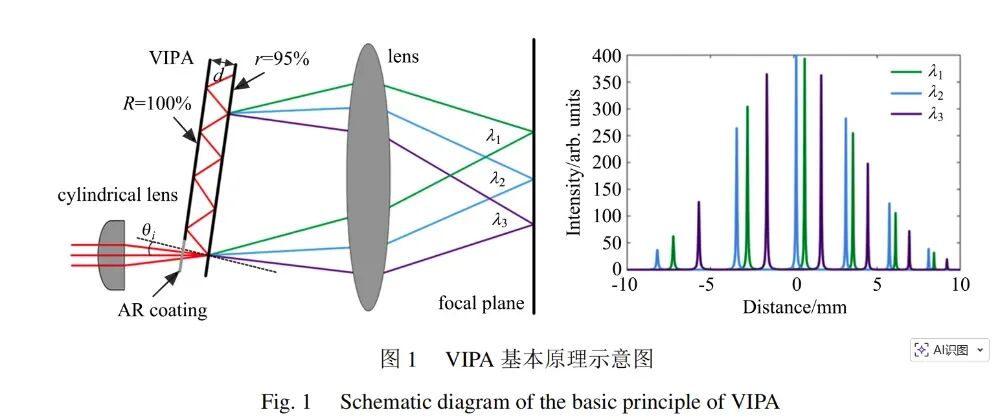
Schematic diagram of VIPA principles (Reference 1)
How can we channel the light to be measured between these mirrors with minimal loss? The VIPA spectrometer provides an ingenious solution: a tilt angle and a 'doorway.' As depicted in Figure 1, the VIPA features a transmission window at the bottom of its front surface, coated with an anti-reflection (AR) layer that allows light to enter the optical resonator almost losslessly. After reflecting once on the rear surface, due to the installed tilt angle, the light beam exits the VIPA etalon not through the transmission window but begins to 'bounce back and forth' between the front and rear surfaces. The front surface of the VIPA is a super mirror, coated with a high-reflectivity film (>99.9%) across its entirety, save for a 3-5mm wide area at the bottom where an AR film serves as the sole entrance for light. The rear surface, resembling an 'optical colander,' has a reflectivity of about 95-98%—meaning that with each reflection, a small amount of energy 'leaks' out of the cavity, crucial for subsequent measurements.
Once inside the VIPA, the light to be measured reflects back and forth in a zigzag pattern between the front and rear surfaces. With each reflection on the rear surface, a faint amount of light is transmitted out, forming a series of equally spaced virtual light sources in space, each with a fixed phase difference. Thus, the VIPA magically creates a virtual array of light sources, known as the 'virtual image array.'
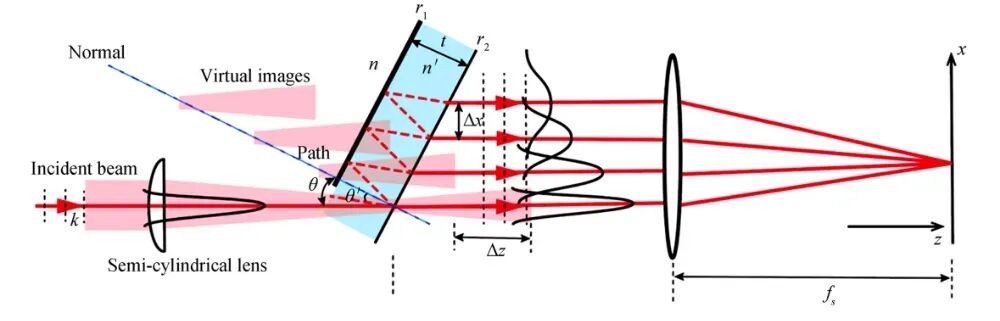 Schematic diagram of VIPA virtual light sources (Reference 2)
Light of different wavelengths experiences different phase differences during propagation, causing them to form constructive interference (bright fringes) at different angles upon 'emission' from the virtual light source array. Two beams of light with a wavelength difference of just 0.0001 nm can exhibit an angular difference in bright fringes on the milliradian scale, sufficient for resolution by modern detectors.
Spectral distribution on the VIPA detector (Reference 1)
The stronger the spectral dispersion ability of the VIPA, the higher its precision, and the greater the distance between lights of three different colors, as shown in Figure 3. However, excessive spacing within the same group of lights can lead to overlap between different groups—that is, different diffraction orders overlap, causing periodic blind spots in the VIPA. To separate different orders, a diffraction grating is often added after the VIPA etalon to spread the spectra of different orders vertically, forming a two-dimensional spectral map. This is akin to unfolding a thick book into a two-dimensional matrix, page by page—connecting the first and last pages of each section yields the complete spectrum.
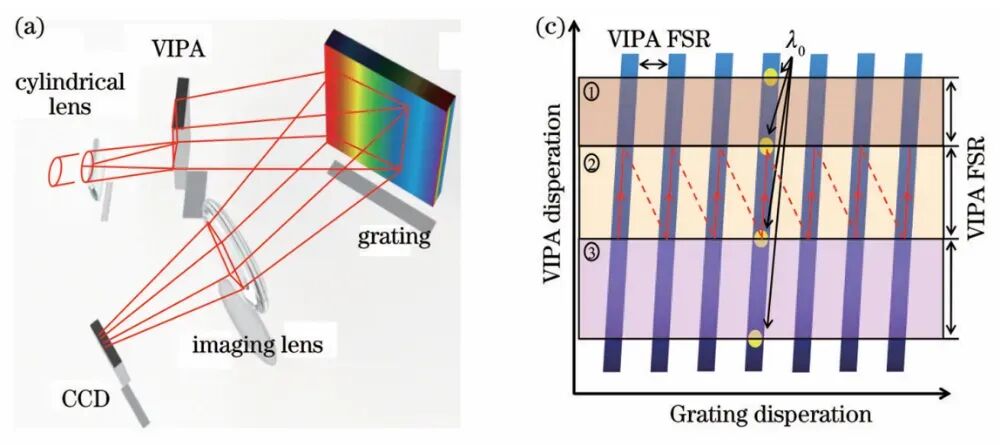
VIPA spectrometer with grating dispersion (Reference 1)
The resolving power formula of the VIPA reveals the secret to its ultra-high performance: R = Δλ/λ ≈ F⋅m, where the finesse F is determined by mirror reflectivity, with higher reflectivity resulting in a larger F (up to over 1000); the interference order m = 2nt/λ, proportional to the cavity thickness t. A 10mm thick VIPA at a wavelength of 1550 nm can reach an interference order on the order of hundreds of thousands! This means the spectral resolution of the VIPA can easily surpass the GHz level (frequency difference), corresponding to a wavelength resolution of about 0.000001 nm. In comparison, the best grating spectrometers can only achieve about 0.001 nm.
History: An 'Accidental' Odyssey from Fiber Optic Communications to Scientific Instruments
The birth of the VIPA is a tale of serendipity. In 1996, Dr. Masataka Shirasaki from Fujitsu in Japan faced a daunting challenge while researching wavelength division multiplexing (WDM) technology for fiber optic communications: how to swiftly separate dozens of wavelength channels (with intervals of only 50 GHz) transmitted in a single fiber? Traditional diffraction gratings were cumbersome and slow, unable to keep pace with communication advancements. Inspired by prism beam expanders and etalon interferometers, Dr. Shirasaki creatively proposed opening a 'dark door' on the front surface to allow light to enter the resonator almost losslessly. He published a paper titled 'Virtually imaged phased array' in Optics Letters, ushering in a new era of precision spectral measurement.
In the first five years after its invention, the VIPA primarily served the fiber optic communication industry. Its advantages—snapshot measurement, compact structure devoid of mechanical parts, and resolution matching the 50 GHz channel spacing—made it ideal for building wavelength selective switches and optical channel monitors. The turning point came in 2002 when the academic community 'rediscovered' the VIPA. A team led by Professor Andrew Weiner at Purdue University, while studying optical pulse shaping, stumbled upon the VIPA's remarkable sensitivity to small spectral changes. They realized it was not just a communication device but had the potential to become a 'microscope' for spectroscopic research. Weiner's team's seminal paper used the VIPA to measure nonlinear effects in optical fibers, achieving a resolution an order of magnitude higher than traditional methods. Subsequently, top laboratories such as MIT, JILA, and Stanford followed suit, and the VIPA began to leave its mark in astronomy, biology, and quantum fields.
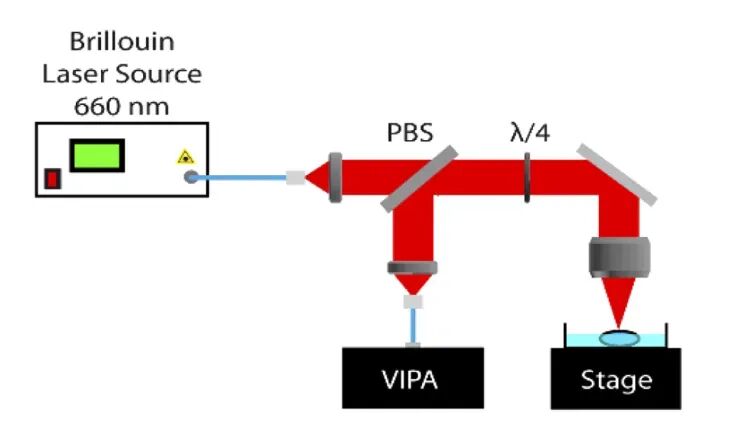 Schematic diagram of VIPA applied to lens mechanical imaging (Reference 4)
Over the past decade, the applications of the VIPA have exploded: in 2013, Brillouin scattering imaging of live cells was achieved for the first time; in 2016, the European Southern Observatory (ESO) integrated the VIPA into the ESPRESSO spectrometer for exoplanet detection; in 2020, the JILA laboratory used the VIPA to measure optical frequency combs, achieving a record-breaking resolution of 94 MHz...
Pros and Cons Comparison: No Perfect Spectrometer, Only the Most Suitable Choice
Compared to traditional spectrometers, the VIPA boasts four main advantages:
Ultra-High Resolution
Traditional gratings are constrained by ruling density, with a theoretical resolution limit of about 0.01 nm. The VIPA, through multi-beam interference, can achieve an equivalent optical path hundreds of times longer than its physical size. The latest record in 2024: an air-spaced VIPA achieved a frequency resolution of 94 MHz, equivalent to resolving two beams of light with a wavelength difference of 0.0000003 nm.
Ultra-Fast Measurement Speed
Imagine scanning a book: traditional spectrometers read word by word, while the VIPA takes a snapshot of the entire page instantly. When measuring rapidly changing phenomena (such as chemical reactions, cellular activities), the VIPA's microsecond-level integration time ensures no details are missed.
Reliability and Miniaturization
The VIPA spectrometer has no motors, gears, or moving parts and can be made as compact as a digital camera, facilitating easy deployment on satellites, drones, and wearable devices.
Light Throughput Advantage
Traditional spectrometers require a slit to limit the spatial size of the incident light, while the VIPA can be directly focused by a cylindrical lens, increasing light utilization by 10-100 times, making it extremely friendly to weak signals (such as single photons, fluorescence).
However, the VIPA also has its weaknesses. The first is the limitation of the free spectral range (FSR). For instance, with an FSR of 50 GHz, frequency shifts of 51 GHz and 1 GHz appear identical to the VIPA—akin to a counter resetting after reaching 999. Therefore, in wide-spectrum measurements, the VIPA must be used in conjunction with a diffraction grating. The grating separates the spectra of different FSR periods vertically, forming a two-dimensional spectral map. Although this increases system complexity, it is currently the only reliable solution.
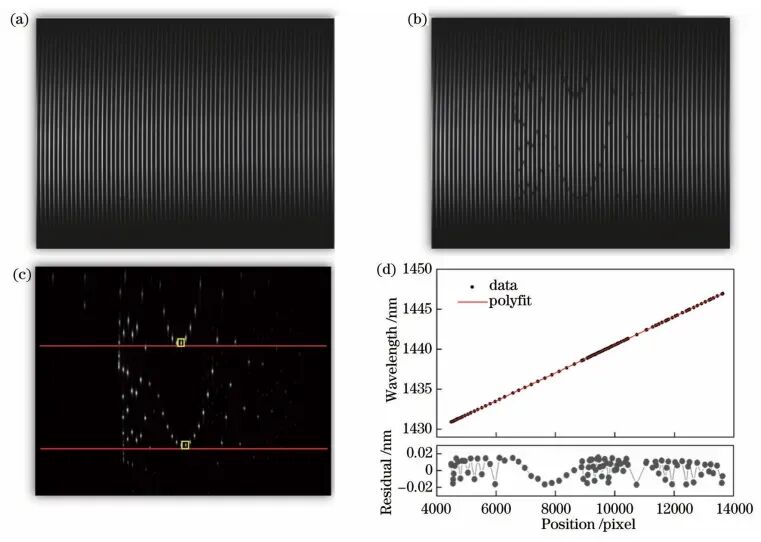 Combined VIPA with grating dispersion for gas spectral measurement (Reference 5)
As an interferometer, the VIPA is highly sensitive to optical path changes caused by vibrations and temperature fluctuations. Minute mechanical vibrations or temperature variations can induce spectral fringe shifts, significantly increasing measurement errors. Therefore, high-precision VIPAs necessitate optical vibration isolation platforms and temperature control systems.
Finally, calibrating the VIPA is relatively complex. Unlike gratings, the pixel-frequency mapping of the VIPA is nonlinear, and the calibration process requires a reference light source with a known frequency (such as an optical frequency comb) for polynomial fitting, posing a technical hurdle for ordinary users.
Applications: From Cellular Activities to Exoplanets
The VIPA has found widespread application in precision spectral measurement. In the field of biomechanical detection based on Brillouin imaging, the VIPA holds an irreplaceable advantage. Light undergoes Brillouin scattering in a medium, producing a small frequency shift directly related to the material's elastic modulus. Measuring the spectrum of the scattered light yields information about the elastic modulus of the biological medium. Traditional confocal Brillouin microscopes have sluggish scanning speeds, taking hours to measure a single cell; whereas the combination of a VIPA + EMCCD camera can achieve video-level frame rates (30 fps), sufficient for live imaging. A team from Harvard University utilized the VIPA to observe changes in nuclear stiffness during cancer cell metastasis, discovering that a 30% decrease in stiffness increased the risk of metastasis by fivefold, providing a new biomarker for early cancer diagnosis.
Imagination of exoplanets (Doubao AI)
Venturing into space, the VIPA is aiding scientists in the search for Earth's 'siblings.' Planetary gravity can induce a faint wobble in the host star, producing a Doppler frequency shift, and measuring this frequency change is an effective method for exoplanet detection. The European Southern Observatory has discovered seven Earth-like planets in the TRAPPIST-1 system using a VIPA spectrometer with a resolving power of tens of millions, three of which are located in the habitable zone.
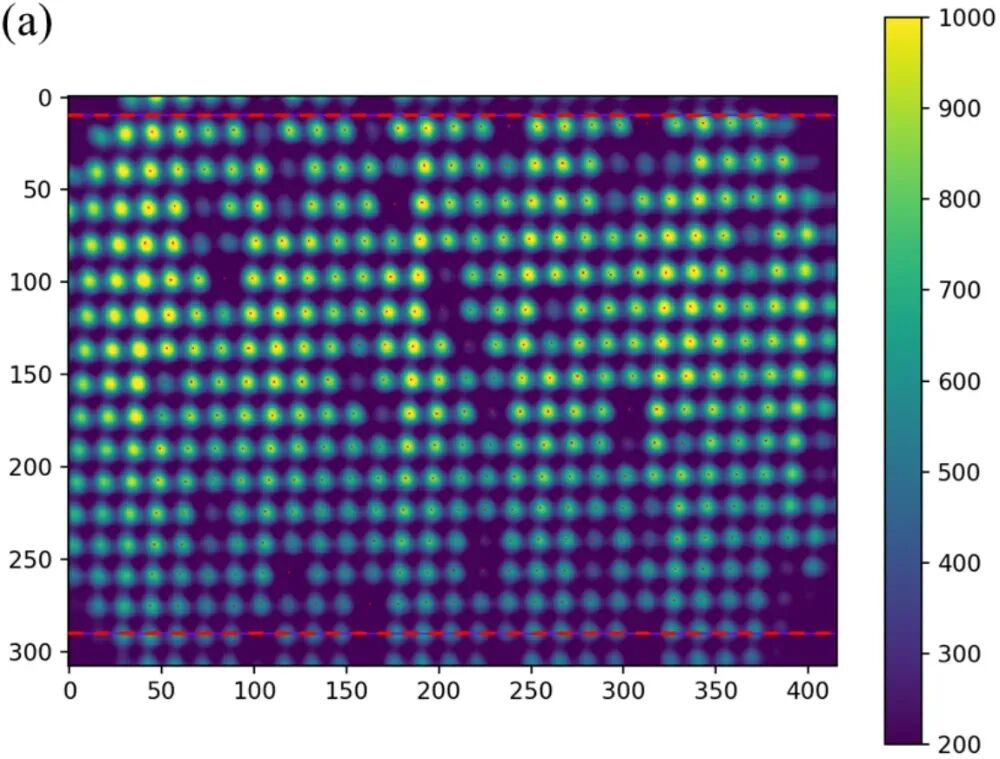
High-resolution air-spaced VIPA measuring optical frequency combs (Reference 6)
In recent years, the VIPA spectrometer has undergone a 'robust integration' with optical frequency combs. An optical frequency comb, a specialized laser, boasts a spectrum comprising numerous evenly spaced spectral lines, resembling a comb, and stands as the most precise frequency standard available. The question arises: How can we discern and accurately measure the frequency of each 'comb tooth'? With a VIPA of sufficient precision, each spectral line of the optical frequency comb can be projected as a dot array onto a two-dimensional plane, allowing for instantaneous clarity. In 2024, the JILA laboratory leveraged an air-spaced cavity VIPA to attain a groundbreaking resolution of 94 MHz, enabling the direct resolution of an optical frequency comb with a 250 MHz repetition rate. This achievement marks a pivotal technology for measuring molecular transition linewidths. Moreover, the VIPA finds extensive applications in environmental monitoring, breath analysis, and industrial precision measurement.
Conclusion
The narrative of the VIPA spectrometer epitomizes engineering ingenuity that 'conquers motion with stillness.' It attains exceptional performance through a clever optical design that minimizes mechanical movement. This insight illuminates our path: in scientific research and engineering, complexity does not inherently equate to progress; sometimes, a straightforward concept can unlock entirely novel domains. Currently, VIPA technology is flourishing, with air-spaced VIPAs, ultra-high-finesse coating technologies, spectral coronagraph technologies, and AI applications pushing the frontiers of measurement precision, stability, and extinction ratio of VIPA spectrometers. Looking ahead, the VIPA may transition from laboratories to everyday households. Perhaps within a decade, your smartwatch will house a millimeter-scale VIPA chip, monitoring your health parameters in real-time. By then, 'spectrum' will transcend its status as a distant technological term, becoming a commonplace language for everyone's health management.
References:
[1] Hao Zhou, Bo Fang, Nana Yang, et al. Research on Red Band Virtually Imaged Phased Array Spectrometer[J]. Chinese Journal of Quantum Electronics, 2021, 38(6).
[2] Xiaoming Zhu, Jinping He. Design and application of a 10-million resolution VIPA spectral device synchronized and calibrated by laser frequency comb (invited)[J]. Acta Photonica Sinica, 2020, 49(11).
[3] Shirasaki, M. "Virtually imaged phased array." Optics Letters 21.5 (1996): 366-368.
[4] Yogeshwari S. Ambekar, Manmohan Singh, Jitao Zhang, Achuth Nair, Salavat R. Aglyamov, Giuliano Scarcelli, and Kirill V. Larin. Biomed. Opt. Express 11, 2041-2051 (2020).
[5] Hao Zhou, Weixiong Zhao, Bingxuan Lv, et al. Research on Broadband High-Resolution CO2 Absorption Spectrum Measurement Technology Based on Virtually Imaged Phased Array Spectrometer[J]. Acta Optica Sinica, 2023, 43(18): 178-186.
[6] Okada, K., et al. "Air-spaced VIPA for ultra-high resolution spectroscopy." arXiv:2411.13413 (2024).
-
![]()
Market Share Dilemma: DJI vs. Insta360—Is It '40-40' or '60-30'?
-
![]()
Market Share Dilemma: DJI vs. Insta360 – A '40-40 Split' or '60-30 Split'?
-
![]()
It's Kunlunxin's Turn to Play
-
![]()
Is the New Performance Peak Just the Starting Point? What Will Be Crystal-Optech's Next Destination?
-
![]()
Goertek Pours 69 Million Yuan into Elite Precision: Ramping Up Optical Precision Manufacturing and R&D Capabilities
-
![]()
Avatr Attempts HKEX Listing Again, With 20,000 Vehicles Sold in First Five Months
-
![]()
NVIDIA Announces 10-Fold Production Capacity Increase in 2 Years, Disrupting the Energy Storage Industry
-
![]()
AI Enters the Second Half: Models Are No Longer Scarce, What’s Truly Scarce Are Computing Power, Scenarios, and Trust