Terafab Interpretation: Computing Power is Escaping Earth
 04/08 2026
 488
488
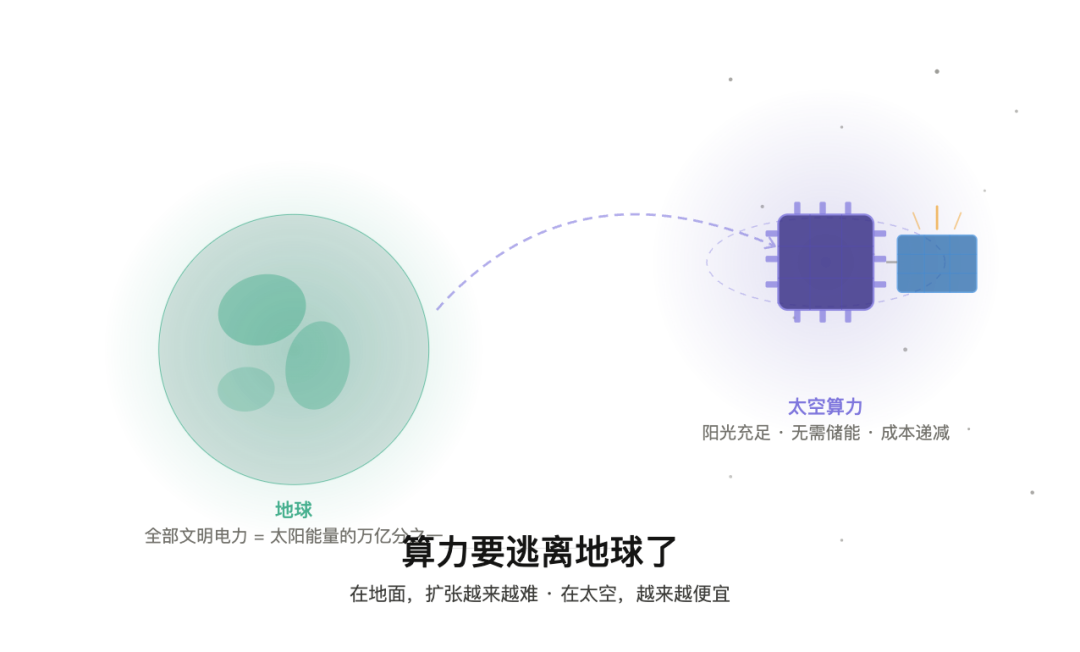
Recently, Musk delivered a keynote speech in Austin, announcing what he called the 'most ambitious chip construction project in history': Terafab—a manufacturing system targeting an annual production capacity of 1 terawatt (TW) of AI computing power, jointly advanced by SpaceX, xAI, and Tesla.
This article provides an interpretation of Musk's Terafab project. After reading, you will gain three insights:
Why Earth-based computing expansion has hit a physical ceiling;
Why space is the inevitable destination for the next generation of AI infrastructure;
What this means for practitioners and decision-makers in the chip, AI, and aerospace industries.
I. Terafab is Not Just a Bigger Chip Factory
Terafab is often misunderstood by the media as 'Musk building his own chips.' This leads to incorrect strategic judgments.
What Terafab truly addresses is a more upstream issue: there is a structural gap of an order of magnitude in global AI computing supply, which cannot be filled by the existing system.
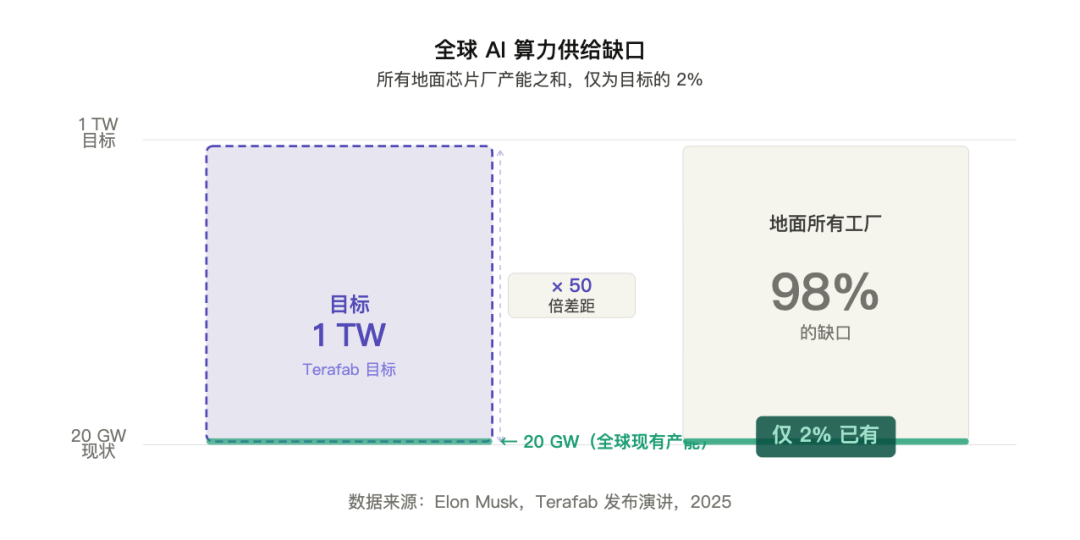
Musk provided a figure: the current global annual AI chip production capacity is about 20 gigawatts (GW). Summing up the capacities of all wafer fabs on Earth, it amounts to about 2% of Terafab's target. He explicitly stated that he had approached Samsung, TSMC, and Micron, saying, 'We'll buy whatever you can produce.' However, these manufacturers' maximum expansion speeds are far below demand.
This is not a commercial negotiation issue but a physical constraint problem—ground energy supply, land, water resources, and grid load are all forming ceilings. Therefore, Terafab's logical starting point is not 'I want to build my own chips' but 'the only way out is to redefine the physical foundation of computing power.'
II. The Marginal Cost Curve of Ground Expansion is Bending Upward
Over the past decade, the paradigm of AI infrastructure construction has been: find more land, build larger data centers, and purchase more power quotas. This paradigm is now failing.
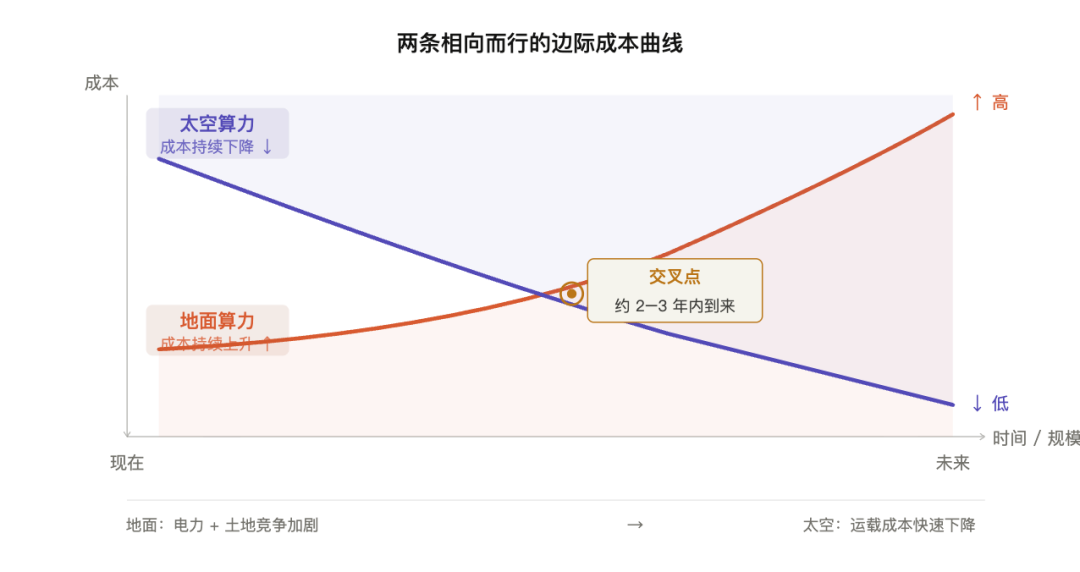
The failure is not due to weak demand but because the marginal costs on the supply side are accelerating: in terms of power, the world's best renewable energy sites are already occupied; in terms of land and cooling, data center locations are becoming increasingly scarce; resident opposition (NIMBY effect) will only grow stronger.
The implication for the industry is that competing for computing resources on the ground is an involution in a battlefield (battlefield) with increasing marginal costs.
III. Surprise: Within 2-3 Years, the Comprehensive Cost of Space Computing Will Be Lower Than Ground Computing
This is the most underestimated judgment in the entire speech and the most counterintuitive discovery worthy of industry reflection. Musk said he believes that within two to three years, the comprehensive cost of deploying AI chips in space will be lower than deploying them on the ground. This sounds like science fiction but is backed by the superposition of several physical and economic facts:
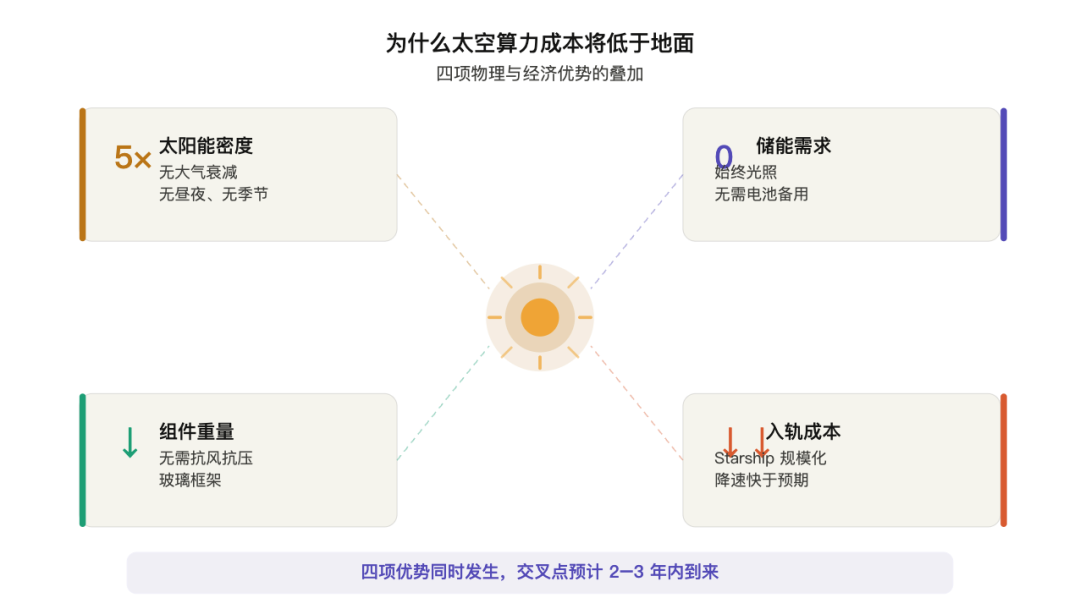
The difference in solar energy density is over 5x. In orbit, solar panels always face the sun directly, with no atmospheric loss, and effective power density is over 5x higher than on the ground.
Space solar panels do not require heavy glass and metal frames. Without extreme weather, components can be made extremely light, significantly increasing power generation per unit weight.
No need for battery energy storage. With reasonable orbital design, satellites can maintain nearly continuous sunlight, greatly reducing energy storage needs.
Launch costs are rapidly declining, with a clear path forward. Starship V3 has achieved a 100-ton orbital payload, with V4 targeting 200 tons and an annual orbital capacity goal of 10 million tons.
These four factors are not independent; they occur simultaneously and all point in the same direction. Musk estimates that this crossover point will arrive within 2-3 years. Even if a conservative estimate pushes it back to 5 years, the logic still holds.
IV. The Bigger Picture of Terafab: A Complete Vertical Integration Chain
To understand Terafab, it must be viewed within a complete system:
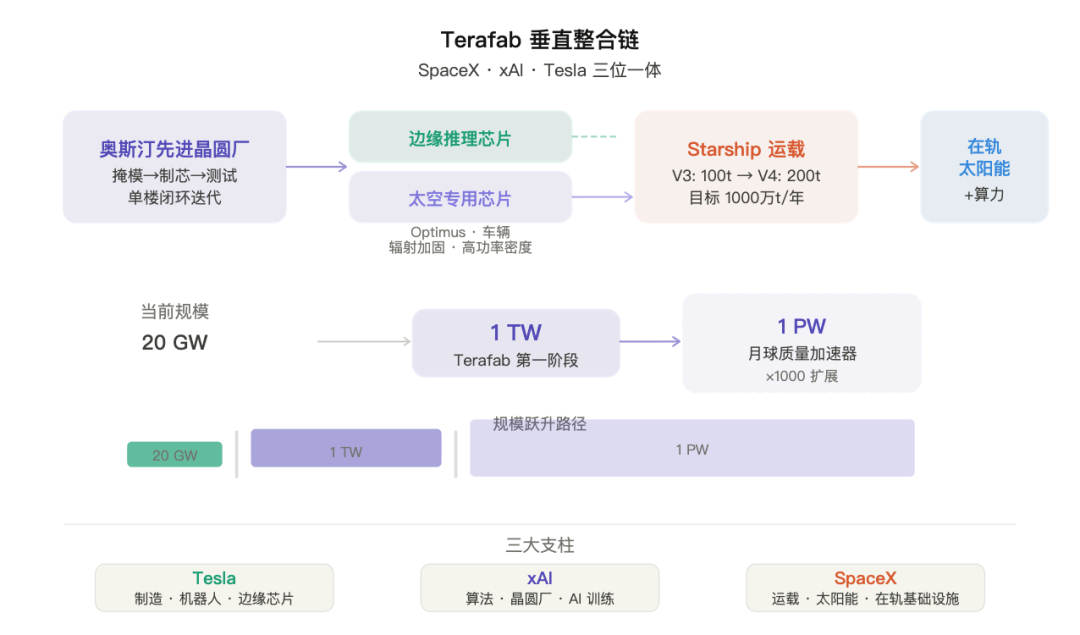
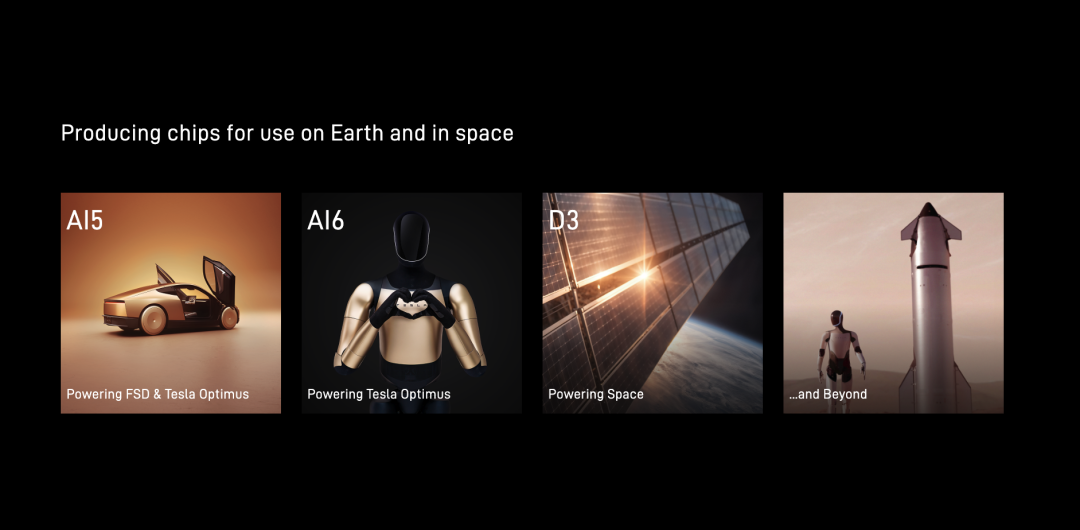
Ground segment: Austin Advanced Technology Wafer Fab. Integrates photomask manufacturing, chip fabrication, and packaging/testing capabilities within a single building. From design changes to next-generation chip verification, the entire recursive loop is completed in the same building, with iteration speeds about an order of magnitude faster than industry norms.
Chip directions: Two distinct product categories. One is edge inference chips, primarily for Optimus humanoid robots and Tesla vehicles—Musk predicts annual humanoid robot production will reach 1-10 billion units, 10-100x the automotive market. The other is space-specific high-power chips, optimized for radiation hardening and space thermal management.
Next step: Lunar Mass Accelerator. Leveraging the Moon's lack of atmosphere and 1/6th Earth gravity, payloads can be accelerated directly to escape velocity without rocket engines. This step will expand computing scale from terawatts (TW) to petawatts (PW), increasing it by another 1000x.
V. Judgment Framework: Three Types of Readers Take Away One Conclusion Each
Decision-makers: Within the next three to five years, the main battlefield of the computing power war will shift from 'who can secure more ground power and land quotas' to 'who can establish space computing deployment capabilities the fastest.' Strategies betting on 'continuing to stack volume on existing ground infrastructure' now have diminishing marginal returns.
Practitioners: The design constraints for space-specific chips are entirely different from those on the ground—radiation hardening, thermal management (primarily radiation-based rather than convection), extreme power density, lightweighting—these directions are becoming genuine large-scale demands. If you work in chip design or systems engineering, the hardware constraints of the space environment are worth studying in advance.
Researchers: Musk explicitly mentioned 'trying some crazy things' in the new fab—novel computing principles that push physical limits. When you have a platform capable of rapid iteration from mask to testing within a single building, the engineering validation cycle for non-traditional computing paths will be significantly compressed. This represents a genuine research opportunity window.
The essence of this speech is the declaration of a resource reallocation: the growth ceiling for computing power lies not in human engineering capabilities but in Earth's physical constraints. The path to bypassing these constraints is not continued involution on the ground but moving infrastructure to where constraints do not exist.
On the ground, expansion is becoming increasingly difficult and expensive; in space, expansion is becoming easier and cheaper. The crossover point of these two curves is arriving faster than most people expect.
References and Images
Musk's Terafab Speech
*Unauthorized reproduction or excerpting is strictly prohibited-
-
![]()
The Allure of 'Acquisition Spree': Li Shufu's Left Turn, Xu Jiayin's Right
-
![]()
Strategic Transformation Yields Results: Phoenix Optics Reports 10.9% YoY Rise in Core Net Profit for H1 2026
-
![]()
Three Key Growth Trajectories Synergize! Crystal-Optech Reports 3.478 Billion Yuan in Revenue for H1 2026
-
![]()
Semi-Annual Report Sparks XPENG Motors Buzz
-
![]()
1.6 Billion Big Order Secured! SeeYA Technology's Revenue Soars by 287.87% in the First Half of the Year
-
![]()
Baidu's Profits Plunge by 68%: Unraveling the Mystery Behind the Numbers
-
![]()
Baidu’s Profits Tumble by 68%! Where Has All the Money Gone?
-
![]()
Hynix’s Taobao Store Shuts Down Abruptly: What Should Customers Do About Warranty Services for Memory Modules?