From 'Selling Goods' to 'Intelligent Connection': AI Empowers New Growth in Cross-Border E-commerce
 04/13 2026
 563
563

In 2026, the global e-commerce industry stands at a critical inflection point. After navigating the 'pressure triangle' of 2025—multinational tariff shocks, narrowing consumer demand, and soaring traffic costs—cross-border e-commerce has undergone a major 'reshuffle'. Meanwhile, artificial intelligence technology is penetrating the entire cross-border e-commerce chain with unprecedented depth, breadth, and speed, propelling the industry from 'global goods distribution' to 'global intelligent connectivity'.

(I) Rapid Expansion of Market Size
The global AI e-commerce market is on a high-growth trajectory. According to The Business Research Company's 'Artificial Intelligence in E-commerce Market Report 2026', the global AI e-commerce market size will surge from $9.12 billion in 2025 to $10.5 billion in 2026, with a compound annual growth rate (CAGR) of 15.1%. By 2030, this figure is projected to climb to $19.12 billion, with the CAGR further rising to 16.2%.
(II) AI Adoption by Chinese Cross-Border E-Commerce Companies
Chinese cross-border e-commerce companies are becoming a major force in global AI adoption. Data shows that in 2025, China's total cross-border e-commerce import and export volume reached RMB 2.75 trillion, a 69.7% increase from 2020, hitting a record high. Over the past five years, China's cross-border e-commerce trade volume has grown more than tenfold, with the number of enterprises exceeding 120,000.
In terms of AI adoption, PayPal statistics reveal that 60-70% of Chinese overseas merchants have integrated AI technology to varying degrees. Wang Xin, President of the Shenzhen Cross-Border E-Commerce Association, noted in early 2026: '2026 marks a strategic turning point for the cross-border e-commerce industry, which has transitioned from 'global goods distribution' to an era of 'global intelligent connectivity', with the core conflict now being the collision between growth potential and systemic challenges.'
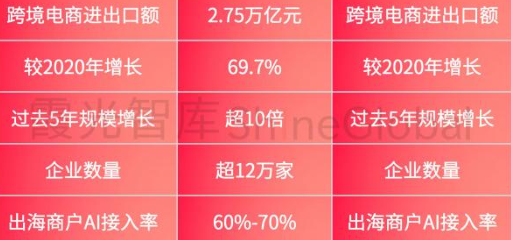
*Data Sources: Shenzhen Cross-Border E-Commerce Association, PayPal, January-March 2026*
(III) Industry Growth Shift: From Incremental to Stock-Based
2025 marked a fundamental shift in the growth logic of global cross-border e-commerce. The growth rate of global retail e-commerce sales continuously declined from 17.1% in 2021 (during the pandemic boom) to below 10% for the first time in 2023, stabilizing at 8.8% in 2025.
Behind this growth shift lies a triple pressure:
1. Tariff Shocks: The U.S. continues to impose additional tariffs on Chinese goods, raising the comprehensive tax rate on Chinese exports to the U.S. Major cross-border e-commerce categories such as apparel and electronics face tariffs generally ranging from 15% to 30%.
2. Tightening Consumer Spending: Although inflation in core U.S. and European markets has fallen to 2-3%, residents' actual purchasing power remains difficult to recover.
3. Soaring Traffic Costs: Meta CPM and Amazon CPC continue to rise, with CPC for some highly competitive keywords exceeding $2.
Against this backdrop, AI is no longer an 'icing on the cake' option but a core strategic tool for businesses to break through growth bottlenecks and achieve efficiency leaps.

Mainstream e-commerce platforms now view AI as the next-generation infrastructure, engaging in fierce competition around traffic acquisition, creative content production, and operational efficiency improvement.
(I) Amazon: From 'People Find Goods' to 'AI Understands You'
Amazon is refactor (restructuring) its search and recommendation logic through AI. Its Rufus AI shopping assistant, deeply integrated into the search bar, has transformed user shopping paths from 'keyword search' to 'needs description'. Meanwhile, Amazon blocks external crawlers like ChatGPT, attempting to lock data and traffic within its self-built ecosystem to form a closed loop.
For sellers, Amazon's 'Opportunity Explorer' uses AI to analyze customer behavior data, automatically generating six-dimensional analysis reports covering market overview, popular product features, customer review analysis, customer segment profiling, and price insights.
(II) TikTok Shop: 'Assembly Line Revolution' in Content Production
The rise of TikTok Shop in emerging markets was one of the most noteworthy variables in cross-border e-commerce in 2025. In 2025, TikTok Shop's Southeast Asian cross-border e-commerce annual GMV more than doubled year-on-year, with daily GMV rising 90% year-on-year. During the 'Double 12' period, GMV surged 2.7 times year-on-year, while short video-driven sales GMV skyrocketed 257%.
TikTok's widely promoted Symphony Creative Studio has made script generation, digital human performance, and multilingual dubbing standard platform features, resolving the core conflict of 'content consumption speed > content production speed'. Xpand Boom, at TikTok Shop's official AI empowerment event for overseas businesses, noted: 'Cross-border interest-based e-commerce has shifted from a 'numbers game' to a 'human-machine collaboration' phase. AI's deep involvement in material generation, script structure optimization, multilingual adaptation, and data feedback loops is significantly improving short video ROI.'
(III) Alibaba.com: Full-Chain AI-Native
Alibaba.com's AI agent, Accio Work, is a landmark product—simply send a creative idea to this agent, and it can autonomously complete the entire process from market analysis and product selection to store decoration and product listing. Its AI engine, Marco, receives over 1 billion daily calls, covering translation, HS code classification, chargeback disputes, and more.
During the 2026 New Trade Festival, merchants using AI 'Business Assistant' achieved a 19% conversion rate for new opportunities, 11 percentage points higher than traditional methods. AI-powered products received 60% more in-depth inquiries than non-AI products.
(IV) Open Ecosystem vs. Closed Ecosystem: The AI-Era Route Debate
In terms of AI adoption philosophy, giants are significantly divided:
· Closed camp (represented by Amazon): Blocks external AI crawlers, strengthens proprietary AI assistants, and attempts to lock data and traffic within its self-built ecosystem.
· Open camp (represented by Google and Alibaba): Advocates for building open ecosystems. Google's UCP (Universal Commerce Protocol) aims to break down data barriers between platforms, allowing AI agents to freely coordinate global merchant inventories for users.
The game theory (competition) between these two models will determine future traffic allocation patterns. Salesforce data shows that by the end of the 2025 holiday season, AI and agent recommendations drove 21% of global online orders.

AI's empowerment of cross-border e-commerce is not a single-point tool substitution but a systemic restructuring of the entire chain. This report summarizes this mechanism as a 'growth loop' model, covering three core links:
· Product Selection: Data insights → 93% increase in blockbuster prediction success rate
· Customer Acquisition: Smart factory → over 90% reduction in content production costs
· Fulfillment: Intelligent risk control → 90% reduction in document review time
Growth Flywheel: Efficiency × Conversion → 22% increase in operational efficiency, 14% increase in decision-making capability
(I) Product Selection: From 'Experience-Based Judgment' to 'Data Insights'
Traditional product selection relies on 'following bestseller lists' or 'personal intuition', essentially gambling. The core logic of AI-driven product selection is transforming this process into probability calculations.
Core method: Scrape competitor reviews → AI sentiment clustering → mine pain points after 'I like but...'. What follows 'but' represents unmet market demand.
Real-world case: Amazon's 2026 'Unsatisfied Demand' mining function analyzes billions of customer searches, browsing, and cart-addition behaviors to automatically identify 'high-search, low-conversion' market gaps.
Data support: AI-based blockbuster prediction success rates have risen to 93%, with new product launch cycles shortened by 40%.
(II) Customer Acquisition: From 'Numbers Game' to 'Smart Factory'
As traffic costs continue to climb, AI is becoming the core engine of content production.
Cost comparison: Traditionally, a high-quality video costs RMB 800-1,000 and takes 3-5 days to produce. With AI, a digital human video costs less than RMB 10 and takes just 10 minutes to generate. This means the same budget can test 100 different scripts and 100 different scenarios.

Efficiency data: On Lazada, products using AI smart listing and recommendation tools have a 68% higher purchase conversion rate than the platform average.
(III) Fulfillment: From 'Human Defense' to 'Intelligent Risk Control'
Cross-border e-commerce must not only 'earn more' but also 'leak less'. AI's value in fulfillment is being rediscovered.
· Customer service: AI provides 24/7 instant responses, converting purchase impulses into orders. After AliExpress Choice launched AI customer service, pre-sales inquiry conversion rates rose by 29%.
· Compliance: As compliance costs rise from 5% to 15%, AI-driven compliance management is becoming a necessity. WCO data shows AI can reduce document review time from 20 minutes to 2 minutes.
· Logistics: 90% of global retailers plan to increase AI investments in the next 12-24 months to optimize logistics operations.
(IV) Growth Flywheel: Dual Improvement in Efficiency and Conversion
The three links above do not operate in isolation but form a self-reinforcing growth flywheel. WTO reports show that 90% of AI-adopting enterprises confirm substantial benefits, including a 22% increase in operational efficiency and a 14% strengthening of decision-making capabilities.

AI's deep penetration into cross-border e-commerce is driving a fundamental paradigm shift in the industry.
(I) Core Differences Between Old and New Paradigms

(II) The Rise of 'One-Person Companies'
The most vivid manifestation of this paradigm shift is the rise of 'One-Person Companies' (OPCs).
Shanghai Lingang case: Building 3 of the Zero-Boundary Magic Cube OPC community, covering 8,700 square meters, is nearly fully occupied. Since opening in October 2025, it has attracted about 150 projects and around 500 actual residents. Entrepreneur Liang Ruiping, using AI tools, has drastically reduced daily operating time from 8-9 hours to just a few hours, achieving RMB 130 million in sales and dominating a niche market in Japan.
Chengdu Jinniu case: The Cross-Border E-Commerce Practical Incubation Camp has successfully incubated 31 OPCs and 30 platform stores, completing over 10,000 cross-border orders.
These cases demonstrate that AI is significantly lowering the barriers to entrepreneurship in cross-border e-commerce. In the future, many inexperienced SMEs and even individual entrepreneurs will have access to an agent team capable of conducting global business. 'One-person multinational enterprises' are moving from imagination to reality.
(III) Branding: The Moat in the AI Era
Notably, while AI lowers the threshold for basic capabilities, it also elevates the strategic value of branding. Data shows that 72% of consumers are more willing to pay a premium for brands, with branded sellers achieving 45-60% gross margins—far higher than the 15-25% of resellers.
In 2025, Amazon's number of new sellers declined by 44% year-on-year, while active sellers fell about 31% from 2021, reflecting the platform's continuously improve (continuously rising) requirements for brand operation quality. Meanwhile, TikTok Shop's Southeast Asian cross-border e-commerce core categories all saw GMV growth exceed 120%, with computer and office equipment categories surging nearly fivefold year-on-year—all high-growth categories emphasizing product quality, user experience, and brand identity.

(I) Agency-Based E-Commerce (Agentic Commerce) Becomes Mainstream
AI's role in e-commerce is evolving from a 'single solution' to an 'intelligent agent'. According to the Taiwan Digital Trade Expo report, platforms like Amazon and Alibaba are promoting AI to make real-time, intelligent decisions in product selection, market analysis, content generation, inventory logistics, and operations management based on seller authorization.
South Korea's E-Mart's collaboration with OpenAI is the latest example of this trend. The two sides plan to launch an 'AI Shopping Agent' function by 2026, generating personalized shopping lists based on user purchase habits and preferences, covering the entire shopping journey from search and product selection to payment and delivery.
(II) AI Engine Optimization (AEO) Replaces Traditional SEO
As generative AI and AI search assistants become widespread, consumer search habits are changing. Traditional search engine optimization (SEO) is evolving into AEO (AI Engine Optimization). International buyers now tend to directly ask AI to select trustworthy suppliers. If a company's website or content is not indexed by AI systems, it risks becoming 'invisible' in the market.
(III) Regional Deep Cultivation Replaces Global Expansion
In 2025, cross-border e-commerce platforms unanimously slowed the pace of launching new sites, shifting to differentiated deep cultivation of advantageous regions. Temu opened over 40 sites globally in 2023 and 80+ by the end of 2024 but only 10 new sites in 2025. Shopee withdrew from Colombia, Chile, and other Latin American countries, concentrating resources on the Brazilian market.
This trend means that AI-empowered refined operations will become the key to regional market competition.
(IV) Compliance Becomes a Core Competitive Advantage
As global trade frictions intensify and regulatory oversight in various countries becomes stricter, compliance is transforming from a 'cost item' to an 'entry threshold'. A four-dimensional compliance system encompassing tax, data, product, and environmental regulations is indispensable, with compliance costs expected to rise from 5% to 15% of total expenses.
Against this backdrop, AI-driven compliance management is emerging as a critical competitive advantage for enterprises. Companies capable of proactive and intelligent compliance will prevail in the new round of industry reshuffling.

In 2026, the cross-border e-commerce industry stands at the historic intersection of 'exporting sweat' and 'exporting computing power'.
Major platforms are leveling the playing field—language barriers, payment systems, and basic customer service, which once posed significant challenges, will no longer be obstacles in the AI era. However, a company's competitive moat lies precisely in how effectively it can 'accelerate' on this leveled path.
Those who can swiftly transform AI into a radar for product selection, an engine for content creation, and a brain for fulfillment operations will gain a decisive edge in this efficiency revolution. This is not a race about 'how much money can be saved' but rather 'how fast one can run.'
-
![]()
Is Design the Root of the Problem? The Lexus ES Dilemma: Despite New and Old Models Coexisting Post-Redesign, Sales Plummet by 40%
-
![]()
Are Japanese Automakers Now Taking Cues from China? A Perspective on Japan's Reversal in Learning
-
![]()
In the First Half of the Year, Car Companies’ Profit Margin Plummets to 3.8%! CPCA: Automakers Must Speed Up Battery Production Amid Upstream Pressures | MINGJING Pro
-
![]()
Tesla’s Q2 Revenue Rises, Yet Profitability Slips; Energy Storage Margins Take a Dive
-
Chinese Automakers Strike Gold Overseas: Prices Double?
-
![]()
Joint Ventures, Once Dismissed, Are Now Making a Comeback
-
![]()
Automotive Market News: Retail Penetration Rate of New Energy Vehicles Reaches 62.8%
-
![]()
Once a Sales Leader Among New Car Manufacturers, Now Selling Equipment at Bargain Prices