Intelligent Driving Chips: Facing Even Fiercer Competition
 04/13 2026
 653
653
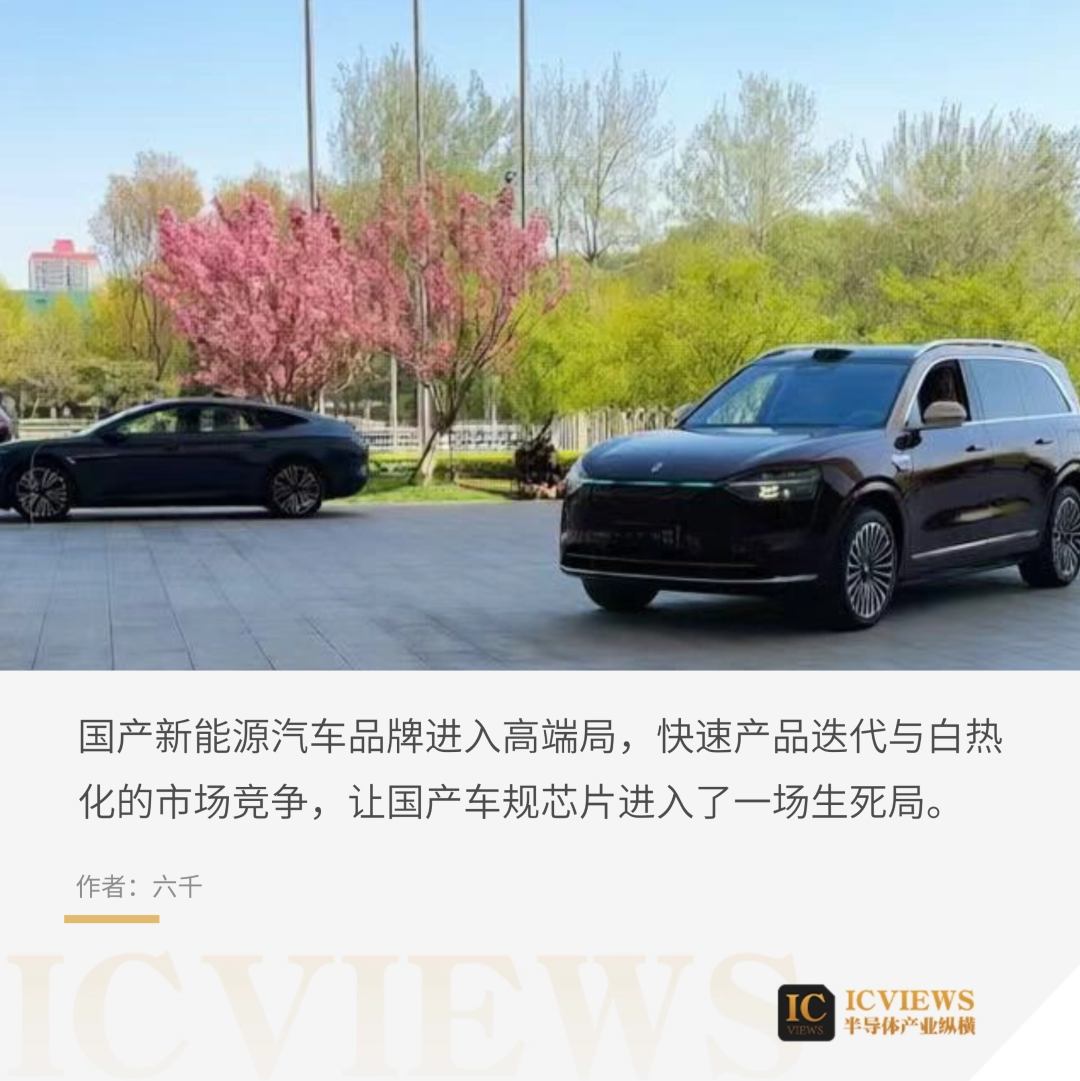
The automotive industry's competitive landscape is swiftly evolving towards intelligence. This transformation is propelled by the soaring demand for computing power, which is essential for intelligent driving. In contrast to the traditional, function-oriented electronic architecture of vehicles, modern vehicle systems have evolved into distributed computing platforms. At the High-Level Forum on the Development of Intelligent Electric Vehicles (2026), Li Bin remarked that every intelligent vehicle today is essentially a non-transformable robot, highlighting the technological leap.
By 2025, intelligent driving chips are poised to achieve remarkable advancements in computing power, cost-efficiency, and mass production capabilities. As intelligent driving becomes more ubiquitous, the number of participants in the intelligent driving chip market is expected to consolidate. While the market for third-party intelligent driving chips remains relatively stable, the three major emerging automotive forces have all opted to develop their own chips.
01
Automakers Developing Chips: A Challenge for Chip Companies?
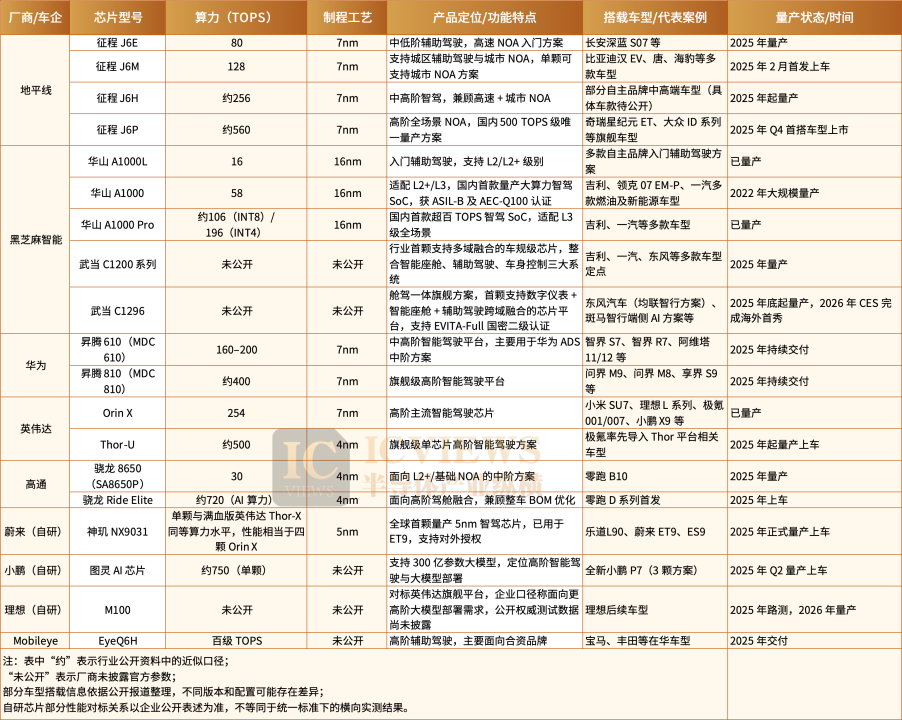
Data from semiconductor industry statistics reveal that the computing power of self-developed chips by domestic new automotive forces has reached the top tier. However, the question of whether these self-developed chips truly reduce costs for automakers remains a subject of debate.
Self-developing chips is a strategic decision for automakers. NIO, for instance, has cited the cost issue associated with purchasing NVIDIA chips, noting that its annual procurement costs soared to $300 million. With vehicle shipments continuing to surge (at a rate of 40%-50%), these costs are expected to escalate further. NIO's experience suggests that self-developed chips have successfully aided in cost reduction.
Third-party chip companies, however, offer a contrasting viewpoint. Qiu Xiaoxin, the founder and CEO of AiXin YuanZhi, emphasized that the division of labor is fundamental to industrialization. The value of independent chip companies lies in their neutrality, enabling them to supply chips to multiple automakers.
Automotive products and technologies are rapidly evolving, yet developing a chip requires substantial investment. Without sufficient volume to support it, cost recovery becomes challenging, rendering the business model unsustainable. With 90 million vehicles produced globally each year, the usage volume from just a few automakers is insufficient to sustain the continuous iteration of chip companies. Many industries undergo a process of vertical integration before specialized companies emerge. If automakers developing their own chips can achieve sufficient scale and profitability from an investment return perspective, they will proceed; otherwise, they will rely on external third-party suppliers. Even companies that develop their own chips may still use third-party products. Self-developed and third-party chips are not mutually exclusive.
For the chip industry, scalability is crucial for cost reduction. A neutral stance enables third-party automotive chips to rapidly increase shipments, giving them a cost advantage over self-developed chips.
Given the pace of technological iteration and cost pressures, only a limited number of automotive players are likely to develop their own chips. For most automakers and Tier 1 suppliers, collaborating with third-party chip companies will remain the preferred strategy.
What is evident is that once the intelligent driving industry matures, the number of remaining players will be limited, and industry concentration will rapidly intensify. For both automakers and chip companies, future competition will focus on technology, innovation, and service rather than price wars. Both domestic and international chip giants are deeply involved in the entire vehicle development process, from early project validation to mid-stage design and post-stage maintenance.
Self-development is not about flaunting technical prowess but about achieving gross margins through R&D investment. Third-party players compete not on price but on neutral ecosystems and system efficiency.
02
Intelligent Driving Chips: Entering the High-End Arena
With the advancement of intelligent driving levels, the proliferation of large models in vehicles, and the push for intelligent driving equality, intelligent driving chips are entering a high-end phase. This is not only reflected in increased computing power but also in the shift of bottlenecks to memory bandwidth and scenario adaptation.
At the April 9th press conference, NIO CEO Li Bin announced that the NIO ES9 would be equipped with the self-developed ShenJi NX9031 chip, marking an acceleration in the mass production of NIO's self-developed chips. The high-end arena for domestic intelligent driving chips has officially commenced, and how automakers' self-developed chips will coexist with domestic independent intelligent driving chips has become a focal point of industry attention.
Whether it's NIO's ShenJi, AiXin's M97, or Black Sesame's A2000, all prioritize 'increasing bandwidth and native support for Transformers' as core design elements. Without sufficient data throughput and algorithm-friendly architectures, even high computing power remains merely a parameter on paper. The competition for intelligent driving chips is shifting from a 'computing power arms race' to a reconstruction of 'system efficiency × scenario matching'.
Entering the high-end arena also means that chip companies are no longer just providing standardized products but require stronger customization capabilities.
Currently, domestic intelligent driving chips account for less than 50% of the market share, but their adoption rate in new vehicles is rising rapidly. This reflects the advantages of domestic manufacturers: flexible customization capabilities, close proximity to local customer needs, and rapid response mechanisms.
AiXin YuanZhi provides lower-cost solutions through system-level optimizations (such as integrating MCUs and reducing LPDDR5 usage) and actively validates domestic alternative solutions at the reference design level.
Black Sesame Intelligence supports customer algorithms through its open full-stack solutions, leveraging its own computing power platform to meet the diverse algorithm choices of automakers and reduce the cost of porting customer models.
With the advent of the era of intelligent driving equality, trends in cost control and technological innovation are leading vehicle manufacturers to increasingly participate in chip definition. Third-party automotive chip suppliers are better serving customers through open ecosystems and flexible solutions.
The ultimate outcome of the high-end arena is not about replacement but about co-creation: automakers define scenarios, chip manufacturers tackle architectures, Tier 1 suppliers ensure mass production, and analog chips form the foundation. Only by expanding the market can every member of the industry chain thrive.
Both Tier 1 and Tier 2 suppliers clearly state that the roles and boundaries within the automotive industry chain are becoming increasingly defined. AiXin YuanZhi noted that once boundaries are clearly drawn, collaboration with chip companies and upstream and downstream partners becomes straightforward. As a Tier 2 supplier, relinquishing control to Tier 1 suppliers and automakers makes it more efficient to create valuable products. This clear boundary has enabled AiXin YuanZhi to achieve 1 million vehicle installations within two years.
03
Navigating Through Cycles Together in the High-End Era
The opening of the high-end arena does not signal the end for low-computing-power intelligent driving chips. The current intelligent driving market has clearly differentiated into two distinct segments: the L2 market, driven by regulations, has become standard; while the high-level intelligent driving market has not yet achieved widespread adoption, industry chain manufacturers have already seen an explosion in demand and begun planning related products.
Chip manufacturing is a long-cycle industry, and the validation cycle for automotive-grade chips is even longer. Therefore, to meet demand two years from now, the industry chain must start planning now to ensure timely mass production and vehicle integration. Thus, even with the emergence of many high-computing-power intelligent driving chips, entry-level products still have a huge market application. Different stages of intelligent driving vehicles require products with varying computing power, so intelligent driving chip companies will continue to focus on entry-level, high cost-effectiveness, and low-power computing chips.
Black Sesame Intelligence stated that it will complete full-scenario coverage of automotive-grade chips this year to meet the diverse needs of customers, expand end-side scenarios, and expects sales to exceed 10 million units.
The overseas intelligent driving market is also an important focus for L2-level chips. As Chinese automakers expand globally, domestic chips have demonstrated performance and safety that meet various stringent European regulations. It is foreseeable that the market share of domestic intelligent driving chips will rapidly increase in the next two to three years.
For domestic chips, as long as their stability and quality are sufficient, they can win over automakers and capture market share. For intelligent driving chip companies, competition in navigating through cycles comes not from automakers but from product strength.
What is the next step for the high-end intelligent driving arena? Both automakers and chip companies believe that embodied intelligence will be a key development direction. NIO stated that automakers pursuing embodied intelligence is a natural choice, as the technology stacks and capability models of vehicles and embodied intelligence are similar. Analog chip giant ADI also noted that from a supply chain perspective, the entire automotive supply chain can be replicated in the robotics field, which is why automakers worldwide are exploring embodied intelligence products.
However, the embodied intelligence industry differs from the automotive industry in that it lacks a strict hierarchical division of labor. As shipments of embodied intelligence products increase, business models will change. For chip companies, when monthly shipments of embodied intelligence products are in the thousands, investing in more complete systems is more cost-effective; when monthly shipments reach hundreds of thousands, providing only chip products becomes wiser. For domestic chip companies, the robotics industry differs from the automotive industry in that the robotics track is still in its early stages, and chip companies are co-developing with local robotics companies. Therefore, the robotics industry inherently has a local supply chain advantage, which is a key reason why domestic intelligent driving chip companies choose embodied intelligence as the next destination in the high-end arena.
04
Beyond the Spotlight
If intelligent driving chips are now in the spotlight, then analog chips are more like the 'invisible pillar'.
As intelligent vehicle applications are increasingly classified under the embodied intelligence domain, vehicles have become an important landing scenario for AI, such as in-cabin applications: voice assistants, driver state perception, and so on. In the process of intelligent driving chips moving towards the high-end, the value of analog chips is reflected in multiple key areas: sensor signal acquisition and conversion, high-precision data processing, power management, and system stability.
All AI applications fundamentally require stable, safe, high-speed connections and basic physical devices, which is precisely the importance of automotive-grade analog chips. For example, in high-level assisted driving interfaces, only interface chips that can provide high-bandwidth, stable, and excellent connection properties can effectively support the implementation of intelligent assisted driving applications.
Since 2025, domestic analog chip companies have seen rapid vehicle integration. This is not only a victory for domestic analog chips but also a reflection of the accelerated development of intelligent automotive chips.
-
![]()
Jitian Xingzhou: A Pioneer in Optical Payloads Secures Hundreds of Millions in Series B Funding!
-
![]()
Orders Secured Through to the Second Half of the Year! The Rationale Behind the 'Surge' in Demand for This Company’s Optical-Grade Base Films
-
![]()
Beyond Patents: The Retail Rivalry of Insta360 and DJI Unfolds
-
![]()
180 Billion Market Cap Vanished! How Did Seres Fall So Far?
-
![]()
Blockbuster! Domestic storage takes the global double crown for the first time, from an AI company
-
![]()
China Spearheads Formulation! World's Pioneering Global Technical Regulation for Automated Driving Systems Greenlit and Unveiled
-
![]()
Farewell to Pulsed Support Policies: Three Major Auto Policy Directions from Multiple Departments Take Effect on the Same Day
-
![]()
Embercore AI’s Accelerated Funding: The Robot Industry’s Shift Toward ‘Learning Systems’