414.7 Billion Atoms Shatter World Record: Domestic 10,000-GPU Supercluster × Scientific Software Propel AI4S to Uncharted Territories
 04/21 2026
 450
450
AI for Science (AI4S) has emerged as a pivotal force in scientific discovery. Beyond merely enhancing research and innovation efficiency, AI4S seamlessly integrates artificial intelligence with scientific discovery paradigms, enabling the resolution of previously intractable problems and pushing the frontiers of scientific exploration.
The profound fusion of artificial intelligence and novel materials is consistently driving transformative shifts within materials science. Recently, the Sugon scaleX 10,000-GPU supercluster, in collaboration with Longxun Kuangteng's MatPL software (MatPL-2026.3 version), and leveraging the National Supercomputing Internet core node, successfully executed a 414.7 billion-atom liquid water molecular dynamics simulation using just 4,096 heterogeneous accelerator cards operating in parallel. All interatomic interactions achieved first-principles accuracy, setting a new benchmark in the field.
This milestone sends a resounding message to the industry: in the pivotal domain of AI4S, the deep synergy between domestic computing power and domestic scientific software has not only transitioned from 'usable' to 'user-friendly' but has also showcased world-leading capabilities.


What Does a 414.7 Billion-Atom Scale Signify?
In the AI era, high-precision simulations of the microscopic realm in materials science hinge on large-scale models. Machine Learning Force Fields (MLFF) represent a research paradigm where AI models directly learn interatomic interactions from vast datasets of high-precision data, offering extensive applications in polycrystalline materials, alloy design, semiconductor devices, solid-state battery development, and other fields.
'The structure, arrangement, and defects of microscopic atoms can directly influence the performance of diverse materials, even affecting their thermal transport properties. We must delve into the atomic scale to continually advance the boundaries of materials science,' stated Tian Hongzhen, General Manager of Beijing Longxun Kuangteng Technology Co., Ltd. This simulation achieves dual breakthroughs in scale and precision for molecular dynamics, providing critical foundational support for major scientific endeavors.
In terms of scale, 414.7 billion atoms represent a 1.43-fold increase over the previous world record of 29 billion atoms, significantly surpassing the upper limit of molecular dynamics simulations. In terms of precision, all interatomic interactions in this simulation reached first-principles accuracy, enabling researchers to study cutting-edge issues such as battery interfaces, biological macromolecules, and complex materials at scales closer to real-world conditions with quantum mechanical precision for the first time.
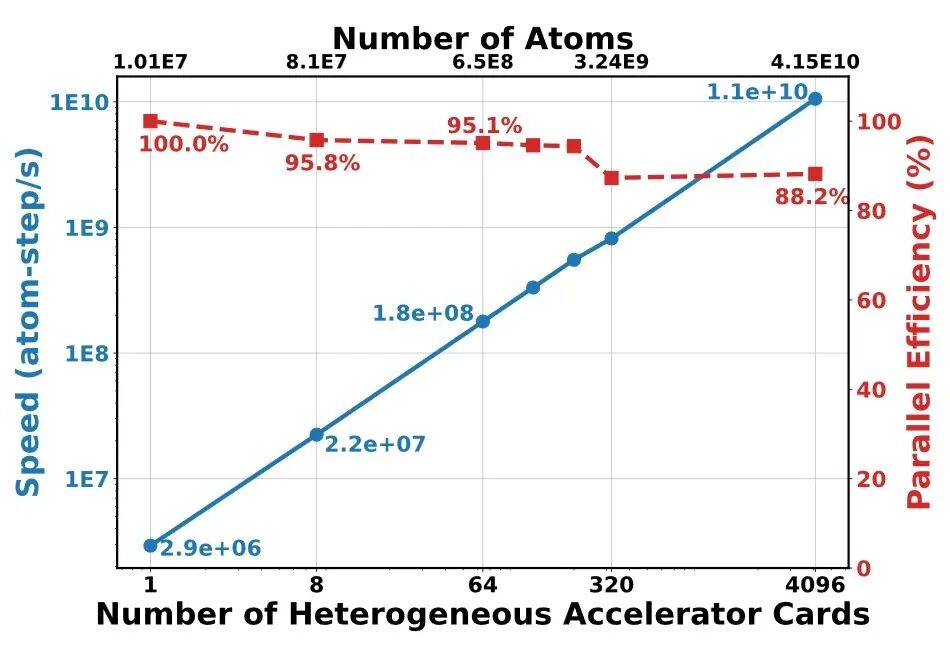
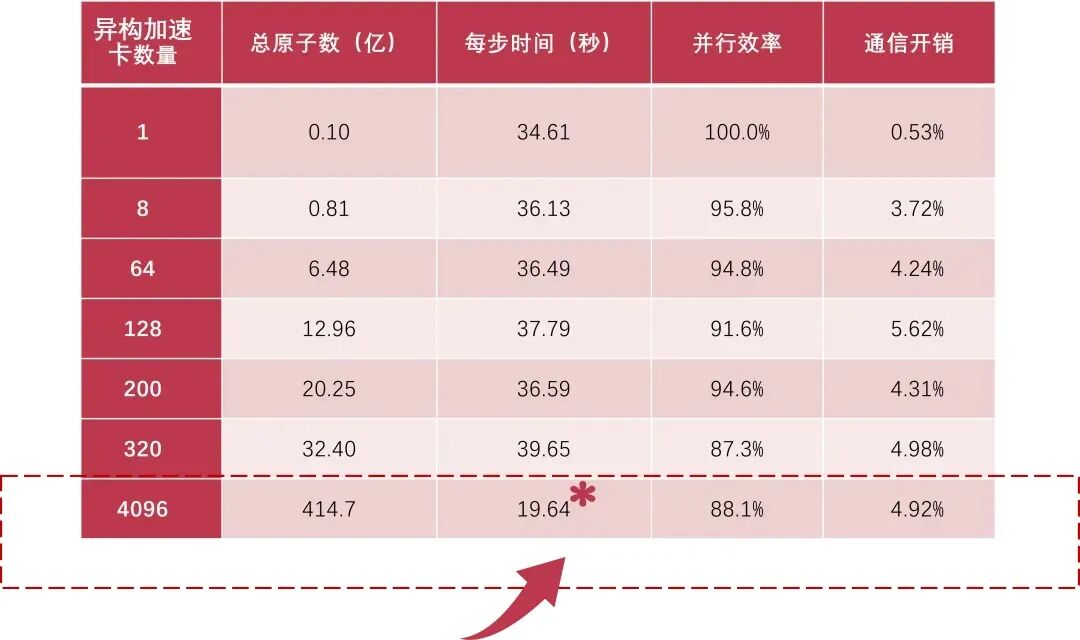
Note: 4,096 cards were run for 500 steps, while other scales were run for 10,000 steps; each step's duration represents the average MD single-step time.
Tian Hongzhen explained that the MatPL machine learning force field boasts high training efficiency, robust cross-node parallel scalability, exceptional single-card performance, and optimal memory usage. Molecular dynamics simulations often necessitate continuous computation of atomic interactions over millions of steps, where every incremental speed improvement in inference is magnified millions of times. Thus, computational efficiency dictates the upper limit of simulation efficiency.
Leveraging the Sugon scaleX 10,000-GPU supercluster deployed at the National Supercomputing Internet core node, the MatPL machine learning force field achieved a substantial boost in computational efficiency:
It completed the ultra-large-scale simulation of 414.7 billion atoms using just 4,096 heterogeneous accelerator cards operating in parallel, with communication overhead as low as 4.92%, providing computational assurance for subsequent even larger-scale structural simulations.

Domestic Computing Power × Domestic Software: Forging a World-Leading Scientific Computing Ecosystem
This breakthrough fully demonstrates that the deep synergy between domestic computing power and domestic software can not only yield world-leading AI4S achievements but also explore the feasibility of a Chinese AI4S ecosystem pathway.
'In the past, those focused on computing power concentrated solely on computing power, and those focused on software concentrated solely on software. In the future, we may move toward a direction of deep synergy between hardware and software ecosystems,' said Zhang Lei, General Manager of Solutions and Innovation Business at Sugon.
Hardware Layer: Autonomous, Secure, and Controllable Domestic Computing Power for Seamless Integration
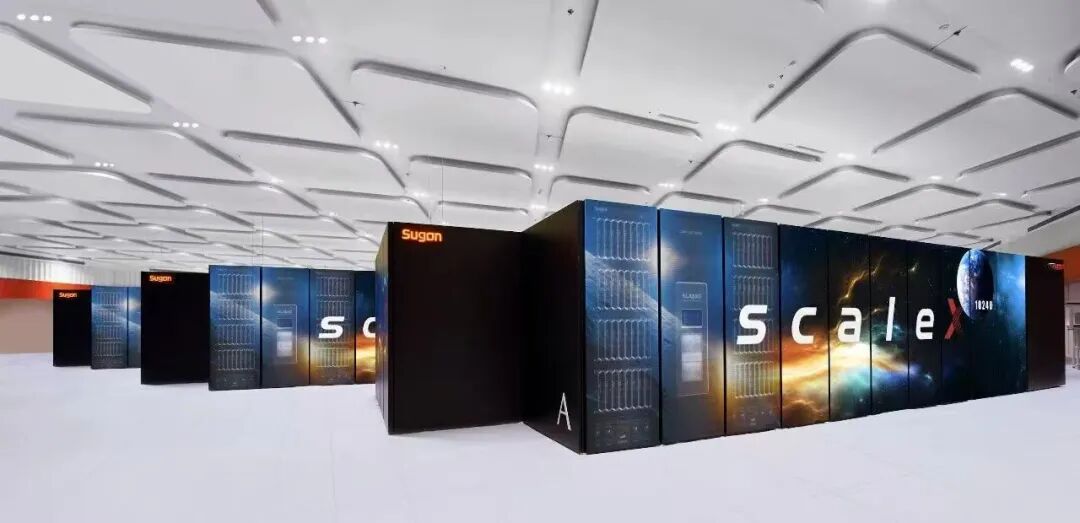
This breakthrough was achieved relying on the National Supercomputing Internet core node, which currently deploys three scaleX 10,000-GPU supercluster systems, providing over 30,000 cards of domestic AI computing power for cutting-edge scientific research with large-scale, autonomous, and controllable computing support.
The Sugon scaleX 10,000-GPU supercluster offers dual-precision and half-precision computing power, meeting the high-precision, high-concurrency, and high-stability requirements of scientific computing. It is also compatible with mainstream computing ecosystems, lowering the barriers for migrating and using scientific research applications, enabling seamless integration by researchers.
The hardware value of Sugon's supercluster was instrumental in this record-breaking achievement: with 4,096 heterogeneous accelerator cards operating in parallel, it achieved a weak scaling efficiency of 88%, communication overhead of just 4.92%, and a computing ratio consistently exceeding 90%, proving that this supercluster is not only 'built large' but also 'runs smoothly'.
Software Layer: Open Source and Open, Facilitating Broader Adoption by Researchers
The record-breaking Longxun Kuangteng MatPL-2026.3 software package maximizes hardware potential through memory optimization, neighbor list reconstruction, cross-node parallelism, and other technologies. The value of scientific software lies not only in a single technological breakthrough but also in whether it can be genuinely utilized by more researchers and continuously iterated in diverse scenarios.
Therefore, the MatPL-2026.3 software package is open-source, aiming to assist more researchers in achieving innovative breakthroughs from 0 to 1. In the future, the Supercomputing Internet and Longxun Kuangteng will further collaborate on optimizing computational efficiency and software performance, as well as exploring cooperative models such as intelligent agents and all-in-one machines.
Platform Layer: Completing the AI4S Ecosystem Loop and Accelerating AI4S Accessibility
The Supercomputing Internet is not merely a pool of computing resources but also an AI4S infrastructure connecting computing power, models, software, services, and intelligent agents.
'The Supercomputing Internet provides a massive pool of heterogeneous computing resources, laying a solid foundation for future molecular dynamics simulations at the trillion, ten-trillion, or even hundred-trillion atom scale. Meanwhile, the synergy between domestic hardware and software frees us from dependence on foreign commercial research, enabling frontier scientific research innovation based on autonomous and controllable domestic computing power,' said Tian Hongzhen.
As a core carrier of the national integrated computing network construction, the Supercomputing Internet has achieved numerous phased successes through the 'Core Node Beta Invitation Program' and the creation of the research-exclusive intelligent agent 'SClaw.' It has not only gathered over 600 service providers and nearly 7,300 application products but also surpassed 1.2 million registered users, gradually building a comprehensive domestic AI4S computing service ecosystem.
The 414.7 billion-atom world record is a new starting point. It once again validates that the deep synergy between domestic 10,000-GPU superclusters and scientific software can not only support world-class scientific research tasks but also build an autonomous, world-class scientific computing ecosystem, accelerating the implementation of AI4S across broader scientific research fields and continuously expanding the boundaries of Chinese scientific research innovation.
END
This article is an original work by 'Intelligent Evolution Theory.' Welcome to follow us.
-
![]()
Wang Huiwen, Former Meituan Executive, Achieves 20-Fold ROI, Supports 24 AI Startups
-
![]()
Another AI Computing Power Unicorn Launches IPO! Founded by a Changjiang Scholar
-
![]()
OFILM Holdings Secures Zhongke Daojing, Marking a Significant Leap in the Optical Communication Industry!
-
What Will Be the Next Key Battleground for Large Models After AI Coding?
-
![]()
Leapmotor's Sales Soar, Yet Hidden Concerns Loom
-
![]()
China’s Action Camera Market Soars: 3.12 Million Units Sold in Six Months, DJI Secures 74% Dominance
-
![]()
Zhang Yiming: Strategic Retreat as a Path Forward
-
![]()
Exploring Charging for Some Features of QianWen App: Can It Follow the Path of Doubao?