Why Did iQIYI's High-Profile Launch of a 100-AI-Artist Library Backfire?
 04/21 2026
 604
604
The AI Artist Library Angered the Artists.
Shougong Laodong/Wage Bro
Edited by/Jiao Shu
Produced by/Unicorn Observer
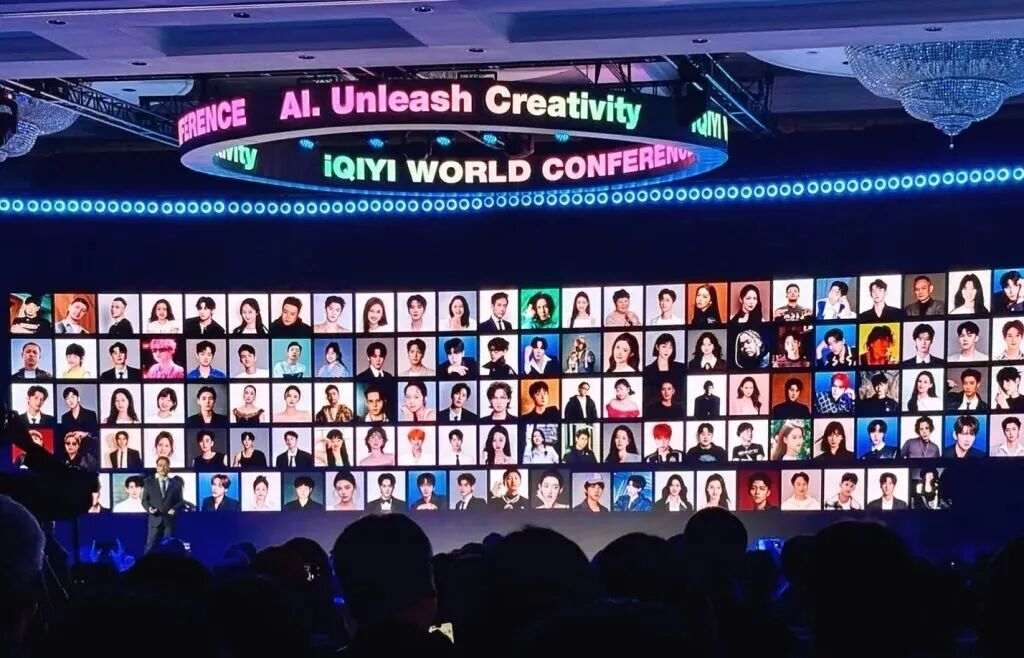
On April 20, iQIYI made a high-profile announcement at the World Conference, launching its AI artist library and claiming to have signed 117 artists. Leveraging its self-developed Nado Pro platform, iQIYI aimed to create digital replicas of these artists, fully deploying an AI-driven ecosystem for film and television creation. The company even made the controversial claim that 'real-life filming might become intangible cultural heritage in the future.'
The news quickly ignited public debate. A so-called 'list of artist authorizations' went viral online. However, within hours, several artists, including Zhang Ruoyun, Yu Hewei, and Wang Churan, issued statements denying having signed any AI-related authorization agreements.
In response to the backlash, iQIYI clarified that inclusion in the AI artist library only indicated the artists' willingness to engage in AI-related projects, not that formal authorization agreements had been signed.
This PR mishap, which escalated from a high-profile announcement to collective refutations and then to damage control, was not merely a publicity blunder. It reflected iQIYI's strategic anxiety and opportunistic mindset amid ongoing financial losses, while also sparking industry-wide reflection on the boundaries of AI replacing human performers.
01 A High-Profile Announcement That Backfired
On April 20, the 2026 iQIYI World Conference was held in Beijing, with the launch of the AI artist library as the centerpiece.
iQIYI's founder and CEO, Gong Yu, proudly announced that 117 artists had already signed contracts to join the AI artist library. A wall of artist photos was displayed on the big screen, with claims that exclusive digital replicas would be created using multi-modal data authorized by the artists. These replicas would be used in high-risk film scenes, reshoots, stunt doubles, and other scenarios, even allowing actors to 'shoot remotely' without scheduling conflicts.
Gong Yu went as far as to say, 'In the future, 100% real-life filming might become intangible cultural heritage.'
This statement quickly sparked controversy, but the tide soon turned.
On the afternoon of April 20, studios and fan clubs of several artists, including Zhang Ruoyun, Yu Hewei, Wang Churan, and Li Yitong, issued statements denying having signed any AI authorization agreements, calling the online rumors false. The wave of collective refutations put iQIYI in a highly passive position, with negative hashtags like 'iQIYI has gone crazy' trending. Netizens joked, 'High EQ: Let actors rest more. Low EQ: Actors are going to be unemployed.'
Faced with escalating criticism, iQIYI scrambled to respond. That afternoon, Gong Yu clarified in an interview that the artists in the library 'only expressed a willingness to participate in AI production, not that they had agreed to a specific AI project.' He explicitly stated that Zhang Ruoyun, Yu Hewei, and others were not on the list.
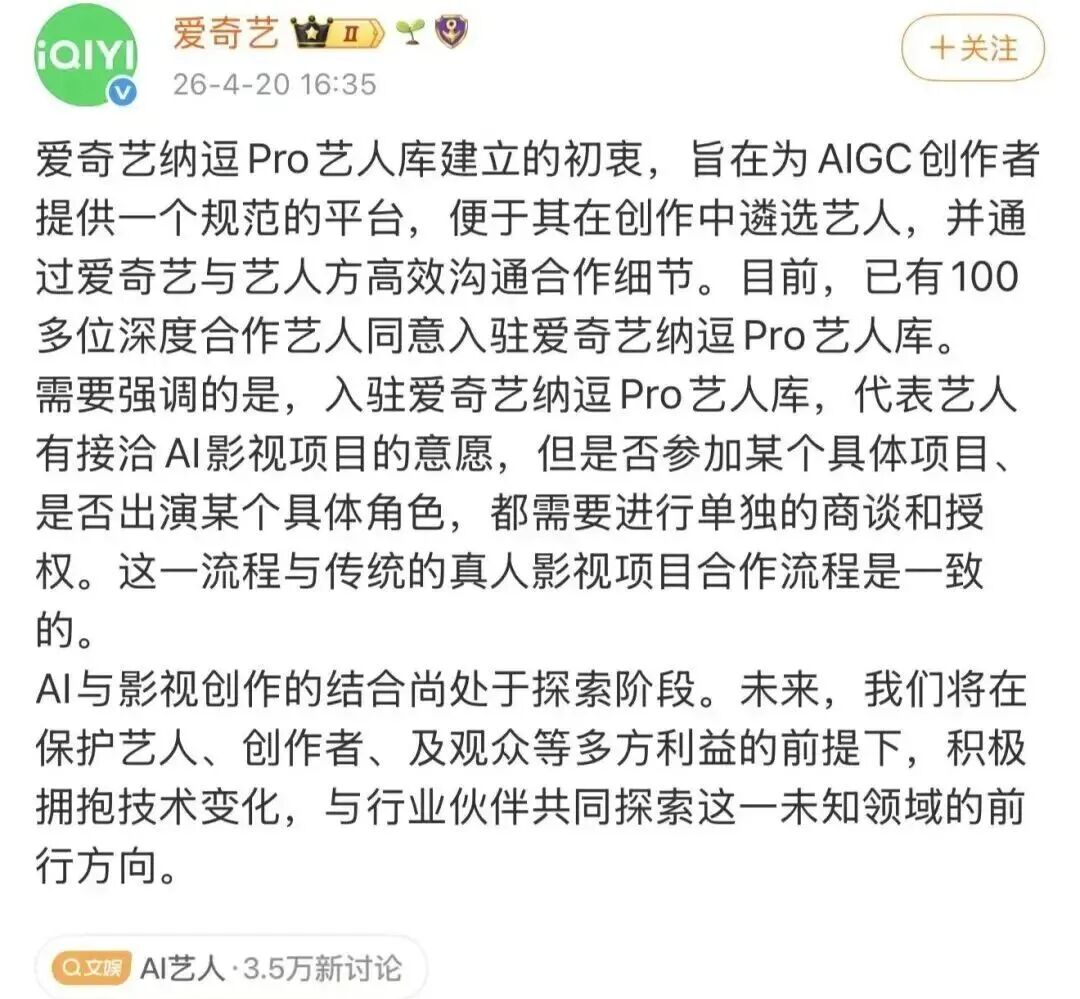
Later, iQIYI's official Weibo account issued a statement further explaining that the Nado Pro artist library was intended to provide a standardized platform for AIGC creators. Inclusion only indicated artists' willingness to engage in AI projects, with specific projects and roles requiring separate authorization negotiations, consistent with traditional real-life film and television collaboration processes.
This hasty damage control failed to fully quell the controversy, with netizens accusing iQIYI of 'concept-stealing' and 'exaggerated promotion.' In reality, many of the so-called '117 artists' were from iQIYI's affiliated talent agencies (Guoran Entertainment, Chaoji Xiangshang, Deyang Entertainment), making it difficult for them to refuse inclusion due to their contractual ties to the platform.
From the high-profile announcement of 'signed contracts' to the emergency clarification of 'mere interest,' this PR mishap not only damaged iQIYI's brand credibility but also exposed the opportunistic nature of its AI strategy.
02 Strategic Breakout Amid Performance Pressure
iQIYI's eagerness to launch the AI artist library and promote it so aggressively was driven not merely by technological innovation but by its attempts to reduce costs, increase efficiency, and appeal to capital markets amid sustained losses and intense industry competition.
A deeper look at its underlying business logic reveals that this PR mishap stemmed from iQIYI's undeniable survival anxiety.
The worsening profitability crisis is the primary reason behind iQIYI's bet on the AI artist library.
According to iQIYI's 2025 financial report, the company's total annual revenue was 27.29 billion yuan, down 6.62% year-on-year, marking a second consecutive year of negative growth after a 7.97% decline in 2024. In terms of profit, non-GAAP operating profit was 640 million yuan, a sharp drop of about 73% from 2.36 billion yuan in 2024. Under GAAP, the company swung from profit to loss, reporting a net loss of 206 million yuan, compared to a net profit of 1.93 billion yuan in 2023, which had been its peak profitability.
Behind the declining revenue and shrinking profits lie three challenges: stagnant membership growth, weak advertising revenue, and high content costs. Membership revenue, the core income source, has hit a growth ceiling. Advertising revenue continues to decline due to the economic environment. While content costs have been reduced from a high of 80% to 56%, further compression space is extremely limited.
Against this backdrop, AI has become iQIYI's perceived 'lifesaver' for cost reduction and efficiency gains. AI digital humans could replace mid-tier artists, stunt doubles, and extras, reducing shooting schedules and salary expenses. As Gong Yu put it, AI could significantly increase actors' annual output, essentially lowering labor costs in content production through technological means.
The long-video industry is currently experiencing intensified internal competition, with rivals like Tencent Video, Youku, and Mango TV accelerating their AI layout (AI layout : strategic AI deployment). However, their strategies are more measured.
Tencent Video focuses AI on script generation, post-production editing, and other supportive roles, developing AI tools to empower content creation. Youku positions AI as a productivity system while building an integrated talent development network for 'screenwriting, directing, and acting' to avoid controversy over 'replacing humans.' Mango TV emphasizes virtual artist development, leveraging its variety show strengths to create virtual hosts and idols for differentiated competition.
In contrast to its competitors' steady strategies, iQIYI chose to make a splash with '100 AI artists,' essentially using 'first-mover' industry competition rhetoric to create a topic ( create a topic : generate buzz) and dominate public discourse, showcasing its supposed 'leadership' in AI to gain an edge in capital markets and industry competition, rather than achieving genuine technological breakthroughs.
From a strategic implementation perspective, iQIYI's AI artist library appears more like 'concept-hyping' than a mature technological layout . Although iQIYI's affiliated companies have applied for multiple patents related to 'character image generation' and 'virtual character pose determination,' the technical maturity of the AI artist library remains questionable.
To date, iQIYI has not demonstrated any mature cases of 'digital replicas filming.' The so-called AI digital humans are largely limited to portrait replication, struggling to perform complex emotional expressions and improvisational acting.
03 The Boundary Dispute Over AI Replacing Human Performers
The controversy sparked by iQIYI's AI artist library cuts to the heart of the film and television industry in the AI era: What are the reasonable boundaries of AI in film and television creation?
Should the industry pursue industrialized, efficient production or uphold the artistic essence of human emotional expression? Gong Yu's remark that 'real-life filming will become intangible cultural heritage' pushed this debate to a climax, triggering a multi-sided debate among platforms, artists, audiences, and industry scholars.
Proponents argue that AI application is an inevitable trend in the industrialization of the film and television industry, effectively reducing production costs, shortening timelines, lowering difficulty, and liberating actors' productivity. In their view, AI digital humans can handle high-risk and repetitive performing tasks, allowing actors to focus on more creative role portrayals. Meanwhile, AI can significantly boost content output efficiency, meeting diverse audience demands and driving industry scale expansion. Behind this perspective is capital's pursuit of efficiency and profit, viewing AI as a core tool for cost reduction and competitiveness enhancement.
Opponents, primarily artists, directors, and cultural scholars, argue that AI can never replace the core value of human performance, and overemphasizing AI substitution would erode the soul of film and television art. Renowned actor Feng Yuanzheng once said, 'AI's tears are painted, but mine flow from within, carrying warmth and flavor.'
The core charm of film and television works has never been standardized technical presentation but the emotions and souls imbued by human actors—the nuanced interpretation of roles, the authentic eruption of emotions, the stories in their eyes, and the warmth in their lines. These vivid expressions cannot be simulated by algorithms or replicated by data.
Industry insiders point out that Gong Yu's remark about 'real-life filming becoming intangible cultural heritage' essentially uses the grand narrative of technological progress to overlook the core value of performing arts, reducing human performance to mere 'physical labor' that can be standardized and digitized, while ignoring its humanistic and aesthetic significance.
iQIYI's AI artist library controversy represents a direct collision between rapid technological advancement and industry rules and artistic essence.
It exposes the strategic anxiety and opportunistic mindset of long-video platforms under financial pressure while sparking industry-wide reflection on the boundaries of AI in film and television creation. AI technology itself is neutral; the key lies in how it is used—whether to uphold the core value of 'humanity' and empower artistic creation with technology or to eagerly pursue efficiency and profit, replacing human value with technology.
For iQIYI, this mishap serves as both a lesson and an opportunity for reflection. In the AI race, only by abandoning opportunism, respecting artists' rights, upholding artistic essence, and using AI as a creative tool can it achieve a healthy integration of technology and content and secure long-term competitiveness.
For the entire film and television industry, this controversy serves as a wake-up call: The arrival of the AI era calls not for blind tech worship but for establishing sound industry rules, balancing the interests of platforms, artists, and audiences, and ensuring that technology truly serves art rather than eroding its warmth. (End)
-
![]()
Wang Huiwen, Former Meituan Executive, Achieves 20-Fold ROI, Supports 24 AI Startups
-
![]()
Another AI Computing Power Unicorn Launches IPO! Founded by a Changjiang Scholar
-
![]()
OFILM Holdings Secures Zhongke Daojing, Marking a Significant Leap in the Optical Communication Industry!
-
What Will Be the Next Key Battleground for Large Models After AI Coding?
-
![]()
Leapmotor's Sales Soar, Yet Hidden Concerns Loom
-
![]()
China’s Action Camera Market Soars: 3.12 Million Units Sold in Six Months, DJI Secures 74% Dominance
-
![]()
Zhang Yiming: Strategic Retreat as a Path Forward
-
![]()
Exploring Charging for Some Features of QianWen App: Can It Follow the Path of Doubao?