Robots Outpace Humans in Marathon, Yet Human 'Limitations' Remain Our Strength
 04/21 2026
 593
593
On April 19, 2026, Beijing witnessed a marathon like no other. The humanoid robot half-marathon kicked off, with over a hundred teams vying for supremacy on the same challenging course. Beijing Honor's 'Lightning' robot emerged victorious, crossing the finish line in a remarkable 48 minutes and 19 seconds. On the same day, Unitree Technology revealed that its H1 robot had completed a 1.9-kilometer, multi-turn course in just 4 minutes and 13 seconds during the qualifying round. When scaled proportionally, this feat eclipsed the human 1,500-meter world record.
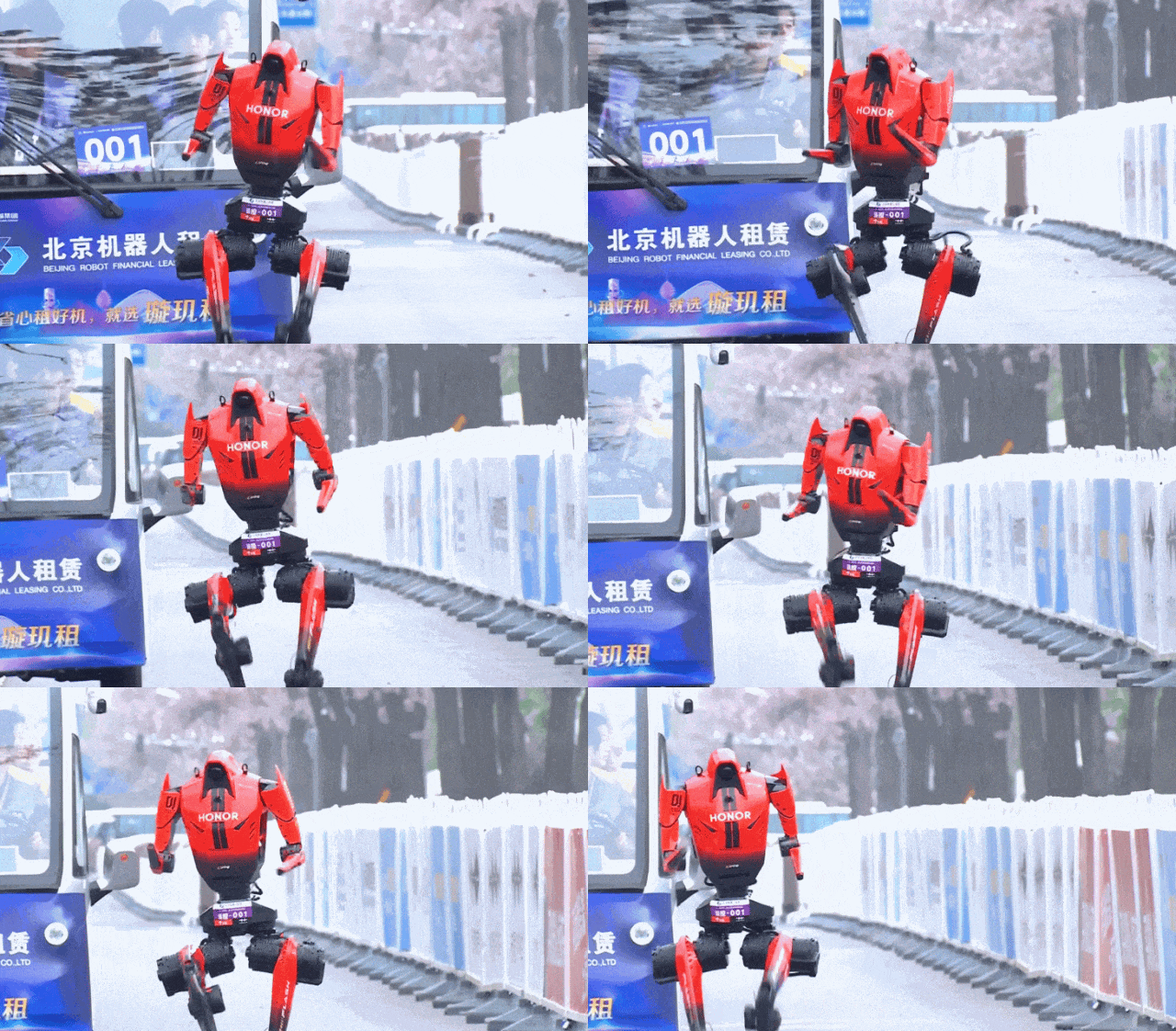
Robots outstripped humans on the track, an outcome that, in itself, is hardly surprising. Over two decades ago, when IBM's Deep Blue vanquished Garry Kasparov on the chessboard, prompting the human chess champion to concede defeat, society was gripped by a wave of collective unease. Later, when AlphaGo triumphed over Lee Sedol in Go, that anxiety resurfaced. Today, with robots utilizing their legs to outrun human champions, anxiety has taken on a fresh guise. Each technological leap serves as a reminder of the same reality: the human body and mind are gradually being overtaken by machines.
Human limitations are becoming ever more evident. Our muscles tire, bones are susceptible to injury, and reaction speeds have a ceiling. Robots, however, are unburdened by these constraints. The 'Lightning' robot on the marathon track relied on batteries and motors, with predictable and replaceable joint wear, and real-time gait optimization through programming. From chessboards to running tracks, and from intellectual to physical realms, machines are systematically surpassing human physiological limits.
Yet, it is precisely these limitations that constitute humanity's most fundamental edge when confronting AI and robots. This conclusion may seem counterintuitive and warrants careful explanation.
Consider a detail from the competition. Unitree's H1 achieved its record-breaking time, but note the premise: the course was a mere 1.9 kilometers with multiple turns. Robots excel in short-distance, structured environments where algorithms can meticulously plan every step and sensors adjust posture in real time. If the distance were extended to a half-marathon's 21 kilometers, the scenario would shift dramatically. Beijing Honor's 'Lightning' completed the race in 48 minutes and 19 seconds, averaging roughly 2 minutes and 18 seconds per kilometer. This pace ranks among the elite for human runners but does not vastly exceed human limits. The human half-marathon world record hovers around 58 minutes, with robots finishing about 10 minutes faster. The gap exists but is not as yawning as one might imagine.
A more critical issue is stability. For a robot to complete 21 kilometers without a hitch, every joint motor, battery, and circuit must function flawlessly. A single malfunctioning component could bring the entire system to a halt. Human runners, on the other hand, can persevere despite a sprained ankle, push through dehydration with sheer willpower, and adjust their breathing rhythm amid muscle soreness. While the human body has its limits, it possesses a capability robots lack: the ability to make adaptive adjustments under extreme conditions. Robots can only operate according to preset parameters and collapse once they exceed their design limits.
This brings us to the first advantage of limitations: value selection. Human time, energy, and attention are finite, compelling us to ask: What truly matters? One cannot pursue everything simultaneously, necessitating priority setting, abandoning secondary options, and investing limited resources in the most meaningful goals.
Robots face no such dilemma. Theoretically, a robot can operate around the clock, handle multiple tasks simultaneously, and expand its computing power and storage indefinitely. Yet, this very infinity is the enemy of value selection. Without scarcity, there is no need for trade-offs; without trade-offs, there are no distinctions of quality; without distinctions, there is no meaning. Humans, because we must face mortality, must decide how to live. Robots, never confronting death, cannot grasp the weight of the term 'way of living.'
Consider another competition detail. Unitree's H1 autonomously completed the 1.9-kilometer qualifying round, a remarkable feat. This means the robot operated without remote control or external navigation assistance, relying solely on its sensors and algorithms for course recognition and path planning. Yet, ponder this question: Does the robot 'know' it is running? Does it 'understand' the significance of a marathon? The answer is no. The robot merely executes a target function: reaching the finish line from the starting point in the shortest time possible. All perception, planning, and control serve this function. Throughout the process, the robot feels no fatigue nor experiences a sense of accomplishment upon crossing the finish line.
This highlights the second advantage of limitations: abstract and metaphorical capabilities. Human memory capacity and processing speed are finite, preventing us from storing vast amounts of data like AI. Instead, we must learn to extract patterns, generalize from a few samples, and use metaphors to understand the unknown through the known, drawing analogies across different fields. We also compress knowledge into theories, laws, and stories for efficient transmission. These abilities lie at the core of wisdom. AI can memorize every chess game but struggles to derive life lessons from a single match. Robots may achieve record-breaking speeds but likely cannot grasp the meaning of 'perseverance' through running. Human limitations compel our brains to develop efficient compression algorithms, enabling reasonable decision-making amid incomplete information, finding certainty in uncertainty, and establishing order amid chaos.
Another easily overlooked detail from the competition: the event featured both autonomously navigating and remotely controlled teams competing together under a unified ranking system, but their results were weighted differently—1.0 for autonomous teams and 1.2 for remotely controlled teams. In other words, remotely controlled robots needed to run faster to achieve the same ranking as autonomous ones. This rule design implicitly acknowledges a fact: autonomous navigation is more challenging than remote control, as autonomous robots face greater uncertainty. When humans remotely control robots, they can make real-time judgments and adjustments from outside the course. While human judgment may be slower, it is more flexible, allowing for on-the-fly strategy changes in response to unforeseen road conditions. Autonomous decision-making systems in robots can only rely on training data and are prone to errors when encountering situations outside their data distribution.
This brings us to the third advantage of limitations: the foundation of morality and responsibility. If a person were omnipotent and always had time to correct mistakes, their choices would lack real consequences. Human limitations ensure that every choice excludes other possibilities, thereby creating responsibility. A wrong decision may be irreversible. Harming others may leave little opportunity for redress. This irreversibility forms the basis of moral judgment. Robots face no such dilemma. A robot that makes a mistake can be reprogrammed, its system reset, and its memory erased to start anew. Robots never truly face consequences, so they can never truly understand responsibility, fairness, or sacrifice.
Consider the organizational logic behind the competition itself. Why did humans organize a humanoid robot marathon? This question exposes a fundamental difference between humans and machines. Humans designed this event not to verify which robot is faster but to explore technological boundaries, facilitate industry exchange, and showcase scientific progress to the public. Humans imbued the event with multiple layers of meaning: technological validation, commercial competition, science education, and entertainment. Robots assign no meaning to anything; they merely complete tasks. Meaning is something humans create with their limited cognitive resources, derived from human needs, emotions, and value judgments.
Limitations also bring an unexpected advantage: the drive for innovation. Many great inventions throughout history have stemmed from resource constraints. The need for lightweight spacecraft led to composite material technology. Limited communication bandwidth spurred compression algorithms. Energy scarcity drove the development of renewable energy technologies. Truly unlimited resources would stifle innovation. If humans, like robots, did not need to eat, there would have been no agricultural revolution. If we did not need to sleep, there would be no lighting technology or nightlife culture. Human limitations constantly create problems, which in turn drive innovation in a virtuous cycle. Robots, lacking needs or deficiencies, experience no suffering and thus possess no intrinsic motivation for innovation. They can optimize and iterate, but only based on goals set by humans. Therefore, robots do not ask themselves, 'Can I do better?' They merely respond, 'You tell me what better means.'
The fact that Unitree's H1 broke the human 1,500-meter record, viewed from another angle, actually proves human greatness. Humans created a machine that runs faster than themselves and designed algorithms that play chess better than we do. These achievements are externalizations of human wisdom. Human intelligence does not lie in running faster, calculating quicker, or writing more rapidly but in creating entities that surpass us in speed, precision, and efficiency. Human limitations inspire us to create tools, which in turn amplify our capabilities. This has been a continuous positive feedback loop spanning tens of thousands of years, from Stone Age axes to today's AI—all fundamentally following the same logic: using tools to compensate for human limitations.
However, a fundamental distinction exists. Past tools were extensions of human limbs, requiring human operation. Today's AI and robots are evolving into independent agents capable of autonomous operation without human intervention. This transformation makes many uneasy. If tools no longer require human operation, what purpose do humans serve?
The answer still lies in our limitations. Humans, because we are limited, know when to stop. The greatest challenge for infinite intelligence is knowing when to cease thinking or optimizing. Human limitations naturally provide stopping points. With limited decision-making time, we must act. With constrained cognitive resources, we must accept 'good enough.' This ability to make decisions under constraints represents meta-wisdom—something AI struggles to imitate. An AI can infinitely optimize a plan but will never proactively say, 'This plan is good enough; let's execute it.' AI lacks concepts of satisfaction or standards for 'sufficiency.' Humans, because we are limited, understand contentment. Only those who understand contentment can build a happy society.

At the marathon's finish line, Beijing Honor's 'Lightning' crossed first amid thunderous applause. These applause were for the robots but even more so for the human engineers behind them. Every robot that completed the course embodied human wisdom, sweat, frustration (setbacks), and persistence. Robots do not take pride in their achievements, but humans do. Robots do not embrace teammates after the race, but humans do. These connections, these moments of significance, all stem from human limitations. Because life is short, every achievement becomes precious. Because our abilities are limited, every breakthrough deserves celebration.
The future of human-machine relations will not be about who is stronger but about division of labor and collaboration. Let AI handle infinite calculations, optimizations, and repetitive tasks. Let humans make finite choices, assign meaning, and exercise value judgment. AI expands the space of possibilities; humans make the final decisions within that space. AI provides options; humans select answers. AI runs faster; humans decide why to run.
Human limitations are not flaws but the soil in which wisdom grows. Because we are limited, we choose. Because we choose, we bear responsibility. Because we bear responsibility, we have morality. Because we have morality, we have civilization. No matter how powerful robotic infinity becomes, it can never take root in this soil.
The End
-
![]()
Wang Huiwen, Former Meituan Executive, Achieves 20-Fold ROI, Supports 24 AI Startups
-
![]()
Another AI Computing Power Unicorn Launches IPO! Founded by a Changjiang Scholar
-
![]()
OFILM Holdings Secures Zhongke Daojing, Marking a Significant Leap in the Optical Communication Industry!
-
What Will Be the Next Key Battleground for Large Models After AI Coding?
-
![]()
Leapmotor's Sales Soar, Yet Hidden Concerns Loom
-
![]()
China’s Action Camera Market Soars: 3.12 Million Units Sold in Six Months, DJI Secures 74% Dominance
-
![]()
Zhang Yiming: Strategic Retreat as a Path Forward
-
![]()
Exploring Charging for Some Features of QianWen App: Can It Follow the Path of Doubao?