Will AI Become So Advanced That Programmers and the Software Industry Will Become Obsolete?
 04/22 2026
 615
615
As a child, I held one profession in high esteem: drivers.
Occasionally, when my father embarked on journeys by car, he would take me along. The exhilaration of speeding down the road was incredibly thrilling. Upon stopping, while my father attended to his business, I would plead with the driver to let me sit behind the wheel, pretending to drive and imitating engine sounds, "WuWuWu~~~".
Back then, being a driver was a prestigious occupation.
Fast forward decades, and now cars are ubiquitous in nearly every household. The profession of a driver hasn't vanished; instead, it has evolved and diversified.
On one hand, high-end professional drivers, though rare, still exist, such as professional racers. On the other hand, driving as a means of livelihood persists, like taxi and ride-hailing drivers. 
And driving has transformed into a fundamental skill that everyone must acquire.
As AI begins to demonstrate its prowess in high-quality programming, a profession is undergoing a transformation similar to that of drivers in the past.
Programmers.
Some may argue that my analogy is flawed.
However, I have already leveraged AI to develop functionalities that previously demanded hundreds of person-days from professional teams.
This implies that product managers or even clients with no programming background can utilize AI to fulfill their requirements. 
So, are programmers still indispensable?
And what about software companies?
In the future, programmers and software companies are likely to bifurcate into two categories, akin to the past diversification of drivers: one will be the realm of relatively professional high-end information systems; the other will encompass relatively low-end operation and maintenance.
For most intermediate needs, the majority of companies won't require professional programmers; they'll only need a few enthusiasts like myself and AI to accomplish the tasks.
1
How Is Yonyou Network Embracing AI?
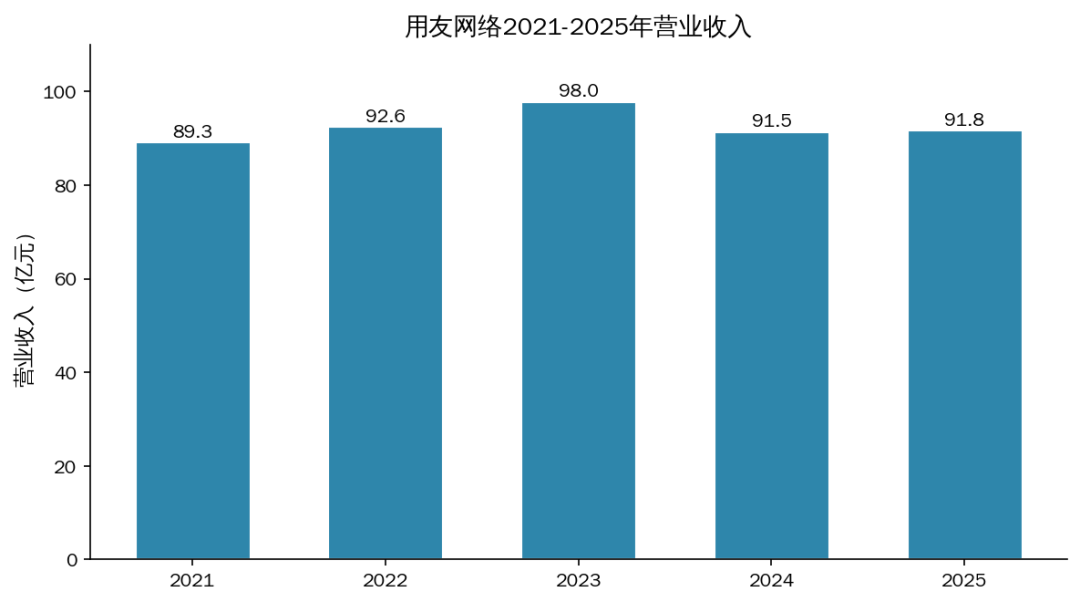
Yonyou Network released its 2025 annual report, revealing a revenue of 9.182 billion yuan, a slight year-on-year increase of 0.32%. The net profit attributable to shareholders stood at -1.389 billion yuan, marking a reduction in losses by 672 million yuan year-on-year. Net profit after non-recurring gains and losses was -1.597 billion yuan, a decrease in losses by 441 million yuan year-on-year. Net cash flow from operating activities reached 812 million yuan, a significant year-on-year surge of 396%, turning positive. Selling expenses declined to 2.443 billion yuan, while administrative expenses dropped to 1.075 billion yuan. AI-related contract signings amounted to 1.67 billion yuan, reflecting a substantial year-on-year increase.
Data source: iFind
One set of data, two contrasting trends.
Revenue fluctuates marginally at the massive scale of 9.1 billion yuan, while profits have been in the red for three consecutive years, albeit with a significant narrowing of the loss margin. Cash flow has transitioned from heavily indebted to positive inflow, accompanied by noticeable contractions in expenses. However, the AI business exhibits a "spark-like" growth trajectory.
This peculiar scenario of stalled growth coexisting with marginal improvement encapsulates the transformational pain Yonyou Network is enduring, as well as a portrayal of the domestic ERP industry's survival in the AI era. 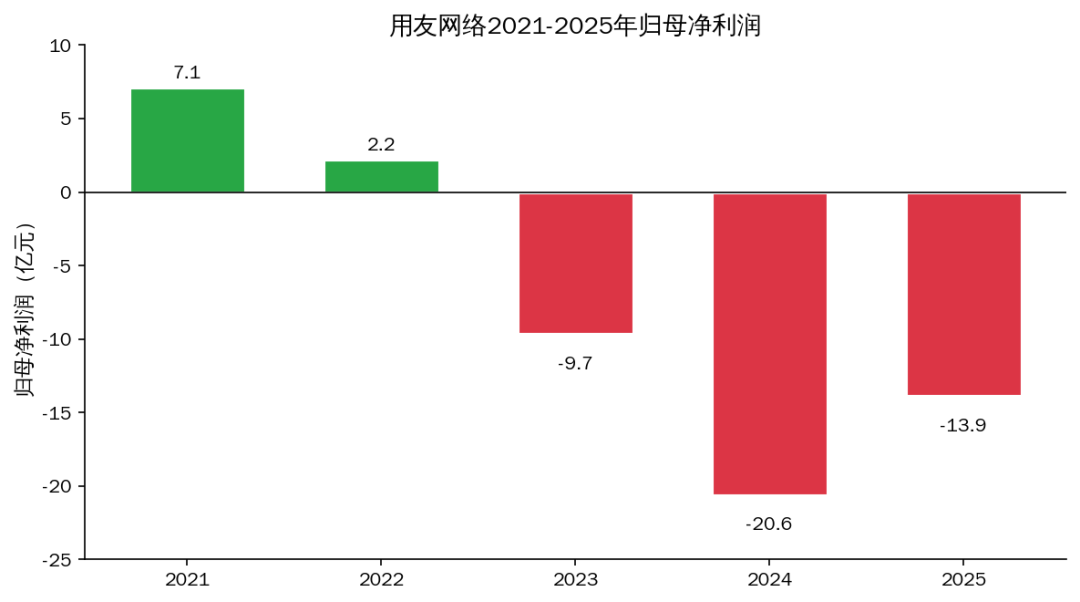
Data source: iFind
Under the triple pressure of three consecutive years of losses, intensifying industry competition, and encirclement by international giants, can Yonyou Network truly rebound against the odds with the aid of AI? Can this leading domestic ERP company prevail in this AI breakthrough battle?
A crucial point is that the net profit after non-recurring gains and losses in 2025 was -1.597 billion yuan, a year-on-year reduction in losses by 21.6%, indicating that the profit improvement is not merely a one-time gain from non-recurring items but a genuine recovery in the profitability of the main business.
The contraction in expenses is the primary reason for the reduction in losses. In 2025, selling expenses were 2.443 billion yuan, a year-on-year decrease of 6.8%. Administrative expenses were 1.075 billion yuan, a year-on-year decrease of 12.0%. The combined savings of approximately 325 million yuan from these two expenses directly contributed to the profit improvement.
However, it's essential to note that expense contraction involves subtraction, not addition, and the quality of this profit improvement remains to be verified. If revenue growth stagnates and there's limited room for further expense reductions, the question of where future loss reductions will originate must be addressed.
2
Cloud Services and Product Licensing
Yonyou Network's business segment structure is relatively straightforward, with cloud and software businesses dominating.
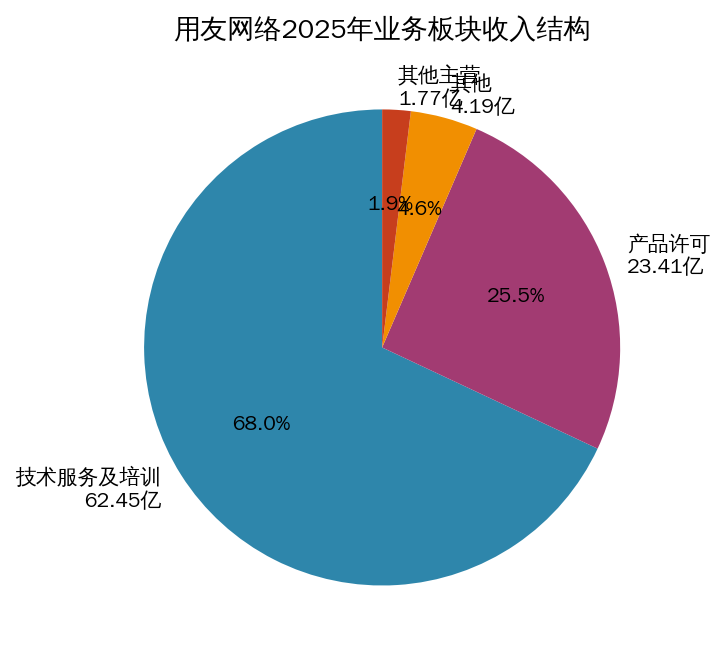
In 2025, revenue from cloud and software businesses was 9.005 billion yuan, accounting for 98.07%, with a gross profit margin of 50.40%. Among this, technical services and training generated revenue of 6.245 billion yuan, accounting for 68.02%, with a gross profit margin of 33.54%.
Revenue from product licensing was 2.341 billion yuan, accounting for 25.49%, with a gross profit margin of 93.35%, making it a cash cow business with a relatively small scale but extremely strong profitability.
Data source: iFind
From a year-on-year perspective, revenue from technical services and training increased by 10.3%, with a gross profit margin improvement of 9.4 percentage points, making it the biggest highlight of 2025.
This indicates that the company has made strides in the cloud service subscription model, with enhanced customer renewal capabilities. However, revenue from product licensing decreased by 19.5% year-on-year, a signal worthy of vigilance.
Product licensing represents the traditional software licensing model, and its revenue decline reflects the market's transition from one-time sales to a subscription model, as well as Yonyou Network's own strategic transformation.
In terms of regional distribution, revenue within China was 8.701 billion yuan, accounting for 94.76%, with a gross profit margin of 50.70%. Revenue outside China was 304 million yuan, accounting for 3.31%, with a gross profit margin of 41.91%, a significant year-on-year increase of 39.4%.
This is one of the brightest growth points of 2025. The "rebound against the odds" in overseas business reflects Yonyou Network's breakthroughs in markets such as Southeast Asia, the Middle East, and Africa.
3
800 Million Yuan Cash Flow Turns Positive
In 2025, Yonyou Network's net cash flow from operating activities was 812 million yuan, a significant year-on-year increase of 396%, turning from negative in 2024 (-274 million yuan) to positive, the most surprising change among all financial indicators. 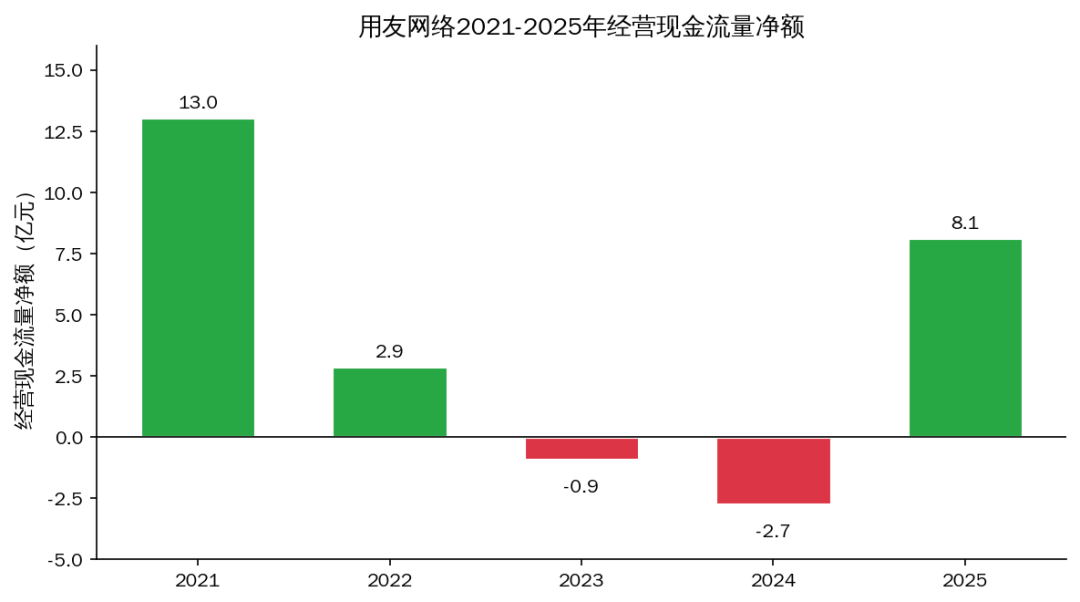
Data source: iFind
A breakdown of the data reveals that the positive cash flow mainly stems from two factors.
First, sales collections were 9.897 billion yuan, basically matching revenue, indicating that customers' payment capabilities have not deteriorated.
Second, the contraction in expense payments directly released cash. In particular, administrative expenses decreased from 1.221 billion yuan to 1.075 billion yuan, and selling expenses decreased from 2.622 billion yuan to 2.443 billion yuan. The combined cash savings from these reductions directly translated into improved operating cash flow.
However, the improvement in cash flow cannot obscure all problems. At the end of 2025, accounts receivable were 2.280 billion yuan, and cash was 379 million yuan, totaling 2.659 billion yuan, accounting for 29% of annual revenue. Although accounts receivable decreased from 2.422 billion yuan in 2024, the absolute scale is still significant.
More critically, investment cash outflows were 1.347 billion yuan, with significant payments for the purchase of fixed assets and intangible assets, indicating that the company is still stockpiling ammunition for the next round of growth. Financing cash outflows were 2.003 billion yuan, mainly for repaying loans and interest payments.
4
AI Strategy: The Evolution of Domestic ERP Behind 1.67 Billion Yuan in AI Contracts
In 2025, the global software industry is undergoing a profound transformation, with the explosion of AI large models serving as the strongest catalyst for this change.
Giants such as OpenAI, Anthropic, Google, Baidu, and Alibaba in China are all intensifying their research and development of large models, with enterprise-level applications transitioning from conceptual verification to commercialization. In this transformation, Yonyou Network's role is undergoing a qualitative change.
In 2025, Yonyou Network signed AI-related contracts worth 1.67 billion yuan. The company's foray into the AI field primarily encompasses two directions.
One is the YonGPT enterprise large model, which infuses AI capabilities into various facets of enterprise management, such as intelligent reporting, intelligent forecasting, and intelligent customer service.
The other is the digital and intelligent foundation BIP (Business Innovation Platform), serving as the base connecting enterprise business with AI capabilities.
From the perspective of practical application scenarios, the implementation of AI in enterprise-level ERP is accelerating.
In financial management, AI can automatically recognize invoices, aggregate expenses, and generate reports, transforming accountants from "data entry clerks" to "auditors".
In supply chain management, AI can predict inventory needs, optimize procurement plans, and warn of supply risks, transforming procurement from "experience-driven" to "data-driven".
In human resources management, AI can screen resumes, match positions, and predict employee turnover rates, transforming HR from "administrative work" to "strategic work".
This series of scenario-based parallels unveils the infinite possibilities of AI in enterprise services.
However, challenges are also significant.
Some investors have questioned whether Anthropic's Claude series AI and intelligent agent technologies have already formed a disruptive impact on traditional enterprise service software. Yonyou Network responded by stating that its BIP possesses five major competitive advantages, and it will achieve catch-up through industry knowledge in the AI wave.
These five advantages are deep industry knowledge accumulation, decades of customer trust, a complete product system, massive data assets, and rich industry scenarios.
These so-called competitive advantages don't seem particularly convincing to me. AI could dismantle these barriers almost effortlessly. Let the market decide.
-END-
Disclaimer: This article is based on the public company attributes of listed companies and the information disclosed by them in accordance with their legal obligations (including but not limited to interim announcements, periodic reports, and official interaction platforms) as the core basis for analysis and research. Shiyu Xingkong strives for fairness in the content and viewpoints presented in the article but does not guarantee its accuracy, completeness, or timeliness. The information or opinions expressed in this article do not constitute any investment advice, and Shiyu Xingkong is not responsible for any actions taken based on this article. Copyright Notice: The content of this article is original to Shiyu Xingkong and may not be reproduced without authorization.
-
![]()
Wang Huiwen, Former Meituan Executive, Achieves 20-Fold ROI, Supports 24 AI Startups
-
![]()
Another AI Computing Power Unicorn Launches IPO! Founded by a Changjiang Scholar
-
![]()
OFILM Holdings Secures Zhongke Daojing, Marking a Significant Leap in the Optical Communication Industry!
-
What Will Be the Next Key Battleground for Large Models After AI Coding?
-
![]()
Leapmotor's Sales Soar, Yet Hidden Concerns Loom
-
![]()
China’s Action Camera Market Soars: 3.12 Million Units Sold in Six Months, DJI Secures 74% Dominance
-
![]()
Zhang Yiming: Strategic Retreat as a Path Forward
-
![]()
Exploring Charging for Some Features of QianWen App: Can It Follow the Path of Doubao?