Industry Insight: Why Have Robots Suddenly Outpaced Humans in Just a Year?
 04/22 2026
 559
559
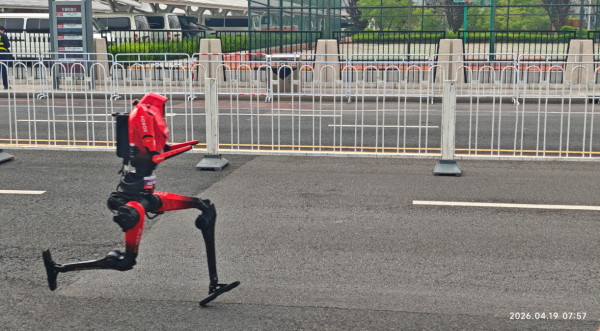
On April 19, at the Beijing Yizhuang Half Marathon, Honor's self-developed humanoid robot "Lightning" crossed the finish line with a net time of 50 minutes and 26 seconds. This performance surpassed the 57-minute and 20-second world record for the men's half marathon set by Ugandan star Jacob Kiplimo at the Lisbon Half Marathon in March this year, finishing nearly 7 minutes faster.
Rewinding to a year ago, the inaugural Yizhuang Humanoid Robot Half Marathon presented a starkly different scene. Back then, the champion robot "Tiangong Ultra" completed the race in 2 hours, 40 minutes, and 42 seconds, entirely reliant on remote control by technicians following alongside. Frequent stumbles and deviations from the course were common, with a completion rate of less than 30%. A year later, the event's scale expanded nearly fivefold, with 102 teams participating and 47 finishing, nearly 40% of whom competed in autonomous navigation mode.
From 2 hours and 40 minutes to 50 minutes and 26 seconds, the time was shortened by nearly 110 minutes within a year, even surpassing the human world record. This is not just a leap in speed but signifies that humanoid robots have crossed a critical threshold in core technologies such as motion control, autonomous navigation, endurance, heat dissipation, and overall engineering.
Zijin Finance's questions naturally arise: What exactly happened to embodied AI over this past year? Why did it suddenly accelerate? After winning on the racecourse, can these robots truly achieve a viable commercial closed loop (closed loop)?
What Advancements Has Embodied AI Made in the Past Year?
A year ago, robots running marathons resembled "toddlers taking their first steps"—stiff gaits, unstable centers of gravity, and frequent falls. Most participating robots relied on technicians following behind for remote control, with deviations and dropouts being commonplace. This year, the champion "Lightning" demonstrated a near-human running posture over the 21-kilometer course, with stable stride frequency, smooth movements, and even the ability to execute high-speed turns while leaning.
The fact that a robot can continuously run 21 kilometers essentially means it has crossed the threshold of occasional success and is approaching replicable, stable, and engineering-ready capabilities.
Zhao Mingguo, a researcher at Tsinghua University's Department of Automation, pointed out: "The ability of an autonomously navigating robot to complete the race marks significant progress compared to last year. This is primarily the result of the humanoid robot industry focusing on stability over the past year, optimizing hardware, software, and algorithms."
The first breakthrough lies in the dual advancements of dynamic balance algorithms and high-power joint drive technology. During high-speed running, joints must withstand high-frequency reciprocating motions, while the main structure must balance lightweight design with high rigidity. Critical connection points must minimize wear, ensure precision, and support overall durability—a comprehensive test of the robot's engineering capabilities.
If last year's competition tested whether "robots could finish the race," this year's event examined whether "robots could finish it autonomously." The event rules explicitly set the weighted coefficient for the autonomous navigation group at 1.0, compared to 1.2 for the remotely controlled group, encouraging the development of autonomous technologies through policy guidance.
"Autonomous running" means the robot must independently handle localization, path planning, motion control, and real-time decision-making in a 21-kilometer open urban environment. For embodied AI, this shift from pre-programmed actions to autonomous closed-loop control is more critical than mere speed improvements, as commercial applications demand robots that can complete tasks despite disturbances—not just performative demonstrations.
Meanwhile, endurance has seen noticeable progress. Last year, due to limitations in battery energy density and motor efficiency, most teams needed frequent battery swaps or recharges, with robots stopping every few kilometers. This year, the champion team completed the 21-kilometer course with just one battery swap, marking a qualitative improvement in energy management systems and core motor efficiency.
The leap in endurance also relies on advancements in heat dissipation technology. Long-distance outdoor running generates significant heat, which traditional cooling solutions struggle to manage. Reportedly, Honor's team behind the champion "Lightning" adapted proven liquid cooling technology from the smartphone industry to robots, solving heat dissipation challenges in high-temperature environments and ensuring stable operation during high-speed runs.
Of course, the humanoid robot's ability to outpace humans is also the result of the coevolution (synergistic evolution) of its "brain + cerebellum + body." A shortcoming (weakness) in any of these three components would collapse the robot's overall performance. The robot marathon this year demonstrates that humanoid robots have achieved systemic performance improvements.
Why Did Embodied AI Suddenly Accelerate This Year?
If the speed improvements on the racecourse are the result, Zijin Finance believes the primary cause lies in policy support. 2025 marked a year of "concentrated policy implementation" for embodied AI. In March last year, high-level reports mentioned "embodied AI" and "intelligent robots" for the first time, and the 15th Five-Year Plan explicitly listed robots as a strategic emerging industry.
In 2026, proposals were further made to "establish a growth and risk-sharing mechanism for future industry investments," continuing to prioritize embodied AI as a key future industry direction. Embodied AI is no longer just a technological trend but has been integrated into the national future industry framework, entering a track with "clear direction, goals, and resource allocation."
Local governments are also accelerating their layout (deployment). Twenty provinces, including Zhejiang and Guangdong, have successively issued policy documents on future industries, focusing on humanoid robots and other key sectors to accelerate industrial incubation and implementation.
For emerging industries to transition from chaos to order, standardization systems are critical infrastructure. Starting in 2025, a series of national standards for humanoid robot technical requirements were approved, covering environmental perception, decision-making, motion control, and operational tasks.
In February 2026, the "Humanoid Robots and Embodied AI Standard System (2026 Edition)" was released—China's first top-level standard design covering the entire industrial chain and lifecycle, encompassing six major sections: foundational commonalities, brain-inspired and intelligent computing, limbs and components, overall systems, applications, and safety ethics.
From fragmented corporate efforts to a preliminary standardized system, the industrial ecosystem's level of standardization (standardization) has achieved a qualitative leap over the past year.
The improvement of policies and standards has created conditions for accelerated capital and industrial chain integration. In the first quarter of 2026, the domestic embodied AI sector disclosed over 50 financing deals, with a cumulative funding volume of approximately 20 billion yuan, a nearly 60% year-on-year increase. On March 2 alone, financing reached 3.8 billion yuan, with Galaxy General Robotics and Songyan Dynamics securing 2.5 billion yuan and nearly 1 billion yuan, respectively. Backers included "national team" capital and industrial giants such as the National Artificial Intelligence Industry Fund, Sinopec, and CITIC Group Investment Holdings.
As capital accelerates its influx, the localization of core components is also picking up pace. Take harmonic reducers as an example: over 30 domestic manufacturers now exist, and by the end of 2025, the localization rate of domestic harmonic reducers reached 55%, a leap from the previously stagnant level below 30%.
Over the past year, the acceleration of embodied AI has been the result of synchronized efforts across policy, standards, capital, and the industrial chain. When an industry simultaneously benefits from top-down institutional support and bottom-up market forces, acceleration naturally follows.
The True Test for Embodied AI Lies in Commercialization
But races are, after all, just races. The 50 minutes on the track address whether robots can perform under extreme conditions, while the business world truly cares about whether they can consistently create value across repetitive scenarios.
In this sense, the marathon serves as a stress test, proving that robots' stability, autonomy, and overall capabilities are improving. However, commercial scenarios present far more complex challenges—not running a fixed course but entering factories, warehouses, supermarkets, and homes, facing random disturbances, irregular objects, human-robot collaboration, safety responsibilities, and cost constraints, all of which pose stricter demands.
Industrial settings are considered the most realistic breakthrough point for humanoid robot commercialization. Compared to highly non-standardized home environments, factory and warehousing scenarios offer clear task objectives and relatively stable processes, making it easier for companies to concentrate data, computing power, and hardware resources.
However, from actual implementation, significant gaps remain before scaling (scalability) can be achieved. In standardized industrial scenarios such as automotive manufacturing and 3C sorting, leading companies' humanoid robots achieve 65% to 75% efficiency compared to skilled human workers for single-workstation tasks, and over 80% for simple repetitive handling tasks. However, the industry average hovers around 40% to 50% of human efficiency, especially struggling to meet demands in non-standardized complex tasks. Numerous challenges remain:
First is the cost challenge. Despite some domestically produced humanoid robots seeing unit prices drop below 200,000 yuan, they still lack clear cost advantages over human labor. Based on current comprehensive labor costs for frontline manufacturing workers, the static investment payback period for a 200,000-yuan robot stretches to 4–5 years, far exceeding the acceptable 2-year threshold for enterprises.
Second is the efficiency challenge. Current humanoid robots still rely heavily on experimental data accumulation, lacking a large-scale, self-reinforcing cycle. Additionally, improvements are needed in yield rates, fault rates, maintenance times, and stable operation cycles.
Third is the safety challenge. As of the first quarter of 2026, core national standards for humanoid robots in areas such as interfaces, communication, safety, and testing remain in the draft stage. In industrial settings, safety norms for human-robot collaboration are not yet unified, with unclear responsibility boundaries. As human-robot collaboration becomes increasingly intimate, safety issues may become a critical variable restricting commercialization.
Conclusion
In just one year, humanoid robots have outpaced humans. This demonstrates their ability to complete complex tasks autonomously, continuously, and over extended periods. This victory is not just about speed but the result of synchronized efforts across technology, policy, and industry.
Today, embodied AI has completed the first half of its journey from concept to reality. The second half requires answering not how fast it can run but how much value it can create. Can costs be reduced? Can efficiency be improved? Can safety be maintained? These questions will determine whether it can truly "run" into thousands of households.
The real marathon has only just begun!
-
![]()
Wang Huiwen, Former Meituan Executive, Achieves 20-Fold ROI, Supports 24 AI Startups
-
![]()
Another AI Computing Power Unicorn Launches IPO! Founded by a Changjiang Scholar
-
![]()
OFILM Holdings Secures Zhongke Daojing, Marking a Significant Leap in the Optical Communication Industry!
-
What Will Be the Next Key Battleground for Large Models After AI Coding?
-
![]()
Leapmotor's Sales Soar, Yet Hidden Concerns Loom
-
![]()
China’s Action Camera Market Soars: 3.12 Million Units Sold in Six Months, DJI Secures 74% Dominance
-
![]()
Zhang Yiming: Strategic Retreat as a Path Forward
-
![]()
Exploring Charging for Some Features of QianWen App: Can It Follow the Path of Doubao?