Figure AI Delivers Over 350 Units: Will It Keep Pace with Tesla to Usher in the 'iPhone Moment'?
 05/06 2026
 647
647

Produced by Zhineng Technology
The first quarter of 2026 has been a lively period for the humanoid robot industry: while Tesla's Optimus Gen3 faced delays, Chinese humanoid robots have been busy with demonstrations and marathons.
Standing at the crossroads of the robotics industry, Brett Adcock, founder of Figure AI, posed a provocative vision to 500 engineers at the Sunnyvale headquarters: to have more robots walking around the campus than humans.
With recent deliveries of Figure 03 surpassing 350 units and production capacity soaring from 'one per day' to 'one per hour,' can Figure truly deliver?

Tesla's journey from the Model S to the Model 3 validated the scalability of electric vehicles. Can humanoid robots follow a similar path, entering an industrial flywheel of 'mass production—data—evolution'? If so, humanoid robots could become a continuously growing intelligent system.
01
Evolution of Humanoid Robots: Balancing Performance and Mass Production Costs
In 2022, Figure 01 was still a scientific apparatus with 'Frankenstein'-like rough forearms.
To expedite R&D, Figure even forcibly adapted foot motors for wrist use, resulting in awkwardly bent forearms. At that stage, the focus was on achieving mobility, with each unit costing hundreds of thousands of dollars.
Subsequently, Figure 02 achieved integration: batteries were tucked into the torso, computing power tripled, and around 50 units were deployed globally.
It could already participate in BMW factory assembly of the X3, but its complex structure and expensive CNC processes hindered large-scale adoption.
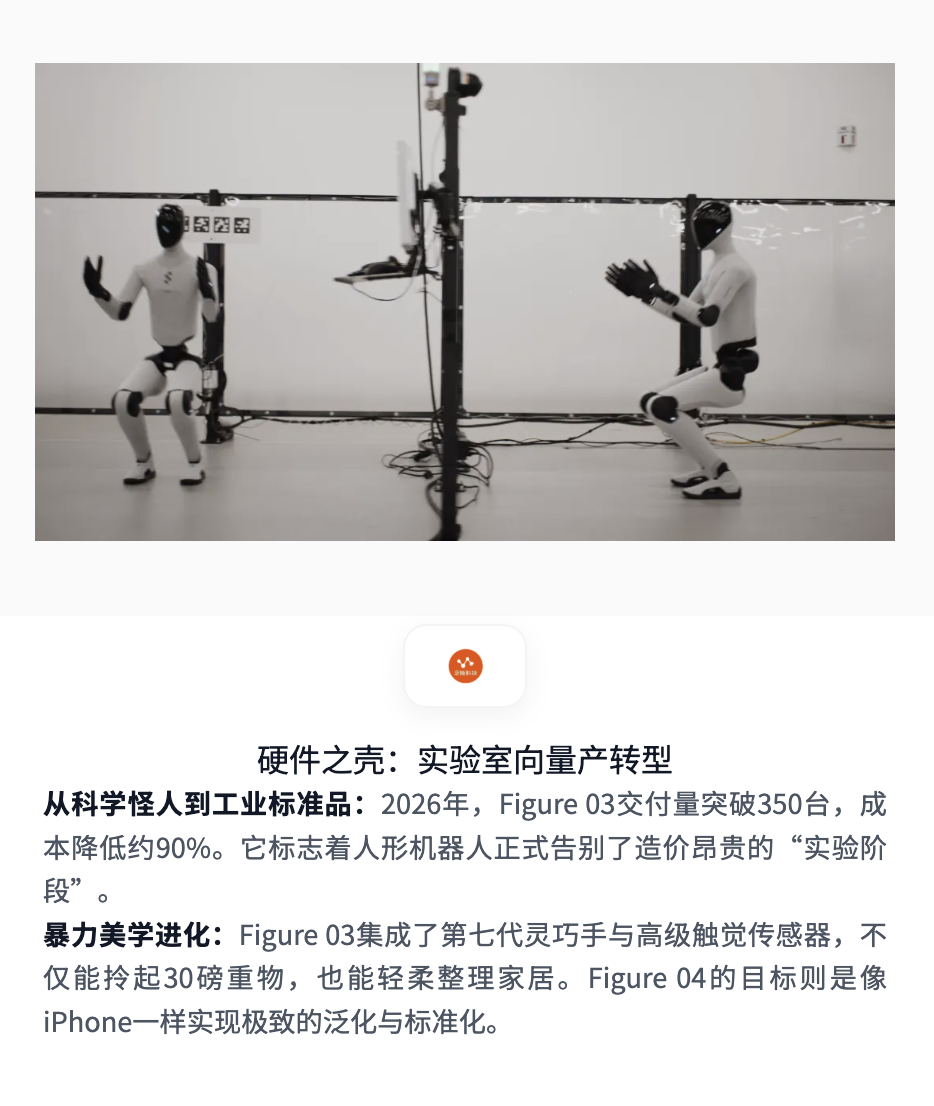
The emergence of Figure 03 marks the transformation of Europe and America -made humanoid robots from 'laboratory luxuries' to affordable 'industrial standards.'
Key factors include cost reduction and performance optimization. By optimizing the supply chain and simplifying manufacturing processes, Figure 03's costs are about 90% lower than its predecessor. The seventh-generation dexterous hand integrates advanced tactile sensors, enabling it to lift 30-pound boxes and demonstrate gentle home organization at the White House.
Figure 04, in its final design stages, holds high hopes from Brett.
If the first three generations addressed 'existence' and 'reliability,' Figure 04 aims for ultimate generalization and standardization, akin to the iPhone's impact on smartphones in 2007.
02
Helix 02 and 'Never-Falling' Robustness
While hardware forms the body, the Helix 02 VLA (Vision-Language-Action) all-purpose model is Figure's soul. Figure has taken the most challenging yet correct path: completely abandoning traditional handwritten C++ control code.
Traditional robot control logic (e.g., inverted pendulum models) is extremely fragile in unstructured environments.
Helix 02 achieves full-stack neural network control through nearly one million hours of training data, enabling robots to infer pixel space in real-time via onboard GPUs, understand their environment, and output torque.
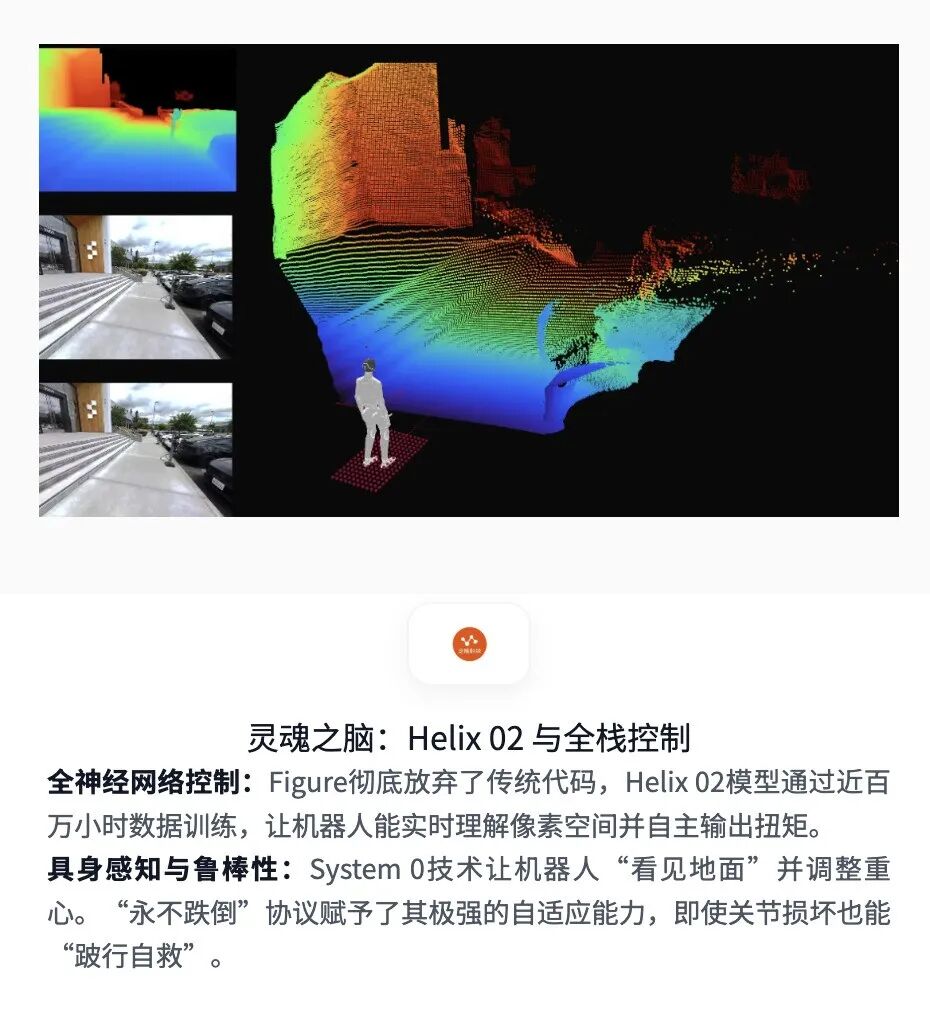
The latest System 0 (S0) technology evolves robots from 'feeling the ground' to 'seeing the ground.' The head-mounted RGB camera elevates images into real-time 3D spatial representations, allowing robots to adjust their center of gravity naturally on stairs or ramps, much like humans.
Core reasoning occurs on the torso's onboard GPU, enabling autonomous dishwashing at night without internet connectivity, ensuring absolute privacy in home environments. Falls are a 'death sentence' for humanoid robots.
Figure's Vulcan project utilizes reinforcement learning to grant robots exceptional adaptive capabilities. Even in extreme tests involving human pushes or single-knee joint lockups, robots can intelligently adjust their center of gravity to 'limp to safety' and return to maintenance areas autonomously. This industrial-grade resilience forms the technical foundation for 24/7 'unattended' operations.
03
The Manufacturing Source: The Flywheel Effect of the BotQ Factory
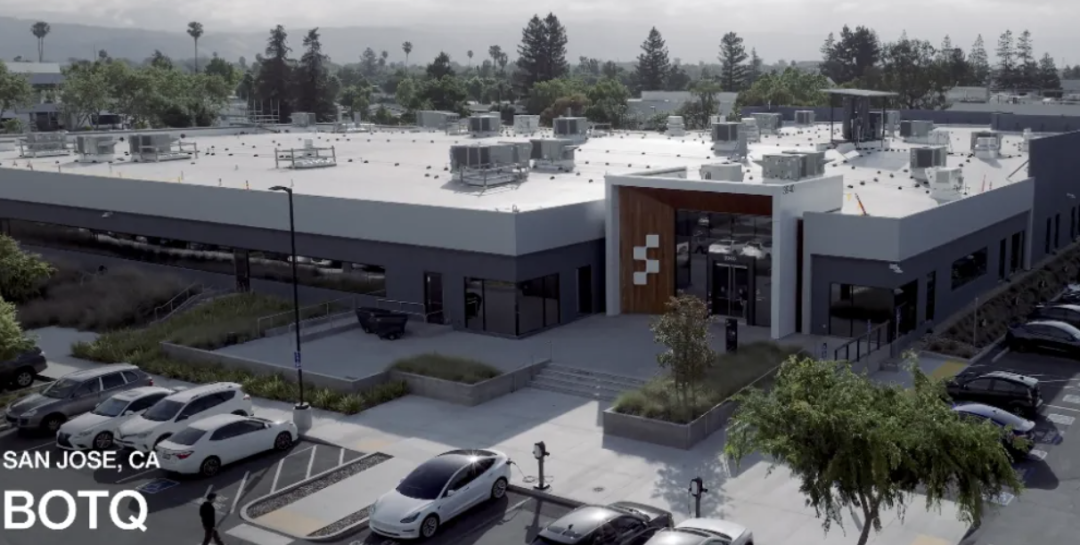
Ramping up production capacity is a 'death trap' for all hardware startups, and Figure is attempting to bypass this chasm through the BotQ manufacturing factory.
In under 120 days, Figure increased production capacity by 24 times, achieving one unit per hour. Although weekly output is temporarily capped at around 55 units due to the absence of three-shift operations, production line yield has undergone a qualitative transformation: final assembly line pass rates have risen to over 80%, and battery pack yields reach 99.3%.
The 2.25kWh battery pack features structural load-bearing capabilities and rigorous thermal runaway protection, ensuring 'no fire, no spread' even in extreme fall scenarios.
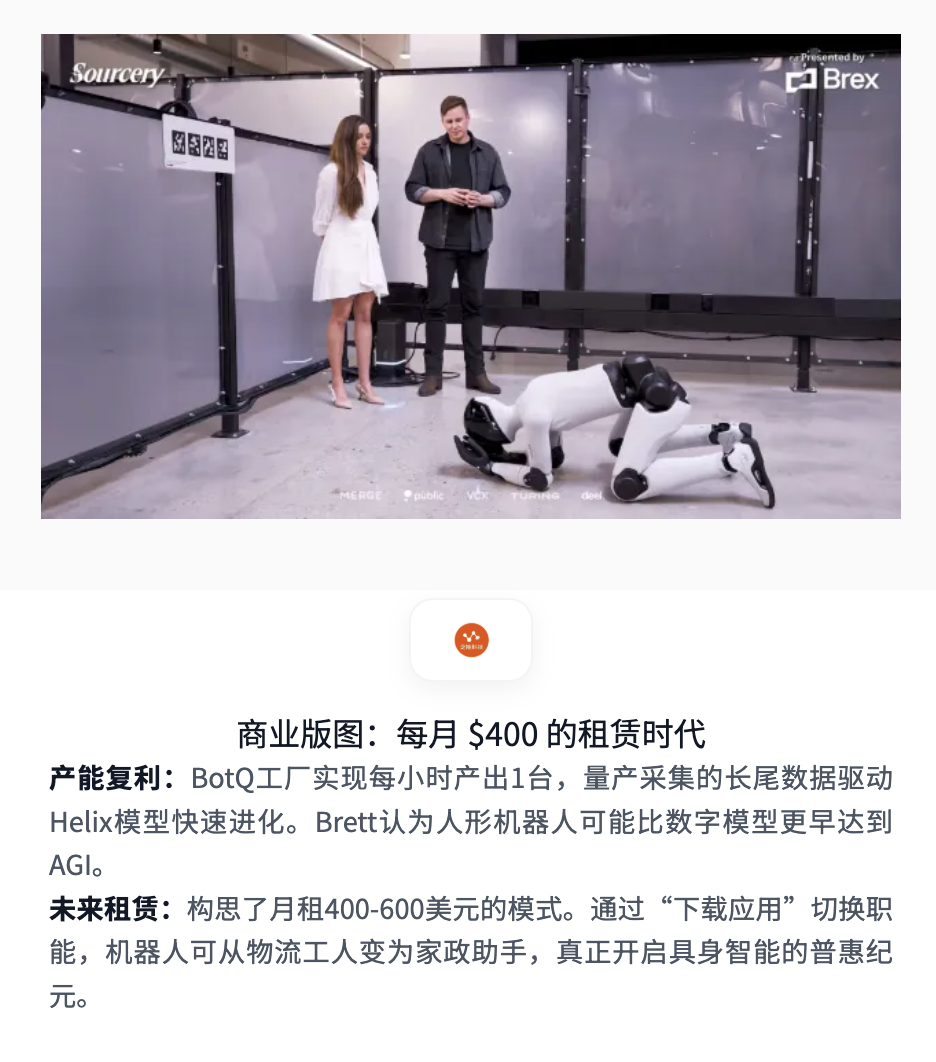
For Figure, mass production supports sales and enables data collection.
Most of the over 350 robots rolled off the BotQ line have been deployed for internal R&D and real-world scenario testing. More robots mean more real-world data, which feeds back into the Helix model, strengthening it and enhancing the hardware's commercial value. This forms an 'intelligence flywheel' that is difficult for latecomers to catch up with once initiated.
Brett Adcock maintains a highly pragmatic approach to commercialization: humanoid robots must be cheaper than human labor.
Figure envisions a business model akin to car leasing for home rental:
◎ Price Point: Monthly rent of $400-600.
◎ Deployment Cost: Requires only a 2ft × 2ft charging space.
◎ 24/7 Collaboration: Paired with 2kW foot-mounted wireless inductive charging and a 30-second hot-swappable battery replacement mechanism, users gain a tireless home assistant.
From assembling parts at BMW factories to sorting packages in logistics warehouses and tidying living rooms at home, Figure's robots can switch functions by 'downloading apps' thanks to interoperable fleet algorithm capabilities, forming a universal platform.
Figure's core philosophical belief is that physical world data is the final piece of the AGI puzzle.
While pure digital models (e.g., LLMs) are knowledgeable, they lack 'pain perception' and cannot understand causality through touching the world. Humanoid robots may reach AGI sooner than digital models because human intelligence stems from interacting with unstructured environments.
Globally, while Unitree Technology and Zhiyuan Robotics temporarily lead in mass production volume (thousands of units), Figure's barriers lie in the depth of its full-stack neural networks and the maturity of its Fleet Management System (FMS).
Tesla Optimus is frantically retrofitting production lines at its Fremont factory, aiming for annual production in the millions. Figure, having delivered 350 units and accumulating end-to-end data, intends to keep pace with Tesla for a while—whether it ends up like Fisker remains to be seen.
Summary
Figure's ultimate blueprint is captivating: a dark factory where robots manufacture robots, assemble themselves, walk into packaging boxes, and are loaded onto trucks by another group of robots.
-
![]()
Tesla Restructures Its Balance Sheet
-
![]()
Accelerating the High-Speed Interconnection Upgrade of AI Computing Clusters! JONHON Releases ELSFP External Light Source Optical Connectors
-
![]()
Breaking the overseas blockade of volumetric holographic materials, this optical enterprise secures nearly 100 million yuan in financing!
-
![]()
Why Does Jensen Huang So Openly Praise China’s AI?
-
![]()
"Wudang" Unveiled: Arm China's Next-Gen AI VPU Redefines Video Encoding
-
![]()
From Energy Conservation and Carbon Reduction to AI Decision-Making: GECON East Intelligence and Chery Group Explore a New Green and Smart Paradigm for Automobile Manufacturing
-
![]()
WAIC 2026 Observation | AI Accelerates Towards the Core of Industries, Industrial AI Enters a Critical Phase
-
![]()
Volkswagen China Fires the First Shot in Foreign-Funded 'White Box Delivery'!