Where is Roborock Headed and Where is Ecovacs Going? Is the Business of Robot Vacuum Cleaners Still Promising?
 05/06 2026
 383
383

By the end of 2025, iRobot, the pioneer of robot vacuum cleaners, went bankrupt and subsequently became a subsidiary of a Chinese contract manufacturer.
It is worth noting that during its heyday, iRobot once held an 80% share of the global market.
The company's bankruptcy does not indicate a problem with the market.
According to IDC, global shipments of household cleaning robots reached 32.72 million units in 2025, a significant year-over-year increase of 20.1%.
Chinese brands dominated the top five positions globally, collectively capturing a 70.4% market share.
Among them, Roborock ranked first with a 17.7% share and an impressive year-over-year increase of 76.5%.
Ecovacs ranked second with a 14.3% share, but its growth rate was only half that of Roborock's.
With the rapid rise of artificial intelligence, humanoid robots have become a sensation online, and new technological products are emerging endlessly. The once cutting-edge robot vacuum cleaners seem to have been overshadowed.

Image Source: AI
Coincidentally, Roborock, the industry leader, and Ecovacs, the runner-up, both released their 2025 financial reports and Q1 2026 financial reports.
Let's examine whether robot vacuum cleaners remain a lucrative business based on these financial reports.
01
Who is Growing and Who is Losing Momentum?
Let's first look at the full-year data for 2025.
Roborock's revenue reached RMB 18.695 billion, a significant year-over-year increase of 56.51%. However, its net profit attributable to shareholders plummeted by 31.03% year-over-year to RMB 1.363 billion.
In contrast, Ecovacs' revenue reached RMB 19.040 billion, a year-over-year increase of 15.10%. Its net profit attributable to shareholders surged by 118.13% year-over-year to RMB 1.758 billion.
Based solely on these core figures, Ecovacs, with its steady revenue growth and substantial profit increase, appears to outperform Roborock, which saw revenue growth without corresponding profit increases.
Now, let's examine the data for the first quarter of 2026.
Roborock's revenue was RMB 4.227 billion, a year-over-year increase of 23.31%. Its net profit attributable to shareholders reached RMB 323 million, a year-over-year increase of 20.83%.
Ecovacs' revenue was RMB 4.902 billion, a year-over-year increase of 27.06%. However, its net profit attributable to shareholders was RMB 405 million, a year-over-year decrease of 14.73%.
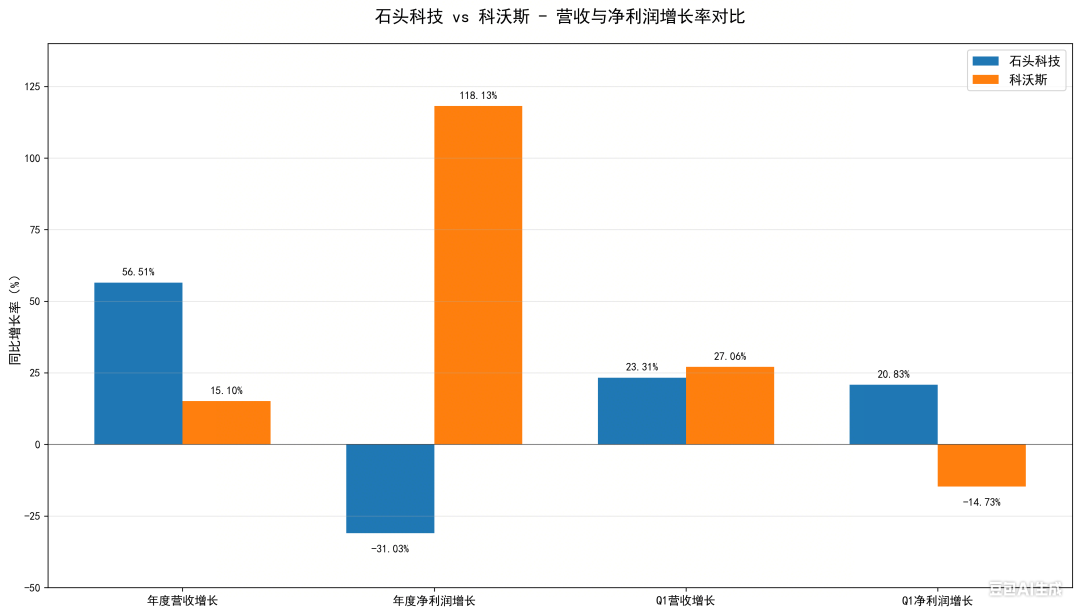
Image Source: AI
Comparing these figures may lead to different conclusions.
When we consider the period from the entire year of 2025 to the end of the first quarter of 2026, the gap between the two companies in terms of core data is not significant, with Ecovacs having higher revenue and profit than Roborock.
What are the two companies focusing on behind these core figures?
02
Roborock: Sacrificing Profits for Market Share
In its 2025 financial report, Roborock's net profit attributable to shareholders plummeted by 31.03% year-over-year.
The company attributed this significant decline to "phased investments in business expansion" in its financial report.
These investments involved, firstly, expanding the coverage of robot vacuum cleaners and floor washers across all price ranges, which temporarily put pressure on the overall gross profit margin.
In the financial report, the gross profit margin of the main business in 2025 was 42.38%, a year-over-year decrease of 7.98%.
Behind this, Roborock expanded from the high-end market to the mid-to-low-end market, with the sales volume in the mid-to-low-end market increasing to 55% of the total.
On the other hand, the company continuously invested in researching and developing new products.
In 2025, Roborock released a smart robot vacuum cleaner equipped with a five-axis folding bionic robotic arm.
In January 2026, Roborock launched another robot featuring a dual-wheel-leg structure capable of climbing stairs while cleaning.
To achieve this, they also increased their investment in research and development.
In 2025, R&D investment reached RMB 1.420 billion, a year-over-year increase of 46.13%, accounting for 7.59% of revenue. The number of R&D personnel reached 1,481, a year-over-year increase of 41.99%. Such aggressive investment is indeed rare.
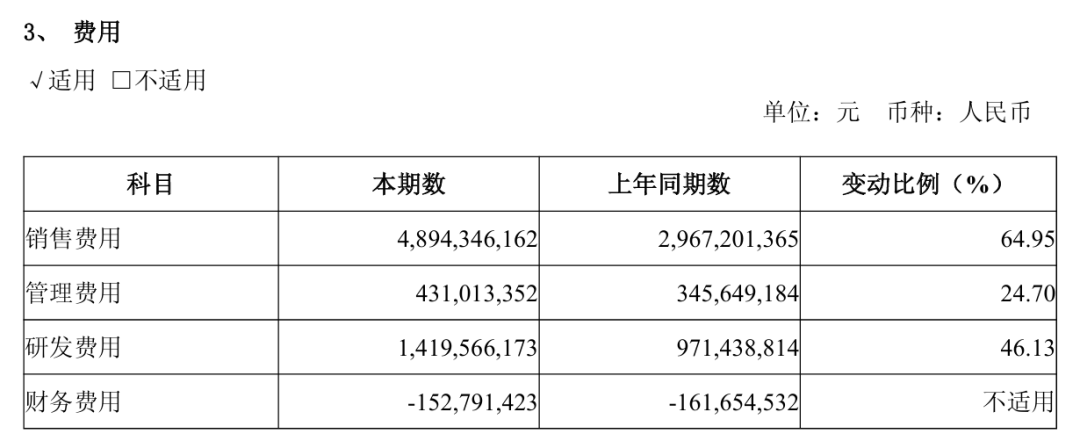
Image Source: Roborock's Financial Report
Secondly, Roborock strengthened its brand and channel expansion, particularly in overseas markets.
In 2025, Roborock's selling expenses reached RMB 4.894 billion, a year-over-year increase of 64.95%, outpacing revenue growth.
This was driven by Roborock's many years (multi-year) overseas expansion, shifting from a reliance on e-commerce channels like Amazon to a Collaborative efforts (synergistic approach) combining both online and offline efforts.
During the reporting period, Roborock rapidly entered channels such as Target, Costco, Sam's Club, and Walmart in North America, as well as MediaMarkt and Carrefour in Europe.
Due to significant investments in new products, technology, and sales and service channels, Roborock's global market growth rate in 2025 was twice that of Ecovacs, securing the top position in global robot vacuum cleaner sales volume and value for two consecutive years.
After substantial investments in 2025, Roborock's profit performance rebounded in the first quarter of 2026.
Huatai Securities even predicts that net profit will reach RMB 2.186 billion this year, with a year-over-year growth rate exceeding 60%.
From this perspective, Roborock chose to increase investments in the short term to enhance its leading position, sacrificing short-term profits for long-term market influence.
Even though short-term investments affected profits, Roborock still maintains a leading market position.
03
Ecovacs: Opting for Stability but Lacking Momentum
Ecovacs' 2025 data was impressive, with net profit doubling.
In contrast, the first quarter saw revenue growth without corresponding profit increases. Why is this the case?
In fact, Ecovacs' issues can be traced back to 2021 when founder Qian Dongqi handed over control to his 28-year-old son, Qian Cheng, who holds three key positions: Vice Chairman, CEO of the Ecovacs brand, and General Manager of the listed company.
Under Qian Cheng's leadership, Ecovacs focused on mid-to-high-end robot vacuum cleaner models, allowing Xiaomi, Roborock, and Dreame to capture the mid-to-low-end market.
In 2021, Ecovacs held a 43.5% online market share and an 86.6% offline market share in the domestic market. Today, it has become the industry's runner-up.
From 2021 to 2024, Ecovacs prioritized marketing over R&D, spending a cumulative RMB 17.7 billion on selling expenses, nearly six times its R&D expenditure.
Its overseas revenue also relied heavily on agency models, and faced with aggressive competition from Roborock, its overseas revenue was surpassed.
In 2025, Ecovacs' overseas revenue growth rate was 24.4%, significantly lower than Roborock's 63.46% and below the industry average.
From 2021 to 2024, Ecovacs' net profit attributable to shareholders was RMB 2.01 billion, RMB 1.698 billion, RMB 612 million, and RMB 806 million, respectively, showing a significant decline.
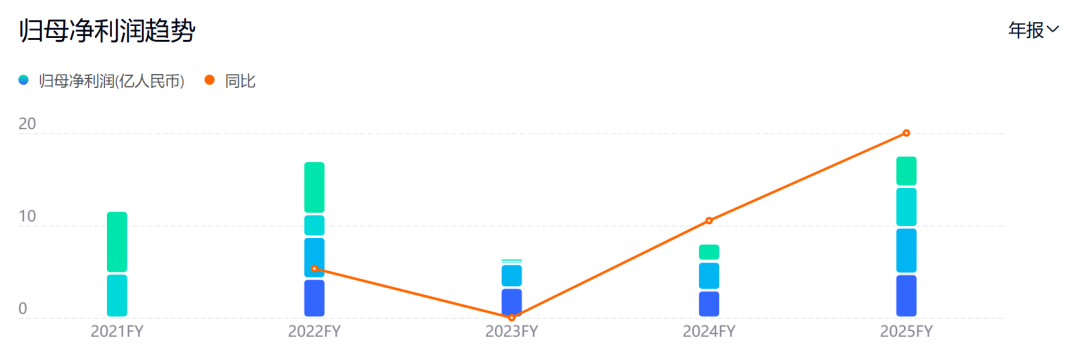
Image Source: Baidu Stock Market
In May 2025, Ecovacs appointed Zhuang Jianhua as General Manager, with Qian Cheng no longer serving in that role. According to multiple media reports, Qian Dongqi has also gradually returned to oversee the company's strategy in recent years.
The 2025 data reflects the failure of the company's strategic expansion and a bright spot in its recovery from a low point. Whether this can continue remains to be seen.
In its annual report, Ecovacs mentioned: "Fully embracing AI, building the Hinton model, and achieving carbon-silicon synergy," and showcased the Bajie household robot.
However, selling expenses reached RMB 5.017 billion, an increase of 18.9%, accounting for 31.3% of revenue.
In contrast, R&D expenses were RMB 980 million, a year-over-year increase of 10.7%, accounting for only 5.1% of revenue.
The significant gap indicates that Ecovacs has not changed its traditional marketing approach and continues to follow the same old path.
The data from the first quarter of 2026 seems to better illustrate the trend.
04
Who Can Rest Easy?
Of course, no one can guarantee that Roborock's or Ecovacs' strategies are definitely correct, especially given the rapid advancements in AI and robotics.
Robots filled the Spring Festival Gala stage, and a half-marathon runner even outpaced humans.
At this pace of evolution, no one knows when household robots will start working in your home.
Of course, robot vacuum cleaners are also part of the household robot category. From blindly sweeping to the integration of LiDAR, binocular AI, and robotic arms, this evolution has occurred in just a few years.
According to predictions by multiple institutions, the penetration rate of robot vacuum cleaners in the U.S. market reached 15-20% in recent years, while the global penetration rate has not yet surpassed 5%. The market is still growing rapidly and holds significant potential.
Although the top five brands dominate 70% of the global market, players like DJI, Dyson, Midea, and others continue to pose challenges. Even iRobot, after being acquired by a contract manufacturer, is poised for a comeback.
The competition for the top five positions is also fierce. According to IDC data, in the second half of 2025, Dreame surpassed Ecovacs with a 14.4% market share, becoming the global runner-up.
In recent years, Roborock, Ecovacs, and Dreame have engaged in patent battles to suppress each other.
Before the 2024 618 shopping festival, Dreame Technology accused Roborock of patent infringement and applied to the court for a sales ban on Roborock's P10 Pro and P10S Pro models. The court supported this pre-litigation behavior preservation, forcing Roborock to temporarily remove the products from shelves and even affecting its 618 sales.
In August 2025, Ecovacs filed lawsuits against Roborock in the U.S. District Court of Texas and the Unified Patent Court (UPC) in Europe, alleging infringement of core patents. This led to the seizure of multiple Roborock products at the International Consumer Electronics Show in Berlin.
In October 2025, the Munich Regional Court issued a temporary injunction based on European Patent EP3231340, directly resulting in a sales ban on Ecovacs' N20 series in the German market.
In April 2026, Roborock filed counterclaims against Ecovacs in Quanzhou and Shenzhen.
Although the robot vacuum cleaner market still appears to have room for growth, the competition among the leading players is already fierce.
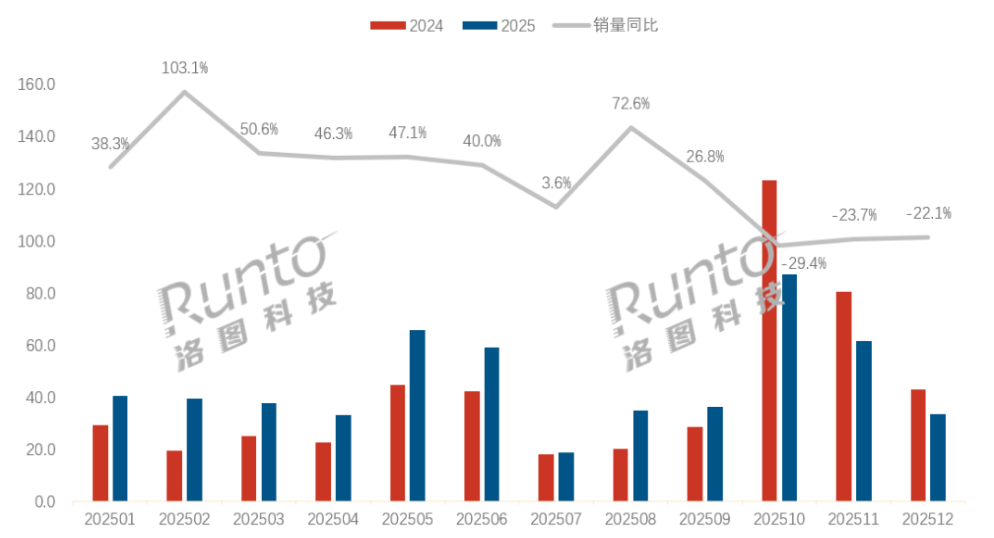
Image Source: LoTu Technology
According to LoTu Technology, online sales of robot vacuum cleaners in China reached 5.464 million units in 2025, a year-over-year increase of 10.1%.
However, with the gradual weakening of quarterly government subsidies and increased competition from Xiaomi, DJI, Haier, Midea, and others, companies are be caught in (trapped in) a competitive tug-of-war over new products and pricing.
In this context, the introduction of AI, product technology iteration, cross-border product expansion, and overseas sales have become optional strategies for companies seeking growth.
No one can rest easy; failure to advance means falling behind.
-
Which Enterprise Dominates the Optical Module Testing Equipment Market with the Fastest Growth?
-
![]()
Thousands of Experts Gather in Beijing to Explore Solutions from Unraveling 'Physical Intuition' to Breakthroughs in Commercializing Proprietary Hardware
-
![]()
Raising Gu: Unveiling the Truth About AI Employees
-
![]()
Doubao Launches Paid Subscription, Drawing a 'Crucial Divide' for China’s Large AI Models
-
![]()
Figure AI Delivers Over 350 Units: Will It Keep Pace with Tesla to Usher in the 'iPhone Moment'?
-
![]()
April’s New Energy Vehicle Sales Unveiled: BYD Dominates with 314,000 Units; Chery and Leapmotor Witness Month-on-Month Surge", "New energy vehicle companies, Sales data, Market dynamics, BYD, Chery
-
![]()
AI Chip Price War Impacts Auto Industry, BYD and Changan Reluctantly Hike Prices
-
![]()
Where is Roborock Headed and Where is Ecovacs Going? Is the Business of Robot Vacuum Cleaners Still Promising?