When AI Starts Charging, How Can We Reap Maximum Benefits at Minimal Cost?
 05/11 2026
 440
440
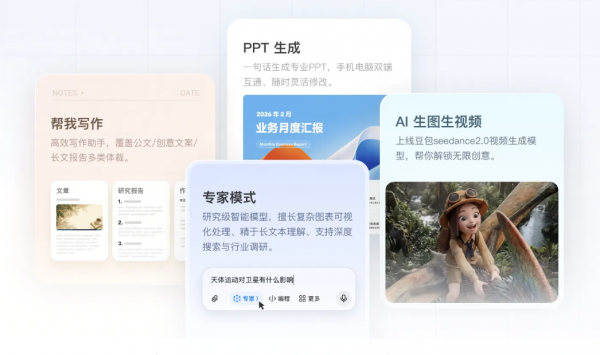
The topic of AI applications beginning to charge fees is gaining increasing attention and sparking widespread discussion!
Recently, Doubao made an announcement about introducing paid services on its Apple App Store page, indicating that it will offer a paid version alongside its free one. The paid version will feature three subscription tiers: Standard, Enhanced, and Professional, with monthly prices set at 68 yuan, 200 yuan, and 500 yuan, respectively. Meanwhile, the basic version will remain free for daily use. In other words, Doubao is not simply transitioning from "free" to "paid"; instead, it is attempting to cater to two distinct layers of user needs: daily use and professional use.
This move has ignited discussions for two primary reasons. Firstly, Doubao boasts 345 million monthly active users, making it the largest AI chat application in China in terms of user base. Secondly, it has struck a chord with many users' perceptions of AI products. Over the past two years, domestic AI applications have been widely available for free, leading users to become accustomed to using them casually, freely asking questions, and incurring no costs. However, as AI capabilities have expanded from chatting and writing copy to generating PPTs, analyzing data, processing long documents, and creating images and videos, costs have surged significantly, with major companies struggling to keep pace. It is becoming increasingly evident that the more useful an AI is, the higher its underlying costs may be.
From an industry perspective, the move towards charging for AI applications is not surprising. Model training, inference calls, server resources, product development, data security, and content moderation all necessitate continuous investment. More critically, as AI transitions from a novelty tool to a productivity tool, platforms must address a fundamental business question: Who is willing to pay for higher-tier, more stable, and more professional capabilities?
Therefore, Doubao's decision to charge is merely a harbinger of what's to come for high-tier AI applications. The real discussion worth having is whether domestic AI applications have transitioned from the "user acquisition" phase to the "monetization" phase. Which AI capabilities will remain free in the future, and which will gradually start charging? For ordinary users and businesses, how can they leverage AI to maximize benefits at minimal cost?
Have domestic AI applications entered the "monetization harvest period"?
To answer this question, we must first look back at the events of the past five years.
In the early stages of domestic AI applications, AI development was a race fueled by major companies' cash flows. Those who could afford to invest heavily had a chance to stay competitive until the end. The underlying logic was that whoever acquired users first, secured entry points, and cultivated usage habits would have a greater chance of success in subsequent commercialization.
Doubao emerged as a dark horse in this context. It entered the market later than its peers but adopted the most aggressive free strategy, achieving 345 million monthly active users within three years. By December 2025, its daily active users surpassed 100 million, making it the product with the fewest promotional expenses in ByteDance's history to reach this milestone.
However, more users mean higher costs, a cost structure never encountered in the traditional internet era.
The "free + advertising" model of the internet is built on the premise that marginal costs approach zero. For WeChat, each additional user means a negligible increase in server electricity consumption; for Douyin, each additional video viewed incurs minimal bandwidth costs. But AI is different. Every conversation, every generation, and every deep inference consumes real GPU computing resources.
It is reported that Doubao's daily Token usage has surpassed 120 trillion, doubling in three months and reaching 1,000 times the volume at its launch in May 2024. ByteDance's capital expenditures in 2025 exceeded 150 billion yuan, with about 90 billion yuan allocated to AI computing power procurement. Plans for 2026 call for an even higher investment of 160 billion yuan. Despite this, net profit has still declined by more than 70% year-on-year.
This is the core contradiction of AI commercialization: User growth no longer linearly drives revenue growth but instead linearly pushes up cost bills. This determines that AI applications cannot remain infinitely free forever. While free models can help products achieve scale, when user scale, usage frequency, and task complexity all rise simultaneously, platforms must shift from validating user needs to validating business models.
This is also a common trend for the future of the AI industry. Kimi's official membership system now offers a free tier alongside multiple paid tiers priced at 49 yuan, 99 yuan, 199 yuan, and 699 yuan, with different packages offering varying entitlements such as Agent quotas, Office file processing, deep research, multitasking, and coding capabilities. The overseas market follows a similar pattern, with ChatGPT Plus priced at $20 per month and Claude offering free, Pro, and higher-usage Max packages.
Zijin Finance believes that at this stage, AI applications are unlikely to achieve large-scale profitability. The trend towards paid models means that AI applications are shifting from merely competing on user growth to competing on retention, paid conversion, usage depth, and unit economics.
Which AI applications will charge, and which will remain free?
As the "free lunch" of AI applications disappears, a critical question arises: Which AI applications will fall into the paid category in the future, and which will remain free long-term?
Zijin Finance believes that AI applications will not completely abandon free models; instead, free versions will continue to exist for the long term.
The reason is that free versions serve three purposes: Firstly, they continuously acquire users. Free entry points are the most effective way to lower user decision thresholds, especially given Chinese users' weak willingness to pay for AI, which is still in its cultivation phase. Secondly, they cultivate user habits. When users integrate a particular AI into their daily routines, forming usage stickiness through basic Q&A, lightweight search, general writing, and low-cost companionship features, paid upgrades become a natural progression. Thirdly, they serve as ecosystem entry points. This is particularly evident in China, where ByteDance positions Doubao as "integrating existing businesses through an AI assistant," with Douyin E-commerce being the primary integration target. The free version acts as a traffic generation tool, data fuel, and the first step in the entire ecosystem empire.
Therefore, basic Q&A, lightweight search, general writing, simple translation, daily chat, and low-cost companionship features are likely to remain free long-term. These functions have relatively controllable single-task computing power consumption while helping platforms maintain user activity. For AI applications, free users are not without value; they are an important source of future conversion, ecosystem distribution, and data feedback.
However, certain capabilities will gradually start charging, and the charging logic will become increasingly clear.
The first category is high-computing-power functions, such as long document summarization, multi-file analysis, complex reasoning, code generation, image and video generation, and real-time voice interaction. These tasks consume more resources, and platforms cannot offer them unlimitedly. Users who demand speed, quality, and stability will need to pay for higher quotas and priorities.
The second category is high-value functions, such as automatic PPT generation, data analysis reports, industry research, marketing plans, business proposals, code engineering assistance, and film and television production assistance. These functions directly correspond to work outcomes. If an AI tool can save users hours or even days of work, its pricing will no longer resemble that of a chat software membership but will be closer to that of productivity software.
The third category is high-frequency professional functions. For ordinary users, occasionally generating an image may be free; but for design teams, short video teams, and e-commerce teams, which frequently call upon images, scripts, storyboards, editing, posters, and product copy, AI transforms from a toy into a production tool. Once it enters a stable workflow, platforms have room to charge.
Therefore, the mainstream form of future AI applications will not be a binary choice between free and paid but rather a long-term coexistence of both.
How can users maximize benefits when using AI?
For users, the core decision-making question is: Where should I pay, and where should I stay free, to maximize the efficiency of using AI for my needs?
Whether it's Doubao, Kimi, Tongyi Qianwen, Wenxin Yiyan, or ChatGPT, functions like basic chat, simple Q&A, short essay writing, daily translation, opinion summarization, and initial data screening will remain free for a considerable time to come. This means that over 80% of the scenarios ordinary users encounter daily can still be resolved with free AI tools. There is no need to pay extra for "subscriptions."
Therefore, for ordinary individual users, the optimal strategy is to build a combination of a "free tool pool + one primary paid tool."
In the free tool pool, users can keep 2 to 3 free AI applications with different strengths to cover daily lightweight use. Different products excel in niche scenarios; some perform well in search and knowledge Q&A, others offer smoother multimodal interactions, and some have a more nuanced understanding of the Chinese context. Maintaining a free tool pool is equivalent to building a low-cost AI safety net for yourself, satisfying needs like daily chat, writing polishing, basic translation, and information retrieval.
On top of this, users should select one paid product that best aligns with their workflow as their primary tool. If you are a white-collar worker focused on copywriting, prioritize which AI's long document summarization and deep research capabilities best suit your topic mining and material organization. If you are a programmer, give priority to AI coding assistance capabilities, such as whether the paid AI's code generation quotas and multi-step reasoning abilities approach or surpass the Copilot-level experience. If you are a designer or video creator, image and video generation capabilities should be the primary weight in your paid decision-making.
For professional team users, such as video teams, design teams, and marketing teams, high-tier AI functions may not be optional but necessary investments. Team users must focus not just on monthly fees but also on unit delivery costs.
In terms of account configuration, a structure of "2 to 3 professional accounts covering core production lines + standard versions meeting daily needs of non-heavy users" can be adopted. Content creators or technical leads are equipped with high-end accounts to ensure production quality and efficiency; lightweight users are equipped with standard versions to avoid capital waste from redundant subscriptions.
Furthermore, for enterprises with very high usage volumes, API-based payment per Token may be more cost-effective than monthly subscriptions. ChatGPT Plus's official documentation also clarifies that API usage is billed separately from Plus subscriptions. In other words, when enterprises need to embed AI into internal systems, customer service processes, data analysis, or content generation platforms, the API model is often more suitable for large-scale deployment than manually opening applications one by one.
However, APIs come with technical barriers. Enterprises need development resources, permission management, usage monitoring, cost control, and data security mechanisms. For medium-to-large teams, APIs are suitable for large-scale automation; for small teams, mature AI product subscriptions may be more hassle-free.
Conclusion
The fact that Doubao, a former proponent of aggressive free strategies, has started charging does not signify the end of the free era but rather indicates that AI applications have entered a more mature phase of commercial stratification.
For the industry, domestic competitors that still maintain free models, such as Alibaba's Tongyi and Tencent's Yuanbao, will face a difficult choice between following suit and charging or sticking to free models. The competitive landscape of the industry is likely to undergo a chain reaction and reshape accordingly.
For users, making AI worth the price in critical areas while accessing it for free in ordinary areas will become the mainstream choice for using AI.
For AI applications, the key to success in the second half of the AI application race lies in making users feel that "this money is well spent."
-
![]()
Tesla Restructures Its Balance Sheet
-
![]()
Accelerating the High-Speed Interconnection Upgrade of AI Computing Clusters! JONHON Releases ELSFP External Light Source Optical Connectors
-
![]()
Breaking the overseas blockade of volumetric holographic materials, this optical enterprise secures nearly 100 million yuan in financing!
-
![]()
Why Does Jensen Huang So Openly Praise China’s AI?
-
![]()
"Wudang" Unveiled: Arm China's Next-Gen AI VPU Redefines Video Encoding
-
![]()
From Energy Conservation and Carbon Reduction to AI Decision-Making: GECON East Intelligence and Chery Group Explore a New Green and Smart Paradigm for Automobile Manufacturing
-
![]()
WAIC 2026 Observation | AI Accelerates Towards the Core of Industries, Industrial AI Enters a Critical Phase
-
![]()
Volkswagen China Fires the First Shot in Foreign-Funded 'White Box Delivery'!