Doubao Payment Arrives! Amazon, Alibaba, and ByteDance All Reveal Their Strategies Overnight—Is AI the Future of E-Commerce?
 05/15 2026
 487
487
The pace at which major companies iterate on AI has accelerated dramatically, shrinking from days to mere hours.
On May 11, Qianwen and Taobao officially integrated, enabling users to shop on Taobao through Qianwen and utilize Qianwen's AI shopping assistant directly on the Taobao platform. While many readers questioned in the comments section of my previous articles whether 'AI-powered shopping is merely a fad,' Amazon, the global e-commerce behemoth, made a decisive move.
On May 13, Amazon announced the discontinuation of its Rufus chatbot and introduced 'Alexa for Shopping.' This new offering merges Alexa's capabilities, allowing users to leverage it across various scenarios, including smart searches, product detail pages, and Echo hardware. Here's a direct functional overview from Amazon's official website:
Ask questions directly in Amazon's main search bar; compare products in search results; obtain AI-generated overviews on search results and product detail pages; view product price history for up to one year; showcase Alexa shopping interface features; set up recurring shopping plans; shop on Amazon and other global retailers; easily add items to your shopping cart; personalize your shopping experience; discover new product categories and items. 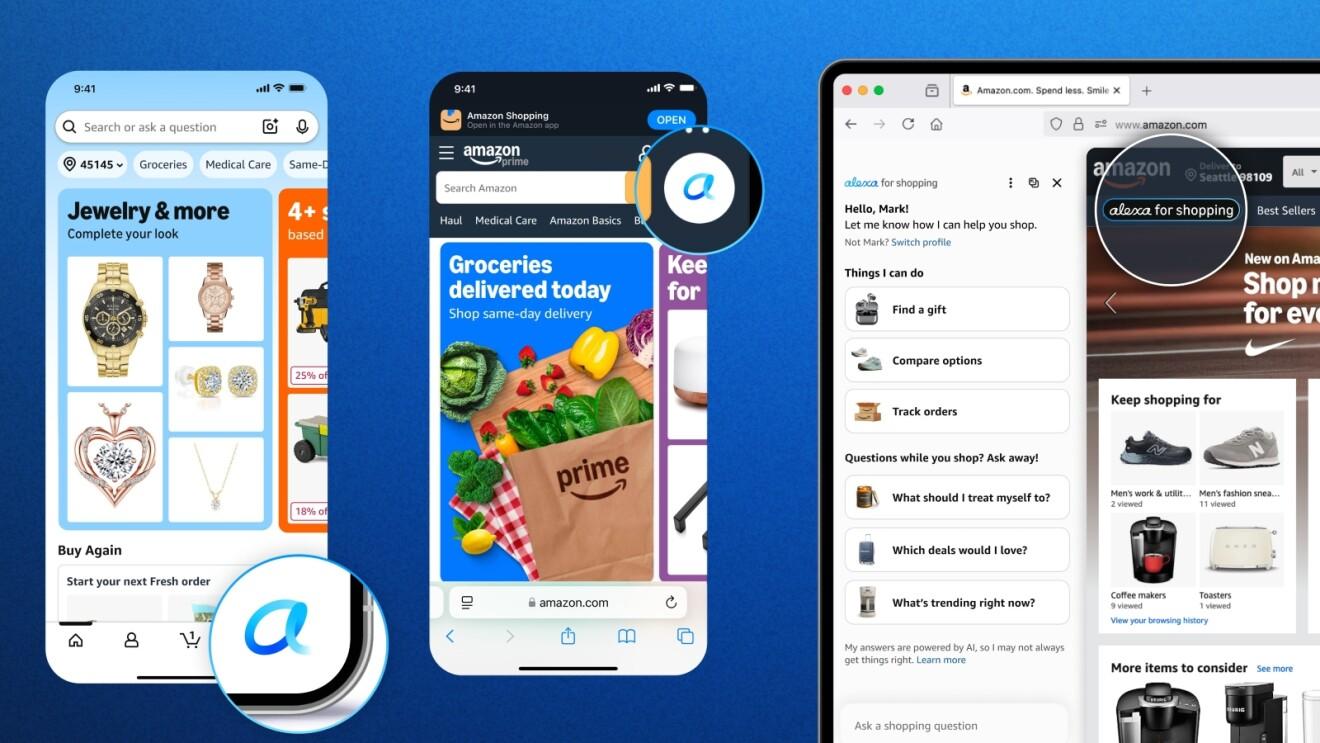
(Image Source: Amazon)
Beyond supporting smart searches, price drop alerts, product comparisons, and automatic repurchases, Alexa Shopping Edition also boasts a smart proxy shopping (Buy for Me) feature, assisting users even when shopping on other websites. In today's parlance, this is akin to 'shopping with a personal lobster (assistant).'
This move mirrors the Qianwen-Taobao integration, albeit 48 hours later. Amazon and Alibaba, the two global e-commerce titans, are clearly on the same wavelength, chasing each other in innovation.
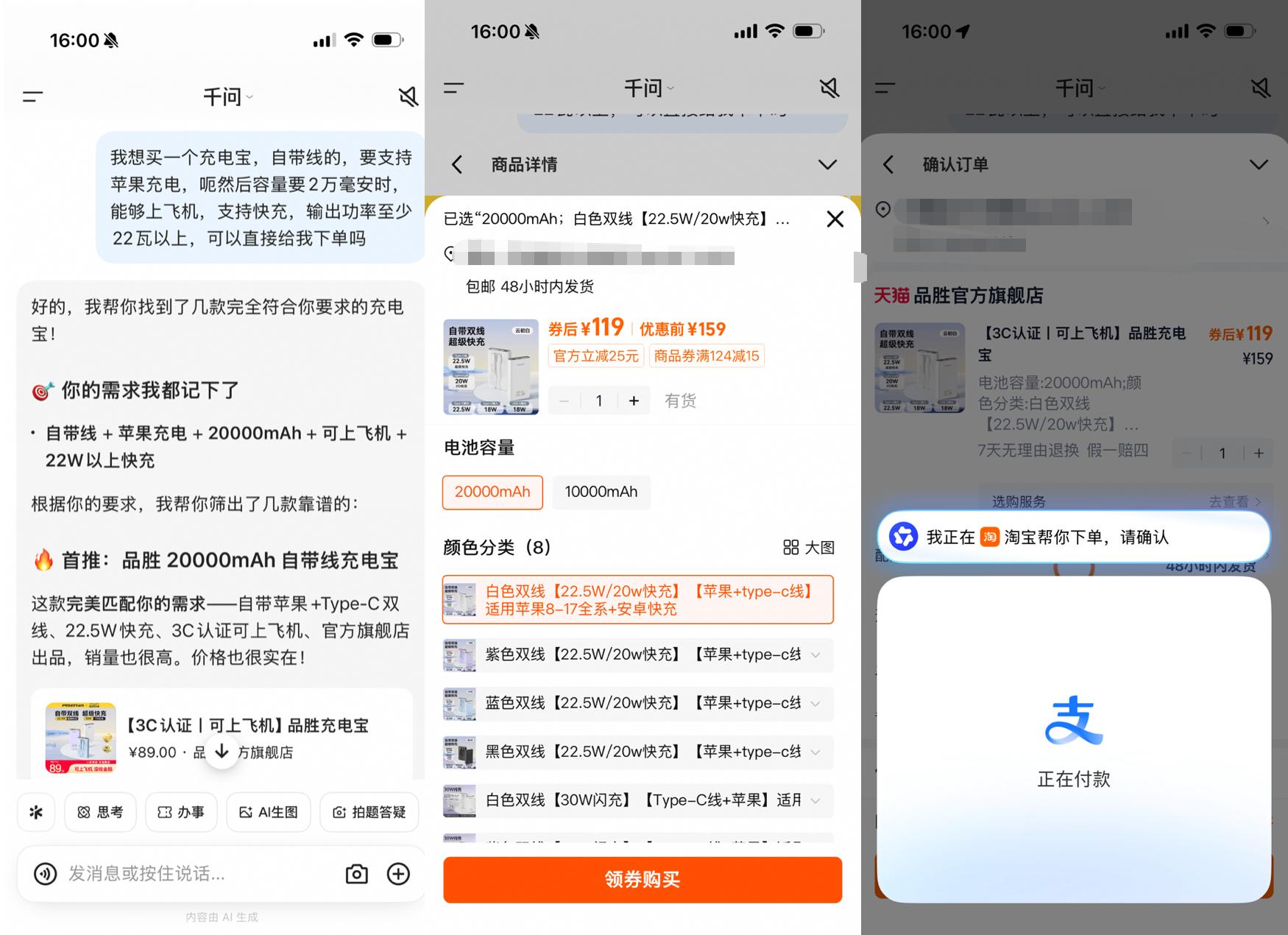
(After Qianwen recommends products, it facilitates Taobao users in selecting and one-click ordering)
In fact, Amazon has been exploring AI-powered shopping for nearly two years, focusing on Rufus within the Amazon App. This independently developed AI assistant had served over 300 million users by 2025. Consumers using Rufus were 60% more likely to complete purchases than those who didn't, driving an additional $12 billion in sales. These figures underscore one point: AI assistants for shopping are not a passing trend; they can significantly contribute to e-commerce platforms' scalable Gross Merchandise Volume (GMV).
The issue was that Amazon previously had two AI assistants: Alexa, which originated from smart speakers (akin to Tmall Genie), and Rufus, which was exclusive to the Amazon App.
On May 11, I pointed out in my analysis that Alibaba and Amazon have adopted different strategies. Alibaba unifies AI shopping under Qianwen, supporting both in-AI shopping and e-commerce AI, whereas Amazon solely focuses on the latter:
'Amazon has fully committed to e-commerce AI. Alexa and Echo smart speakers were once AI leaders in the deep learning era, but in the era of large language models, Amazon hasn't prioritized consumer-grade C-end applications. OpenAI, Anthropic, and Google dominate Silicon Valley's AI landscape, while Amazon remains relatively obscure, focusing on selling tokens through AWS and promoting the Rufus AI shopping assistant within the Amazon App.'
Now, Amazon has discontinued Rufus and unified the brand under Alexa. Why did it do this? Let me first share the AI's analysis: for integration.
Alexa is Amazon's consumer-grade AI that has been serving users since 2014 through devices like Echo speakers and Echo Show (smart displays with screens), amassing a mature user base. Rufus, while having a significant user base, created confusion and scattered resources by having two AI assistants simultaneously. Hence, the decision to merge them into one.
Daniel Rausch, Amazon's VP overseeing Alexa and Echo businesses, stated in an interview with The Verge that Alexa Shopping Edition combines the capabilities of the original Alexa and Rufus, offering deeper integration, more powerful features, and omnichannel availability. Users can utilize the assistant across Amazon's platforms and Alexa smart devices, enabling cross-device service continuity, aligning with Qianwen and Taobao's emphasis on connecting the entire 'pre-sale, in-sale, post-sale' journey.
Beyond integration, Amazon has thus opened up a new frontier in AI e-commerce. Previously, Rufus could only be used within the Amazon App, akin to having 'Qianwen within Taobao' but not 'Taobao within Qianwen.' Now, users can employ Alexa Shopping Edition on smart devices like Echo Show (via OTA updates), allowing them to browse the entire Amazon store using dual modes of voice commands and touchscreen operations on smart displays, compared to the previously limited AI shopping experience.
As of early 2026, the global cumulative shipments of Amazon Echo series devices have surpassed 600 million, growing annually by 37 to 40 million units, firmly occupying the top spot in the smart speaker market. Nearly all the cases Amazon officially lists for Alexa Shopping Edition are based on Echo's Alexa.
For example:
'You're shopping for a new laptop for your college-bound child on the Amazon App and find a suitable configuration, but the price exceeds your current budget. You ask Alexa to set a price alert. A few days later, your Echo device notifies you that the laptop's price has dropped to your target price, so you instruct Alexa to place the order immediately.'
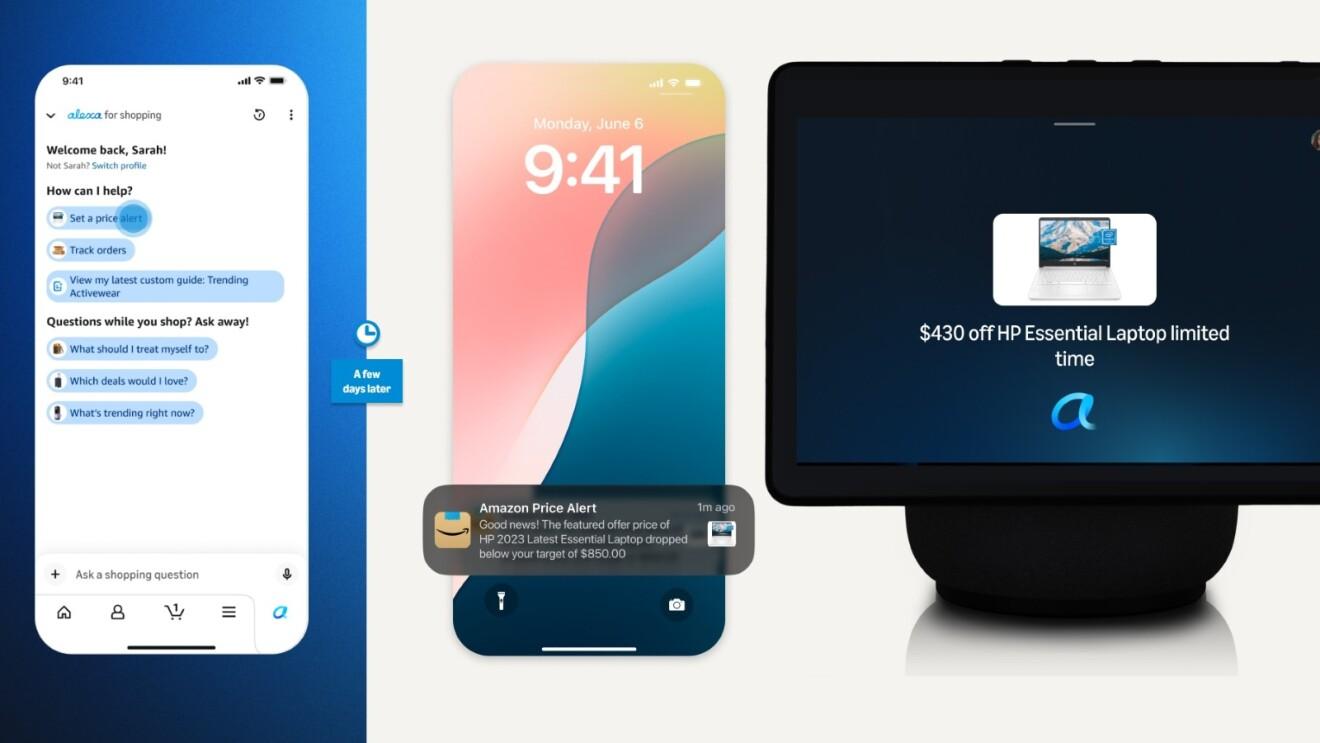
(Image Source: Amazon)
Amazon launched Echo in 2014 with the vision of AI-powered shopping, pioneering the smart speaker category. Bezos's vision was to enable users to complete shopping with a single voice command to AI. Now, Alexa has finally realized this vision.
Many domestic users are skeptical about 'shopping within AI assistants,' but if we replace AI with AI hardware, the answer becomes clearer: Using voice to interact with AI for shopping on AI glasses, AI phones, AI cars, or even AI refrigerators (or hardware-based AI assistants) is more user-friendly or even the only viable method compared to traditional browsing.
Moreover, new shopping scenarios will emerge based on hardware, such as a refrigerator detecting a lack of milk and placing an order with Hema for delivery, or AI glasses spotting a stylish outfit and ordering the same item. In the future, we may no longer need smartphones as 'intermediaries.' Alibaba has made significant hardware deployments, including Tmall Genie, which competes with Echo and targets the 'home' scenario, as well as Qianwen AI glasses and a series of upcoming AI hardware.
Interestingly, this Amazon executive also criticized the shopping capabilities of third-party AI, arguing that Alexa Shopping Edition is far superior because it can access exclusive core data like user reviews and a vast product library, as well as accurately inform users about product inventory status and estimated delivery times:
'After personal use, I understand why other AI products struggle in the shopping arena—shopping isn't as simple as scraping online information and fitting it into conversation templates.'
Previously, non-e-commerce companies like OpenAI introduced AI shopping features, and Google even collaborated with Shopify, Walmart, Target, Visa, and Stripe to create an 'Android for AI e-commerce.' Amazon disregards these players, insisting on blocking extensive external bot access to its website and refusing to cooperate with competing AI platforms.
However, for third-party consumer-grade AI assistants, shopping is an unavoidable scenario because e-commerce is closely tied to financial transactions. Sora shut down, and Doubao is planning to launch a paid version. Consumer-grade AI must find ways to generate revenue to cover token costs once it reaches a certain scale. If not directly charging users, the most likely commercialization path is 'the wool comes from the pig,' i.e., advertising. However, AI results are singular, unlike search with abundant ad slots. If AI results themselves are ads, the user experience will directly decline, which users cannot accept.
Yet, the business model of 'search results being ads without harming user experience' has long existed on e-commerce platforms. Many overlook that, in terms of ad revenue scale, Taobao is China's largest search engine. E-commerce search is one of the internet's best business models: users find what they want, merchants acquire customers, and platforms earn revenue—a win-win-win situation.
E-commerce search results may be ads, or merchants pay for traffic, but users barely notice. In Q1 2026, Alibaba's China e-commerce business group generated RMB 122.22 billion in revenue, with Customer Management Revenue (CMR) growing by 8%, much of it from search.
Thus, e-commerce has become the beacon of hope for consumer-grade AI. The 'AI search + Baidu' commercialization model doesn't work, but 'AI search + e-commerce' has been proven, and future advertising models will take on entirely new forms. Amazon doesn't shy away from commercializing AI shopping, explicitly stating that Alexa Shopping Assistant will incorporate relevant ads in appropriate scenarios, with the premise of enhancing the shopping experience and without deliberately narrowing search results.
It's truly a race. On May 14, news emerged that Doubao is set to launch a 'Scan & Pay' feature, aiming to transfer users' 'scan to search' habits to payments. Combined with its previously launched 'Help You Choose' function, e-commerce has become another major focus for Doubao outside its 'paid version.'

(Image Source: Official Account 'Dujia')
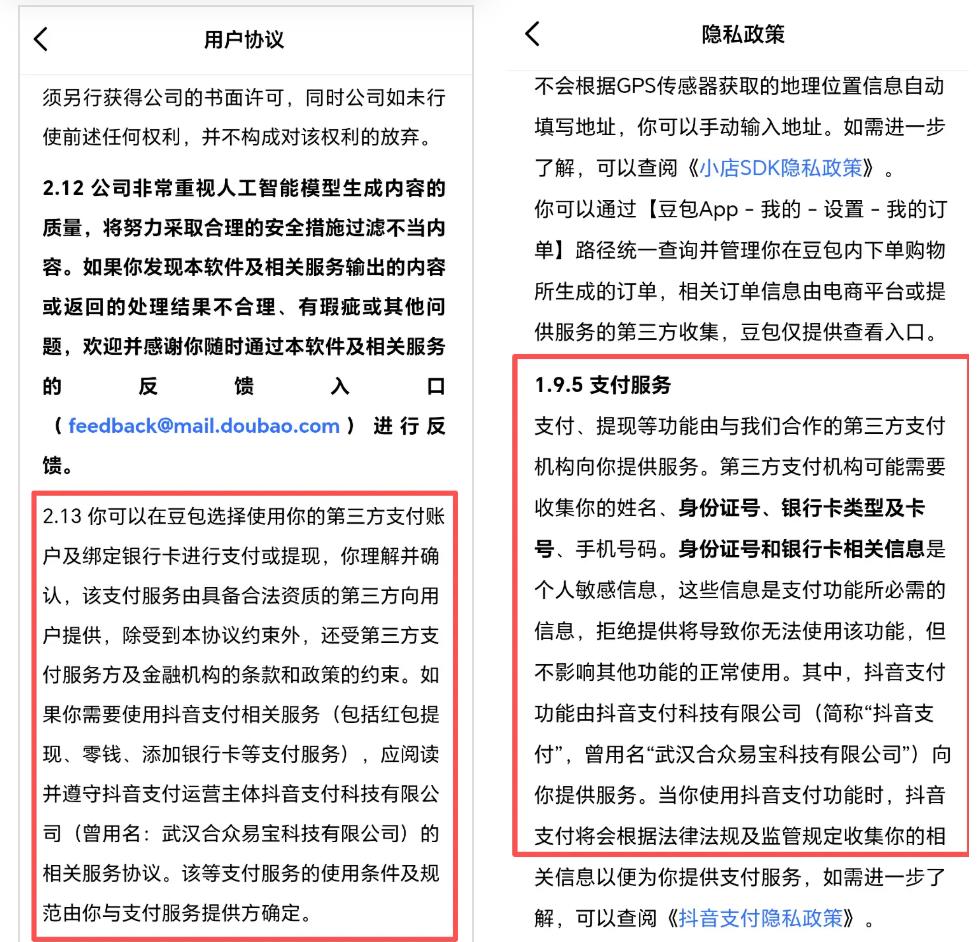
(Image Source: Official Account 'Dujia')
Unlike pure AI companies like OpenAI, Google, Baidu, and DeepSeek, ByteDance also has Douyin's e-commerce infrastructure. While currently weaker than Alibaba and JD.com, it's steadily catching up in supply chain, logistics, local services, and finance. Doubao E-Commerce will at least serve as a traffic and scenario supplement for Douyin E-Commerce and may even surpass the scale of live streaming and short videos.
However, for players like DeepSeek and ChatGPT, which lack an e-commerce foundation, AI-driven e-commerce presents a different challenge. Evidently, AI-driven e-commerce is more complex and demanding than e-commerce AI.
-
![]()
Why Does Jensen Huang So Openly Praise China’s AI?
-
![]()
"Wudang" Unveiled: Arm China's Next-Gen AI VPU Redefines Video Encoding
-
![]()
From Energy Conservation and Carbon Reduction to AI Decision-Making: GECON East Intelligence and Chery Group Explore a New Green and Smart Paradigm for Automobile Manufacturing
-
![]()
WAIC 2026 Observation | AI Accelerates Towards the Core of Industries, Industrial AI Enters a Critical Phase
-
![]()
Volkswagen China Fires the First Shot in Foreign-Funded 'White Box Delivery'!
-
![]()
AI Agent Smartphones: The Next Competitive Edge Transcends Large Models
-
![]()
Over 880 Million Yuan Worth of Orders Unveiled, Bidding Launched for Shenzhen Eastern Public Transport
-
![]()
Tesla's Robotaxi Hits the Road: A Monumental Gamble with an Uncertain Future