Doubao Embraces Premium Tier, Wukong Expands: The Divergence Paths of AI Assistants
 05/15 2026
 691
691
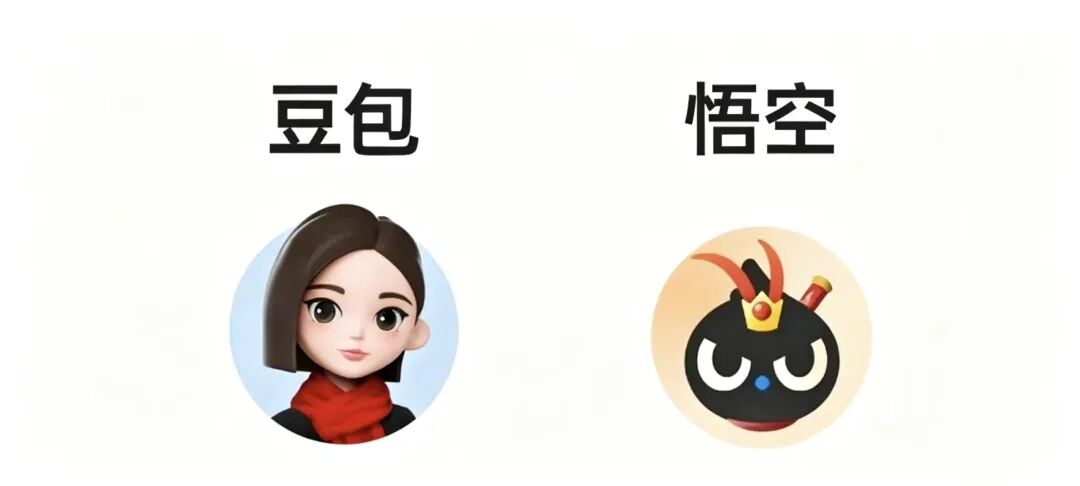
One ventures into the expansive realm of personal work and life scenarios, while the other delves deep into the core of enterprise workflows.

By She Zongming
Though barely halfway through the year, 2026 is already shaping up to be a transformative year for AI assistants.
If the early-year 'AI Red Packet War' was seen as a prelude and the subsequent 'Lobster Craze' as a breakthrough, then the recent moves by two iconic AI assistants indicate a significant shift in the industry.
These two AI assistants are Doubao and Wukong. Doubao stands as China's leading AI-to-Consumer (AI2C) platform, while Wukong serves as a benchmark enterprise-grade AI-native work platform.
Last night, Alibaba unveiled its latest financial report, revealing that its full-stack AI technology investment has officially transitioned from the initial cultivation phase to a cycle of positive, large-scale commercial returns. In the enterprise AI sector, the enterprise-grade agent platform 'Wukong' has recently begun to scale up progressively.
About 10 days ago, Doubao initiated testing for a tiered paid subscription model, offering premium features tailored for complex tasks and productivity scenarios, including advanced needs such as PPT generation, data analysis, and film and television production.
One, a personal AI assistant, is raising its price; the other, an enterprise AI assistant, is undergoing large-scale validation. On the surface, they appear unrelated.
However, applying Newton's principle—'By considering simple things as complex, new fields can be discovered; by simplifying complex phenomena, new laws can be found'—and viewing these events together, new signals emerge.
Doubao's shift to paid subscriptions and Wukong's scaling up convey at least two significant signals:
1. AI assistants are diverging, with clear paths for personal efficiency and enterprise efficiency.
2. As high-productivity scenarios become the key focus for AI commercialization, the value of enterprise AI is being recognized.
01 /
What should AI competition ultimately focus on? From the internet lexicon, many point to 'traffic first.' However, Jensen Huang offers a new perspective: 'Token is king.'
Doubao's move to paid subscriptions and Wukong's scaling up are essentially offshoots of 'token economics.'
Under the 'more users, higher costs' diseconomy of scale, Doubao must account for tokens.
Doubao's strategy is to target high-value computing power consumption and charge personal users.

▲ Doubao's trial of paid subscriptions has elicited significant feedback.
Without transitioning from a chatbot primarily used for chatting, poetry writing, and answering questions to an efficient productivity tool, it cannot balance its return on investment.
Wukong also needs to account for tokens: In Alibaba's grand strategy of 'creating tokens → transferring tokens → applying tokens' outlined in March this year, Wukong serves as the primary consumption engine for the B-side market.
Wukong's scaling up, shifting its focus from demo showcases to real-world business applications, is inevitable. After all, it must support Alibaba's token ecosystem with a commercial foundation on the B-side.
It should be noted that both Doubao and Wukong are significant consumers of tokens and will inevitably compete for the 'entry point to human-machine collaboration platforms for carbon-based employees.' However, their approaches differ.
While Doubao's move to paid subscriptions accelerates its transformation from a mass-market chat assistant to a 'universal productivity tool + lightweight enterprise AI service provider,' it remains, overall, a personal efficiency tool.
Wukong's scaling up, on the other hand, involves moving from a group of early-adopting enterprises to countless businesses across industries. From its inception, Wukong was not designed for 'chatting' but for 'getting work done.' It has always been an enterprise efficiency tool.
Now, both Doubao and Wukong have taken significant strides, reflecting the trend of divergence among AI assistants.
Previously, many believed that AI assistants were all competing in the same arena, differing only in intelligence levels.
However, a divide has now emerged, with AI assistants following two distinct paths: one venturing into the expansive realm of personal work and life scenarios, and the other delving deep into the core of enterprise workflows.
This may remind you of Silicon Valley's 'archrivals'—ChatGPT and Claude. Indeed, a similar divergence is unfolding in Silicon Valley:
ChatGPT follows a 'personal super entry point' route, enhancing search, integrating shopping, and optimizing multimodal chat experiences, all with a focus on the consumer side. While it offers features like ChatGPT for Excel and meeting assistants, its overall emphasis is on boosting personal efficiency.
Claude, in contrast, delves deep into enterprise scenarios. Its Artifacts feature enables AI to generate interactive documents and code directly, Computer Use allows AI to operate computers for complex tasks, and the Projects feature provides collaboration spaces for enterprise teams—all aimed at enhancing enterprise efficiency.
Chinese AI assistants have their own 'enterprise context,' but a cross-comparison reveals a striking similarity: the AI development paths on both sides of the Pacific may not repeat, but they certainly rhyme.
02 /
Whether focusing on personal efficiency or enterprise efficiency, there is a need to build To Prosumer (professional producer) agent platforms to enhance office productivity.
This raises a question: What kind of agent platform best improves human-machine collaboration efficiency for carbon-based employees?
ChatGPT and Claude can serve as reference points here.
ChatGPT's strength lies in its general capabilities and ecological breadth. Its native context density is weaker than Claude's, relying more on 'external RAG + plugins' for supplementation.
Claude's core strength lies in its extreme refinement of native context density: a million-level native context window, low prompt caching costs, Claude Code, Dreaming memory mechanisms, and more, forming its competitive moat.
As a result, 'strong model + multiple plugins + a large user base' gives ChatGPT an edge in general scenarios, while 'long window + memory governance + native scenario integration' provides Claude with deeper barriers in deep knowledge work and complex business process scenarios.
The key takeaways involve two terms: model capability and native context density. Model capability is straightforward; native context density, while sounding abstract, is... not much easier to grasp.
Think of it this way: Your organization's relationships, supply chain information, database records, historical work orders, product manuals, operational audit logs, real-time business processes, and other information together constitute the context. Native context density refers to the richness, accuracy, structural integrity, and reusability of the context that a platform can provide to an agent without relying on 'external plugins,' solely through native integration.
While the actual effectiveness of an agent = model capability × context quality, considering that gaps in model capability can be bridged through technological iteration and API access, high-density context—which enables agents to stably understand business and precisely execute tasks—requires long-term accumulation. Thus, the core competitive barrier of an agent platform lies not in model capability but in native context density.
Among domestic AI assistants, C-side-oriented products (like Doubao and DeepSeek) share a common trait: meeting professional demands relies on general model capabilities and a rich plugin ecosystem.
Take Doubao, for example. Although Doubao and Feishu are both under ByteDance, they are 'decoupled' products. Theoretically, Doubao can integrate with Feishu, but this integration is external: Doubao serves as the front-end general agent entry point, while Feishu acts as the back-end context provider.
If Doubao wants to access industry data from Feishu to generate operational reports, it must go through steps like API interfaces, permission reviews, and data format conversions, resulting in a lengthy process.
Wukong takes a different approach: It is built into DingTalk, combining the 'agent entry point' and 'back-end context middleware' into one. This means Wukong does not need to 'seek externally.' By CLI-fying all of DingTalk's underlying capabilities, Wukong can natively access enterprise data on attendance, approvals, meetings, documents, projects, and more.
This enables zero-friction access—users no longer need to export data or switch software, and data is spared from loss during transfers, alignments, and pushbacks. It also ensures high-permission controllability, keeping data within enterprise boundaries, and enables executable closures, where AI can not only provide answers but also send notifications, modify data, run processes, and deliver results.
Consider the task of drafting a project review report. With Doubao, you would first copy meeting minutes and project materials from Feishu, clean up unnecessary formats, paste them into Doubao, provide prompts, wait for generation, and then copy the output back into a document for formatting. With Wukong, you could simply say, 'Find the follow-up records in the multi-dimensional table of last Wednesday's DingTalk meeting minutes, combine them with data from Project XX, and help me draft a review report and send it directly to my DingTalk document.'
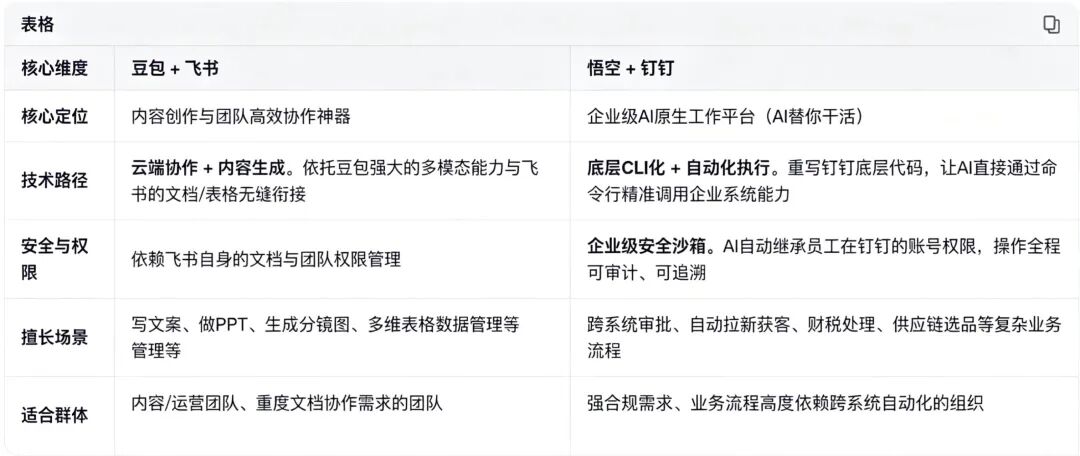
▲ There are significant differences between 'Doubao + Feishu' and 'Wukong + DingTalk.'
One helps you do things faster; the other helps you get things done directly. Neither is superior, but they differ in scenario suitability: Doubao's speed and lightness are better suited for individuals and small teams handling standardized, high-frequency tasks; Wukong's depth and closed-loop nature are better suited for addressing complex enterprise pain points.
03 /
To some extent, Doubao's move to paid subscriptions is an 'indirect proof' of the value of enterprise-grade AI—the signal behind the signal it releases is not that 'AI is now paid,' but that AI assistants only hold core value when they can meet advanced productivity demands.
And enterprise scenarios are the primary battleground where advanced productivity demands are most intense and concentrated.
Wukong might say in response: 'Now you're speaking my language.' When it comes to enterprise scenarios, many AI assistants are like novices who need external coaches and floaties before they dare to take the plunge. Wukong, however, is a natural swimmer, born to thrive in the water.
From this perspective, the reason behind Doubao's move to paid subscriptions is not unrelated to the reason behind Wukong's scaling up; there is a potential link between the commercialization of personal AI assistants and the large-scale validation of enterprise AI assistants.
It should be noted that 'chatting' is no longer the most valuable AI scenario—'getting work done' is increasingly recognized as the industry consensus.
On the same day Doubao trialed paid subscriptions, both OpenAI and Anthropic announced the establishment of on-the-ground service companies, sparking a 'last-mile' melee for AI's entry into enterprise scenarios. Earlier, OpenAI, which has traditionally focused on the consumer side, released enterprise workflow agents—Workspace Agents.
It is foreseeable that the battle among AI assistants in the B-side market has just begun, and a war for control over human-machine collaboration platform entry points by enterprise-grade agents is inevitable.
This battle will not be won by parameters, daily active users, or hype but by who can first be validated in real enterprise scenarios.
And the usability of enterprise-facing agents is best judged by the enterprises themselves. Non-standardization and low fault tolerance are inherent characteristics of enterprise scenarios. Only if an agent is sufficiently useful, practical, and easy to use will enterprises pay real money for token consumption.
Usefulness, practicality, and ease of use are not abstract concepts but are reflected in details perceivable by enterprises: If I am an employee or boss with a need to monitor industry competition, can AI automatically crawl competitor data to generate a market radar? If I need user insights, can AI perform intelligent analysis of massive UGC comments to precisely dissect user pain points, itching points, and needs? If I require daily operational reviews, can AI automatically generate daily operational analysis reports, providing recommendations to scale up/cut losses and early warnings on operational risks?
These are not baseless scenarios. Youkela, an enterprise in Yiwu, Zhejiang, once faced these exact needs: As a domestic hidden champion in starry sky lamp categories and an 'integrated industrial and trade' enterprise with 'front-end stores and back-end factories,' Youkela has fewer than 80 employees but covers R&D, manufacturing, and multi-platform e-commerce operations. With a long supply chain, a shortage of manpower, and high pressure,
Founder Wei Jun's solution was to adopt new technologies. In 2017, he moved the company onto DingTalk; in 2025, he became one of the earliest deep users of DingTalk AI Tables; and in March of this year, he became one of the first 'monkey breeders.'
Sure enough, Wukong provided reliable solutions: For market monitoring, there was no need to rely on manual spot checks—AI could handle it. For product R&D, there was no need to rely on gut feelings—AI could provide evidence. For operational reviews, there was no need to check data across platforms—AI could automatically aggregate data from all domains. The corresponding Skills were 'Online Competitor Radar,' 'Product R&D Guide,' and 'Store Inspection Daily Report.'
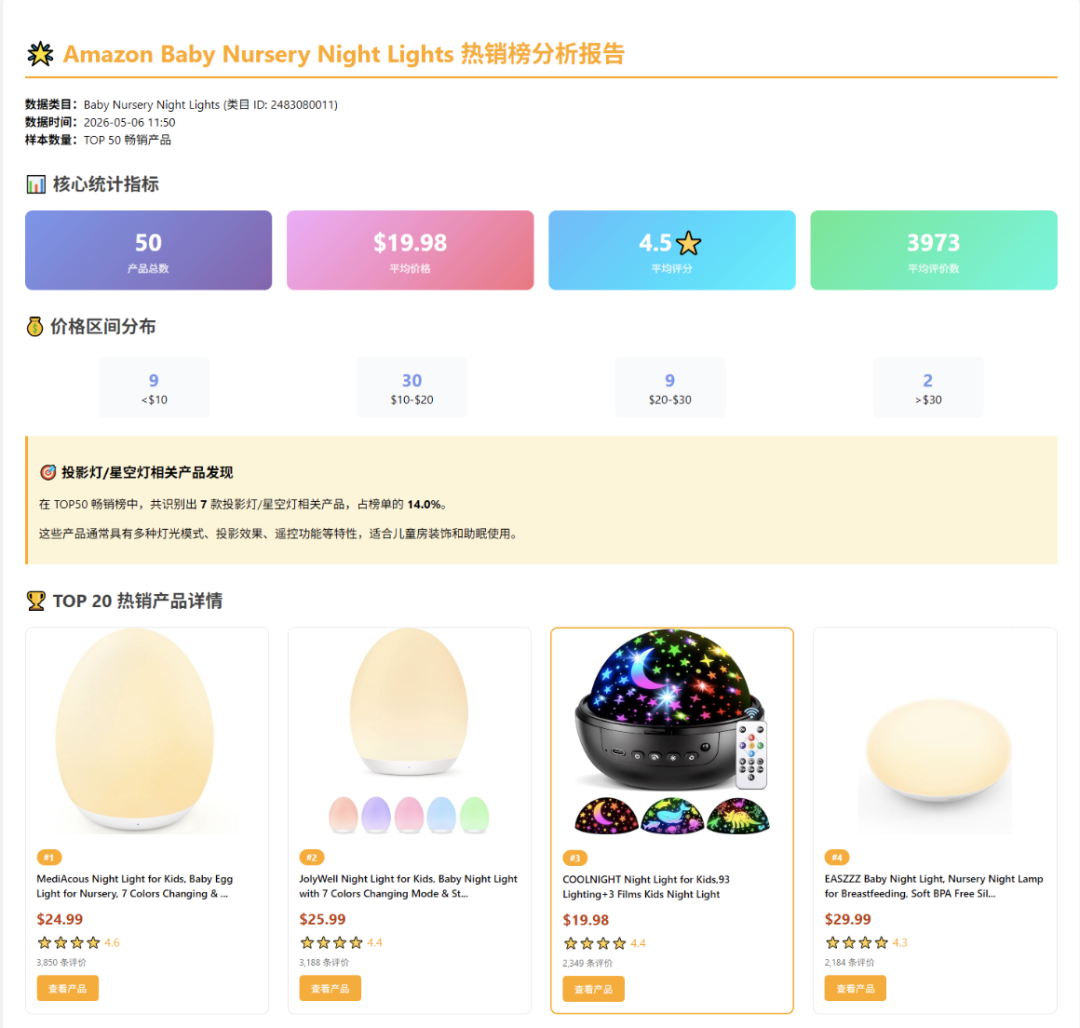
▲ This is a bestseller analysis report generated by Youkela using its 'Online Competitor Radar Skill' (screenshot provided).
A notable transformation has taken place: Previously, the company's sole HR personnel would dedicate two full days to calculating salaries. However, after implementing a specific Skill, the HR department could now 'instruct' Wukong with clock-in records, attendance regulations, and company-specific scenarios. Wukong would then automatically process and convert the data, slashing the salary calculation time to under 10 minutes.
This instance is not an exception but rather a reflection of Wukong's early and successful real-world validation across various industries. Such validation is not merely a demonstration; it is substantiated by tangible business outcomes, genuine efficiency improvements, and actual revenue growth.
In corporate settings, the efficacy of AI in data extraction, summarization, and analysis is gauged by whether it can streamline processes or introduce unnecessary complexities. As Wukong expands its reach, an increasing number of real enterprise users will engage with, provide feedback on, and enhance its AI services within their actual workflows. Whether this will foster a virtuous cycle of 'increased enterprise adoption → improved usability → even greater enterprise adoption' remains to be observed.
Ultimately, the true yardsticks for evaluating AI assistants like Doubao and Wukong are their usefulness, practicality, and user-friendliness. Essentially, Doubao and Wukong serve as two facets of AI assistants. Neither is inherently superior; the key lies in their ability to address real-world challenges for individuals and businesses, thereby affirming the value of AI.
Against the backdrop of high-productivity scenarios emerging as the focal point of AI implementation, it becomes increasingly crucial to delve deeper into the value proposition of enterprise AI assistants and to foster superior closed-loop systems. From a narrower standpoint, this pertains to the realization of enterprise AI's worth; from a broader perspective, it relates to the advancement of China's AI productivity landscape.
Time may pass silently, but achievements resonate loudly.
-
![]()
Why Does Jensen Huang So Openly Praise China’s AI?
-
![]()
"Wudang" Unveiled: Arm China's Next-Gen AI VPU Redefines Video Encoding
-
![]()
From Energy Conservation and Carbon Reduction to AI Decision-Making: GECON East Intelligence and Chery Group Explore a New Green and Smart Paradigm for Automobile Manufacturing
-
![]()
WAIC 2026 Observation | AI Accelerates Towards the Core of Industries, Industrial AI Enters a Critical Phase
-
![]()
Volkswagen China Fires the First Shot in Foreign-Funded 'White Box Delivery'!
-
![]()
AI Agent Smartphones: The Next Competitive Edge Transcends Large Models
-
![]()
Over 880 Million Yuan Worth of Orders Unveiled, Bidding Launched for Shenzhen Eastern Public Transport
-
![]()
Tesla's Robotaxi Hits the Road: A Monumental Gamble with an Uncertain Future