Two Months of Free Codex Access! AI Programming Tool Price War Ignites, Sam Altman Steps In to Lure Users
 05/15 2026
 648
648
Two Months of "Generosity": OpenAI Reignites Codex Fervor
OpenAI's founder and CEO, Sam Altman, took to X today to declare: "Codex stands as the premier AI coding tool, and we're committed to making its trial seamless. For the next 30 days, we're offering two months of complimentary Codex access to companies eager to make the switch." To facilitate a smooth transition, OpenAI has also rolled out migration tools, ensuring hassle-free transfer of settings, plugins, skills, infrastructure, projects, and conversation histories.
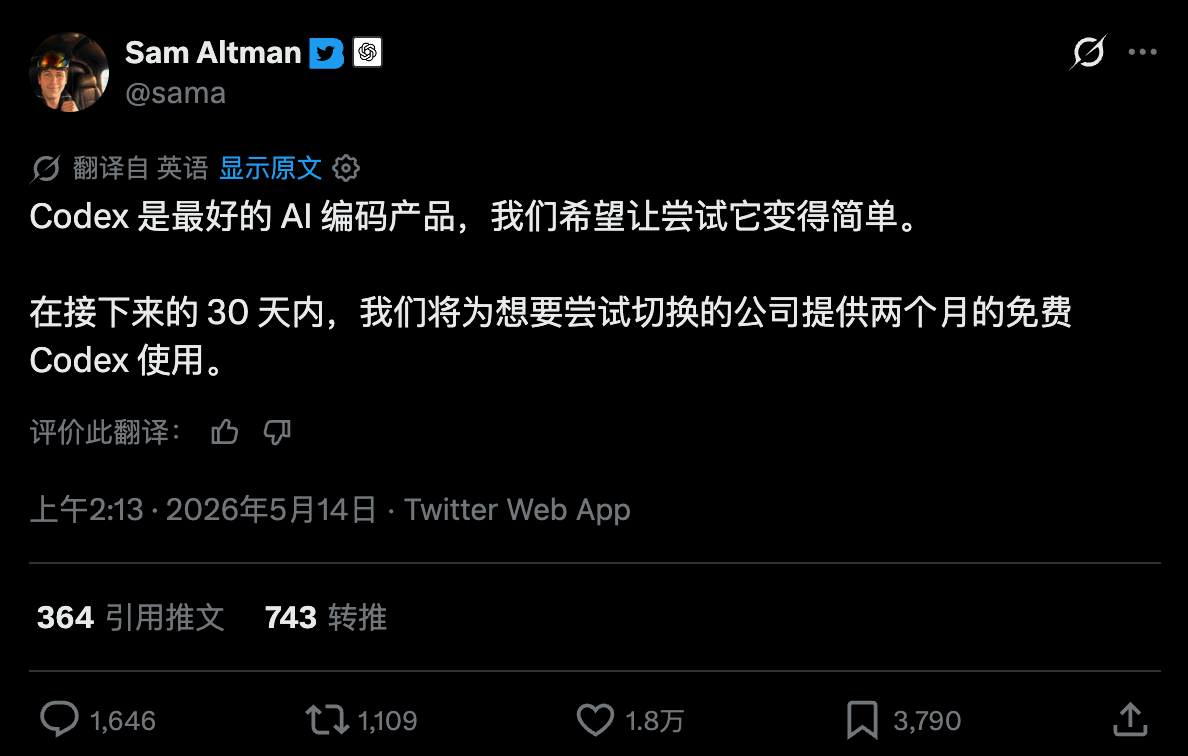
Image Source: X
Interestingly, Anthropic responded almost simultaneously by boosting the weekly quota for Claude Code by 50%, a benefit available to Pro, Max, Team, and seat-based Enterprise users until July 13th. Thus, a promotional showdown between the two AI behemoths has commenced.
In recent months, Codex has propelled OpenAI's resurgence. Post-GPT-5.5, OpenAI has reclaimed the trust of numerous developer users with its enhanced coding capabilities, tool invocation, and Agentic Coding. Codex, too, has transcended programming, now supporting browser-based tasks, image generation, memory functions, and cross-tool collaboration.
However, developer enthusiasm doesn't automatically translate to enterprise market dominance.
For OpenAI, Codex now aims to secure not just individual subscriptions and developer buzz on Reddit, X, and Hacker News but also to become the go-to AI coding tool for enterprise clients. Currently, Anthropic's Claude/Claude Code holds that distinction.
Codex Gains Traction, but Claude Code Holds Enterprise Mindshare
Judging by the reactions to Sam Altman's tweet, Codex boasts a substantial following. Many developer communities report marked improvements in Codex's ability to write code, debug, understand project structures, make cross-file modifications, run tests, and explain complex engineering issues, rivaling Claude Code.
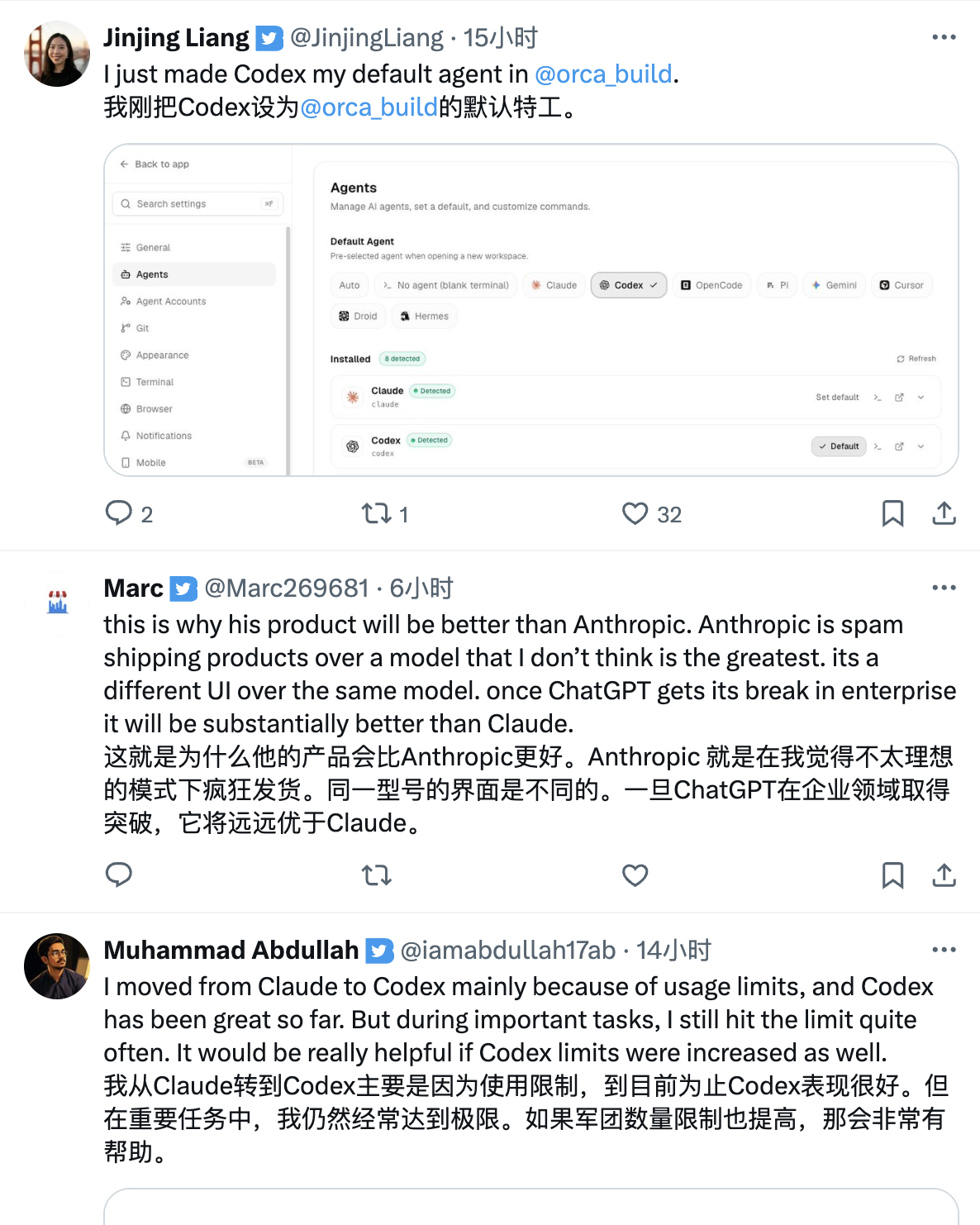
Image Source: X
Several factors contribute to this. The release of GPT-5.5 has bolstered the model's "hard power," enhancing its understanding of task structures, engineering goal breakdown, tool invocation, and sustained progress. The new Codex version not only matches Claude Code's AI coding performance but also evolves from a Coding Agent to a general-purpose Agent.
Additionally, Anthropic faced a computational crisis, significantly curtailing Claude Code's quota and performance, sparking discontent among individual and enterprise developers and making them more receptive to Codex.
Official data reveals that Codex developer users surpassed 3 million in early April, with the number exceeding 4 million by April 21st, following GPT-5.5's launch and the new Codex version.
Furthermore, npm download tracking reports from TickerTrends indicate exponential growth for Codex in early May, surpassing the previously dominant Claude Code. While npm downloads don't fully reflect market changes, they illustrate Codex's meteoric rise.
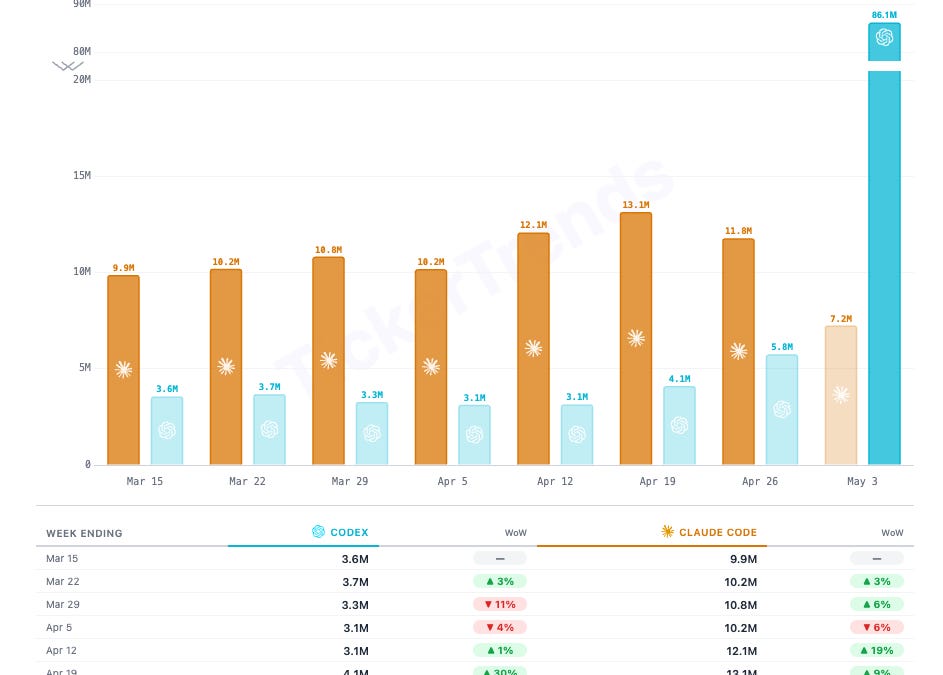
Image Source: TickerTrends
(Editor's Note: npm is Node.js's package management tool. Products like OpenClaw, Hermes, Claude Code, and Codex often rely on the Node.js environment, though both Claude Code and Codex are gradually moving away from it.)
However, Anthropic's lead extends beyond Claude (the model) and Claude Code (the product). Over the past year, its reputation has solidified, establishing a strong presence among individual and enterprise developers. Since late last year, more enterprises have adopted Claude Code for software development, with its adoption rate rising significantly and permeating corporate workflows like legal, finance, and research.
Reversing this mindshare won't be easy.
Data from Ramp AI Index also indicates that in April, Anthropic's adoption rate among Ramp enterprise clients reached 34.4%, surpassing OpenAI's 32.3% for the first time. While Ramp's scope doesn't cover the entire enterprise AI market, it reflects trends in real enterprise procurement and payment behaviors based on data from over 50,000 U.S. enterprises.
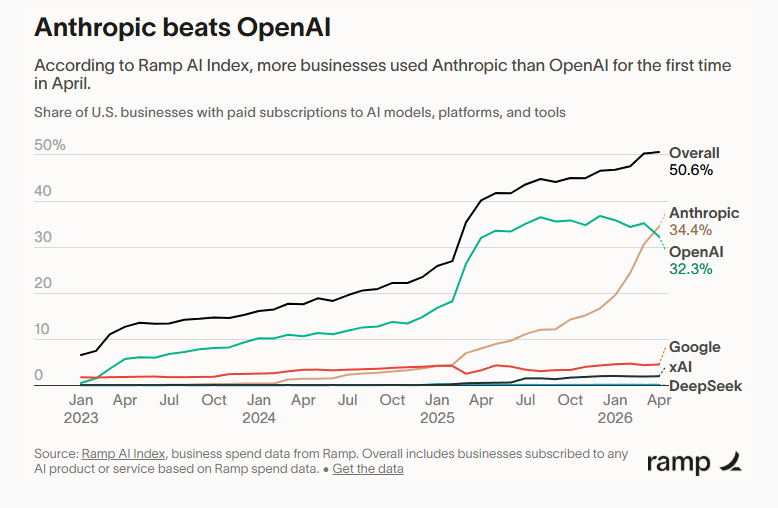
Image Source: Ramp
This presents OpenAI's greatest challenge. While ChatGPT remains the default AI entry point for ordinary users, and OpenAI enjoys strong brand recognition, in the high-frequency, essential, and monetizable AI coding scenario, Claude Code has positioned itself as "truly capable of getting the job done."
Enterprise procurement may not sway with social media trends, but engineering team word-of-mouth often influences procurement decisions. As OpenAI noted when introducing client cases, "Once leadership sees improvements in team speed, output, and leverage, Codex's application often rapidly expands from one team to the entire company."
From this perspective, Codex's two-month free offer is a strategic move to encourage enterprises to implement Codex in real projects and let developers prove its potential to replace Claude Code. For enterprises, cost isn't the primary concern; Codex's actual output effectiveness is key.
Limited-Time Free Access: A Gateway, but Consistency is Key
AI programming tools differ significantly from traditional SaaS in that free trials alone don't form a long-term competitive edge. For enterprises, two months of free access is enticing, especially amid rising token consumption and unpredictable pilot costs for AI coding tools. OpenAI's generous trial period can reduce resistance to internal pilot initiatives.
Ultimately, free access isn't a cure-all. Claude Code's past popularity stemmed not from affordability but from its ability to make developers feel "truly efficient" in real engineering scenarios. It could handle large projects, modify files, run commands, explain errors, manage context, and even with occasional mistakes, users felt it was progressing along engineering tasks.
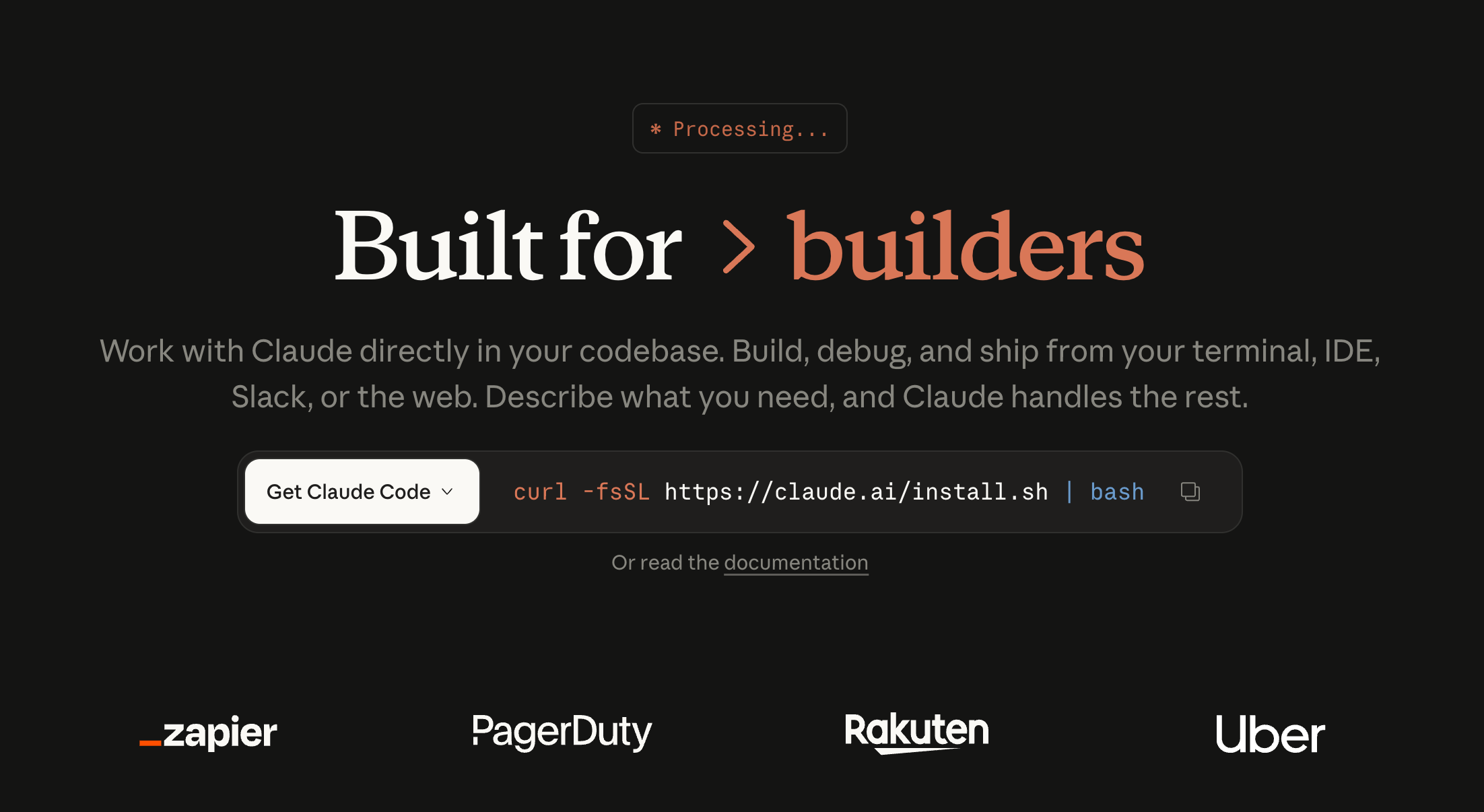
Image Source: Anthropic
Codex's recent advancements show that OpenAI has learned this lesson. OpenAI now positions Codex as a tool supporting actual engineering work, from planning, feature development, refactoring, and code review to release. The company emphasizes Codex's ability to improve team baseline quality, provide more thorough design, more complete testing, and more accurate code reviews.
On the other hand, Claude Code is strong but faces computational constraints. As Codex surged in early May, Anthropic secured the entire computational capacity of the SpaceXAI Colossus 1 supercomputing data center. Anthropic founders Dario Amodei and Daniela Amodei acknowledged the company's computational challenges:
"We planned for growth ranging from 'very little' to '10 times,' but we encountered 80 times growth. As a result, as seen today with our computational partnership with SpaceX, we're urgently seeking more computational power than ever before and will quickly deliver it to you."

Code with Claude event in San Francisco. Image Source: Anthropic
In this regard, OpenAI clearly possesses a more robust computational scale and infrastructure. However, the harsh reality of AI agents is that the better they are, the more they consume resources. Every complex task consumes numerous tokens, and every long context, multi-round modification, tool invocation, and test feedback entails substantial computational costs.
This is why free strategies are both effective and risky for AI agents. They're effective in lowering the barrier for enterprises to try them out. Once a few teams start using them, enterprises can quickly sense the impact on development efficiency, code review, and maintenance. They're risky in that once a large number of enterprise users begin using them frequently, the demand generated by free access immediately turns into computational pressure.
Therefore, the success of the two-month free trial hinges on OpenAI's ability to maintain a good user experience after user scale expansion. Quotas must be sufficient, responses must be stable, model quality must not fluctuate, and enterprise management and security capabilities must keep pace. Otherwise, the free trial could expose Codex's unstable experience and deter enterprise users.
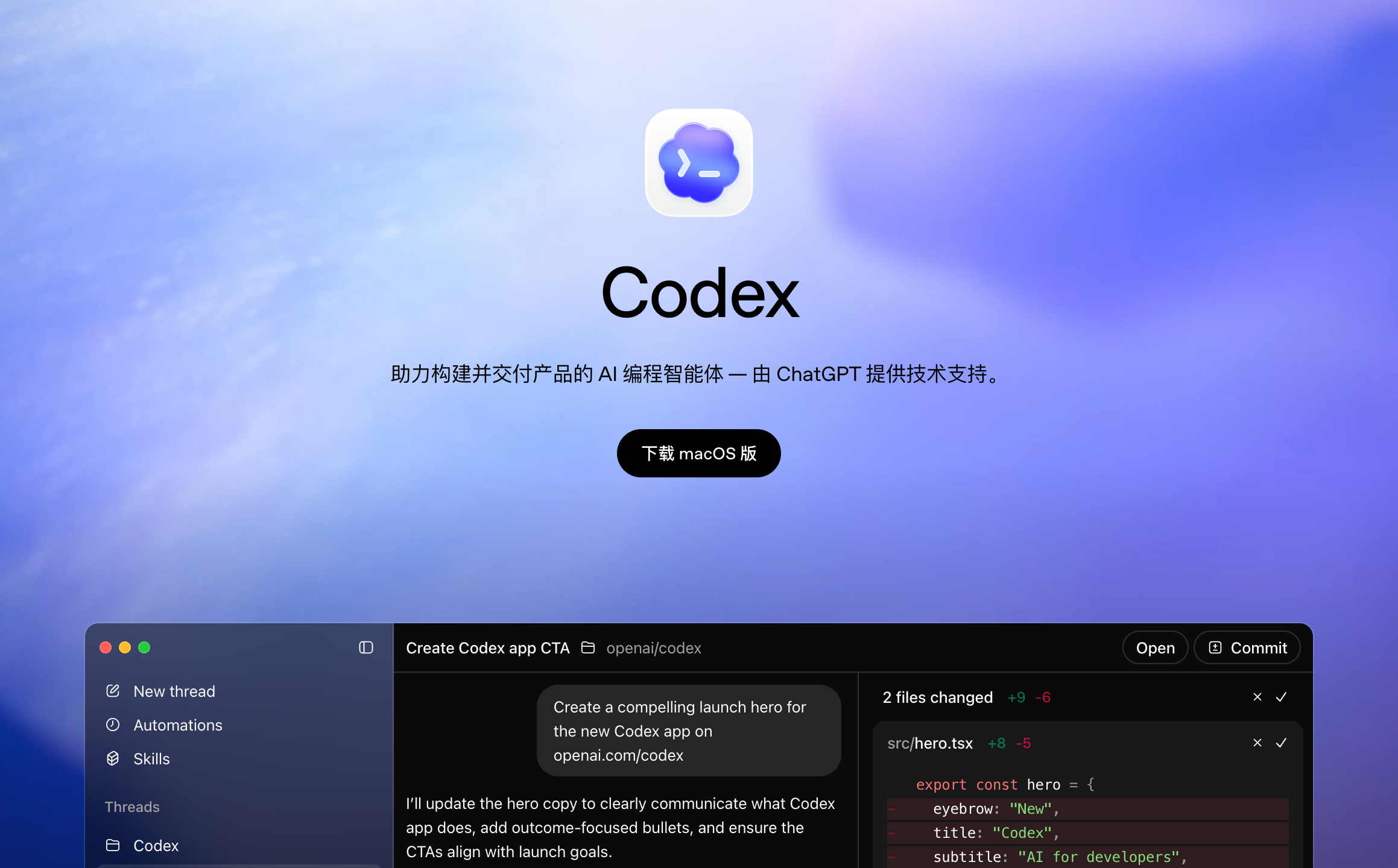
Image Source: OpenAI
For Codex to continue gaining traction in the enterprise market, OpenAI will likely have to prioritize inference resources for Codex's enterprise users, potentially even squeezing ChatGPT's computational supply.
In essence, for Codex to outperform Claude Code, it can't rely solely on Sam Altman's promotion on X or just two months of free access. It must convince enterprises that it will remain just as good, fast, and affordable after the trial period ends. This is the most realistic threshold for Codex to win back enterprise clients.
Epilogue
Codex's two-month free offer is undoubtedly an aggressive move, targeting the migration window of enterprise clients. Whether it's Claude Code's mindshare advantage among enterprise clients or Anthropic's lead in enterprise payment data, it's clear that OpenAI can't rely solely on ChatGPT's brand.
However, migration in the enterprise market tends to be slower, especially when Claude Code has already become the default recommendation for many engineering teams. OpenAI needs more than just a promotion; it requires stable performance over several months or even longer. The free trial may get enterprises through the door, but the real reason they stay is straightforward: Can it consistently write good code, fix problems, free the team from repetitive labor, and not make quotas and costs a new source of anxiety?
In summary, in this battle from AI coding agents to AI agents, OpenAI has returned to the fray, but to dislodge Claude Code from its default position in developers' minds, two months of free access is just the first step. The real challenge is getting enterprises to continue paying after the trial ends.
OpenAI, Anthropic, Claude, Codex
Source: Leikeji
Images in this article come from: 123RF Royalty-Free Image Library
-
![]()
From Energy Conservation and Carbon Reduction to AI Decision-Making: GECON East Intelligence and Chery Group Explore a New Green and Smart Paradigm for Automobile Manufacturing
-
![]()
WAIC 2026 Observation | AI Accelerates Towards the Core of Industries, Industrial AI Enters a Critical Phase
-
![]()
Volkswagen China Fires the First Shot in Foreign-Funded 'White Box Delivery'!
-
![]()
AI Agent Smartphones: The Next Competitive Edge Transcends Large Models
-
![]()
Over 880 Million Yuan Worth of Orders Unveiled, Bidding Launched for Shenzhen Eastern Public Transport
-
![]()
Tesla's Robotaxi Hits the Road: A Monumental Gamble with an Uncertain Future
-
![]()
Ford and Geely Forge New Joint Venture in Spain, Sidestepping Changan and JMC
-
![]()
199 RMB! Godox's First Camera Review: Subpar Photography, Transparent Viewfinder Frame is the Highlight