Holding Similar AI “Passes,” Alibaba and Tencent Have Transformed Beyond Recognition
 05/15 2026
 451
451
Produced by | RoboIsland
The time has come again for internet giants to unveil their financial results, and the capital market has responded positively. Alibaba's U.S.-listed shares surged 8% overnight, while Tencent's ADRs rose by 4%.
A closer examination of the two financial reports unveils a nuanced truth: armed with similar AI “passes,” the two companies have evolved into versions of themselves that are barely recognizable.
Alibaba has delivered a visually arresting report card: an operating loss of RMB 848 million in the fourth fiscal quarter, a staggering 84% year-on-year decline in adjusted EBITA, and a net outflow of RMB 46.6 billion in free cash flow for the year.
Yet, simultaneously, Alibaba Cloud's external revenue growth soared to 40%, with AI-related product revenue surpassing 30% for the first time, and annualized recurring revenue exceeding RMB 35.8 billion.
This financial report, filled with contradictions, is akin to a gambler placing all their chips on the AI square and declaring to the market: Look, I've won.
Tencent presents a contrasting scenario: revenue of RMB 196.458 billion, up 9% year-on-year; net profit attributable to shareholders of RMB 58.1 billion, up 21% year-on-year; gross margin rising from 56% to 57%; and free cash flow of RMB 56.7 billion.
However, excluding the impact of revenue and expenditure from new AI products, operating profit would have grown by 17% instead of 9%. In just one quarter, new AI products consumed nearly RMB 8.8 billion in profits.
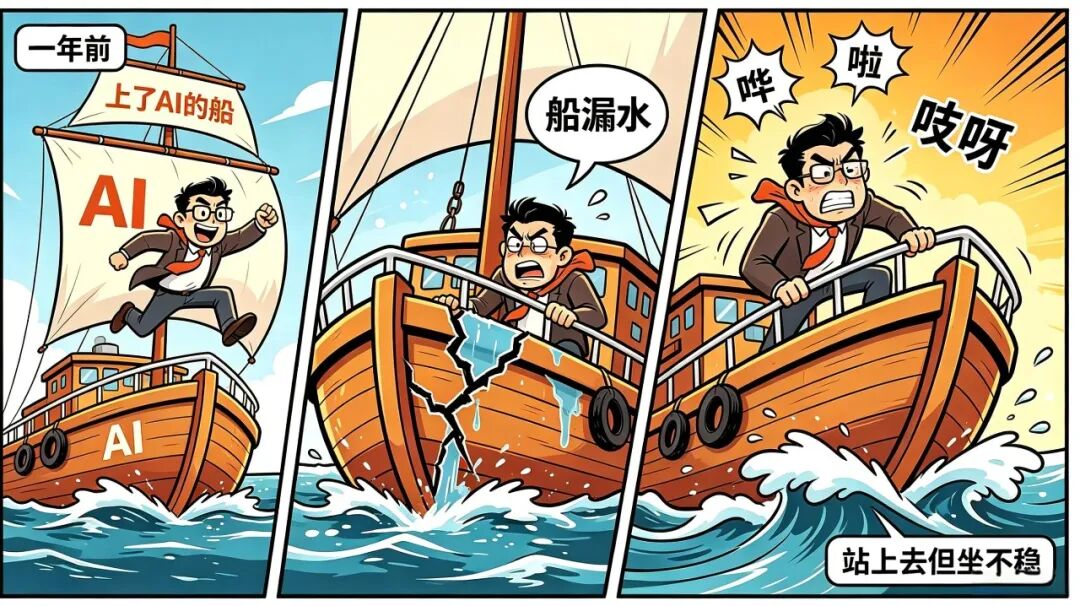
Pony Ma candidly stated at the shareholders' meeting: 'A year ago, we thought we were on board, but later found the ship was leaking. Now, we feel like we've stepped onto it, but we still can't sit comfortably.'
Two financial reports, two narratives. One declares, 'I bet right,' while the other admits, 'I'm still catching up.'
I. Cash Cows and Money Burners
Let's begin with Tencent.
Tencent's financial report conceals a secret: excluding the impact of new AI products like Hy, Yuanbao, CodeBuddy, and WorkBuddy, Non-IFRS operating profit for the first quarter grew 17% year-on-year to RMB 84.4 billion, eight percentage points higher than the reported growth rate.
In essence, Tencent is utilizing profits from its core businesses to nourish an AI team still in its infancy.
So, who's supporting the family? The answer remains consistent: games and advertising.
Value-added services revenue reached RMB 96.1 billion, up 4% year-on-year. Timeless games like Honor of Kings, Peacekeeper Elite, and Delta Force achieved record-high quarterly revenues, with domestic game revenue up by double-digit percentages year-on-year.
The advertising business shone brightly, with first-quarter revenue of RMB 38.2 billion, up 20% year-on-year. AI-driven upgrades to recommendation models boosted both ad prices and delivery effectiveness. Revenue from financial technology and enterprise services reached RMB 59.9 billion, up 9% year-on-year, with enterprise services revenue growing 20% year-on-year and cloud services accelerating amid AI demand.
The only laggard was social networks, with revenue down 2% year-on-year to RMB 31.9 billion, primarily due to deferred revenue from in-game item sales caused by timing differences during the Spring Festival holiday—a technical factor rather than a fundamental issue.
Tencent's R&D investment is also noteworthy: first-quarter R&D expenditure reached RMB 22.542 billion, up 19% year-on-year; capital expenditure hit RMB 31.94 billion, up 16% year-on-year. Sales expenses surged from RMB 7.5 billion per quarter in the past to RMB 11.3 billion, primarily for marketing new AI products.
In terms of R&D achievements, the Hy3 preview model has consistently ranked high in token consumption on OpenRouter since April 28, and WorkBuddy has become China's most popular AI efficiency agent service.
Now, let's turn our attention to Alibaba.
Alibaba Cloud Intelligence Group's quarterly revenue reached RMB 41.626 billion, up 38% year-on-year. AI-related product revenue hit RMB 8.971 billion, marking the 11th consecutive quarter of triple-digit growth and accounting for over 30% of cloud external commercialization revenue for the first time.
Alibaba CEO Wu Yongming announced: 'Alibaba's full-stack AI technology investment has officially moved beyond the initial cultivation stage and entered a cycle of positive, large-scale commercial returns.'
Yet, Alibaba's profit statement has been nearly wiped out. Adjusted EBITA was just RMB 5.102 billion, down 84% year-on-year, with a net outflow of RMB 17.3 billion in free cash flow, compared to a net inflow of RMB 3.7 billion in the same period last year.
The main culprits dragging down profits were threefold: massive subsidies for Taobao Flash Sales, user acquisition investments for Qianwen App, and capital expenditures on cloud infrastructure.
Taobao Flash Sales generated quarterly revenue of RMB 19.988 billion, up 57% year-on-year, driven by heavy subsidies. China's e-commerce group saw adjusted EBITA decline by 40% year-on-year. The 'All Other' segment reported a quarterly loss of RMB 21.1 billion, with the primary reason for the expanded loss being 'increased investment in user acquisition for Qianwen App.'
The good news is that Qianwen App's monthly active users (MAUs) surged to 166 million, surpassing DeepSeek's 127 million and trailing only Doubao. Taobao and Tmall's core business remains stable, with customer management revenue growing 8% on a comparable basis and 88VIP members exceeding 62 million.
II. Pursuing AI or AI-Like?
Both companies view AI as a strategic core but adopt vastly different approaches.
Tencent's AI strategy can be summarized as a natural extension. Tencent isn't building AI from scratch; it's making its existing businesses more AI-driven.
Pony Ma admitted that Tencent may not be the fastest to seize opportunities in the industry: 'We can't just rush in because others are doing it and try to seize their turf. We've tried that before and mostly failed.'
Tencent hasn't been without its missteps. It ventured into e-commerce (Paipai), search (Soso), and microblogging (Tencent Weibo), all of which failed. Those failures taught Ma one thing: you can't win wars on someone else's turf.
So, for AI, he's fighting on his own turf, finding the most lucrative application scenarios within his ecosystem, and letting AI act as an amplifier for his businesses rather than a replacement.
Alibaba's AI strategy is closer to placing a heavy bet on a new hand, gambling that AI itself can become an independent new growth engine.
The Cloud Intelligence Group is the core vehicle. Wu Yongming explicitly stated that 'over the next five years, cloud and AI commercialization revenue will exceed $100 billion annually.' Alibaba Cloud's future holding of computing power center assets will be more than ten times that before the AI boom, with capital expenditures likely far exceeding RMB 380 billion over the next three years.
Qianwen App is another pillar of Alibaba's AI strategy. It's not just a technological showcase but a significant investment in securing a position in the C-end AI entry point. Currently, Qianwen is fully integrated with Taobao and Tmall, attempting to bridge AI with the large consumer ecosystem.
The rationality of the two strategies depends on their respective DNA.
Tencent's strength lies in traffic and scenarios. AI's implementation in these scenarios naturally possesses closed-loop monetization capabilities, eliminating the need to sell AI products separately. Tencent chooses to manage this with a portfolio approach.
This long-term mindset, combined with its two cash cows—games and advertising—makes Tencent's AI strategy appear slow.
Alibaba faces a far more complex situation. While Taobao and Tmall remain its core business, growth has nearly plateaued, and it faces dual pressure from Pinduoduo and Douyin. Goldman Sachs data shows that Taobao and Tmall's GMV market share has slipped to 31%.
Against this backdrop, Alibaba must find a steep growth curve outside its existing businesses, and cloud and AI are virtually the only options.
Alibaba isn't unaware of the financial burn. Wu Yongming said, 'Now, there's hardly an empty card in Alibaba's servers. Customer demand cannot be fully met.' Alibaba is waging a war for the future, gambling that cloud and AI can grow into a sufficiently robust second leg before e-commerce growth peaks.
An interesting detail: Alibaba's annual revenue surpassed RMB 1 trillion for the first time, reaching RMB 1,023.67 billion; Tencent's first-quarter gross profit was RMB 111.3 billion, with a gross margin of 57%.
Trillion-dollar revenue vs. ultra-high gross margin—these are snapshots of two distinct business models: Alibaba focuses on scale, while Tencent focuses on profitability.
III. The Most Expensive 'Free' AI Assistant
Several definitive signals emerge from this round of financial reports, with the most intuitive one being: AI is transitioning from narrative to revenue.
Tencent's advertising revenue growth accelerated from 17% to 20%, with the financial report explicitly attributing it to AI-driven upgrades to recommendation models; enterprise services revenue grew 20% year-on-year, benefiting from demand for AI-related services.
Alibaba's cloud external commercialization revenue growth accelerated to 40%, with AI product revenue achieving triple-digit growth for the 11th consecutive quarter and annualized recurring revenue surpassing RMB 35.8 billion.
These aren't just promising futures in PPTs; they're tangible contributions to the income curves of these tech giants.
At the same time, AI is being priced.
Tencent's capital expenditure payments reached RMB 37 billion in the first quarter, while Alibaba's capital expenditures hit RMB 26.887 billion. Tencent's sales expenses surged 44% year-on-year to RMB 11.3 billion, while Alibaba's 'All Other' segment reported a quarterly loss of RMB 21.1 billion due to Qianwen's user acquisition efforts.
AI investments aren't free; they're consuming profits at an alarming rate. More notably, both companies indicate this is just the beginning. Tencent expects capital expenditures to continue rising throughout 2026, while Alibaba has vowed to 'far exceed RMB 380 billion.'
The most controversial signal is that AI has reached the point where users may need to pay. The choices of tech giants have begun to diverge.
Tencent's efficiency AI products like WorkBuddy, CodeBuddy, and QClaw naturally follow a B2B subscription model, with businesses paying for efficiency.
Alibaba's Qianwen App takes a different path: burn money to scale up user numbers first, then explore monetization possibilities—a traffic monetization logic repeatedly validated during the mobile internet era.
Which AI are users more willing to pay for? There's no clear answer yet, but some signals are worth noting.
Tencent's enterprise services revenue grew 20%, indicating that B-end clients are indeed paying for AI capabilities; Qianwen App surpassed 166 million users, but there's no data yet on how many of those 166 million are willing to pay.
IV. Conclusion
If we use personality as a metaphor, Tencent resembles an experienced fund manager holding two surefire winners—games and advertising. Regarding AI, this new asset class, Tencent adopts a proactive allocation strategy but doesn't bet the house.
It knows what to heavily invest in (advertising, enterprise services), what to test (standalone AI products), and what to abandon outright.
Alibaba resembles a desperate entrepreneur on the eve of industry transformation. Its core e-commerce business is on defense, its instant retail operations are attacking, and its AI efforts are charging ahead.
Fighting on three fronts is exhausting, but Alibaba has no retreat. Wu Yongming's statement that 'the window of opportunity may only last a few years' underscores its all-in gamble on AI, even at the cost of obliterating profits.
Neither personality is inherently superior.
Tencent's calm comes from the time dividend provided by its business structure, as games and social media are natural allies of time. Alibaba's urgency stems from its competitive landscape, as e-commerce is a natural enemy of time.
Every company is answering the same question in its own way: When the AI tide arrives, do you choose to make AI an accelerator for old businesses or let AI become the new business itself? Tencent chose the former; Alibaba chose the latter.
History will provide the answer, but at least in this quarter's financial reports, the company with stronger payment capacity appears to be under less pressure.
Whether the AI bill makes sense from the tech giants' perspective will become clearer in next quarter's and next year's financial reports. But for Chinese users surrounded by various AI products—whether enterprise clients paying for WorkBuddy or ordinary netizens lured by Qianwen App's subsidies—this quarter has been a pleasant one.
© RoboIsland. All rights reserved. No reproduction without authorization.
-
![]()
Why Does Jensen Huang So Openly Praise China’s AI?
-
![]()
"Wudang" Unveiled: Arm China's Next-Gen AI VPU Redefines Video Encoding
-
![]()
From Energy Conservation and Carbon Reduction to AI Decision-Making: GECON East Intelligence and Chery Group Explore a New Green and Smart Paradigm for Automobile Manufacturing
-
![]()
WAIC 2026 Observation | AI Accelerates Towards the Core of Industries, Industrial AI Enters a Critical Phase
-
![]()
Volkswagen China Fires the First Shot in Foreign-Funded 'White Box Delivery'!
-
![]()
AI Agent Smartphones: The Next Competitive Edge Transcends Large Models
-
![]()
Over 880 Million Yuan Worth of Orders Unveiled, Bidding Launched for Shenzhen Eastern Public Transport
-
![]()
Tesla's Robotaxi Hits the Road: A Monumental Gamble with an Uncertain Future