The Year’s Largest IPO of 380 Billion Yuan is on the Horizon
 05/15 2026
 511
511

NVIDIA, with a staggering market capitalization of $5.5 trillion, is about to face a formidable competitor.
Soon, chip manufacturer Cerebras will make its debut on the Nasdaq stock exchange. Its IPO is priced at $189 per share, aiming to raise $5.55 billion and achieve a valuation of $56.4 billion (approximately 380 billion yuan).
This will mark the largest global IPO of the year and is likely to hold that title for the entire first half.
Why is Cerebras generating so much buzz? Because it aims to challenge NVIDIA's dominance in AI computing chips.
Cerebras indeed possesses a unique edge.
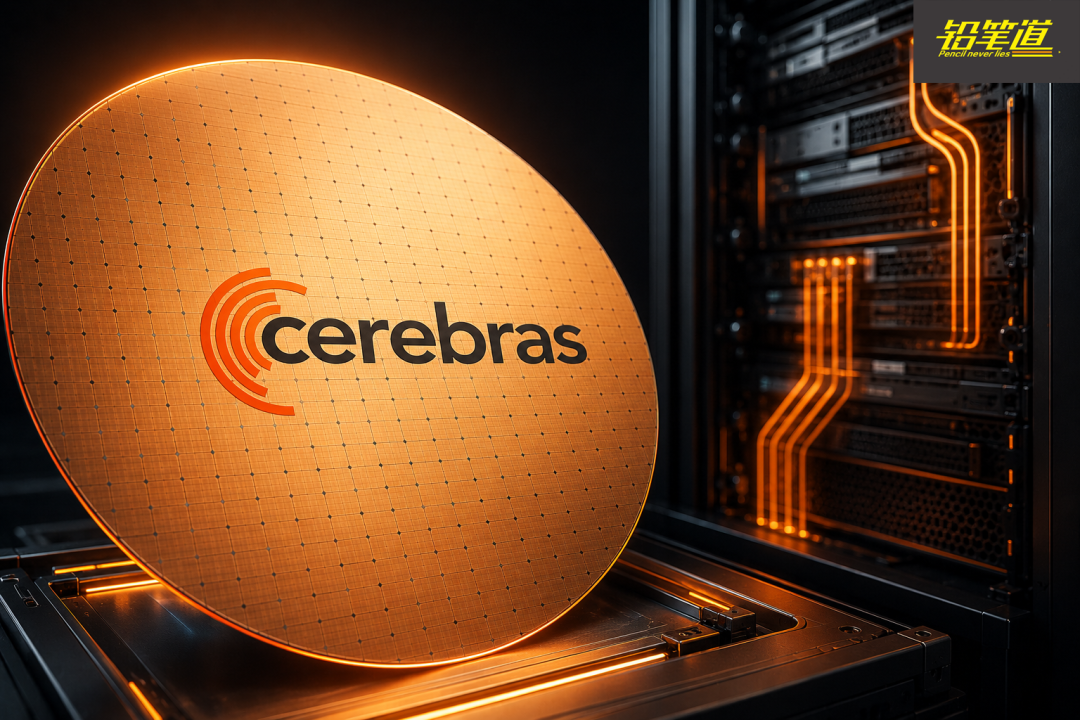
While NVIDIA and AMD's GPUs are manufactured by slicing a whole wafer into numerous small chips before packaging, Cerebras takes the opposite approach—it directly utilizes an entire 12-inch wafer as a 'giant chip' for AI inference.
This chip is the largest in human history, with OpenAI placing a staggering $10 billion order.
Let's delve into how it operates.
- 01 - A Direct Approach to Tackling a Complex Challenge
Founded in 2016 and headquartered in Sunnyvale, California, Cerebras specializes in AI training and inference chips, along with complementary servers and cloud services.
The company's flagship product is the Wafer-Scale Engine (WSE), now in its third generation (WSE-3).
How remarkable is this chip?
Traditional GPUs are roughly the size of a stamp. In contrast, Cerebras' WSE is an entire wafer, comparable in size to a dinner plate. It boasts nearly 4 trillion transistors and over 900,000 AI computing cores, functioning as a single chip across the entire wafer.
It aims to address a growing issue in the AI industry: GPU clusters are becoming increasingly complex.
Training large models now necessitates the connection of thousands or even tens of thousands of GPUs via high-speed networks.
However, more GPUs equate to higher communication latency. Often, models are not slow due to computation but rather due to communication bottlenecks.
Cerebras adopts an aggressive strategy: Instead of assembling numerous GPUs, it constructs a single super-large chip. It integrates computing, storage, and network communication onto a single wafer, reducing the need for frequent data movement between multiple GPUs.
The advantages are evident: lower latency, reduced power consumption, faster training and inference speeds, and easier scalability for extremely large models.
It is considered the most unconventional approach outside of NVIDIA's GPU ecosystem.
How did this innovative idea originate? We must acknowledge the founder.
Founder Andrew Feldman is a seasoned entrepreneur who co-founded SeaMicro, a low-power server company, before establishing Cerebras.
In 2012, AMD acquired SeaMicro for approximately $334 million.
He later realized that the costs associated with data movement in deep learning were escalating. If the AI era continued with the CPU/GPU model of splicing small chips together, bottlenecks would inevitably arise.
Thus, he decided to undertake what many in the industry considered impossible: building wafer-scale chips.
The industry deemed him insane. Because if you create a single chip, any flaw could render the entire chip useless. That's why wafers are typically cut into smaller pieces.
Feldman had a different perspective: While he couldn't guarantee a flawless chip, he could design the system to operate around flaws, utilizing only the functional areas.
In 2019, Cerebras unveiled its first-generation wafer-scale chip. They succeeded.
Cerebras has raised between $2.5 billion and $3 billion in total funding, a relatively high amount among AI chip startups. Its valuation after the final funding round was $23 billion, which was adjusted to $56.4 billion just before going public.
- 02 - Skyrocketing Revenue, With $24.6 Billion in New Orders
Cerebras truly shone in the past two years as AI inference became increasingly important.
Its primary selling point is AI inference chips. It positions itself as an alternative to GPUs for AI inference, thanks to its extremely large single-chip design, ultra-high memory bandwidth, and low GPU communication overhead, resulting in exceptionally low inference latency.
Cerebras' revenue skyrocketed from $24.6 million in 2022 to $510 million in 2025, marking a 19-fold increase over four years, including a 76% year-over-year jump in 2025. Net profit swung from a $482 million loss in 2024 to a $238 million profit in 2025, achieving a remarkable turnaround.
Few AI hardware companies have matched Cerebras' growth rate.
However, its revenue is highly concentrated. In 2025, 86% came from two Middle Eastern clients: G42 and MBZUAI.
G42 is a technology company controlled by an Abu Dhabi sovereign fund, while MBZUAI is the Mohamed bin Zayed University of Artificial Intelligence in the UAE. MBZUAI alone accounted for 62%.
This indicates that Cerebras has not yet achieved broad market penetration but is being supported by a few major clients.
Why this revenue structure? Because Cerebras does not sell standard chips. It sells entire AI supercomputing systems, including WSE chips, servers, networking, software, data center deployment, and AI inference facilities.
It is naturally suited for national AI projects, supercomputing centers, and large model companies—exactly what Abu Dhabi seeks for its sovereign AI infrastructure and independent AI clusters.
Cerebras' revenue growth is not the most astonishing aspect. What stunned capital markets was its $24.6 billion backlog. A company with $510 million in revenue claims $24.6 billion in future revenue.
It signifies that the AI industry is shifting from selling chips to pre-ordering token throughput capacity.
Who placed these orders?
The majority came from OpenAI, whose CEO, Sam Altman, was an early investor in Cerebras.
OpenAI and Cerebras signed a 750MW AI computing deal, conservatively estimated at over $10 billion, with actual commitments likely exceeding $20 billion. The agreement extends through 2028.
OpenAI may also provide approximately $1 billion to support Cerebras' data center construction and could eventually hold up to 10% of Cerebras' shares. Their relationship now extends beyond customer-supplier to joint AI infrastructure development.
Previously, many U.S. media outlets, while impressed by Cerebras' technology, would note: 'It lacks real major clients.' After OpenAI's deal, everything changed.
Another client is G42, mentioned earlier. Among the $24.6 billion in orders, G42 likely accounts for several billion dollars, though no specific amount is disclosed in public filings.
- 03 - Challenging NVIDIA? Not So Quick
Can Cerebras truly challenge NVIDIA? This is a key concern for investors and the AI industry.
Conclusion: It is still far from a real challenge.
The real issue is not whether Cerebras' chips are powerful enough—it's that NVIDIA is no longer just a chip company.
NVIDIA's greatest strength lies not just in its GPUs but in its CUDA software ecosystem. Today, nearly all global AI frameworks, training systems, inference tools, and engineering libraries are built around CUDA. Many companies do not just choose NVIDIA because they have to—they cannot leave CUDA. Meanwhile, Cerebras' software ecosystem maturity still lags far behind CUDA.
More critical is the client structure.
Currently, Cerebras' revenue heavily relies on a few major clients, meaning it resembles a company focused on super-projects rather than a platform enterprise with a broad ecosystem.
Additionally, there's a reality in the industry: No single 'correct' path exists for AI hardware. A study on AI accelerators released this year by Harvard and other institutions noted that optimal hardware platforms vary across different AI workloads. Cerebras, Groq, TPUs, Gaudi, and GPUs each excel in specific scenarios. In other words, while Cerebras may outperform GPUs in certain inference scenarios, it does not mean it can fully replace NVIDIA.
NVIDIA has also established strong supply chain control. What the AI industry truly lacks now is not just GPUs but CoWoS advanced packaging, HBM memory, power, data centers, and networking equipment. NVIDIA has deeply integrated with TSMC's advanced packaging capacity, Micron's memory, and SK Hynix's HBM. This means even if Cerebras' architecture succeeds, it still relies on the same supply chain.
Moreover, Cerebras' business model inherently makes it harder to scale like NVIDIA. NVIDIA sells standardized products. Cerebras resembles super-customized projects—inherently heavier, slower, and more dependent on major clients.
This article does not constitute investment advice.
-
![]()
Why Does Jensen Huang So Openly Praise China’s AI?
-
![]()
"Wudang" Unveiled: Arm China's Next-Gen AI VPU Redefines Video Encoding
-
![]()
From Energy Conservation and Carbon Reduction to AI Decision-Making: GECON East Intelligence and Chery Group Explore a New Green and Smart Paradigm for Automobile Manufacturing
-
![]()
WAIC 2026 Observation | AI Accelerates Towards the Core of Industries, Industrial AI Enters a Critical Phase
-
![]()
Volkswagen China Fires the First Shot in Foreign-Funded 'White Box Delivery'!
-
![]()
AI Agent Smartphones: The Next Competitive Edge Transcends Large Models
-
![]()
Over 880 Million Yuan Worth of Orders Unveiled, Bidding Launched for Shenzhen Eastern Public Transport
-
![]()
Tesla's Robotaxi Hits the Road: A Monumental Gamble with an Uncertain Future