The Pioneering AI-Native Enterprises Are Stealthily Emerging in Yiwu
 05/15 2026
 609
609
Extending the timeline, it becomes evident that the evaluation criteria for AI Agents will increasingly emphasize practicality. The focus of observation will shift from product launch events or model parameters to the comprehensive fulfillment of needs, the augmentation of productivity across various roles, and the nuanced understanding and assessment of product evolution.
Whether it's DingTalk Wukong, a plethora of AI Agents, or enterprises across diverse industrial sectors, a pragmatic, results-driven era of enterprise AI is quietly ushering in. The entity that can first substantiate genuine value will secure a competitive advantage in this arena.
Author | Pi Ye
Produced by | Industry Insight
"Why is Anthropic Even More 'Pricey' Than OpenAI?"
Delving into overseas AI forums or technical stacks, one finds this question gaining traction among developers and enterprise users worldwide. In the ongoing month of May, recent speculative valuations place Anthropic's pre-IPO valuation at a staggering $1.2 trillion, with OpenAI trailing at approximately $1.1 trillion. The former, established a mere five years ago, has officially eclipsed the latter.
While the outcome may be surprising, the current valuation landscape is not incomprehensible. From a business model standpoint, Anthropic primarily targets the deterministic enterprise AI market, focusing on deterministic enterprise clients with exceptionally high user loyalty. In contrast, despite OpenAI's forays into the enterprise market over the past year or two, consumer-end payments still constitute a significant portion of its current business model, with relatively modest penetration and pricing in the enterprise sector.
A clear inference is that the consensus value anchor for AI products now resides in the enterprise AI market.
This consensus is also gaining momentum in the Chinese market. In 2026, compared to the traffic-oriented, model-centric, and parameter-focused approach of previous years, the current market's new benchmark for AI is effectiveness, tangible results, and performance.
In essence, whoever can genuinely assist enterprises in forging new productivity in real-world scenarios and catalyzing transformations in their business models and organizational structures will have their value more readily acknowledged based on these real, observable growth enhancements.
Indeed, Alibaba's recent stock price surge following the release of its financial report underscores this point. Firstly, AI has commenced its journey into a period of commercial returns. Secondly, expectations for a surge in demand for enterprise-grade Agents have risen, with both cloud services and enterprise Agent businesses widely perceived as promising.
Simultaneously, Alibaba's enterprise-grade Agent platform, "Wukong," has gradually scaled up and entered the commercial verification phase in recent times.
So, from a supply-side perspective, compared to overseas new service paradigms for enterprise AI, ranging from Anthropic to Rox.AI (customer management), what kind of AI do Chinese enterprises require to bolster their productivity?
I. Enterprise Workflows: The New Crucible for AI
"Many AI products are adept at chatting but have little relevance to our enterprise," remarked Wu Tianming.
He is the founder of Suzhou Guangxian Energy Construction Co., Ltd. At the outset of 2026, amidst the AI Agent boom, he became a paying user of various Agent products. However, post-usage, none of these products met his expectations.
His core demand is straightforward: to leverage AI to assist Guangxian Energy in efficiently managing nearly a million internal order data points. Previously, much of the data was stored on third-party platforms, and he sought AI to aid in organizing, summarizing, and analyzing all the data. In essence, Wu Tianming desired AI to genuinely infiltrate Guangxian Energy's core workflow.
DingTalk Wukong emerged as his ultimate choice. Now, encompassing order data management, corporate regulations, and cultural systems, Guangxian Energy has developed specialized skills based on Wukong, and an AI-native business model has already been successfully implemented internally.
Such demands are not isolated incidents. A more precise perspective is that, compared to the trend-driven purchases of previous years, enterprises' requirements for Agents have now entered a phase of commercial value assessment, with the core scenarios being the enterprise's primary workflows.
What does this shift in metrics signify?
For Agents to confer value in real enterprise workflows, beyond parameters, they must possess several capabilities, such as contextual understanding of enterprise businesses, the ability to integrate into existing enterprise SaaS or AI workflows, and the ability to generate skills while maintaining compatibility with external skills to ensure continuous Agent evolution, along with crucial security and cost control.
But this is no small feat.
According to Gartner and other institutions, over the past few years, more than 60% of enterprises have encountered challenges such as system integration difficulties and compliance hurdles when utilizing AI. Moreover, in over 40% of enterprises, some AI assistants have been relegated to mere "chat tools," with an ROI that is simply immeasurable.
Various issues abound. For instance, typical contextual understanding problems primarily manifest in two ways: difficulty in identifying enterprise business knowledge, often leading to hallucinations and illusions when employees use them to answer questions or perform tasks, and an inability to recognize the enterprise's real workflow, making it difficult to autonomously advance even small closed loops in certain processes.
Another recurring issue is "incompatibility." For many AI Agents, integrating with enterprise personnel systems, business systems, financial systems, and production systems is challenging, leading to a series of "AI silo" problems, where Agents struggle to collaborate with each other and with existing software.
This was also the predicament Wu Tianming encountered earlier.
From a certain vantage point, these implementation flaws correspond to the commercial flaws of some AI solutions. So, is there any AI that can genuinely operate in real enterprise scenarios and become a new driving force for enterprises? Or, is the case of Guangxian Energy replicable?
In the current industrial landscape, we have also unearthed another batch of enterprise exemplars.
II. The Pioneering AI-Native Enterprises Are Stealthily Emerging
Yiwu, Zhejiang, stands as a unique model in Chinese commercial history.
Based on the front-shop, back-factory model, it can swiftly complete the production of goods from back-end factories to front-end stores and sell them to the global market. This extreme efficiency within a confined space places high demands not only on equipment but also on process efficiency.
However, these high demands have remained unmet for numerous years.
Take "competitive analysis," a pivotal daily task for most merchants, as an example. As a core link for merchants where "information gap equals competitiveness," this task has been manually executed for years, with each person able to monitor at most 20+ channels per day, lacking supervision over other information sources.

Another instance is store management. As a business model blending online and offline operations, most merchant operation managers dedicate a significant portion of their day to summarizing and reviewing data from stores on platforms like Taobao, Tmall, and 1688 to better formulate the next sales strategy.
And product development, platform operations, etc., can be understood as follows: over the past few decades, the existing personnel efficiency model has been misaligned with Yiwu's extreme efficiency model of "front-shop, back-factory."
But this year, one enterprise has discovered a novel solution: Zhejiang Youkela Intelligent Technology. Located in Yiwu, it is a hidden champion in China's lighting industry, developing, producing, and selling products tailored to the lighting needs of consumers at home and abroad.
This year, driven by CEO Wei Jun, the enterprise's operational mode has undergone subtle transformations, or it could be said that it is quietly evolving into an AI-native enterprise.
For instance, based on AI, the core workload of Youkela's HR department has been reduced from two days per month to "less than ten minutes." In the competitive analysis process, AI tracks the top 100 daily sales items, proactively analyzes the price band distribution and product description characteristics of competitors, and provides real-time operational strategy recommendations.
And in product development, store inspections, etc., Youkela has also achieved new process reshaping based on AI. For example, based on skills developed by the team, AI can collect and analyze user comments across the web, deriving product development directions from real needs. Additionally, AI automatically generates daily reports on the operation of all stores, aiding the team in better review and analysis.
They are also utilizing DingTalk Wukong.
The transformations are not confined to business models; organizational forms are also quietly evolving. Under Wei Jun's decision, Youkela's most capable talents were reassigned from sales positions to skill development positions. "Those who can develop skills are the ones with the most abundant current or frontline business experience, and the quality of the skills they develop is the best."
This is not Wei Jun's inaugural interaction with DingTalk. Previously, Youkela's operations were "80% data capture and 20% decision analysis." However, with the support of DingTalk's AI spreadsheets, this ratio has been completely reversed: AI automatically captures business data and fills it into AI spreadsheets, with AI able to extract product pain points and design directions from 5,000+ comments in just 15 minutes.
This system aided them in increasing the success rate of new product launches from 60% to 92%.
From a broader perspective, if AI spreadsheets assisted Youkela in solving the "automated processing of structured data," then Wukong has propelled this Yiwu enterprise a step further: AI is no longer just a tool but a digital employee capable of directly completing tasks in various links and embedding into real business systems. The "human + Wukong" work mode has supplanted the original collaboration between individuals, doubling efficiency.
III. Behind Wukong's Scaling: The Enterprise Battlefield Welcomes AI's Definitive Expression
Indeed, extending the perspective further, what is visible is not just the low-threshold utilization methods brought by Wukong to Guangxian Energy, Youkela, and others, but rather that DingTalk and Wukong together have constructed a closed loop for enterprises, from the soil environment to AI product expression.
The documents, spreadsheets, chat records, etc., amassed on DingTalk over the years serve as the harness system for the implementation of enterprise Agents. Wukong, based on a comprehensive understanding of enterprise contexts, seamless integration with existing systems, and various enterprise-grade AI settings, aids enterprises in constructing optimal business practices. It directly outputs corresponding results based on a "model + product" system engineering approach, assisting enterprises in completing tasks.
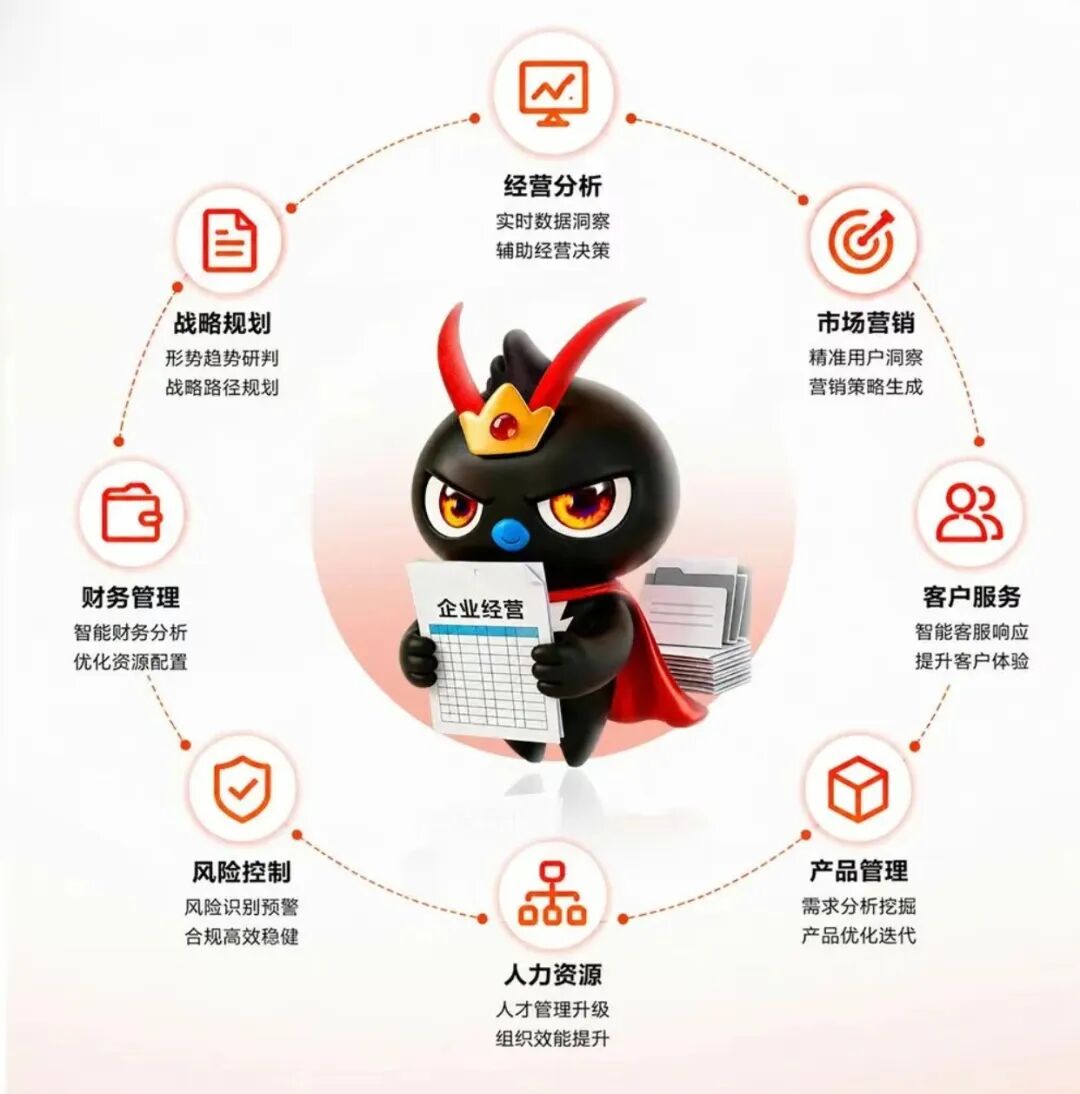
This ease of use, accuracy, and security also constitute Wukong's new characteristics: it is evolving into an ecological platform that propels enterprises towards AI-native transformation. Based on this enterprise AI positioning, enterprises can build skills that are sufficiently adapted to themselves using various components within it, thereby genuinely making AI work for them.
And with the occurrence of these transformations, enterprise evolution will gradually transition from business processes to organizational processes. Roles such as development, management, and operations can all be redefined, with new AI-era native organizational forms built based on Wukong.
This is precisely the value of DingTalk Wukong in the current Chinese AI market. If Qianwen, Doubao, and Kimi are constructing traffic models based on the consumer-end, attempting more to meet the needs of consumer-end users in the AI era for search, shopping, travel, etc., then DingTalk Wukong is exploring the certainty of AI in enterprise scenarios. This certainty is specifically expressed in the reshaping of existing business processes, the enhancement of personnel productivity in different roles, and the promotion of the construction of new enterprise organizational forms.
For now, compared to the former, the quantitative indicators of the latter are more specific and clear, and even more "ruthless." However, correspondingly, their manifestation in commercial value is also more concrete: how many enterprises are willing to pay for it, how many tokens enterprises have consumed through Agents, and what revenue growth enterprises have achieved with the support of Agents...
Extending the timeline, it becomes evident that in the times ahead, the evaluation value of Agents will increasingly emphasize practicality. The perspective of observation will no longer be at product launch events or in model parameters, but rather in the comprehensive fulfillment of needs, the augmentation of productivity across various roles, and the nuanced understanding and assessment of product evolution.
Whether it's DingTalk Wukong, a plethora of AI Agents, or enterprises across diverse industrial sectors, a pragmatic, results-driven era of enterprise AI is quietly ushering in. The entity that can first substantiate genuine value will secure a competitive advantage in this arena.
-
![]()
From Energy Conservation and Carbon Reduction to AI Decision-Making: GECON East Intelligence and Chery Group Explore a New Green and Smart Paradigm for Automobile Manufacturing
-
![]()
WAIC 2026 Observation | AI Accelerates Towards the Core of Industries, Industrial AI Enters a Critical Phase
-
![]()
Volkswagen China Fires the First Shot in Foreign-Funded 'White Box Delivery'!
-
![]()
AI Agent Smartphones: The Next Competitive Edge Transcends Large Models
-
![]()
Over 880 Million Yuan Worth of Orders Unveiled, Bidding Launched for Shenzhen Eastern Public Transport
-
![]()
Tesla's Robotaxi Hits the Road: A Monumental Gamble with an Uncertain Future
-
![]()
Ford and Geely Forge New Joint Venture in Spain, Sidestepping Changan and JMC
-
![]()
199 RMB! Godox's First Camera Review: Subpar Photography, Transparent Viewfinder Frame is the Highlight