After Being 'Inspired' by DeepSeek, Kimi Finally Discovers Its Path
 05/15 2026
 685
685

Source | Yuan Media Group
Recently, the domestic AI sector has been buzzing with news of two significant funding rounds.
According to comprehensive reports, DeepSeek is set to embark on its inaugural funding round, targeting an impressive 50 billion yuan (RMB, unless stated otherwise), with a post-money valuation reaching 350 billion yuan. Concurrently, Moonshot AI (Kimi) has reportedly secured $2 billion in funding, with a post-money valuation exceeding $20 billion, bringing its total cumulative funding to over 37.6 billion yuan—the highest among domestic large-scale model startups.
Geographically, both companies are situated in the Zhichun Road area of Haidian District, Beijing, less than 2 kilometers apart, just a short ten-minute walk. Over the past year, they have maintained a similar pace in technological innovation and paper publication, often updating in quick succession. In 2026, this "unspoken understanding" continued—just four days after Moonshot AI unveiled Kimi K2.6, DeepSeek unexpectedly launched its V4 version.
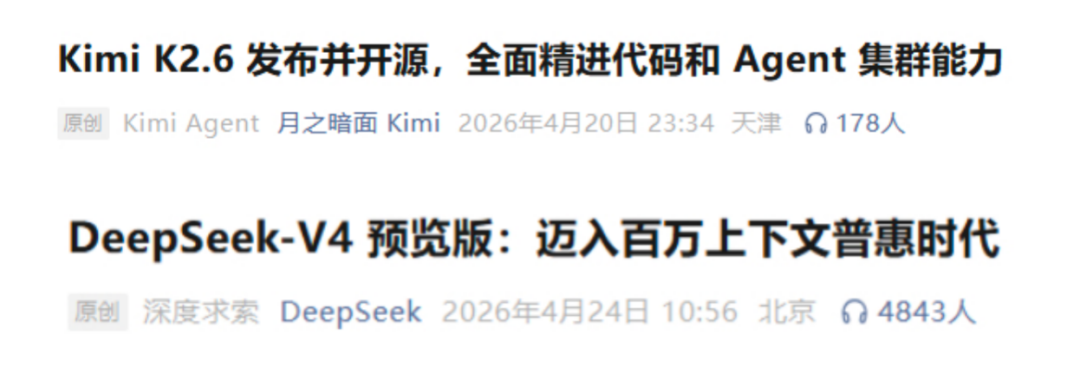
Image source: Official releases from Moonshot AI (Kimi) and DeepSeek
Now, the renewed alignment in funding timelines underscores two distinct development trajectories and strategic rationales.
Over the past year and a half, Kimi has undergone a remarkable transformation, rebounding from a challenging period. This narrative lacks dramatic twists but features an intriguing detail: when DeepSeek unexpectedly gained prominence, capturing widespread attention, Kimi's internal team felt no resentment. Instead, they genuinely believed DeepSeek deserved gratitude.
Because DeepSeek demonstrated two crucial points for the entire industry: the viability of the open-source path and that breakthroughs in large models do not solely rely on "computational power accumulation." This also guided Kimi towards its primary directions for subsequent iterations and commercialization during its dormant phase.
01.
"Embracing Challenges Leads to Progress"
In early 2025, DeepSeek R1 emerged, swiftly becoming the benchmark for domestic AI, overshadowing all competitors. In contrast, Kimi found itself in its most challenging period since inception, with repeated doubts about "Kimi falling behind" surfacing. Rather than rushing to defend itself, Moonshot AI chose to focus on deepening its technological capabilities.
The industry's turning point came in mid-2025 when Kimi officially launched the K2 model—the first domestic trillion-parameter open-source foundational large model—validating the practical value of the second-order optimizer Muon through large-scale deployment. This hardcore technological breakthrough marked a stunning comeback, dubbed "another DeepSeek moment" by Nature magazine, even earning public praise from Elon Musk on social media. Kimi had emerged from the shadow of public skepticism.
Following its technological breakthrough, Kimi's financial situation improved. On the last day of 2025, Yang Zhilin revealed in an internal letter that the company had over 10 billion yuan in cash on hand, stating that the B and C round funding amounts surpassed most IPO fundraising. He also judged that the company could secure more funds from the primary market than the secondary market, so there was no rush to go public.
Leveraging the SOTA performance of the K2 model, Kimi's domestic and international paid user base grew by an average monthly rate exceeding 170% from September to November 2025. Meanwhile, the release of K2 Thinking significantly boosted API revenue, with overseas API income quadrupling. This marked a departure from the industry's common issue of "having technology but no revenue" among domestic large models.
However, what truly propelled Kimi back into the spotlight was the "lobster craze" after the 2026 Spring Festival. The open-source AI agent framework OpenClaw went viral overnight, with Kimi K2.5 widely recognized by the developer community as its "best brain." Together, they enabled ordinary users to have AI take over their phones and computers 24/7.
Kimi then made a strategic move—directly integrating the lobster framework into its product, launching the "Kimi Claw" one-click deployment feature without requiring server purchases or coding. The impact was immediate: the K2.5 model surpassed Gemini 3 and Claude Opus 4.6 to top the OpenRouter usage rankings. Even more impressive were the revenue figures: since late January, Kimi's revenue in just 20 days exceeded its total for 2025. Payment orders in January and February grew by over 8,000% and 120% month-on-month, respectively.
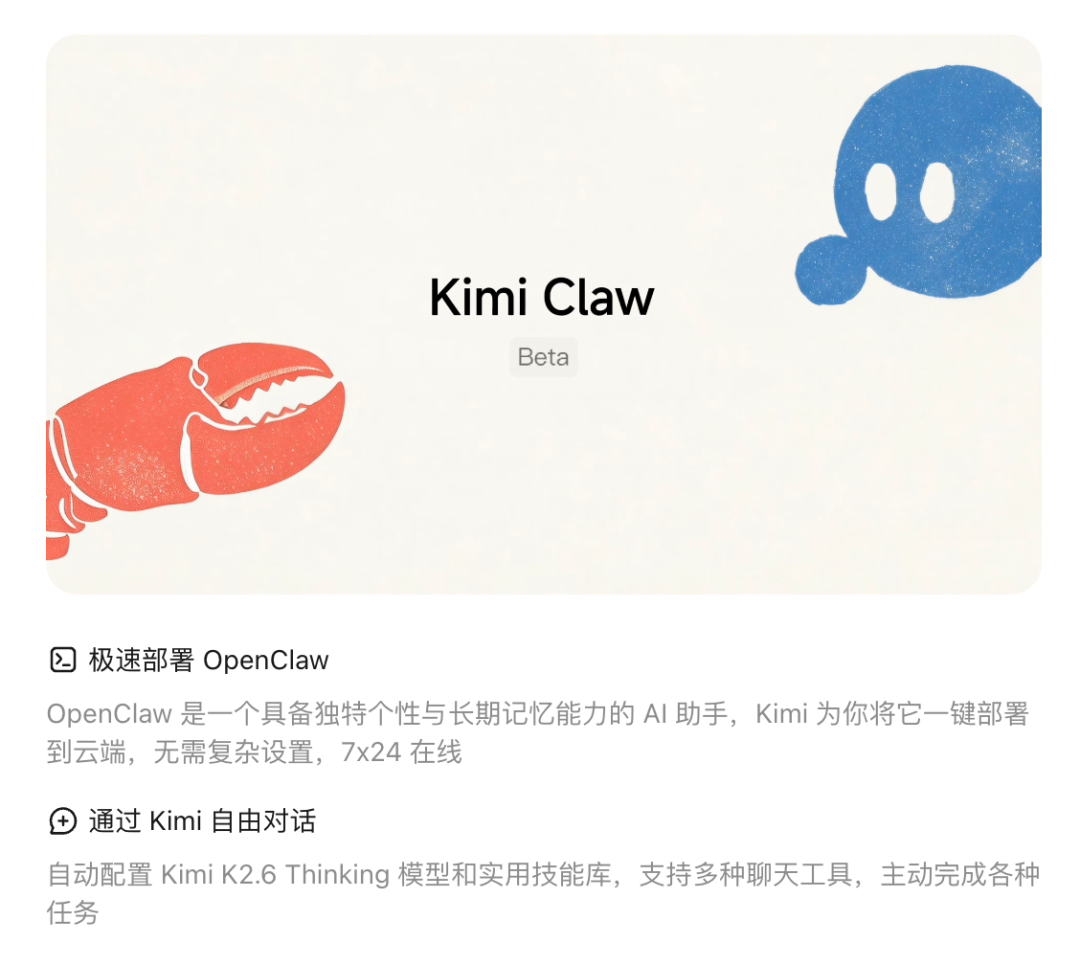
Screenshot sourced from Kimi's official website
The entire AI circle sensed the "aroma of opportunity." Giants like Alibaba and NetEase joined the fray, but Kimi had already seized the initiative. The value of this wave of dividends was further validated in the following two months. According to Wang Xinyu, a partner at Meituan Dragonball, Kimi's ARR (Annual Recurring Revenue) surpassed $100 million in March and doubled to $200 million in April.
Thus, when Moonshot AI secured $2 billion in funding on May 7, the market was not overly surprised.
Tianyancha data shows that Moonshot AI's valuation surged nearly fivefold in six months, from $4.3 billion in November 2025 to over $20 billion. This growth rate is remarkable for the entire industry.
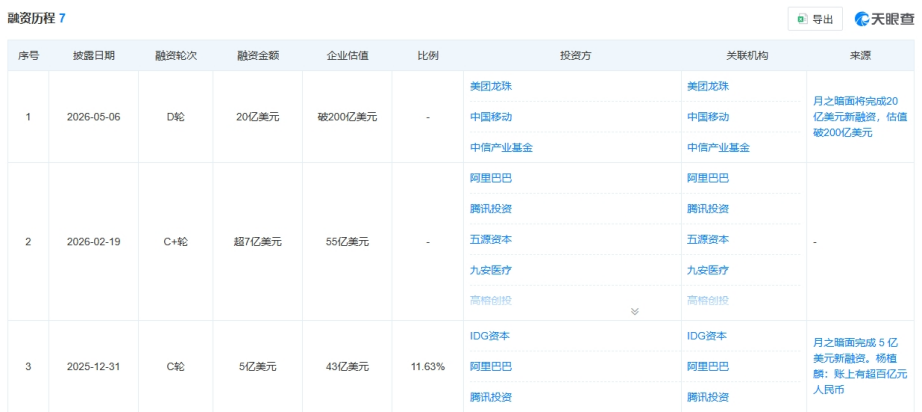
Image source: Tianyancha
02.
"Mutual Inspiration" with DeepSeek
Compared to Kimi's tangible revenue growth and commercialization, DeepSeek's funding story carries more industry intrigue. How did this company, with virtually no visible revenue and entirely open-source code, justify a staggering 350 billion yuan valuation? The capital market's answer is clear: unwavering faith in foundational technology and boundless imagination for domestic computing power substitution.
On April 24, 2026, DeepSeek V4 officially launched, once again raising industry technical standards: it made million-token context windows standard and slashed inference costs to 27% of V3.2's. More exciting for the market, DeepSeek publicly verified the compatibility of Huawei's Ascend 950PR chip in its official technical report, signaling a shift from NVIDIA's ecosystem to domestic computing power. This marked the first time Chinese AI had a viable path away from CUDA.
Currently, DeepSeek relies on its parent company, High-Flyer Quantitative Trading, to fund R&D, maintaining stable cash flow and seemingly no immediate need for funding.
However, the AI industry has long moved beyond asset-light models into a phase of high-intensity, high-investment asset-heavy competition, where training and iterating large models require sustained massive funding. More critically, intense talent competition has seen several key R&D personnel leave DeepSeek.
This first external funding round aims primarily to stabilize the talent team and reinforce R&D capabilities. Reports indicate that out of DeepSeek's 50 billion yuan funding, founder Liang Wenfeng personally contributed 20 billion yuan (40%), with the remaining 30 billion yuan raised from external institutions. Market rumors also suggest that the National Integrated Circuit Industry Investment Fund (Big Fund) may become the second-largest investor in this round.
Outsiders often interpret Kimi and DeepSeek's simultaneous iterations and funding as a head-to-head clash between two domestic AI giants. However, beneath the surface, the two have forged entirely differentiated, complementary paths.
DeepSeek's core vision is to reconstruct AI's foundational infrastructure, focusing on breakthroughs in foundational technologies—from mHC residual connection optimization to million-context cost revolutions—aiming to break overseas monopolies on computing power and model architectures, laying a solid foundation for domestic AI.
Kimi's strength lies in application deployment. From K2 to K2.5 and K2.6, all iterations revolve around "enabling efficient AI deployment to solve complex real-world tasks." The latest K2.6 version can coordinate 300 sub-agents in parallel to complete 4,000-step ultra-long complex tasks, not merely showcasing technology but genuinely expanding AI's capabilities and commercial scenarios.
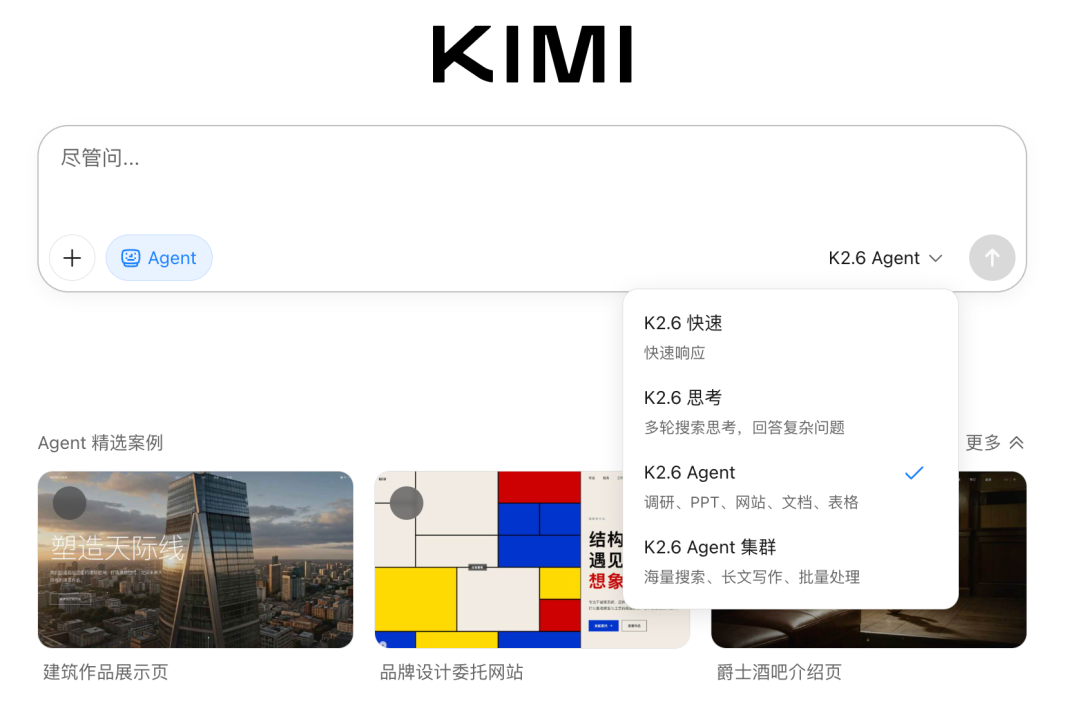
Screenshot sourced from Kimi's official website
Most notably, their competition has never fallen into a zero-sum game. Instead, they've formed a rare relay-style symbiotic iteration: Kimi K2 incorporated DeepSeek's proven MLA attention mechanism, while DeepSeek V4 adopted Kimi's validated Muon optimizer.
These two AI leaders, competing in the same city, mutually learn and empower each other in the open-source ecosystem, driving rapid advancement in the domestic large model industry through healthy competition—a testament to top players' "mutual inspiration."
03.
Focusing on Paying Users?
In early May 2026, rumors of "Doubao soon charging fees" spread rapidly online. Netizens discovered that Doubao quietly added descriptions for paid versions on its App Store page, offering Standard, Advanced, and Professional tiers with monthly fees ranging from 68 to 500 yuan (up to 5,088 yuan annually). This instantly sparked widespread controversy, with social media flooded with comments like "uninstall if it's no longer free."
This public outcry is no accident. It reflects a common dilemma in the domestic AI industry: high traffic, high costs, and low conversion rates.
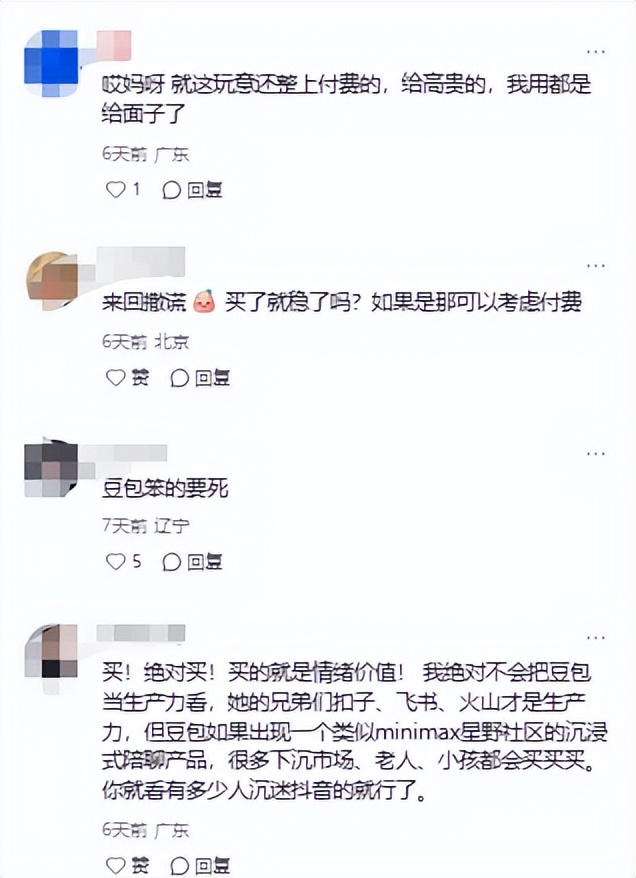
Image source: User comments on Xiaohongshu
For China's AI industry, 345 million monthly active users represent a vast asset, but the daily 120 million yuan in computing power costs place immense pressure on platforms—the era of free computing power bonuses cannot last.
In response to the backlash, Doubao officially stated that it would always offer free services while exploring additional value-added services, with details still in testing.
Doubao's user resistance highlights Kimi's foresight and clarity in commercialization strategy.
As early as the "lobster craze," Kimi established clear, unwavering payment rules: users must subscribe to premium plans priced at 199 yuan/month or higher to access core Claw agent functions. This stance has remained consistent since the K2 era, showing no hesitation or compromise due to traffic temptations. Yang Zhilin's business logic is simple: Kimi serves not everyone, but those truly willing to pay for productivity tools. Looking at Kimi's data since November 2025—170% month-on-month growth in overseas paid users, ARR soaring from under $100 million to $200 million—validates its commercialization judgment.
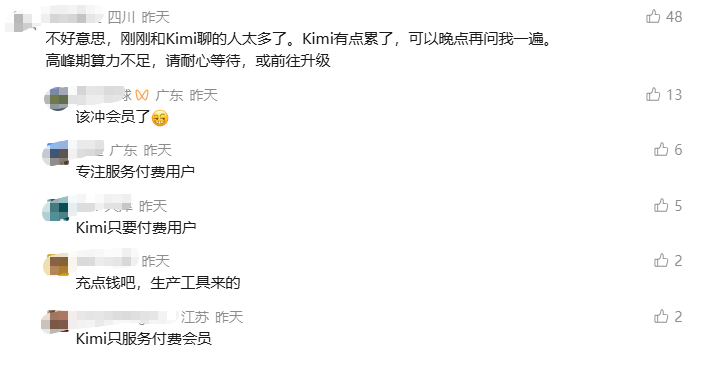
Image source: User comments under a WeChat official account post
While the industry debates "whether to charge," Kimi focuses on "making payers feel it's worth it." This milestone may define China's AI commercialization landscape. The user resistance Doubao faces today has already been validated by Kimi through product value.
China Mobile's participation in Kimi's latest funding round is particularly noteworthy, its strategic significance even surpassing lead investor Meituan Dragonball. Telecom operators prioritize stability and long-termism, avoiding short-term industry hype and traffic stories, betting only on the long-term certainty of AI industrialization and infrastructure.
Kimi secured this funding not by becoming another DeepSeek, but by "becoming itself."
Just five months into 2026, China's AI narrative has shifted multiple times. Early in the year, the "lobster craze" brought "wealth creation myths"; March saw a "arms race" of soaring financials and valuations; by late April, the releases of K2.6 and V4 within a week ignited technical debates. Everyone chases the next big thing.
But stepping back, Kimi's journey over the past year and a half forms a complete commercial story: from being written off to technological rebirth, from "cash-rich" composure to post-"lobster craze" revenue surge, to now standing at a new valuation milestone of $20 billion. It took no shortcuts nor abandoned its original aspiration—to build great models, deliver value to paying users, and reinvest earnings into R&D.
This cycle seems simple but may represent the healthiest growth path for Chinese AI companies. Yang Zhilin's late-2025 internal letter stated, "No rush to go public, nor is IPO the goal." Looking back, this confidence stems not from the billion-yuan cash reserves but from belief in taking the slow road—one that ultimately goes farther.
After all, in a race where everyone sprints, knowing when to slow down can be harder than speeding up.
Note: Some images in the text are AI-generated/sourced from the internet. Please notify us for removal if any infringement exists.
-
![]()
From Energy Conservation and Carbon Reduction to AI Decision-Making: GECON East Intelligence and Chery Group Explore a New Green and Smart Paradigm for Automobile Manufacturing
-
![]()
WAIC 2026 Observation | AI Accelerates Towards the Core of Industries, Industrial AI Enters a Critical Phase
-
![]()
Volkswagen China Fires the First Shot in Foreign-Funded 'White Box Delivery'!
-
![]()
AI Agent Smartphones: The Next Competitive Edge Transcends Large Models
-
![]()
Over 880 Million Yuan Worth of Orders Unveiled, Bidding Launched for Shenzhen Eastern Public Transport
-
![]()
Tesla's Robotaxi Hits the Road: A Monumental Gamble with an Uncertain Future
-
![]()
Ford and Geely Forge New Joint Venture in Spain, Sidestepping Changan and JMC
-
![]()
199 RMB! Godox's First Camera Review: Subpar Photography, Transparent Viewfinder Frame is the Highlight