Has xAI Disbanded and Tesla Stalled? Is Musk Falling from Grace?
 05/15 2026
 576
576
Layout | Xiaoxi
"I'm not going to Mars; I'm building Earth."
When Yu Hao, CEO of Dreame Technology, initiated a "bragging contest" on social media in early 2026 and used this provocative statement to tease Musk, he probably didn't anticipate that the "Silicon Valley Iron Man" he had long benchmarked against would soon find himself in a crisis-ridden situation.
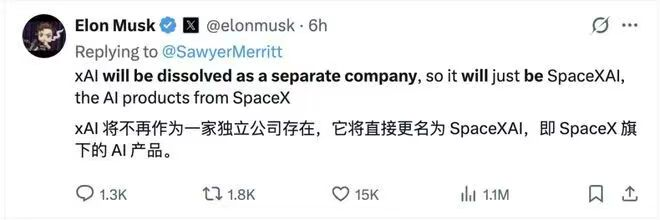
On May 6, Musk announced the dissolution of xAI and the formal cancellation of its independent operation, sparking heated discussions worldwide. Prior to shutting down xAI, he had already been pushed into the spotlight due to a series of setbacks in his core businesses, the postponement of his Mars dream, and a high-profile lawsuit with Altman.
▲ Note: Image sourced from X
The aura of the "tech genius" is being eroded in the harsh realities of commercial competition. Has Musk, once deemed invincible and worshipped as a "deity" by countless followers, truly "fallen from grace"?
| Compromises and the Inevitable End of xAI |
If modern tech history is a ruthless tale of burning money and elimination, then the downfall of xAI is undoubtedly its most expensive and dramatic chapter.
Founded less than three years ago and once valued at a staggering $250 billion, this AI star company was unexpectedly merged into SpaceX, downgraded to an internal product line named "SpaceX AI."
Even more surreal is that on the same day as the dissolution announcement, Musk leased the supercomputing cluster originally built for xAI in Memphis—Colossus 1, equipped with 220,000 NVIDIA GPUs and costing billions—exclusively to Anthropic, OpenAI's most formidable rival.
Why would an AI giant valued at hundreds of billions "self-dismantle" in just a few months? What hidden frustrations and strategies lie behind this seemingly "self-sabotaging" move?
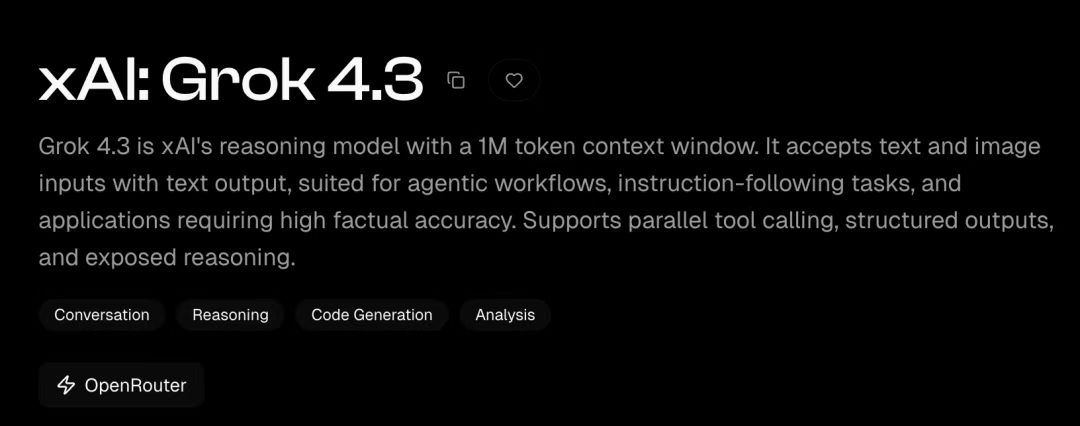
In truth, xAI had become a "money pit" before its dissolution. Public financial projections show that xAI was burning through $1 billion per month in 2025, consuming $8 billion in cash in the first nine months and projecting an annual loss of about $13 billion.
Such massive investments failed to yield core competitiveness in product development. Its flagship large language model, Grok, though marketed as "rebellious" and "pursuing absolute truth," remained a negligible presence in the developer ecosystem and enterprise market.
▲ Note: Image sourced from X
Despite hoarding around 550,000 GPUs, xAI's actual floating-point utilization rate was a pitiful 11%. In contrast, Meta and Google's similar clusters operated at over 40% efficiency, wasting vast computational power on ineffective scheduling and idle time.
Even more fatal was the mass exodus of talent. By the end of March 2026, all 11 of xAI's original co-founders had departed, and the core R&D team underwent a complete overhaul. Without top architects and algorithm scientists, the GPUs became nothing more than giant power-hungry heaters.
Under attack from all sides, merging xAI into SpaceX—valued at $1.25 trillion—to secure stronger group financing became the only viable option for survival.
Leasing 220,000 GPUs to Anthropic was a shrewd move of "using enemies to defeat enemies."
Amid a heated legal battle with Altman, Musk realized that Grok couldn't defeat ChatGPT in consumer or enterprise markets anytime soon. Instead, he armed OpenAI's biggest rival, adhering to the principle that "the enemy of my enemy is my friend."
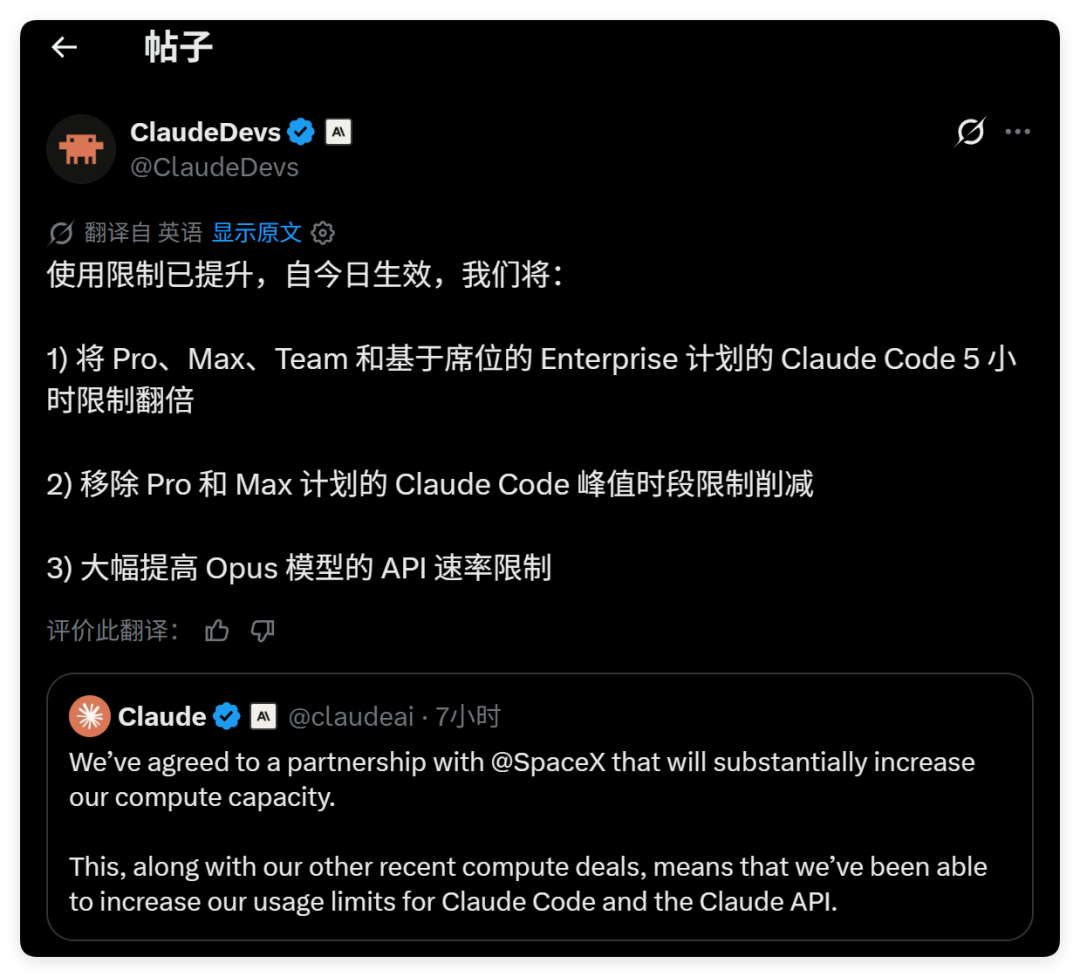
With Anthropic gaining "timely" computational power, it immediately lifted peak-hour restrictions on Claude Code and doubled usage quotas, directly threatening OpenAI's market share.
▲ Note: Image sourced from X
Simultaneously, this marked Musk's strategic shift from a "gold prospector" to a "water seller."
The cluster delivered to Anthropic primarily used last-generation Hopper architecture GPUs. In 2026, with NVIDIA's Blackwell architecture rolling out, these older cards faced imminent significant depreciation risks. Rather than letting them gather dust in warehouses and incur hefty electricity bills, Musk repackaged them as a computational leasing service.
Wall Street analysts estimate this deal will generate $3–4 billion in annual stable revenue and $2.5 billion in cash profit for SpaceX.
Moreover, Musk hasn't abandoned the AI race. He shifted computational resources for training the next-gen Grok to a fully Blackwell-architected Colossus 2. Additionally, rumors suggest SpaceX plans to acquire Cursor, a top AI programming tool, for $60 billion and has already stationed some Cursor employees in xAI's offices for transition.
Abandoning head-on competition in general-purpose large models, Musk now focuses on foundational computational infrastructure and acquiring developer applications with strong monetization potential. In the AI battle, he appears to retreat but hasn't exited.
| Core Business Slowdown: Tesla and the Mars Dream Suffer Double Blows |
The contraction of xAI's battlefield is just one corner of the crisis. The slowdown in Musk's core businesses and their ripple effects have left him overwhelmed.
For years, Tesla has been Musk's cash cow, leveraging capital to sustain his vast tech ecosystem.
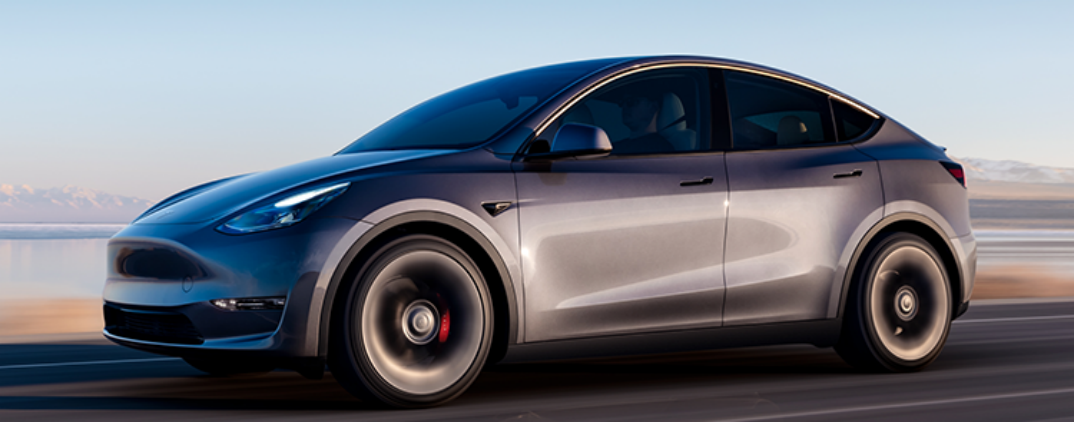
However, in 2025, Tesla's total revenue was $94.827 billion, down 3% year-on-year—its first annual revenue decline since inception. Net profit plummeted 46% to $3.794 billion, a quarter of its 2023 peak.
In the global new energy vehicle market, especially the fiercely competitive Chinese market, traditional automakers' counterattacks and newcomers' surge erased Tesla's first-mover advantage. Flagship models Model 3 and Model Y neared the end of their product lifecycles without groundbreaking replacements. The highly anticipated Cybertruck, hampered by production ramp-up and high manufacturing costs, failed to become a new profit pillar.
▲ Note: Image sourced from Tesla
To maintain market share, Tesla launched global price wars. The "volume-over-price" strategy failed to halt slowing sales growth and severely eroded profitability.
Tesla is more than a carmaker; it's Musk's "ATM" for his Mars ambitions. With its profitability shrinking, his "Mars colonization plan" also suffered.
Musk has publicly outlined a grand interstellar vision: transporting 1 million humans to Mars by 2050 to establish a self-sustaining permanent settlement.
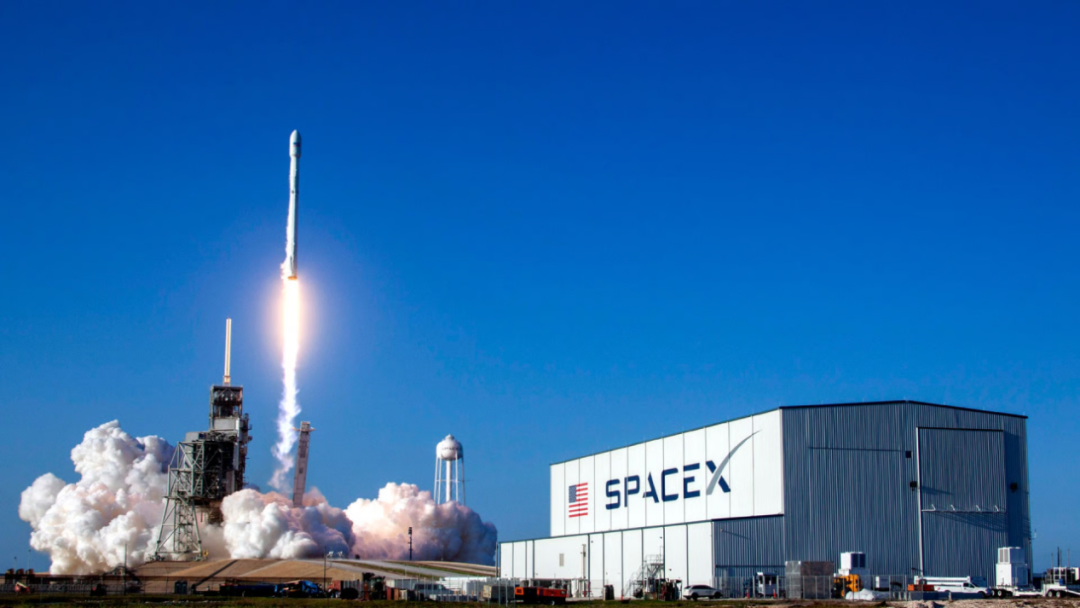
This crazy (fēngkuáng, insane) migration goal imposes stringent engineering demands. To sustain a million people, at least 1,000 Starships must be built, launching three times daily and delivering millions of tons of supplies to orbit annually—an astronomical financial burden.
▲ Note: Image sourced from X
Aerospace industry estimates suggest the Starship project has already consumed over $15 billion in R&D funding. Each Raptor engine iteration and Boca Chica Starbase test flight explosion costs hundreds of millions.
Previously, Musk funded these cutting-edge projects by pledging high-value Tesla shares or relying on valuation premiums. But now, with Tesla's core business shaken and net profit halved, financial strain has permeated the entire group.
Reality's gravity weighs on Musk's cosmic dreams. Constrained by funding pressures, technical bottlenecks like Starship orbital recovery reliability, and strict U.S. Federal Aviation Administration environmental approvals, the Mars timeline has been repeatedly delayed. The promised 2026 unmanned Mars mission now seems unattainable.
Reports indicate SpaceX plans the largest IPO in human history by mid-2026, targeting a valuation of $1.75–2 trillion. To justify this, Musk is packaging a grand narrative of "rocket launches + Starlink broadband + space AI data centers."
But when foundational economics signal collapse, investors are reluctant to fund distant, expensive sci-fi visions unconditionally. The Mars dream's delay reflects not just technical realities but Musk's empire's financial strain.
| Reputation Reversal: From Geek Leader to Political Strategist |
Commercial setbacks, product line contractions, and performance declines can be mitigated through strategic adjustments. However, the collapse of Musk's public image, reputation reversal, and loss of trust pose deeper, harder-to-reverse crises.
Once, Musk was a spiritual icon for global tech enthusiasts, environmentalists, and futurists. Media hype portrayed him as a pure, idealistic "geek leader" fighting for humanity's fate against worldly norms.
Building electric cars was to free humanity from fossil fuels and save Earth's environment. Launching rockets at bankruptcy risk was to prevent Earth's extinction and make humanity multi-planetary. In this narrative, he was the real-life "Iron Man" from Marvel, an eternal star-gazing idealist.
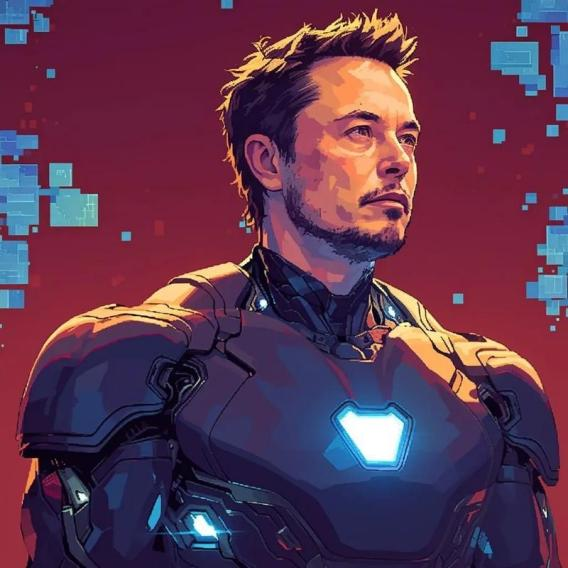
▲ Note: Image sourced from Musk Says
But in recent years, this "dragon slayer" has wallowed in worldly quagmires.
Abandoning his early cautious political distance, Musk now openly and deeply intervene (jièrù, intervene ) U.S. politics. From acquiring Twitter and unblocking controversial far-right accounts as a "free speech absolutist" to complex benefit (lìyì, benefit ) ties and frequent interactions with Trump, Musk has placed himself at the forefront of global cultural conflicts.
He seems to forget that Tesla's early high-end, eco-friendly brand image relied heavily on support from liberal elites, middle-class consumers, and environmentalists in California and New York. When Musk posted controversial political remarks and attacked diversity and inclusion policies, these initial supporters felt anger and betrayal.
An entrepreneur's every word now bears partisan labels, turning his products into political polarization casualties. Many potential consumers now boycott Tesla due to disdain for Musk, causing brand favorability to plummet in independent surveys.
Political gaming hasn't strengthened his empire's moat but instead tear (sīliè, tear ) his audience and eroded brand equity.
His legal battle with Sam Altman, OpenAI's current CEO, over OpenAI's non-profit origins also reveals Musk's controlling "political" side.
In Oakland federal court, the world saw not a prophet preventing AI apocalypse but a disgruntled businessman envious of OpenAI's wealth, watching his former protégé grow powerful.
As evidence disclosure progressed, internal emails exposed Musk's "altruistic" facade, revealing naked power struggles, control battles, and financial calculations during OpenAI's founding.
Excessive political entanglement and frequent lawsuits have drained Musk's energy and credibility as a cross-border entrepreneur. When news focuses on his social media political feuds, courtroom aggressiveness, and ruthless employee purges rather than revolutionary battery tech or rocket engines, his "geek leader" aura fades.
All signs suggest that by 2026, Musk has fallen from idealistic clouds into the commercial deep end of worldly interests and power games. Yet, amid crisis, he still commands the world's unparalleled Starlink network, cutting-edge heavy-lift rocket tech, and a brain-computer interface company pushing medical boundaries.
The once moon-gazing dreamer now fights in the mud of sixpence, answering Wall Street's grilling, alleviating AI competition anxieties, and filling the Mars plan's financial black hole.
Whether this tech empire sustains its glory hinges on whether the former dragon slayer can escape disputes and power games to regain his swagger.
Image sourced from the internet. Rights reserved for removal upon request.
-
![]()
Proposed to Raise 955 Million Yuan through Private Placement! Huicheng Vacuum Boosts Localization of Ultra-Precision Optical Coating Equipment
-
![]()
Cash Flow Soars 13-Fold! What Major Strategic Move is Wuhan Five Square Optoelectronics Planning?
-
![]()
Leaked Design of vivo X500: Reverts to Circular Camera Module in Top-Left Corner, Pays Homage to Classic X90 Aesthetic
-
![]()
DeepSeek Shows Signs of Foraying into Code Agents, Launches WeChat Official Account Focused on Harness
-
![]()
Auto Companies Deny Claims That ‘Cooperation with Huawei Is Non-Essential’, as Huawei Transforms into a ‘Public Platform’
-
![]()
Starship to Independently 'Return to the Launch Tower': SpaceX's Ambitions Extend Beyond Rocket Building to Dominating Space Transportation
-
![]()
Starship Set to Independently 'Return to the Launch Tower': SpaceX is Revolutionizing Space Transportation, Not Just Building Rockets
-
![]()
Anthropic and OpenAI Face Off Against Deepseek