Anthropic Releases Report Detailing Two Potential Scenarios for Global AI Leadership by 2028
 05/18 2026
 559
559
On May 14, Anthropic unveiled a report titled '2028: Two Scenarios for Global AI Leadership' in the research section of its official website. The report offers a systematic analysis of Anthropic's assessment regarding the Sino-US AI competition and its policy implications. It predicts the trajectory of Sino-US AI developments by 2028 and delineates four strategic fronts in the ongoing quest for competitive advantages.
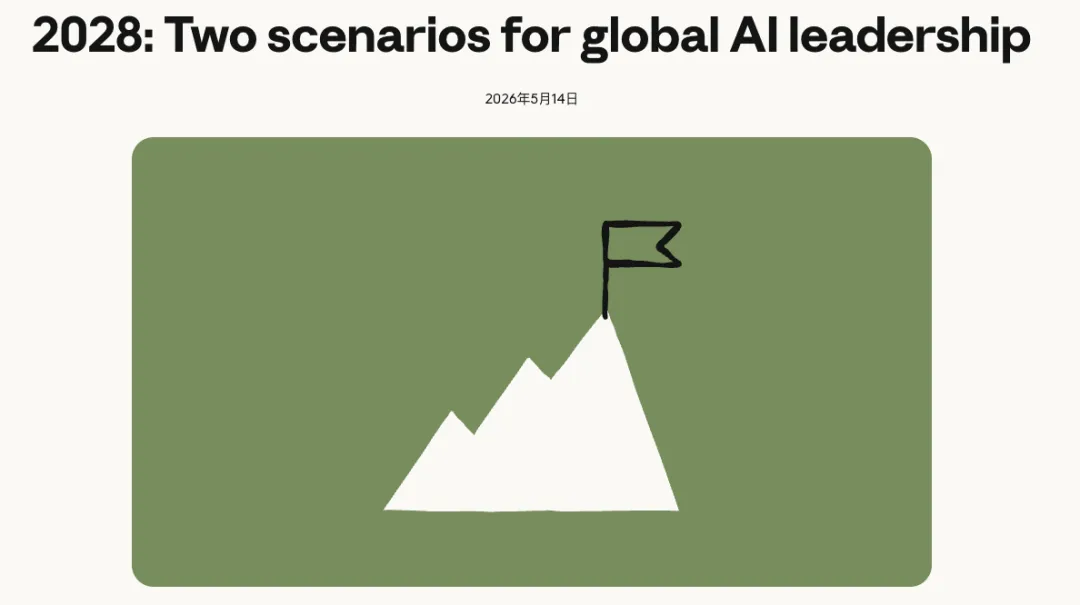
Departing from the well-worn narratives of 'how many years China's AI needs to catch up,' this report presents two distinct scenarios.
Scenario 1 envisions democratic nations maintaining a 12- to 24-month lead in computing power. Scenario 2, however, paints a more nuanced picture—a stalemate in the Sino-US AI competition, where neither side secures a decisive advantage.
To be candid, the mention of a 'stalemate' brought a sense of relief. Why? Because it signifies one crucial point: at least in the foreseeable future, China hasn't been left too far behind.
How significant is the gap in model capabilities between China and the US?
According to Stanford's 2026 AI Index, the disparity in model capabilities between China and the US stands at approximately 2.7%.
While this figure may seem negligible, its implications are profound. It suggests that, in terms of capabilities, both nations are already operating on a comparable scale.
The remaining 2.7% gap is likely attributable more to differences in engineering proficiency and practical application scenarios rather than fundamental capability disparities.
However, the situation becomes less optimistic when we shift our focus to computing power.
Let's begin with chips. Huawei's Ascend 910B offers around 256 TFLOPS of computing power, whereas NVIDIA's H100 delivers approximately 312 TFLOPS. A straightforward calculation reveals that Huawei's performance is roughly 60% of NVIDIA's—a 40% gap. This figure initially caught me off guard. I had anticipated a wider gap, not realizing it was around 60%.
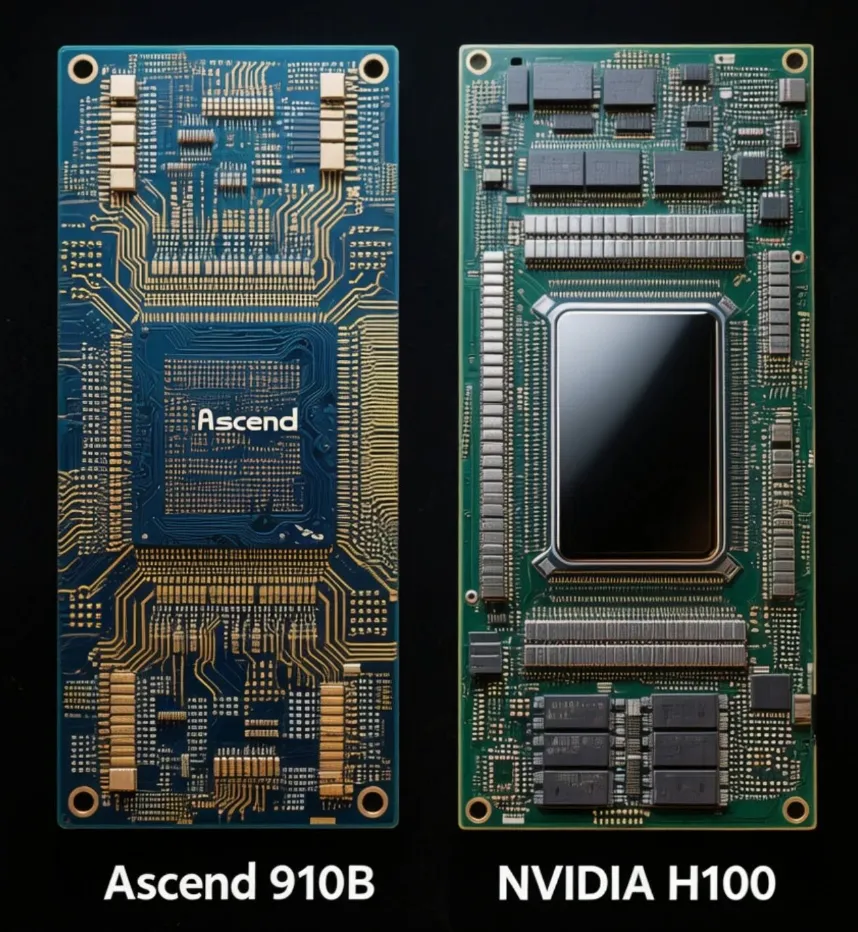
Yet, upon further reflection, this gap was achieved under the stringent conditions of U.S. sanctions. Without access to advanced EUV lithography machines or TSMC's foundry services, Huawei's accomplishment is indeed remarkable.
Jensen Huang, in an interview this year, stated that NVIDIA's market share in China's AI chip sector has plummeted from 66% to nearly zero.
Back in 2022 and 2023, domestic tech giants resorted to 'special channels' to acquire NVIDIA chips. Now, such avenues are no longer available.
What about Huawei? Reports indicate that Ascend's revenue could surge to $12 billion next year, up from $7.5 billion last year—a remarkable 60% increase. This growth is truly impressive.
Currently, demand for Ascend chips far outstrips supply, with customers eagerly awaiting their turn. This at least demonstrates one thing: the pace of domestic substitution is faster than many had anticipated.
However, the U.S. currently controls approximately 75% of global GPU cluster production capacity, while China accounts for only about 15%. This means that even if China's chip performance catches up, scaling up production and cluster size will remain a formidable challenge in the short term.
The U.S. isn't running this race alone; it enjoys the advantage of an entire industrial ecosystem. It's akin to a race where one runner has a 500-meter head start, while the other is just beginning—but with a twist: the latter can only wear domestically produced running shoes. These shoes are decent but not as lightweight as the imported ones.
The U.S. also has chip-related legislation and various export control policies in place. These restrictions target not just high-end chips but also key technologies for AI training, talent exchange, and more. Together, these policies form a systematic containment strategy.
Where Are China's Opportunities in This Scenario-Based Game?
The report outlines two distinct future scenarios for 2028.
Scenario 1: The U.S. and its allies maintain an overwhelming and widening lead. Scenario 2: China's AI ecosystem achieves parity.
The crux of the scenario-based game lies in whether the U.S. and its allies can sustain a 12- to 24-month technological edge.
So, where are China's opportunities?
The first opportunity lies in application-layer innovation. China's vast internet population, complex scenarios, and abundant data provide a unique advantage. This enables Chinese AI to partially offset computing power gaps through superior engineering and implementation capabilities.
Much like the mobile internet era, when China lacked the most advanced chips but still produced global hits like WeChat and TikTok.
The second opportunity is open-source ecosystems. DeepSeek has demonstrated the immense power of open-source communities. As open-source models grow more capable, the significance of hardware gaps diminishes.
The third opportunity is time. The two scenarios for 2028 essentially pose the question: Can China reduce the gap from 40% to 20% or even less within these two years? I view this as a protracted tug-of-war—a 'stalemate,' as the report describes. A stalemate means neither side can dominate, ensuring market continuity and persistent opportunities.
Back in 2019, discussions centered on China's chip sector being 'choked.' Many were pessimistic, believing it was hopeless. Yet, the Ascend 910 series not only survived but thrived.
The road ahead remains long, but this at least proves one thing: restrictions can sometimes spur unexpected innovations.
So, what's your take? If a stalemate between Chinese and U.S. AI emerges by 2028, what does it mean for ordinary entrepreneurs and developers?
-
![]()
Ford and Geely Forge New Joint Venture in Spain, Sidestepping Changan and JMC
-
![]()
199 RMB! Godox's First Camera Review: Subpar Photography, Transparent Viewfinder Frame is the Highlight
-
![]()
AI Smartphones: A Modern-Day 'Emperor's New Clothes'?
-
![]()
Yonyou Network: A Company Selling 'Transformation' but Struggling in Its Own Transition
-
![]()
Focus | CCCC’s Takeover of Greentown Comes to Fruition: Why Did the 11-Year ‘Control Without Authority’ Era End?
-
![]()
Final Verdict: The 2026 China Auto Forum Shines with Unique Characteristics at a Pivotal Moment
-
![]()
Tencent Maintains Matrix Approach, Alibaba Merges Entry Points: Tech Titans Initiate AI Agent Consolidation
-
![]()
Geely Secures Portion of Ford’s Spanish Production Capacity