Is Kling Losing Its Affection for Its 'Parent Company' Kuaishou?
 05/19 2026
 437
437
Layout | Xiaoxi
Kling is on the verge of surpassing Kuaishou in terms of market value.
On May 11, 2026, as the closing bell tolled at the Hong Kong Stock Exchange, Kuaishou's market capitalization stood frozen at HK$224.3 billion (approximately US$28.8 billion).
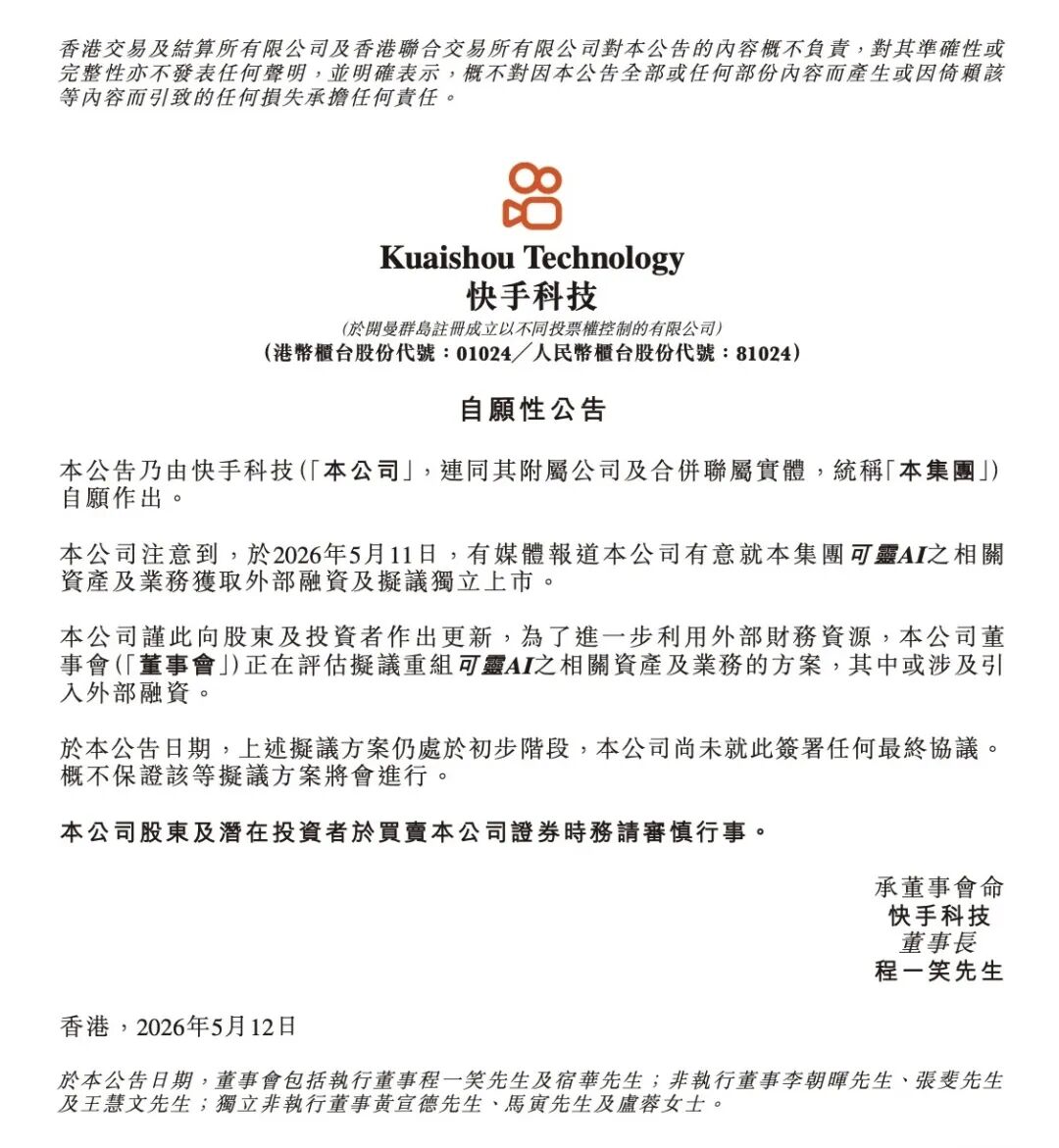
On that very same day, a bombshell announcement rocked the venture capital circle: Kuaishou's video generation model, 'Kling', was set to secure US$2 billion in standalone financing, with a valuation of US$20 billion. That evening, Kuaishou made an official announcement via the Hong Kong Stock Exchange, stating that its board was in the process of evaluating Kling's AI asset restructuring plan.
An US$8.8 billion disparity—that's the chasm between Kuaishou and Kling. Launched less than two years ago and contributing less than 1% to Kuaishou's total revenue, Kling's valuation has soared to nearly 70% of its parent company's market capitalization.
Internally at Kuaishou, Kling is valued at US$1.95 billion. Externally, it commands a valuation of US$20 billion—a staggering tenfold difference.
For Kuaishou, the silver lining is Kling's promising prospects. However, the looming concern is whether Kuaishou can still provide the necessary environment for Kling's continued growth.
| Kuaishou Can No Longer Maintain Its Position |
Cheng Yixiao is acutely aware that the foundations of Kuaishou are crumbling.
A review of Kuaishou's financials over the past five years reveals a consistent decline in e-commerce GMV growth: 78.4% in 2021, 32% in 2022, 20% in 2023, 18% in 2024, and 15% in 2025. What was once a formidable player in the e-commerce arena now merely aligns with industry averages.
Live streaming is showing signs of fatigue. In 2025, Kuaishou's annual live streaming revenue reached RMB 39.1 billion, marking a meager 5.5% year-on-year growth. In the fourth quarter of 2025, revenue even declined by 1.9% year-on-year to RMB 9.7 billion—Kuaishou's first-ever quarterly decline in live streaming revenue.
Even more alarming for Cheng Yixiao is the daily active user (DAU) data. In 2025, Kuaishou averaged 410 million DAUs, up 2.7% year-on-year. However, in the fourth quarter, DAUs dropped sequentially by 8 million.
Four years ago, Kuaishou boasted a 16% DAU growth rate, 78% e-commerce GMV growth, and doubled advertising revenue. It was one of the 'Short video duo' (short-video giants), rivaling Douyin.
Today, WeChat Channels has surpassed 500 million DAUs, outpacing Kuaishou. Douyin's monthly active users (MAUs) are double those of Kuaishou. Kuaishou has quietly slipped to third place in the short-video race.
On March 25, 2026, Kuaishou released its 2025 financials. Revenue grew by 12.5% year-on-year to RMB 142.8 billion; adjusted net profit rose by 16.5% to RMB 20.6 billion. Yet, the market reacted harshly, with the stock plummeting by 14%—its largest single-day drop in 11 months.
Kuaishou appears to have lost its growth momentum. Yet, from this very company emerged Kling, its most valuable asset.

On June 6, 2024, Kling 1.0 was officially launched. Although it debuted four months later than OpenAI's Sora, Kling opened to the public half a year earlier. More importantly, it was the world's first truly user-accessible DiT-based video generation model.
Gai Kun, Kuaishou's senior vice president and head of Kling's AI business, later stated publicly, 'We were underdogs. If we lose, we remain underdogs. If we win, we change our fate.' Internally, Kling had no resource advantages and relied on 'non-mainstream' computing power for training. But Gai Kun bet on OpenAI leaving a window of opportunity.
Kling adopted a Sora-like DiT architecture, replacing traditional convolutional networks with Transformers and pairing them with Kuaishou's proprietary 3D VAE network. This enabled it to generate videos with large, realistic motions while simulating physical world properties. By late 2024, Kling's cumulative revenue exceeded RMB 100 million. In 2025, annual revenue reached RMB 1.04 billion, far surpassing its initial target of US$60 million.
In 2026, Kling's revenue potential further surged. Its ARR (annualized revenue) exceeded US$300 million in January and US$500 million by April, doubling since the Lunar New Year.
Commercialization data underscores Kling's value. In the fourth quarter of 2025, Kling AI generated RMB 340 million in revenue, with December revenue surpassing US$20 million. It served over 60 million global users, generated over 600 million videos, and supported over 30,000 enterprise clients.
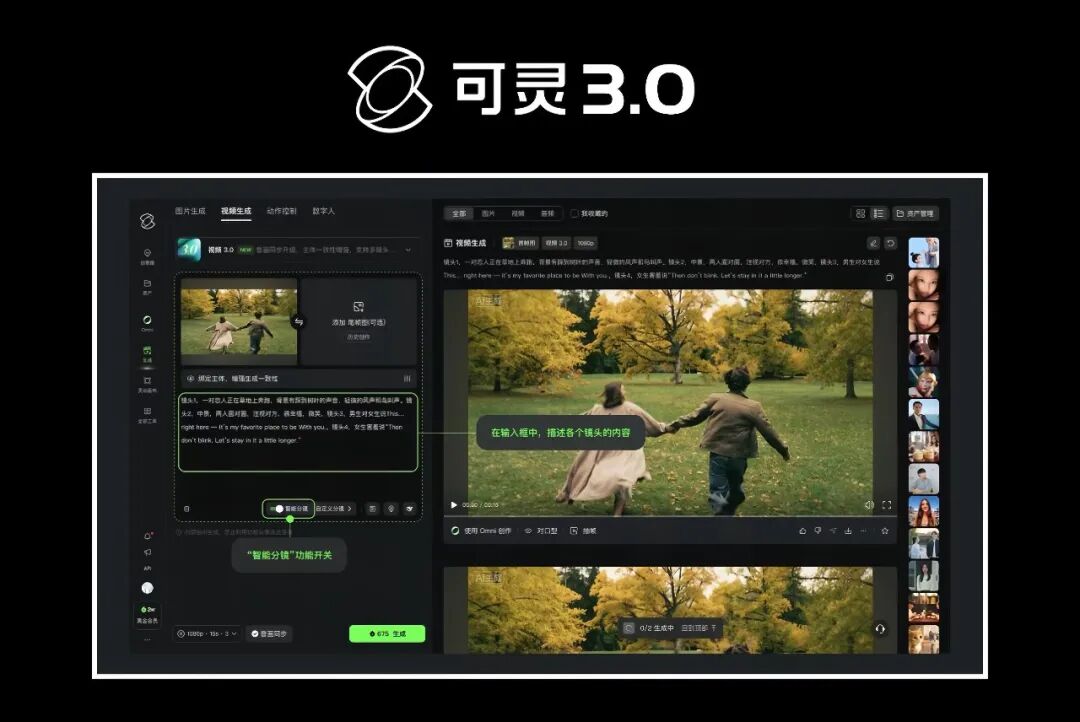
On February 5, 2026, Kling 3.0 was launched globally, introducing Kling Video 3.0, Kling Video 3.0 Omni, Kling Image 3.0, and Kling Image 3.0 Omni models, covering the entire pipeline from image to video generation.
At Kuaishou's 2025 earnings call, Cheng Yixiao said, 'Given the current growth momentum and commercialization progress, we remain confident that Kling AI will more than double its revenue in 2026.'
Kling has proven its profitability. But will it continue to thrive within Kuaishou's faltering infrastructure?
| Kling's Voracious Appetite for Growth |
China's AI sector is experiencing unprecedented financing fervor. DeepSeek's valuation skyrocketed from US$10 billion to US$51.5 billion in just 21 days; Moonshot AI secured US$2 billion in funding; Jueyue Xingchen is rushing toward a Hong Kong IPO.
How far can Kuaishou's resources sustain Kling's growth?
ByteDance's 2026 AI spending budget exceeds RMB 200 billion, with an additional US$25 billion invested in a Thai data center. Kuaishou's budget is merely one-eighth of ByteDance's. CFO Jin Bing noted during the Q1 2026 earnings call that the group's total capital expenditures would reach RMB 26 billion in 2026, up RMB 11 billion from 2025, with most allocated to computing power for large models like Kling.
AI video generation is notoriously capital-intensive. RMB 26 billion may sound substantial, but it pales in comparison to ByteDance's RMB 200 billion. Kuaishou's financial resources are clearly insufficient to support Kling's ambitious growth plans.
The talent war is equally fierce. In the second half of 2025, at least five core researchers left DeepSeek: V2 lead contributor Luo Fuli was recruited by Lei Jun for a multi-million-dollar salary, while R1 lead researcher Guo Daya joined ByteDance's Seed team. Faced with multiplied salaries and vested options, few could resist the allure of better opportunities.
But Kuaishou's problems run deeper than just insufficient funds.
In 2020, Zhang Di followed Gai Kun from Alibaba to Kuaishou. By 2024, as chief technical architect, Zhang led Kling's end-to-end development, building its initial infrastructure.
In August 2025, Zhang Di suddenly resigned. He took a two-month sabbatical at Bilibili before officially returning to Alibaba in November 2025 as head of Taobao & Tmall Group's 'Future Life Lab' (P11 level).
In April 2026, Alibaba launched HappyHorse, Zhang Di's new project, which topped both text-to-video and image-to-video rankings on Artificial Analysis.
What Kuaishou taught Zhang Di now directly competes with it.
Kling's most valuable assets are not its model architecture or training data—but people like Zhang Di. He was the first, but certainly not the last to leave.
In late 2025, Kuaishou established a separate option pool for Kling's team—the first time Kling's incentives were decoupled from Kuaishou's. However, this move came after Zhang Di's departure—a reactive measure rather than a proactive strategy.
ByteDance has already granted 'Doubao shares' to its Seedance team, directly linking incentives to external valuations. If Kling's option pool remains tied to Kuaishou's valuation, how can it compete with ByteDance or Alibaba for top talent?
| A Spin-off Benefits All Parties Involved |
For Cheng Yixiao, keeping Kling tethered to Kuaishou risks it falling behind in the AI arms race due to resource constraints.
Alibaba spun off Alibaba Cloud, JD.com spun off JD Health, and Baidu spun off Kunlun Core. Each split followed the same logic: different entities thrive under different conditions. Forcing them together leads to mutual depletion.
Spinning off Kling offers three immediate benefits:

Kling would shed its 'short-video company' valuation and be repriced as a 'pure AI company'. ByteDance's 2026 AI budget is RMB 200 billion; Kuaishou's annual net profit is just RMB 20.6 billion. Kuaishou can't afford a protracted war, but Kling can raise its own funds, alleviating Kuaishou's financial pressure.
The appeal of an independent option pool depends on Kling's valuation ceiling. Industry practice links post-spin-off option pools to IPO valuations. If Kling's IPO valuation reaches US$40 billion, team incentives would far exceed Kuaishou's internal caps. This isn't just an empty promise—it's a tangible way to retain and attract top talent.
According to LatePost, Tencent is negotiating to participate in Kling's current financing round. Tencent, Kuaishou's second-largest shareholder with approximately 15.8% ownership, needs Kling to bolster its video AI capabilities, while Kling needs capital. All three parties stand to benefit.
But the valuation isn't without controversy.
Runway, the most mature global AI video company, had an ARR of approximately US$100 million in mid-2025 and a valuation of approximately US$5.3 billion (53x P/S). Kling's 40x P/S is lower—but its absolute valuation is nearly four times Runway's.
More notably, nearly 70% of Kling's revenue comes from professional creator subscriptions. Professional users are limited, capping the payment ceiling and scenario expansion. When ByteDance's Jimeng surpasses Kling in user scale, commercialization depth will become Kling's new challenge.
Even if Kling spins off, Kuaishou's problems remain unsolved. Will Kuaishou and Kling follow the post-split decline of Sohu and Sogou, or the rise of Alibaba and Alibaba Cloud? The answer remains to be seen.
Image sourced from the internet. Rights reserved.
-
![]()
Focus | CCCC’s Takeover of Greentown Comes to Fruition: Why Did the 11-Year ‘Control Without Authority’ Era End?
-
![]()
Final Verdict: The 2026 China Auto Forum Shines with Unique Characteristics at a Pivotal Moment
-
![]()
Tencent Maintains Matrix Approach, Alibaba Merges Entry Points: Tech Titans Initiate AI Agent Consolidation
-
![]()
Geely Secures Portion of Ford’s Spanish Production Capacity
-
![]()
Tesla Stalls This Second
-
![]()
Elon Musk's 'Money-Burning' Spree: All Car Sales Profits Poured into AI
-
![]()
Why Did Tesla’s Profits Drop and Cash Flow Go Negative?
-
![]()
AI Titans Are All in the Red: Time for Intelligent Driving Car Buyers to Reassess?