XREAL, a Realist in the Smart Glasses Space
 05/19 2026
 647
647
By Wen Yehao
Edited by Wu Xianzhi
Over the past year, AI has injected a shot of adrenaline into the long-stagnant XR sector.
Under the narrative of AI glasses, enthusiastic players keep cramming features into frames—from large models and agents to real-time translation, navigation, and various other applications—as if they want to weld an entire smartphone onto the bridge of one’s nose.
Amid this frenzy, one company stands out for its calmness, even seeming a bit "out of sync."
That company is XREAL.
Even though XREAL operates in the most "exciting" XR sector, it hasn’t clung to the so-called AI narrative. Instead, it forges steadily ahead on its own path.
While it discusses spatial computing and AI, what truly drives it forward may not be visions of an AI glasses endgame but rather a more pragmatic and weighty business in the here and now.
And this has made it a rather unique case in the chaotic "Hundred Glasses Battle."
XREAL’s Answer Lies Beyond AI
Today, as the "Hundred Glasses Battle" intensifies and players from different factions emerge, the industry discourse seems mired in debate over what truly determines success in AI glasses.
The answer likely varies among different players.
For giants like Alibaba and ByteDance, armed with large models, the answer is probably AI itself. For traditional hardware makers like Xiaomi and Huawei, channels and supply chain capabilities are their weapons. Meanwhile, veterans in the space like Thunderbird and Rokid focus more on the synergy of past solutions and scene accumulation.
Though answers differ, one industry consensus is firm: this wave belongs to AI.
XREAL, however, seeks to offer a distinct response.
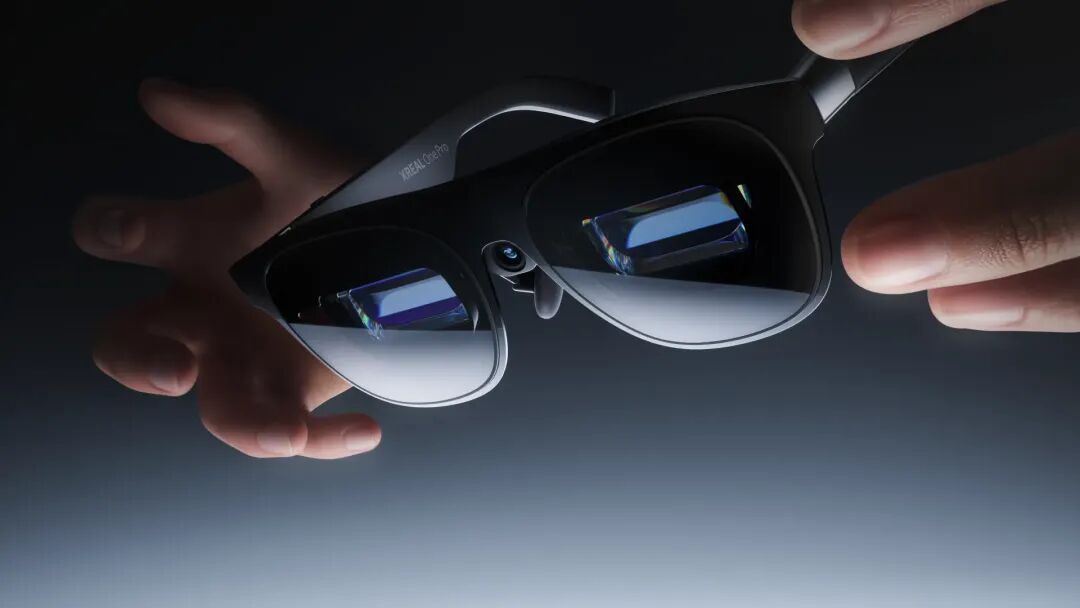
While all manufacturers Crazy chase [frantically chase] AI hype, touting large models, agents, and multimodality as heralds of a new era, XREAL immerses itself day after day in the "old world"—the longer-term XR narrative.
This doesn’t mean XREAL ignores AI. On the contrary, it seems to refrain from treating AI as a panacea precisely because it sees things too clearly.
At this stage, the most mainstream vision for the AI glasses track is to use AI to comprehensively transform XR glasses, create all-weather wearable scenarios, and ultimately elevate glasses from smartphone peripherals to the next generation of hardware terminals. Microphones receive commands, cameras capture information, and large models build applications and understand the world. The story is alluring and seamless.
Yet, for now, XREAL seems to lack such ambition for instant success. Instead, it aims to provide a more realistic answer during this transitional phase.
Current so-called all-weather AI glasses are mostly based on waveguide solutions, with an overall experience that remains immature. Weight, brightness, field of view, cost, power consumption, and display effects all pull against each other. Given the high return rates of AI glasses at this stage, the experience under this logic still feels insufficiently substantial.
XREAL founder Xu Chi once stated in an interview that many domestic players are not "professional" enough, lacking patience and respect for a complex hardware category. They see cutting-edge players launch products, quickly follow suit, disassemble, replicate, and "realize" products through supply chain assembly—but without a deep understanding of underlying issues.
XREAL’s stubbornness stems partly from this. Rather than redoing what has already been proven, it seems more willing to experiment when answers are still blur [unclear] and bear the cost of disproof.
Thus, for now, XREAL’s products focus more on all-weather usability scenarios. Based on the more mature Birdbath solution, it treats glasses as screen extensions, moving displays from hands to eyes.
In other words, compared to AI hardware players, XREAL aligns more closely with AR glasses manufacturers.
And indeed, from a sales revenue perspective, XREAL ranked first globally in the AR glasses market for four consecutive years from 2022 to 2025. In 2025, its revenue reached RMB 516 million, with over 70% coming from overseas markets.
Though not fully engaged in the main battlefield of AI glasses, XREAL has gone the furthest in selling screens.
Yet, whether this path leads to the finish line remains unanswered.
Selling Screens, Not Dreams
In an uncertain endgame, it’s no surprise that players are taking different paths.
Take AI voice glasses without any optical display as an example. Even though many players realize these are far from the sector’s final form, they still roll up their sleeves and work hard to survive until the so-called dawn arrives.
For XREAL, this narrow path is also a pragmatic choice.
Throughout XR history, one reason for the sector’s repeated setbacks is its tendency to try creating entirely new scene demands out of thin air, aiming for dimensional upgrades.
But often, new scenes and demands correspond to gaps in user education. Especially in hardware, few users will pay for an abstract future.
During the metaverse craze, crude, angular "avatars" were once expected to carry the next generation of social and entertainment experiences, while virtual meetings, concerts, and real estate were packaged as future infrastructure. Naturally, these illogical creations collapsed.
The same goes for AI glasses. Even if enthusiasts and industry insiders force themselves to wear them and seek daily use cases, the mainstream audience currently has no pressing need—or even initiative—to experience AI glasses.
XREAL doesn’t demand that users immediately embrace lofty visions. Instead, it borrows an old demand, downgrading XR to a "display"—people always need screens; they just aren’t free enough yet.
For example, enabling users without TV walls to enjoy large-screen viewing via glasses or creating new display methods for travel and business trips, thereby liberating existing demands from fixed spaces. Though not glamorous, these scenarios align more closely with the conventional product logic of the consumer electronics industry.
An XR industry insider told Photon Planet that screens must adhere to XR’s first principles: "Take Vision Pro, for instance. Many buyers fantasize about exercising, doing yoga, or integrating it into professional workflows like 3D modeling. But after bringing it home, most people just use it as a screen or for watching movies."
Thus, what XREAL truly bets on may not be an endgame proposition like "when AI glasses will replace smartphones," but rather a simpler judgment: before the iPhone moment for AI glasses arrives, it can at least become an iPod.
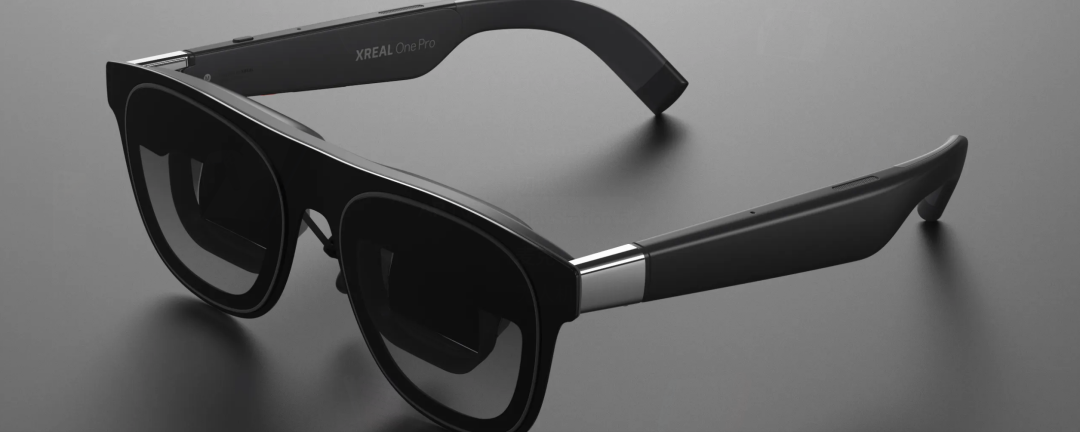
Data shows that in 2025, XREAL’s One series sold 111,400 units, while Air series sales dropped from 104,000 units in 2024 to 17,400 units. The average selling price of the One series was RMB 3,196, higher than the Air series’ RMB 1,656.
This indicates that rather than expanding its user base, XREAL currently focuses more on structural upgrades for AR glasses—using the pricier, more powerful, and more complete One series to shift products from low-cost trials to high-value hardware. Though overall sales growth isn’t dramatic, revenue structure and gross margin have improved significantly, with the overall gross margin rising from 22.1% in 2024 to 35.2%.
Watching movies, gaming, and mobile office work are strong scenarios, but the issue is that strong scenarios don’t necessarily equate to high-frequency needs. If a growing hardware category remains stuck between strong scenarios and low frequency, it may produce good products but struggle to scale into a big business.
This is the next narrow gate XREAL must face.
In the short term, selling displays allows it to avoid the most speculative parts of industry narratives, making its business more solid. But in the long run, no matter how deeply rooted it is now, XREAL cannot remain in the "display" niche forever. It must eventually advance to the higher-dimensional AI glasses battlefield and face stronger, better-resourced players.
As warfare expands, more ammunition will be needed. This may be one reason behind XREAL’s IPO sprint.
In April, XREAL submitted its prospectus to the Hong Kong Stock Exchange. As the first domestic smart glasses company to Sprint for Hong Kong stocks IPO [pursue a Hong Kong Stock Exchange IPO], if all goes smoothly, XREAL could become the "first smart glasses stock."
The prospectus shows that in 2025, XREAL’s revenue grew to RMB 516 million, with its net loss narrowing from RMB 709 million in 2024 to RMB 456 million, and its adjusted net loss shrinking to RMB 250 million.
True dawn may still be far off. For XREAL, the most critical task now may not be seeing the sun first but striving to stay at the table before daybreak.
Lifted Up, Also Weighed Down
Its collaboration with Google is undoubtedly the most crucial variable for XREAL as it Full sprint IPO [fully sprints toward an IPO].
This is a very pragmatic deal.
Google needs a lightweight AR hardware partner to prove that a full-fledged Android XR isn’t limited to bulky headsets. However, Meta—the most compatible choice in every regard—is a direct competitor in the XR ecosystem, forcing Google to partner with hardware-focused companies like Samsung and XREAL.
The same goes for XREAL. AI, applications, and developer ecosystems are beyond its innate capabilities. To escape the pure "display" business and address AI and ecological shortcomings, collaborating with leading industry players is inevitable.
Moreover, being included in Google’s core partner list serves as an endorsement of its capabilities and value, which it can relay to capital markets for greater valuation potential.
However, due to well-known reasons, XREAL’s partnership with Google focuses primarily on overseas markets. In the domestic market, where ASUS leans too heavily into gaming verticals, XREAL may still need more powerful allies to supplement system capabilities, AI, and channel resources.
On the other hand, for XREAL, Google’s olive branch is both a handrail and a scale—it will lift XREAL up but also measure its true weight.
In the 1980s, IBM launched the influential IBM PC. To accelerate market dominance, IBM outsourced the operating system to Microsoft and the processor to Intel.
Little did it know that this seemingly minor decision at the time forged the later "Wintel alliance" and led IBM to eventually sell its PC business to Lenovo, retreating from the market it had created.
The PC era followed this pattern, and the mobile era did too. Will the AR era be an exception?
The answer remains unclear, but one certainty is that most smart glasses manufacturers today are supply chain integrators lacking technological barriers and vertical integration capabilities. Amid this chaos, XREAL—with its self-built supply chain and in-house chip development—stands out as a refreshing presence. However, in terms of product differentiation, its pragmatic approach shares similarities with competitors like Thunderbird.
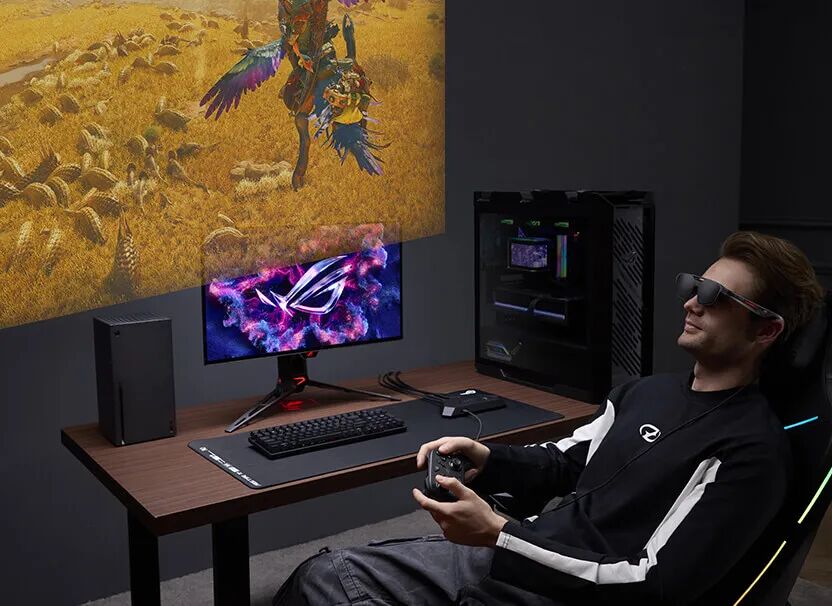
Fortunately, collaboration with Google is only part of XREAL’s business. Beyond that, XREAL maintains relative independence in optical technology, XR chips, and supply chain operations. It has partnered with ASUS ROG to develop 240Hz high-refresh-rate gaming glasses and maintains close cooperation with automakers and smartphone manufacturers.
But as the ecosystem matures, competition will only intensify. Google currently needs XREAL for its technical advantages and mass production capabilities. However, as market scale grows and ecosystems and form factors mature, more hardware players will enter, turning AR glasses into a "toaster" scenario—if user demand for certain designs or functions surges, other players will quickly release similar products.
At that point, XREAL won’t just face competitors like Rokid, Thunderbird, or INMO but the entire consumer electronics ecosystem’s Copy ability [replication capabilities].
Ultimately, despite the growing hype around AI glasses, XREAL is fighting a dumber, heavier, and more pragmatic battle.",
-
![]()
Personnel Shuffle: Independent Director Mi Xuming Steps Down from OFILM
-
![]()
Net Profit Anticipated to Skyrocket by 103%: What Gives This Optical Company a Competitive Edge?
-
In Just One Year, China Unveils Unicorns Valued at 10 Trillion Yuan!
-
![]()
6 Park Companies Shine at WAIC: How Hong Kong Science Park Bridges AI from Research to Industry
-
![]()
Wang Wenjing’s Third Act: Can Yonyou Reinvent Itself in the AI Era?
-
![]()
Performance Coupe Entry Threshold Reduced to 170,000 Yuan: Assessing the 2027 Exeed ES's Prospects
-
![]()
Battery "Crisis" for 4 Million New Energy Commercial Vehicles
-
【Focus】Fluorinated Photosensitive Polyimide (FPSPI): A High-End Subdivision of PSPI with Great Potential in High-Tech Industries