Surge of Short Drama Exports: Only a Few Truly Profit in the $3.6 Billion Market
 05/19 2026
 686
686
By Hengxin
Source: Bowang Finance
A few years ago, ReelShort, a Chinese short drama app targeting overseas markets, quietly topped the U.S. App Store's entertainment chart.
On-screen, vertically oriented 60-90 second episodes like 'I’m Pregnant with the 50-Year-Old CEO’s Child' and 'The Surrogate Bride Awakens for Revenge' captivated North American housewives and Latin American youth alike, who eagerly paid for unlocks.
This scene ignited capital market fantasies about 'micro-short drama exports'—after all, the last sector to make foreigners pay for Chinese internet content was online literature and mobile games.
By 2025, the narrative evolved: AIGC began infiltrating every link of the micro-short drama supply chain—from AI-assisted scriptwriting and multilingual dubbing to AI-generated comic adaptations, virtual actor performances, and smart ad material production. This slashed localization and production costs for individual dramas while doubling content output efficiency. The industry slogan upgraded from 'dubbed exports' to 'AI-driven full-chain globalization.'
Yet beneath the glossy surface, data revealed a different reality: Leading platform ReelShort swung from profit to loss in 2025; DramaBox’s parent company, Dianzhong Technology, admitted net profit margins for its short drama business fell below 1%.
This raises the article’s core question: Is AI-powered short drama export the next $10 billion incremental market for content globalization, or just another round of capital-fueled, scale-driven cash burn?
01
Overseas Market Explodes, But Profits Remain Concentrated
Global demand for exported micro-short dramas is real and growing exponentially, as data confirms.
According to the 2025 Overseas Short Drama Industry Report released at the 13th China Internet Audio-Visual Conference, overseas short drama apps saw 1.199 billion downloads in 2025, up 268% year-on-year, with total revenue reaching $2.329 billion (+133%). Active markets expanded from 37 to 46.
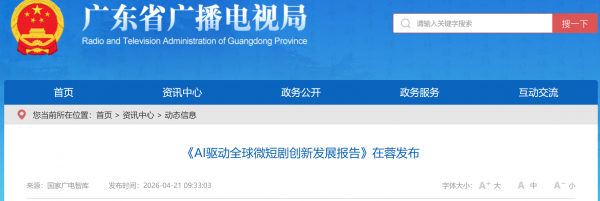
The AI-Driven Global Micro-Short Drama Innovation Report further revealed that the international market (excluding China) hit $3.6 billion in 2025, with Chinese companies contributing ~90%. The top 10 overseas short drama platforms by in-app purchase revenue all had Chinese backgrounds, collectively generating ~$1.65 billion (45.83% of the market).
By revenue, North America, Europe, and Japan/Korea ranked as the top three markets for Chinese micro-short drama purchases. North America alone contributed 45% of overseas revenue, with U.S. users paying $8.27 per download.
By downloads, Southeast Asia, South Asia, and South America led, each accounting for ~20% of the market. Southeast Asia topped with 403 million downloads (22% of the total), followed by South Asia (367 million, 20%) and South America (357 million, 19%).
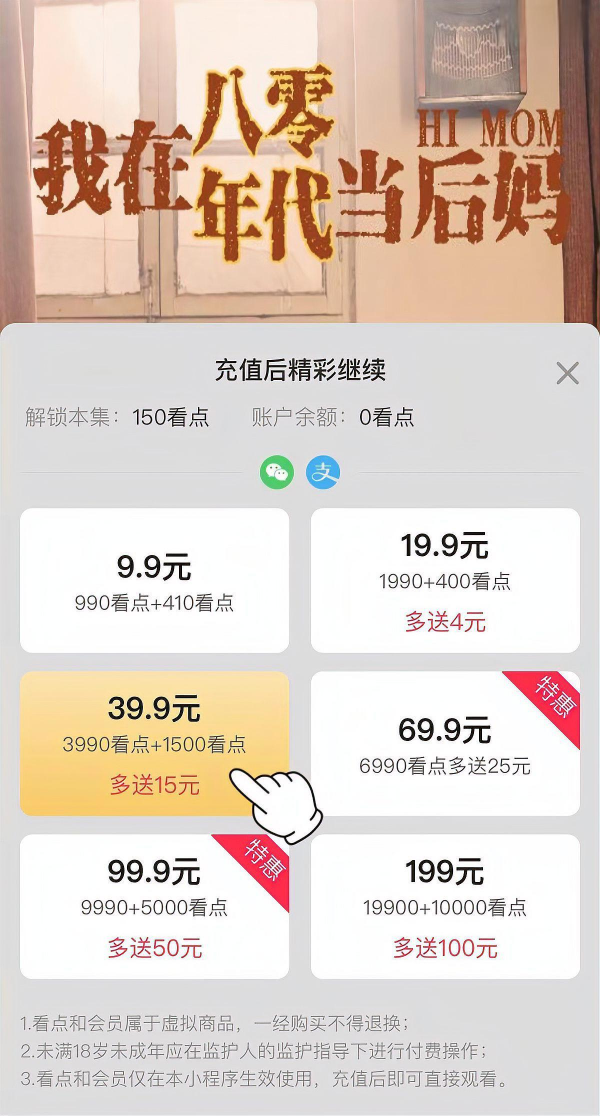
Hybrid monetization dominates: The first 3-5 episodes are free, with subsequent unlocks requiring payment per episode or watching incentive ads (IAA). By 2025, IAA-based short drama apps surged from 4.7% to 24.7% of downloads, tapping price-sensitive markets like Southeast Asia.
However, regional payment disparities and a winner-takes-all landscape leave most mid-tier players unable to share in growth. The industry epitomizes 'market prosperity (boom), profit scarcity.'
In 2025, 74 new short drama apps launched while 19 small platforms exited, mostly low-cost dubbed drama platforms targeting Southeast Asia. DramaBox and ReelShort, both Chinese, dominated the top tier for two years, but among the 2025 top 10 mid-tier apps, 5 (all Chinese) saw declines in both downloads and revenue.
The market exists, but 'inclusive gold rushes' do not.
02
AI Cuts Costs, But Isn’t a Profit Panacea
AI is slashing costs across key micro-short drama supply chain nodes. Multilingual AI dubbing reduces translation costs by an order of magnitude, while AI-generated comic adaptations lower content production barriers.
Yet AI also accelerates content homogenization, leaving the 'blockbuster power law' intact—AI merely increases trial frequency and ad targeting precision without eliminating the industry’s high failure rate.

AIGC’s role in short drama exports spans five areas:
1. AI-assisted scriptwriting: Rapidly generates multiple script versions, episode summaries, and dialogues using large language models, ideal for batch-adapting online literature IPs.
2. Multilingual AI dubbing: Neural network TTS delivers near-human emotional delivery in English, Spanish, Portuguese, and Indonesian, slashing traditional dubbing costs and timelines.
3. AI comic adaptations: Tools like Midjourney and ComfyUI create coherent storyboards or convert live-action drama frames into anime style, paired with lip-sync tech for 'AI-generated comic dramas.'
4. Virtual actor performances: Some platforms experiment with full-CGI 'simulated human dramas,' offering long-term potential to bypass actor scheduling and salary costs.
5. Smart ad material generation: Automatically clips highlight reels, generates multi-format vertical previews, and A/B tests them—a core driver of high ROI for exported short dramas.
This tech shift has three structural impacts:
1. Lower barriers trigger a content explosion, with a 'fast-in, fast-out' dynamic.
2. Local production cost pressures force AI adoption; dubbing+AI dubbing becomes the primary cost-control method for smaller players, while leaders test high-budget local productions to build content moats.
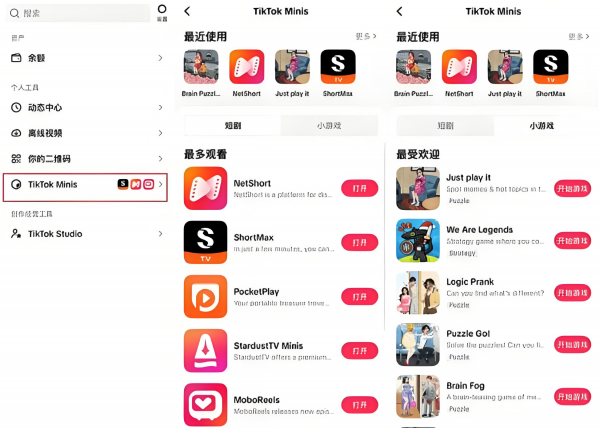
3. New formats divert user attention: TikTok now hosts dozens of AI short drama accounts, with single-episode views topping 600 million. AI short drama revenue exceeded $2 million in Q1 2026, suggesting social media platforms could bypass standalone apps via 'content+algorithm distribution,' creating new cross-border competition.
Yet AI cannot eliminate the 'blockbuster power law'—where a few hits drive most revenue, while most titles lose money.
AI reduces production/dubbing marginal costs, accelerates material iteration, and boosts ad efficiency, lowering trial-and-error costs. But it doesn’t alter the core business logic and may worsen click dispersion due to oversupply.
Thus, AI is a critical efficiency lever and differentiation tool, not a profit guarantee. It lets leaders build content library LTV (lifetime value) at lower costs but accelerates the demise of followers lacking content judgment who rely solely on paid traffic.
03
Chinese Exporters Form a 'Big Three,' But Face Bleeding Growth and Second-Tier Predators
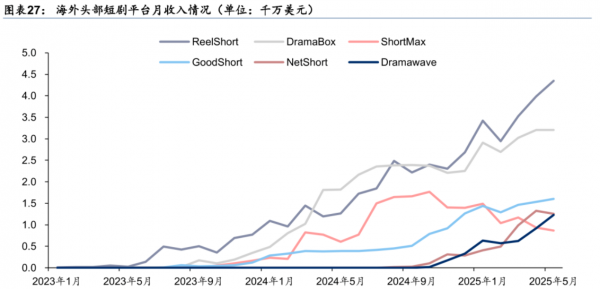
China’s micro-short drama exports now feature a 'Big Three' leadership tier—ReelShort (Crazy Maple Studio), DramaBox (Dianzhong Technology), and ShortMax (Jiuzhou Culture)—in a 'duopoly+challenger' pattern (landscape). However, all leaders face 'revenue growth without profitability' phases.
ReelShort pioneered the overseas paid short drama model. Its parent, Crazy Maple Studio, has a core team experienced in Chinese online literature exports. Financially: ReelShort’s 2025 revenue hit RMB 5.721 billion (+97% YoY), but net losses exceeded RMB 85 million, swinging from profit to loss—a classic 'bleeding growth' scenario.
Sensor Tower data and Huatai Securities reports show ReelShort generated $43.48 million in May 2025 revenue with 11.48 million downloads. By monthly active users, it ranked third with 25.57 million.
Strategically, ReelShort was first to build a local U.S. production team for original English dramas, combining heavy ad spending with data-driven content selection. It leverages Chinese online literature IPs for script reserves, but risks rising Meta/Google ad costs in North America.
Dianzhong Technology operates domestic licensed online literature and short drama platforms. Its DramaBox app went global in 2023, surpassing RMB 2 billion in revenue and 100 million downloads across 200+ countries in 2024.
Content-wise, DramaBox still relies heavily on dubbed dramas, importing proven Chinese hits with AI-generated English/Spanish/Portuguese dubbing. According to 36Kr Outbound, Dianzhong disclosed an overall gross margin of ~10%, with short drama net margins below 1%—struggling with high ad spend eroding profits.

Jiuzhou Culture, a private Chinese firm early in micro-short drama production, owns hits like *The Peerless*. Its ShortMax platform held ~7.1% market share from January-May 2025, ranking fourth, and briefly topped the U.S. iOS Entertainment Free Chart with ~5.5 million daily active users at peak.
ShortMax emphasizes 'online literature export IP + local adaptation,' launching manga IP adaptations in Japan and Spanish-language local productions in Latin America. It seeks a middle ground between ReelShort’s high-cost originals and DramaBox’s mass dubbing—leveraging upstream production capabilities to support its global platform.

Meanwhile, Kunlun Wanwei’s DramaWave, COL’s FlareFlow/Sereal+, Zhangyue’s iDrama, and ByteDance’s Melolo are carving out niches with different strategies.
Undoubtedly, China’s short drama exporters now have a clear 'Big Two + Challenger' leadership tier (ReelShort, DramaBox, ShortMax), with Kunlun, COL, and ByteDance in the second tier. The industry has entered a 'capital-intensive + content-driven' deep water zone.
Current leaders prioritize scaling at a loss, betting on future localization hits and LTV growth to cross the breakeven point—a severe test of investor patience and financial strength.
Conclusion
Labeling AI short drama exports as either 'the next online literature export' or 'another bike-sharing cash burn' is overly simplistic.
For investors tracking this sector, key metrics include: quarterly IAA revenue shifts and customer acquisition cost inflection points for leading platforms; signs of positive ROI on North American/European original hits; quantifiable AIGC cost reductions in dubbing and comic adaptations; and TikTok’s impact on standalone app paywall dilution.
Short-term valuations are prone to hype, but true safety margins come from 'who first achieves a sustainable unit economic model without continuous funding.'
Micro-short drama exports won’t be a trap—they’re the fastest-growing pillar of China’s 'new three exports' (online literature, gaming, short dramas). But for individual companies, until they achieve positive unit economics, most are merely fuel for this $10 billion party.
-
![]()
Proposed to Raise 955 Million Yuan through Private Placement! Huicheng Vacuum Boosts Localization of Ultra-Precision Optical Coating Equipment
-
![]()
Cash Flow Soars 13-Fold! What Major Strategic Move is Wuhan Five Square Optoelectronics Planning?
-
![]()
Leaked Design of vivo X500: Reverts to Circular Camera Module in Top-Left Corner, Pays Homage to Classic X90 Aesthetic
-
![]()
DeepSeek Shows Signs of Foraying into Code Agents, Launches WeChat Official Account Focused on Harness
-
![]()
Auto Companies Deny Claims That ‘Cooperation with Huawei Is Non-Essential’, as Huawei Transforms into a ‘Public Platform’
-
![]()
Starship to Independently 'Return to the Launch Tower': SpaceX's Ambitions Extend Beyond Rocket Building to Dominating Space Transportation
-
![]()
Starship Set to Independently 'Return to the Launch Tower': SpaceX is Revolutionizing Space Transportation, Not Just Building Rockets
-
![]()
Anthropic and OpenAI Face Off Against Deepseek