Chip ETF Tumbles! ChinaAMC Rides the Wave of AI Profits
 05/22 2026
 609
609
A Single Statement from a Listed Company's Executive Causes Stock Price to Plummet by 24%
Roborock Invests 3.2 Billion in Advertising Over a Year, Only to Be Marginalized in the AI Field?
Source: Shenlan Finance
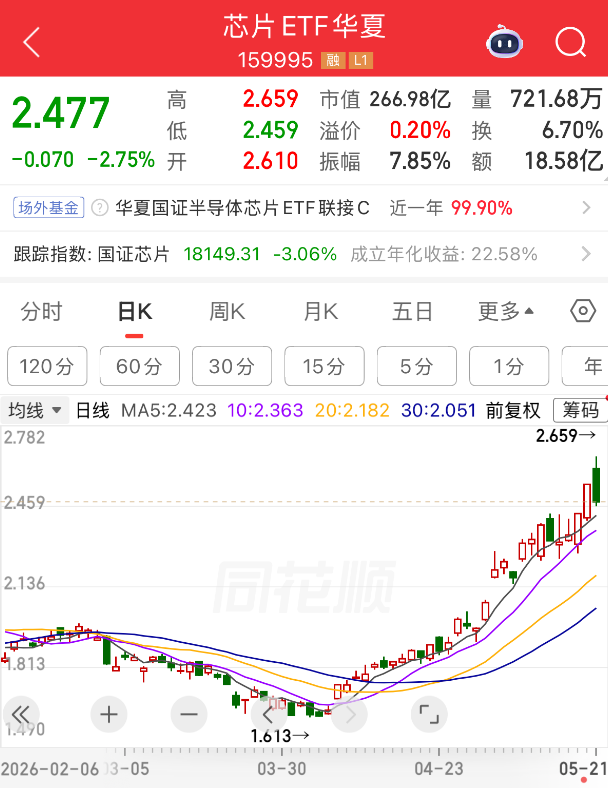
On May 21, the Chip ETF managed by ChinaAMC experienced significant fluctuations, initially surging by 4.4% at its peak during the trading session before ultimately closing down 2.75%. Since April, the fund has witnessed a series of sharp rallies, accumulating gains exceeding 50%, and has become a popular choice among investors.
Amidst the AI boom, while market attention is firmly fixed on emerging players like Yongying Fund, the seasoned public offering giant ChinaAMC has quietly achieved remarkable performance in the ETF sector.
However, as capital floods into the AI sector, related ETFs are experiencing increasingly intense intraday volatility. ChinaAMC has capitalized on this wave of profits, but the question of how long it can sustain this momentum has become a concern for both investors and fund companies.
1. Collective Rise of AI Sector Products
ChinaAMC has demonstrated remarkable precision in sensing the tech bull market.
The Communication ETF managed by ChinaAMC (515050) stands as a solid example. Strategically positioned as early as 2019, it targets the core optical modules and CPO segments within the AI computing power demand and has been consistently managed by Li Jun. In 2023, as AI hardware began to surge, the fund decisively followed the tracked index, the CSI 5G Communication Theme Index (931079), heavily weighting stocks like Zhongji Innolight, Foxconn Industrial Internet, and Luxshare Precision, thereby seizing the bullish trend.
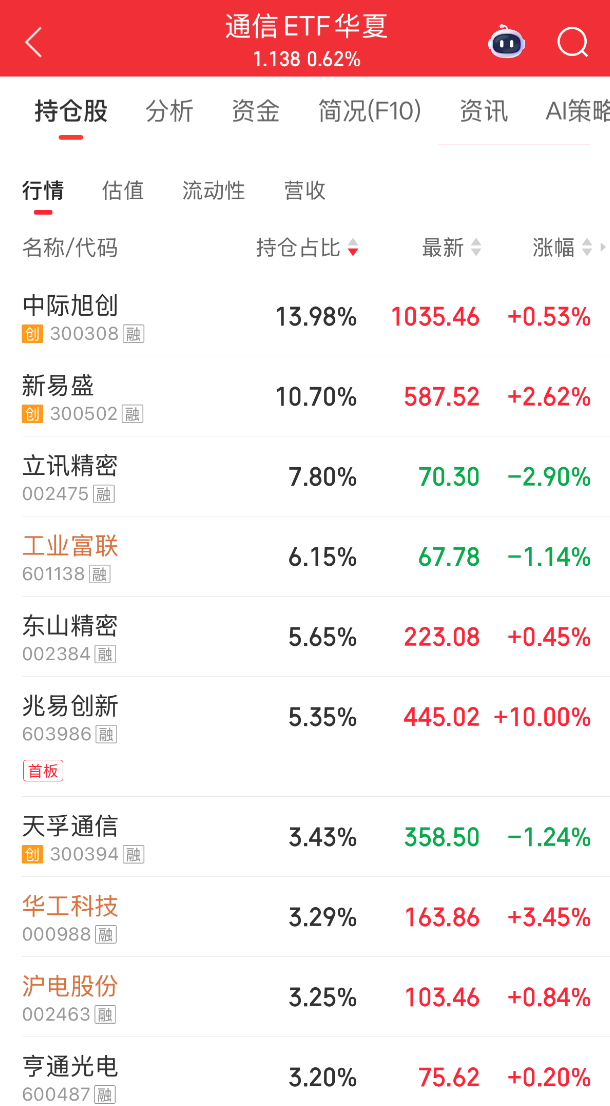
Latest Holdings of Communication ETF ChinaAMC as of May 20
As of May 19, the fund's net asset value has surged by 266% over the past three years, ranking in the top 0.28% of its peers, with a tracking error of just 0.017% year-to-date, the highest precision among comparable funds. Its latest scale has reached 13 billion yuan, ranking first in the industry, with an average daily trading volume exceeding 500 million yuan, enabling instant transactions for buyers and sellers.
The Chip ETF managed by ChinaAMC (159995) follows closely behind. Established in 2020 and managed by Zhao Zongting, the fund's latest scale is approximately 25.8 billion yuan. Although its scale has recently fluctuated, its liquidity significantly outperforms its peers. It has achieved a one-year return of 99.34% and a cumulative return of about 143% since inception. Recently, its holdings have undergone significant changes, with increased positions in Montage Technology and GigaDevice, leading to noticeable net asset value gains, reflecting the market's shift from AI hardware to chips. However, today's sharp pullback may signal a clear short-term cooling.
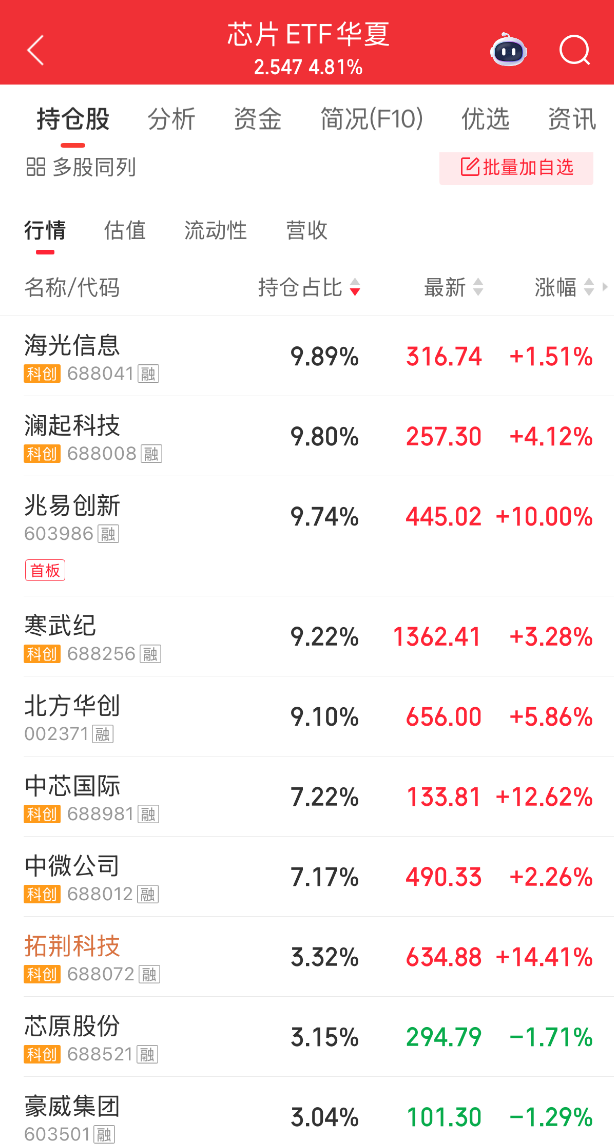
Latest Holdings of Chip ETF ChinaAMC as of May 20
The Robotics ETF managed by ChinaAMC (562500) is equally impressive, with a latest scale of approximately 20.7 billion yuan, the largest among similar products in the market. The fund tracks the CSI Robotics Index, surging over 18% in the past month and about 30% since April 8. Although its cumulative return since inception temporarily lags behind the other two major AI sector ETFs, the entire embodied intelligent robotics industry is at a critical juncture on the verge of commercialization. The sector is still accumulating strength, with significant potential yet to be unleashed.
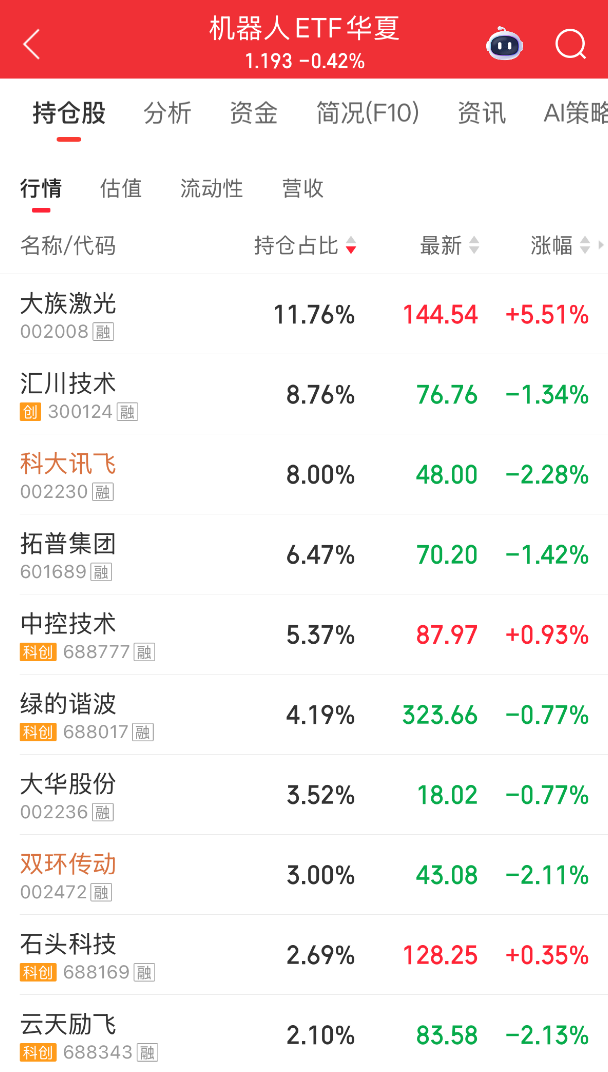
Latest Holdings of Robotics ETF ChinaAMC as of May 20
With all three major AI sector products surpassing the 10 billion yuan mark, this matrix is unmatched in the entire industry.
2. Solid Foundation in Broad-based ETFs
If AI sector ETFs are ChinaAMC's sharp blades, then broad-based ETFs are its massive anchors.
The ChinaAMC CSI 300 ETF (510330) had a scale of 228.7 billion yuan at the end of 2025, ranking second in the market, just behind Huatai-PineBridge. Its latest scale is 83.7 billion yuan, mainly due to significant redemptions this year, but its unit net asset value continues to reach new highs. Such products remain the cornerstone for long-term allocation of China's core assets.
The ChinaAMC SSE 50 ETF (510050) had a scale of 175.9 billion yuan at the end of 2025, with its latest scale at 33.3 billion yuan, ranking among the top. As one of the oldest broad-based ETFs in the market, established in 2004, it has navigated bull and bear markets for two decades, with consistently strong liquidity. Institutional funds, insurance funds, and retail investors all consider it a top choice when allocating to large-cap blue chips.
The ChinaAMC STAR 50 ETF (588000) has a latest scale of nearly 70 billion yuan, firmly leading among sci-tech innovation board ETFs. The sci-tech innovation board is highly volatile, but ChinaAMC's product consistently leads in average daily trading volume, allowing for smooth entries and exits.
These three products alone surpass the total ETF scale of most fund companies. From broad-based to sector-specific, from domestic to cross-border, they have built ChinaAMC's complete ecosystem in the ETF arena.
3. The Trillion-Yuan King Also Has Weaknesses
On January 12 this year, ChinaAMC's total non-monetary ETF scale reached 1.02 trillion yuan, becoming the first domestic member of the "trillion-yuan club," accounting for over 16% of the market share and ranking first in the industry for 21 consecutive years.
However, in the active equity space, ChinaAMC presents a different picture—long-term underperformance, akin to a student excelling in some subjects but struggling in others.
In 2024, ChinaAMC's active equity products underperformed the industry average in terms of average return, ranking in the bottom third. Over the past three years, its active equity fund scale has shrunk by more than 30% from its peak, while its ETF scale has doubled over the same period.
Behind this lies a challenging issue of talent stability. In 2025, "ETF king" Zhang Hongtao resigned, with his managed scale plummeting from 456.1 billion yuan to zero. In the active equity space, former "energy king" Zheng Zehong and "tech star" Zhou Keping, among other star fund managers, have also departed.
Take Zheng Zehong's ChinaAMC Energy Innovation as an example. At its 2021 peak, its scale exceeded 20 billion yuan, but it had halved by the time of his departure. Zhou Keping's ChinaAMC Innovation Future similarly fell from over 10 billion yuan to less than 5 billion yuan.
It's not that the market is bad; it's that active management capabilities haven't kept pace.
Compliance issues have also led to deductions. In November 2025, ChinaAMC was warned by the Beijing Securities Regulatory Bureau for violations in investment research management, internal controls, sales management, and compensation management, with a senior executive also receiving a separate warning letter for similar issues. Coupled with past cases of insider trading involving Luo Zeping, Wang Peng, and Xia Yunlong, the brand's reputation and compliance capabilities have been repeatedly questioned.
Furthermore, intensifying ETF fee wars, competitors catching up, and potential redemption pressures after sector overheating are all variables that could alter the competitive landscape. Without addressing the shortcomings in active equity, ChinaAMC will forever remain a "half-giant."
Note: This article is based on market observations and does not constitute any investment or financial advice.
Shenlan Finance New Media Cluster, originating from the Shenlan Finance Journalist Community, has a 15-year history and is a well-known domestic financial new media outlet. Its accounts focus on China's most valuable companies, cutting-edge industry developments, and emerging regional economies, providing valuable content for investors, listed company executives, and the middle class. Welcome to follow.
-
Ofilm Teams Up with ADSensE to Propel Large-Scale Deployment of All-Solid-State LiDAR Powered by ADS6311 Chip!
-
![]()
Loss of 2.5 Billion Yet Facing Strong Demand for Shares? Another Battle for Control of Lianchuang Electronics
-
![]()
Huawei’s Enjoy Series Flies Off the Shelves, Prompting Xiaomi to Double Down on Budget Smartphones
-
![]()
Beijing Hyundai's Top Executive Criticizes Industry Disorder: Certain Brands Treat Customers as Beta Testers
-
![]()
The domestic mobile phone market has declined for five consecutive quarters! Huawei defies the trend with significant growth: maintains its top market share
-
Annual Revenue Surpasses 3 Billion: An Automotive Trim 'Little Giant' Makes Its Debut on the Beijing Stock Exchange
-
![]()
The Space Force Wants to Spend $30 Billion on Rocket Launches: Is Trump Doubling Down, and Is SpaceX the Big Winner?
-
![]()
Going Crazy! One out of Every Three Plug-in Hybrids Sold in Europe is a Chinese Vehicle