The AI Large Model Co-Developed by Chinese Academy of Sciences Scientists Is Truly Remarkable
 06/11 2026
 552
552
At present, mainstream AI large model companies are mainly focused on addressing whether AI can "mimic human language." However, a select few companies are taking a counterintuitive approach—empowering AI to "make decisions."
This company, currently valued at $4 billion, is supported by the Chinese Academy of Sciences and has recently cleared the Hong Kong Stock Exchange hearing. It is poised to debut on the Hong Kong stock market as the "pioneer stock of a general decision-making large model."
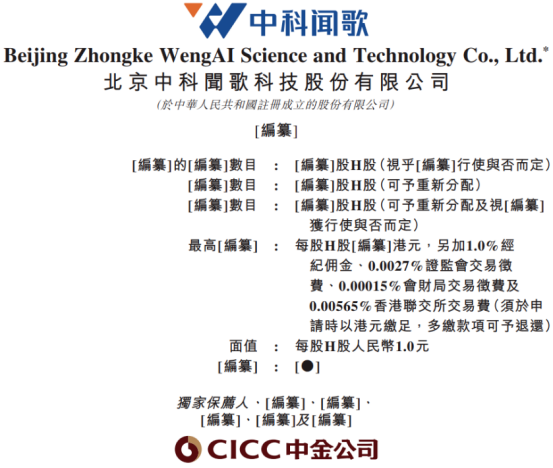
What exactly has it accomplished? Is decision intelligence truly the next big thing for the AI industry? Let's delve deeper.
What Exactly Is "AI Decision-Making"?
The narratives of AI companies in the market are becoming increasingly similar. They primarily focus on benchmarking or promoting empowerment. Yet, when you examine their products—chatting, writing, drawing, creating PPTs—they are essentially performing the same function: getting AI to say or draw something for you.
While this is undoubtedly useful, it doesn't encompass the full potential of AI.
Wen-Ge Science has chosen a less-traveled path. Instead of assisting you with writing, it aids you in making decisions.
But don't be daunted by the term "decision intelligence."
How many decisions do you make in a day? From choosing what to eat for dinner to deciding whether to click on a notification, sign a contract, invest money, or adjust policies—most of the time, you're not seeking a standard answer. Instead, you're deducing several possibilities with incomplete information and then taking a calculated risk.
Traditional enterprise software deals with the "known"—reports inform you of what happened and, further, why it occurred. However, no one tells you whether to choose option A or B next.
Wen-Ge Science aims to bridge this gap. It has developed a system known as DIOS (Decision Intelligence Operating System) to assist governments and enterprises in conducting analysis, simulation, and deduction. The output is a judgment, not just text.
Take flood warning as an example. The traditional method triggers an alarm when hydrological data exceeds predefined standards. However, Wen-Ge Science inputs meteorological, hydrological, topographical, and population distribution data into the model to deduce flood paths under various conditions, reducing warning time from hours to minutes. This provides a solid foundation for flood control decisions.
It's crucial to address a common misconception about decision-making—a large model combined with industry knowledge does not automatically equate to decision intelligence.
Intuitively, one might think: feeding industry data into a general-purpose large model will yield an industry decision-making brain.
But it's not that straightforward.
True decision intelligence must simultaneously address three key aspects.
The first is modeling. It's not about having AI read reports and summarize them but about making it comprehend the causal relationships between variables—if A changes, how does B respond? If B changes, does C increase or decrease? This is deduction, not mere prediction.
The second is uncertainty quantification. A robust decision-making system won't just say "choose A"; it will inform you of the success rate of choosing A and how much higher the success rate can be if you're willing to invest more. This is referred to as decision boundaries, not multiple-choice questions.
The third is closed-loop verification. After the model completes a round of deduction, someone must provide feedback on its accuracy, the extent of any errors, and how to correct them in the future. This isn't a simple question-and-answer session; it's a continuously operating feedback system.
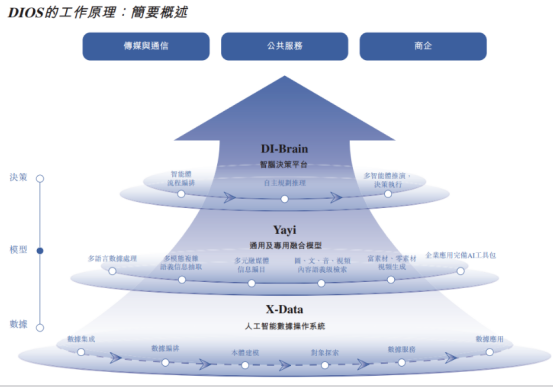
Wen-Ge Science has integrated these three aspects into its system. The Decitron decision-making machine, released in June 2025, is a general-purpose decision-making large model specifically designed to simulate different choices and deduce possible outcomes.
There are only a few companies in the market pursuing this approach. This rarity also contributes to its value in the secondary market.
Gross Profit Margin Continues to Rise
Now that we've explored the product, let's examine the company's market performance.
The gross profit margin stands at 51.2% and is still increasing. It was 44% in 2023, 50.4% in 2024, and 51.2% this year. For an AI company engaging in business with governments and enterprises to consistently maintain a gross profit margin above 50% indicates that it's not a one-time transaction—customers are continuously willing to pay a premium for its services.
The net revenue retention rate is 139.5%. This means that, on average, existing customers spent 39.5% more in 2025 than they did the previous year. The growth isn't driven by new customers but by existing customers increasing their purchases.
This is a core metric in SaaS investment logic and holds even greater significance for a company that derives 72.7% of its revenue from localized deployments—suggesting that the label of "project-based" can be gradually shed.
The delivery cycle has been reduced from 185 days to 80 days, more than doubling in efficiency over two years. The configurability of DIOS as an underlying system plays a role—not every project starts from scratch; the foundation is unified, and the upper layers are customized.
Now, let's consider the less flattering aspect. From 2023 to 2025, the company accumulated losses of approximately 600 million. The R&D expense ratio has decreased from 71.9% to 46.3%, but the absolute value remains high at 188 million—for every 100 yuan earned, 46 yuan is reinvested in R&D.
This isn't uncommon for AI companies. However, the duration of "burning money for growth" depends on the quality of growth. Wen-Ge Science's revenue growth rate in 2025 was 27.4%, roughly the same as 27.2% in 2024. For a company supporting a 4 billion valuation, this growth rate isn't explosive.
The Chinese Academy of Sciences Brand: Useful but Costly
In terms of internal management, the founders, Wang Lei, Luo Yin, and Zeng Dajun, are all scientists from the Institute of Automation, Chinese Academy of Sciences. The Chinese Academy of Sciences brand is highly regarded in the ToG (Government-Oriented) market, saving the company from many detours.
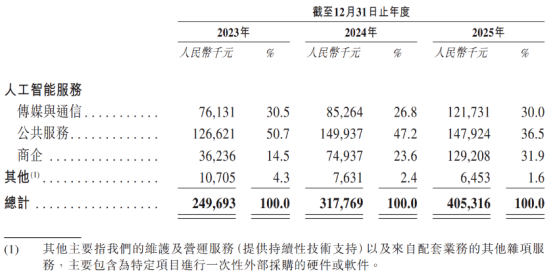
Indeed, in 2025, Wen-Ge Science had 116 public service clients, 102 media clients, and 184 commercial clients. Government clients contributed 36.5% of revenue, with government and enterprise clients combined accounting for over 60%.
The investor list includes the China Development Bank Manufacturing Transformation Fund, China Internet Investment Fund, and CCTV Integrated Media Industry Fund, providing national-level endorsement and a stable foundation.
However, on the flip side, although commercial clients are the most numerous, they only account for 31.9% of revenue, indicating significantly lower average spending per client. To support the narrative of a "general-purpose decision-making OS," relying solely on government purchases isn't sufficient—enterprises must be willing to pay, and pay handsomely.
Wen-Ge Science has announced plans to expand overseas, targeting the Middle East and Southeast Asia, with product directions including science education, energy, and healthcare. The direction is sound, but execution is what separates good ideas from successful ones.
It's worth mentioning that Wen-Ge Science is going public under Chapter 18C of the Hong Kong Stock Exchange, a green channel for "specialized technology companies" that allows unprofitable high-tech enterprises to list on the main board. This is the path Wen-Ge Science has chosen.
The Hong Kong capital market is willing to provide a pricing window for companies with high technical barriers but no profits yet. Not all AI companies can go public under 18C; their technology must withstand scrutiny.
Moreover, the liquidity pressure after an 18C listing is higher than that of a regular IPO. Investors' valuations are based on long-term imagination, and the company must repay them with sustained customer growth and technological implementation. Once growth slows, the market's patience is much shorter than for traditional companies.
Returning to the original question. Is it valuable for AI large models to transition from the "tool layer" to the "decision-making layer"?
ChatGPT demonstrated what AI can say, but the next truly worthwhile challenge is: What can AI decide for you?
It's not because decision-making is inherently more advanced than content generation. It's simply closer to generating revenue. For example, an AI that helps you write emails might charge $20 a year, while an AI that helps you adjust your supply chain might charge $2 million a year. The thousand-fold difference in pricing reflects the gap in value density. This is where the value of decision-making AI large models lies.
-
![]()
Will WeChat Start Charging Fees?
-
![]()
Cross-border 'Golden Window' in 2026: Chinese Products Sweep Across Southeast Asia
-
![]()
BIWIN Storage, Betting 20 Billion on the Future with Hundreds of Billions in Market Cap
-
![]()
Jensen Huang: The Globetrotting Icon
-
![]()
Auto Retailer Rankings: January-May 2026 - Geely Leads, BYD Follows
-
![]()
199 RMB! Nokia Small-Screen Phone Review: WeChat Video Calls Add a Quirky Twist
-
![]()
2.27 Billion Shares Unlocked: Will Insta360 Face a Mass Sell-Off?
-
![]()
Desktop Agent Unleashed! Alibaba’s QoderWork Handles Odd Jobs, But Only at Intern Level