Zhipu’s Stock Plunge: AI Industry Bubble Pops, Signaling a Pivotal Shift
 06/11 2026
 497
497
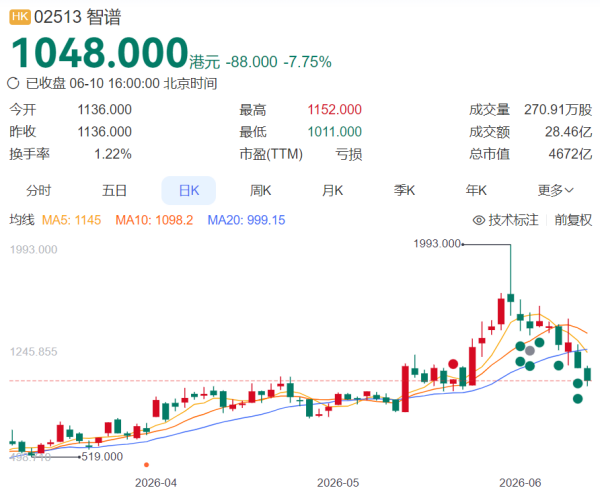
Recently, Zhipu, the so-called "pioneer large model stock," has experienced a stock price rollercoaster. After reaching a historic high of HK$1,993 on May 29, its stock price has seen a significant retreat, with a cumulative decline nearing 50%. As of today's close, the stock price stands at HK$1,048, with the market value having shrunk by over HK$420 billion from its peak.
Three core factors explain why Zhipu's stock price nearly halved in just eight trading days:
1. Valuation Bubble Bursts, Fundamentals Fail to Align
Zhipu's earlier surge was largely fueled by the enthusiasm surrounding the domestic large model sector and capital concentration, leading to a valuation that had long been significantly detached from the company's true fundamentals. At its peak, Zhipu's price-to-sales ratio (PS) soared to 1,124 times, dwarfing the PS ratios of mature tech giants like Microsoft and Apple, which stand at around 10 times, and even falling short of one-tenth of those of overseas AI leaders.
Despite Zhipu maintaining rapid revenue growth in 2025, its net loss ballooned to RMB 4.718 billion, 6.5 times its revenue. This indicates massive R&D investment and the absence of a stable profit model. When market sentiment wanes, such high valuations without performance support inevitably face severe corrections. In essence, during Zhipu's stock price frenzy, 99% was based on expectations, and only 1% on reality, with the stock price largely propped up by speculative narratives.
2. Multiple Negative Expectations Converge, Triggering Capital Exodus
Zhipu's stock price plunge was directly propelled by the convergence and amplification of multiple negative expectations, including:
① Pressure from share unlocking: Zhipu is set to face its first large-scale share unlocking post-IPO in July, involving approximately 11.98 million shares held by cornerstone investors. With early investors sitting on substantial floating profits, market panic about potential share reductions and cash-outs has spread, pushing down the stock price in anticipation.
② "Good news fulfilled" effect: Although Zhipu was included in the Hang Seng Tech Index and the Stock Connect on June 8, funds had already positioned themselves in advance and driven up the stock price. The official inclusion, therefore, triggered a classic "buy the rumor, sell the news" scenario, leading to a concentrated exodus of profit-taking, with a further 20% drop in just two trading days.
③ Refinancing dilution concerns: Just five months after its listing, Zhipu announced plans to initiate a listing process on the Science and Technology Innovation Board, aiming to raise up to RMB 15 billion. This not only raised concerns about equity dilution but also sparked doubts about the company's financial health, further eroding shareholder confidence and causing the stock price to plummet by over 8% on the day of the announcement.
3. Tightening Macro Liquidity and Escalating Industry Competition
Changes in the external macro environment have systematically suppressed high-valuation AI stocks. The U.S. non-farm payrolls data exceeded expectations, increasing the likelihood of a Federal Reserve interest rate hike and tightening global liquidity. This has made investors hesitant to pay extremely high premiums for future profits, impacting overall liquidity in the Hong Kong stock market.
Meanwhile, competition in the domestic large model industry is intensifying, with internet giants like Baidu, Alibaba, and ByteDance leveraging their own computing power clusters and constantly squeezing survival space through price wars. In contrast, Zhipu lacks its own computing power, and its high GPU procurement costs result in a unit Token cost far exceeding that of competitors, making pricing difficult and profits thin, posing severe challenges to its business model.
In my opinion, Zhipu's stock price rollercoaster is not just a case of market volatility but a microcosm of the entire AI industry's capital narrative shifting from frenetic hype to rationality. This plunge marks a fundamental transformation in the capital market's investment logic towards the AI sector, with the focus shifting from pure technological potential to demanding tangible commercialization and positive profitability.
To put it bluntly, the AI industry bubble is clearing, and a turning point has arrived, characterized by the end of "technology-only" theories and the emergence of commercialization capabilities as the core. As capital becomes more rational, stories of high investment and no output will find it difficult to secure funding. For Zhipu, while its stock price has returned to rationality, its fundamentals have not improved. If it cannot swiftly reduce costs, boost revenue, and cut losses, its stock price may continue to face downward pressure. Only by transforming technological barriers into commercial barriers can it hope to see a valuation recovery.
For ordinary investors, these violent oscillations serve as a profound risk education, reminding them that while they should pay attention to the long-term development trends of the AI industry, they must also guard against valuation traps caused by short-term emotional hype and focus on substantial progress in areas such as reducing ineffective costs and achieving healthy cash flow. For instance, leading companies with computing power, scenarios, and cash flow are the AI investments worth considering.
In short, it's not that Zhipu is not strong enough; it's that the capital market is finally no longer paying for "castles in the air"!
-
![]()
Chinese Cars Seize Overseas Markets: The Advent of a Winner-Takes-All Era
-
![]()
Will WeChat Start Charging Fees?
-
![]()
Cross-border 'Golden Window' in 2026: Chinese Products Sweep Across Southeast Asia
-
![]()
BIWIN Storage, Betting 20 Billion on the Future with Hundreds of Billions in Market Cap
-
![]()
Jensen Huang: The Globetrotting Icon
-
![]()
Auto Retailer Rankings: January-May 2026 - Geely Leads, BYD Follows
-
![]()
199 RMB! Nokia Small-Screen Phone Review: WeChat Video Calls Add a Quirky Twist
-
![]()
2.27 Billion Shares Unlocked: Will Insta360 Face a Mass Sell-Off?