Can You Snag a Complete Trio of Digital Gadgets for 10,000 Yuan? AI Recommendation Showdown: How Trustworthy Are Doubao, DS, Qianwen, Kimi, and Yuanbao?
 06/15 2026
 542
542
When it comes to AI shopping guides, there's still a considerable gap compared to professional consumer guides.
Every year after the college entrance exams, smartphones, computers, and tablets become the quintessential "must-have trio" for incoming university students. However, for most average families, the budget is often capped at 10,000 yuan, posing a challenge in how to allocate funds wisely. Questions arise, such as whether to splurge on a flagship smartphone, whether a computer's specs will hold up throughout four years of college, and whether a tablet is truly indispensable—each question lacks a one-size-fits-all answer.
Particularly since the college entrance exam period coincides with the mid-year 618 shopping extravaganza, compounded by national and local subsidy policies in recent years, the plethora of overlapping discounts makes the selection process incredibly daunting for many parents and students. At this juncture, some savvy individuals have pondered: why not enlist AI to assist candidates in making their choices?
Thus, Leitech devised a seemingly logical solution: entrust this challenge directly to AI. This time around, we pitted five mainstream AI tools—Doubao, DeepSeek, Kimi, Tongyi Qianwen, and Tencent Yuanbao—against each other on the same stage. We posed the question from the perspective of a genuine high school graduate, with a maximum budget of 10,000 yuan, hoping to acquire a smartphone, computer, and tablet, with an undecided major, aiming to utilize them until graduation.
Would the AI's recommendations be absurd, or could it provide a shopping guide on par with those crafted by Leitech's professional editors?
None of the Recommendation Plans from the Five Leading AI Tools Were Entirely Trustworthy
To avoid revealing our evaluation intent, we eschewed prompts like "Please act as a shopping consultant" and instead framed the question as if posed by a student who had just completed exams. Our objective was to observe what product combinations the AI would suggest when faced with a complete digital novice. As it turned out, none of the five AI tools "disappointed" us in this regard.
1. Doubao: Strongly promoted the Apple ecosystem but suffered from severe price inaccuracies.
Doubao swiftly provided two "hassle-free" plans: the Apple ecosystem for 9,850 yuan, purportedly including the iPhone 17, iPad Air M2, and MacBook Air M3; and the Huawei ecosystem for approximately 8,900 yuan, encompassing the nova 12 Pro, MatePad Air, and MateBook 14 HarmonyOS edition. After organizing the information into a table, it opted for the Apple plan, insisting that the iPhone 17 128GB would retail for 4,099 yuan and the MacBook Air M3 8+256GB for just 2,550 yuan. Anyone with a discerning eye would recognize that these prices and configurations are clearly erroneous.
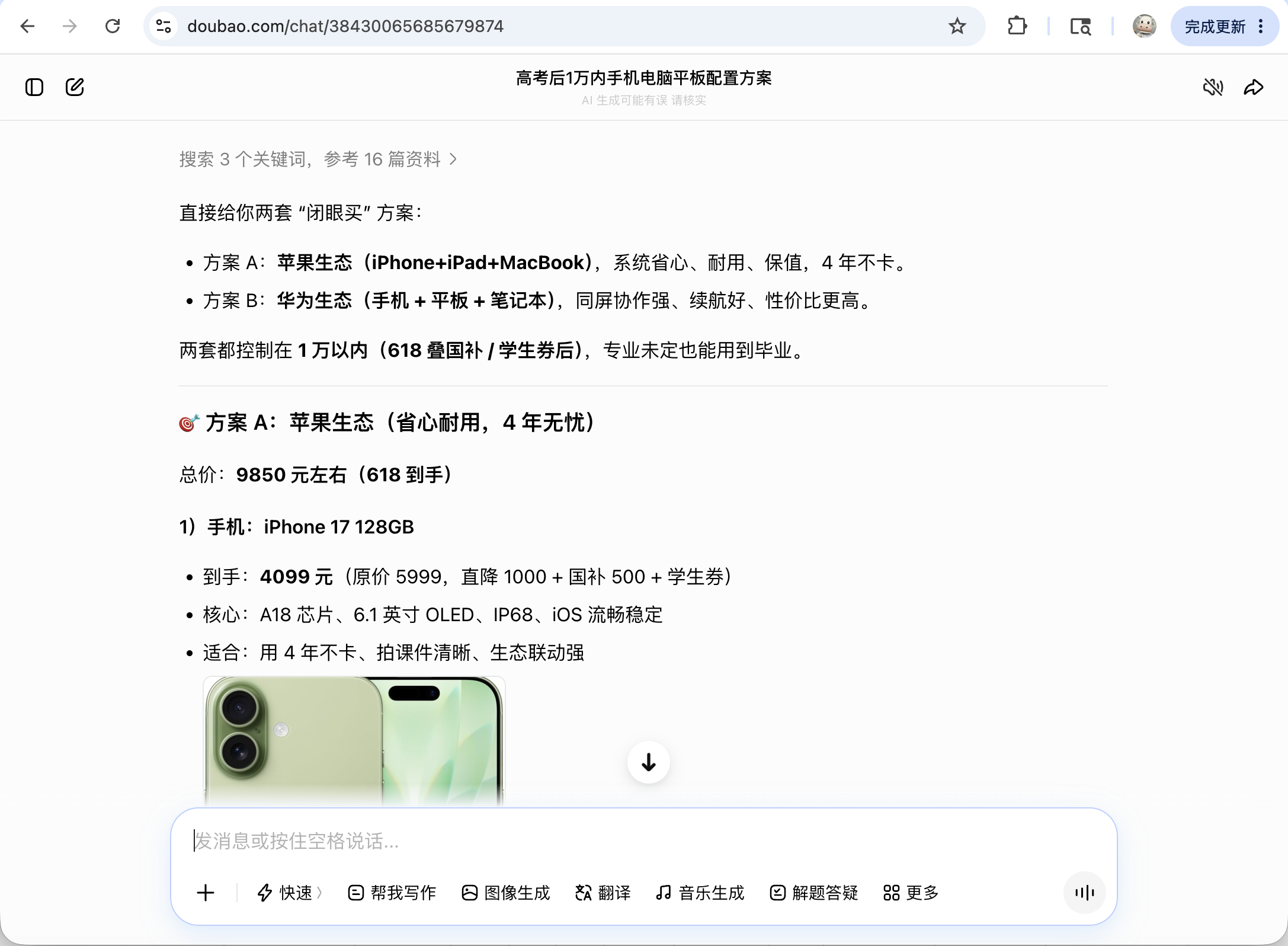
(Image source: Doubao)
The crux of the issue lies in the fact that nearly every item in this plan fails to withstand scrutiny. The official base storage for the iPhone 17 is 256GB; there is no 128GB version, which constitutes a fundamental specification error. The MacBook Air M3 priced at 2,550 yuan can be immediately identified as a price fabrication. More critically, the M3 Air is a 2024 product, yet when recommending it to high school graduates in 2026, Doubao provided no "outdated model" disclaimer. Additionally, it packaged the 8GB RAM and 256GB SSD as a worry-free choice that could last four years.
Objectively speaking, the M3 Air itself is not a subpar computer; it is lightweight, boasts good battery life, and offers stable screen quality, making it suitable for writing papers in liberal arts or business. However, when students engage in multitasking with browsers, WeChat, cloud storage, AI webpages, and PDFs, 8GB of RAM can quickly become insufficient, and the 256GB SSD will soon be filled with courseware, photos, and cache.
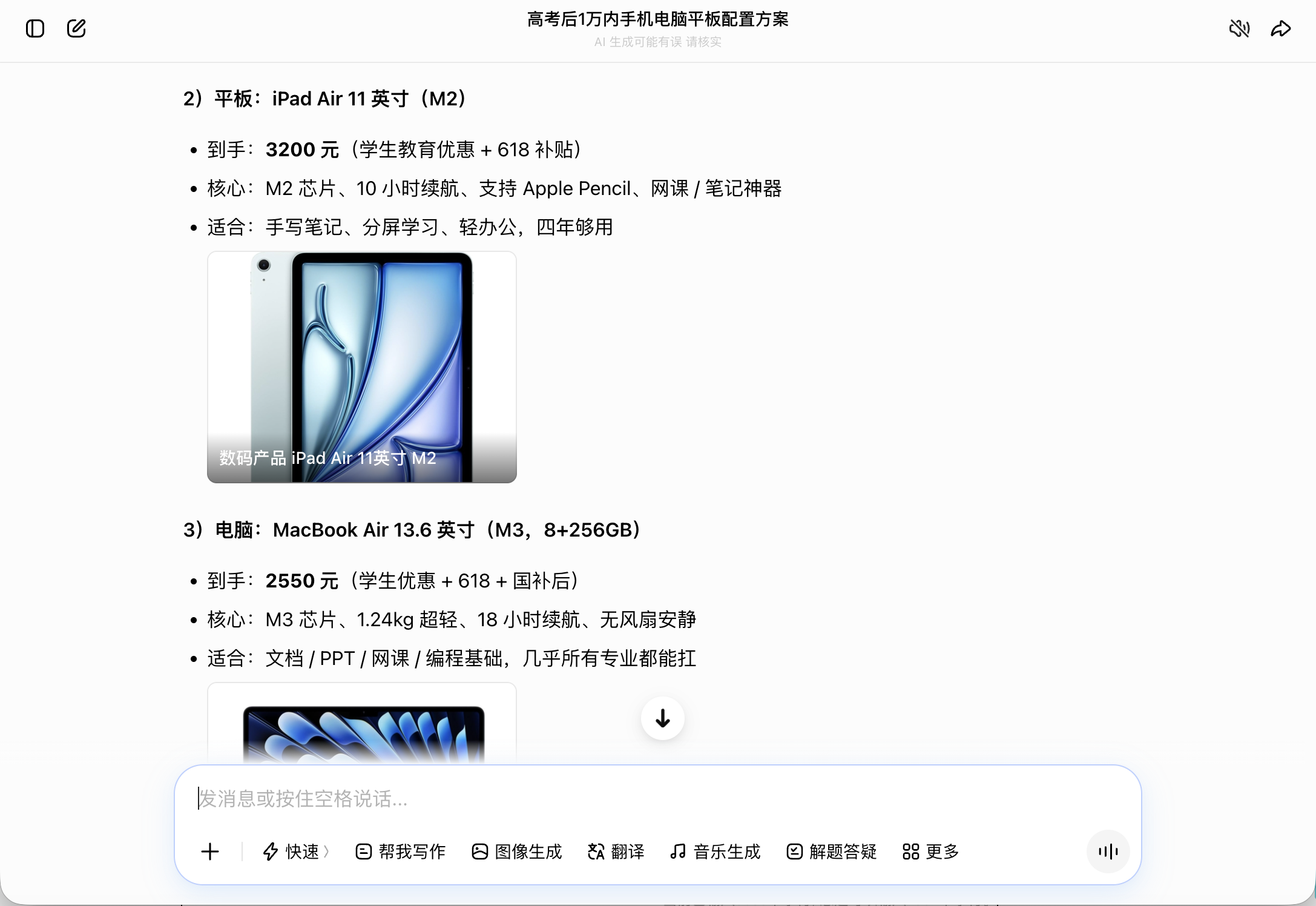
(Image source: Doubao)
Doubao's real issue is that it utilized a set of non-existent low prices to shoehorn the Apple ecosystem into a 10,000-yuan budget, creating the illusion of "purchasing the complete Apple ecosystem for 10,000 yuan." In reality, parents searching on e-commerce platforms would find that these prices cannot procure the Apple trio.
2. DeepSeek: Most comprehensive in search content but provided the most perfunctory answers.
DeepSeek retrieved a vast amount of web content and presented three plans: all-around balanced, Apple ecosystem, and gaming enthusiast. It candidly admitted that the Apple plan would cost around 11,800 yuan, exceeding the budget. Therefore, its most recommended all-around balanced plan consisted of the Xiaomi 17 16+512GB (4,299 yuan), Lenovo Xiaoxin Air 15 16+512GB (3,800 yuan), and Lenovo Legion Y700 3rd Gen (1,900 yuan), totaling approximately 10,000 yuan.
On the surface, this plan just meets the budget, but a closer examination reveals issues with priority allocation. The Xiaomi 17 smartphone consumes nearly half of the budget, whereas for prospective college students, the computer should be the device warranting higher priority investment. The Xiaoxin Air 15 can handle documents, online courses, and papers without issue, but when facing four years of multitasking, AI tools, and light video editing, 16+512GB is merely the bare minimum, with clearly insufficient margin. It's not that the Lenovo Xiaoxin Air 15 is inadequate, but rather that DeepSeek's chosen memory combination may not suffice for four years. Logically, it would make more sense to slightly reallocate the smartphone budget toward the computer.
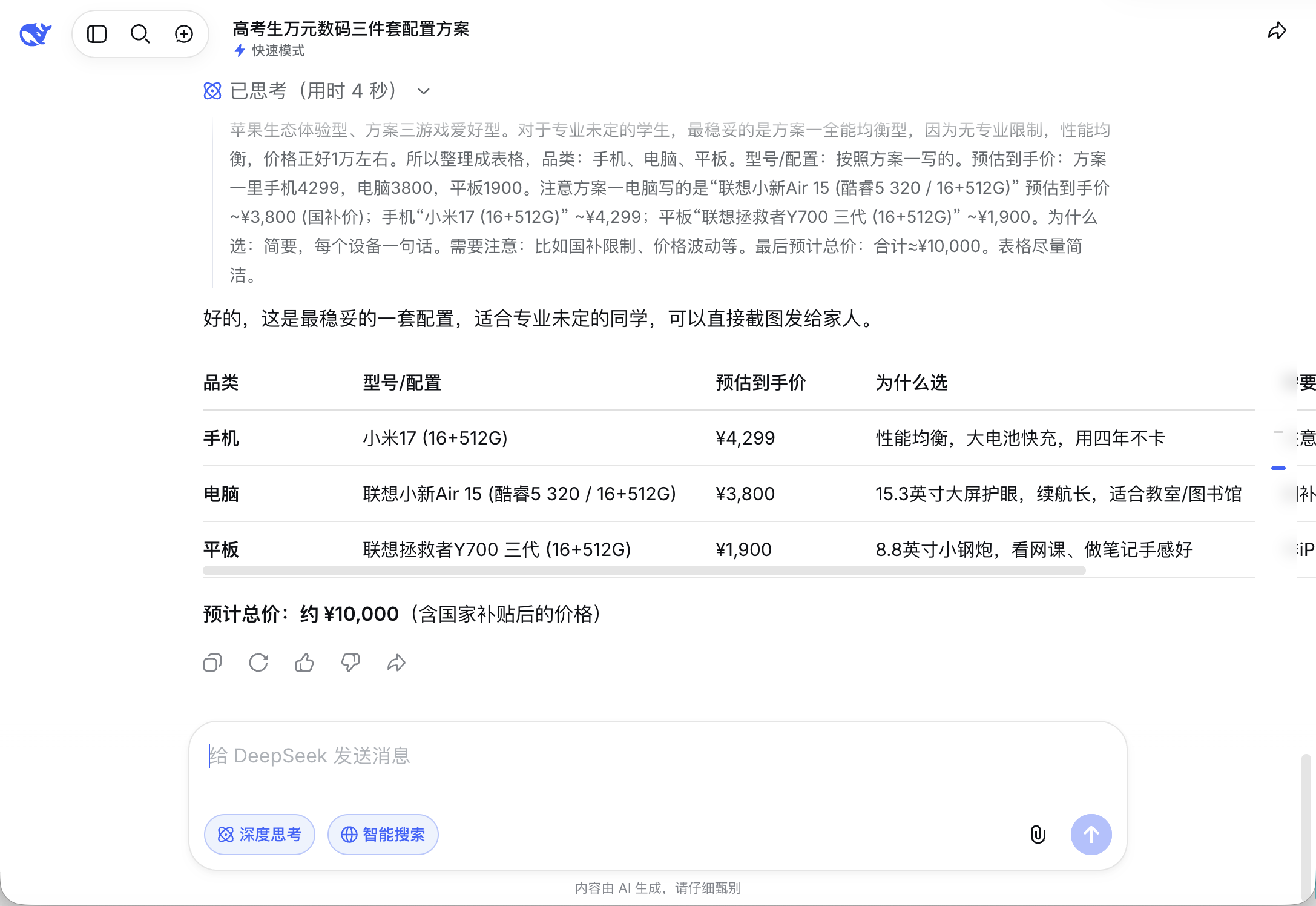
(Image source: DeepSeek)
More absurdly, the Legion Y700 is a small-sized performance tablet geared toward gaming and multimedia, making it unsuitable for long-term PDF viewing and split-screen note-taking. DeepSeek's plan seems to have randomly selected "high-performance-looking" models from popular lists in each category, with each individual item appearing acceptable but the combination failing to grasp the true priorities of a student's trio.
It must be said that parents encountering this plan would likely be furious, as the tablet appears highly unsuitable for "studying."
3. Kimi: Most closely resembled a professional digital editor from Leitech.
Kimi's plan included the OnePlus Ace 5 Pro 16+512GB (2,800-3,000 yuan), Lenovo Xiaoxin Pro 14 2024 R7-8745H 32GB+1TB (5,200-5,500 yuan), and Xiaomi Pad 7 Pro 12+256GB (1,600-1,800 yuan), totaling approximately 9,600-9,900 yuan.
The smartest aspect of this plan is that Kimi was the only AI that understood to allocate the majority of the budget to the computer, equipping it with 32GB of RAM and a 1TB SSD. By our standards, 16GB+512GB is the minimum for college students' computers in 2026, while 32GB+1TB ensures comfortable usage for four years. The smartphone's 16+512GB configuration provides ample storage, and the tablet is positioned as "not an absolute necessity."
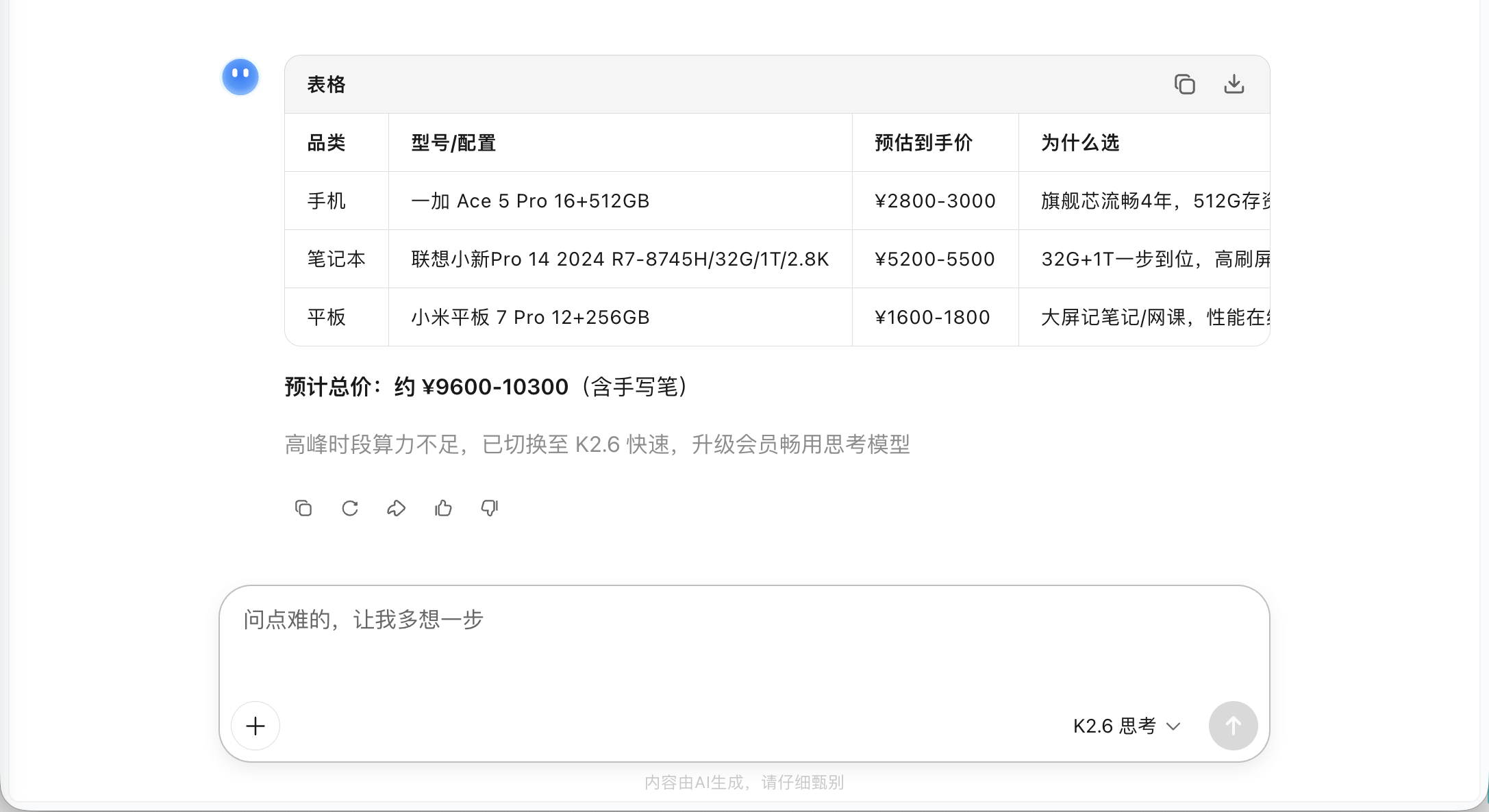
(Image source: Kimi)
However, possibly to stay within budget, Kimi selected the Xiaoxin Pro 14 2024 and OnePlus Ace 5 Pro, both products from around 2024. Recommending older models is acceptable, but only if users are actively reminded that these are previous-generation products worth buying only at significantly lower prices—a reminder Kimi failed to provide.
Additionally, while the OnePlus Ace 5 Pro offers strong performance, its imaging capabilities are not the most balanced at its price point. College students use their smartphones for more than just scanning codes; club activities, travel, night scenes, and classroom notes all rely on this device, yet Kimi made no mention of this trade-off.
4. Qianwen: Strongly pushed for new products but failed to control prices.
Qianwen provided two plans: the Xiaomi ecosystem and Huawei HarmonyOS ecosystem, listing 2026 new releases such as the Redmi K90 Max and Redmi Book Pro 14 2026, with rich images and video sources on the page, appearing highly professional.
However, the Redmi K90 Max at 2,500 yuan, Redmi Book Pro 14 2026 at 5,500 yuan, and Redmi Pad 2 Pro Educational Edition at 3,000 yuan total 11,000 yuan, failing the user's stated maximum budget of 10,000 yuan.
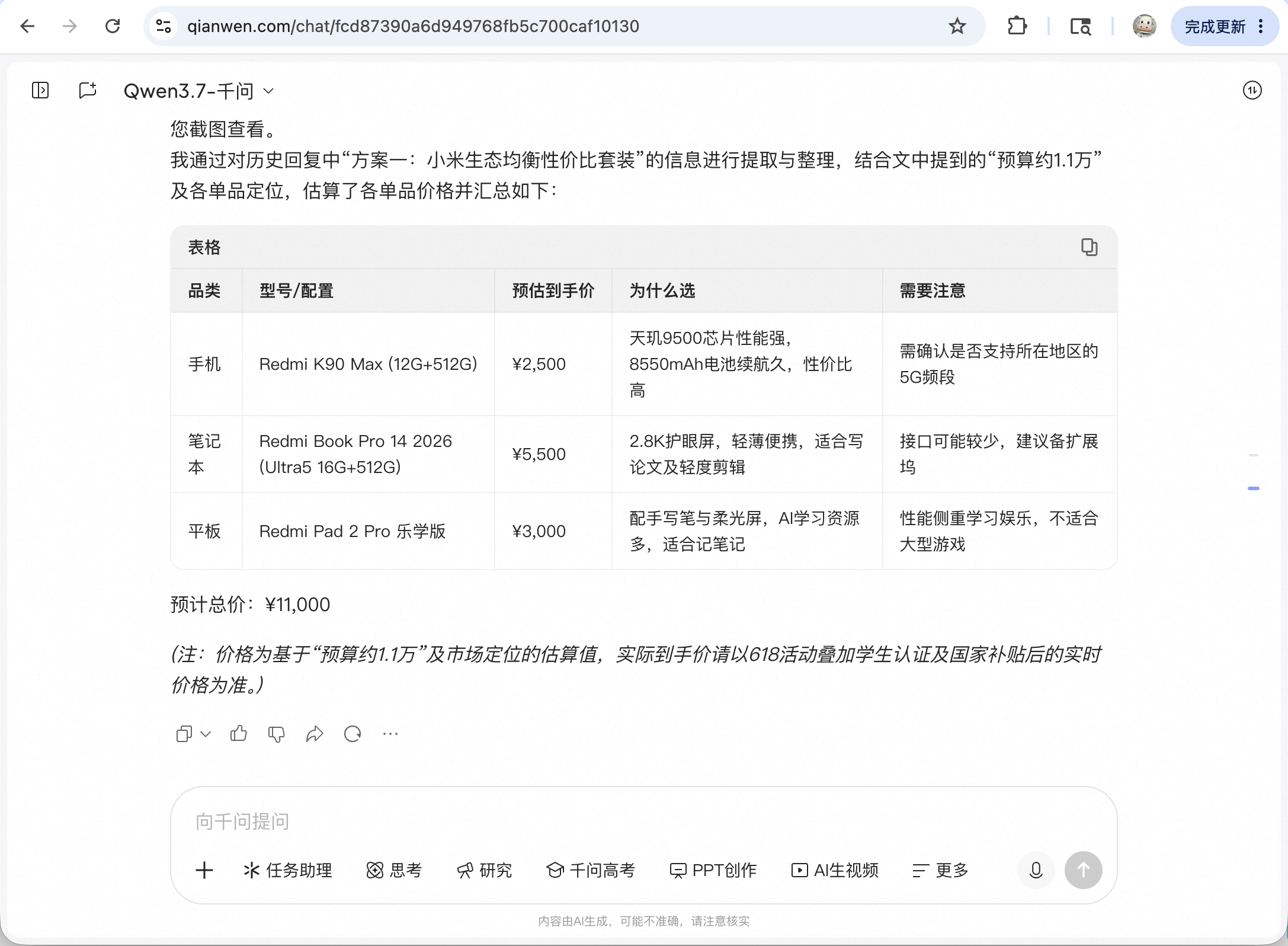
(Image source: Qianwen)
Somewhat puzzlingly, the tablet accounts for 3,000 yuan, while the computer remains configured conservatively at 16GB+512GB. The Huawei plan, consisting of the Mate 80 Pro, MateBook 14, and MatePad Air, would be even less likely to fit within 10,000 yuan. It seems Qianwen prioritized recommending the latest products, selecting those with slightly more reasonable prices among new releases. However, this approach risks offering a plan where none of the three products excel in performance.
5. Yuanbao: Most straightforward answers, most sincere recommendations.
Yuanbao provided several key judgments in its initial response: since the major is undecided, the computer must not be a poor choice; blindly buying a Mac or a heavy gaming laptop is not recommended; a Windows all-rounder ultrabook is a safer bet; a smartphone that can last four years suffices; and the tablet should be configured flexibly based on demand. Its main plan included the Lenovo Xiaoxin Pro 14 (16/32GB+1TB, 5,000-5,400 yuan), Redmi K80 or iQOO Neo10 equivalent (2,700-2,900 yuan), and Xiaomi Pad 7 bundle (1,500-1,800 yuan), plus accessories costing two to three hundred yuan, totaling 9,500-9,800 yuan.
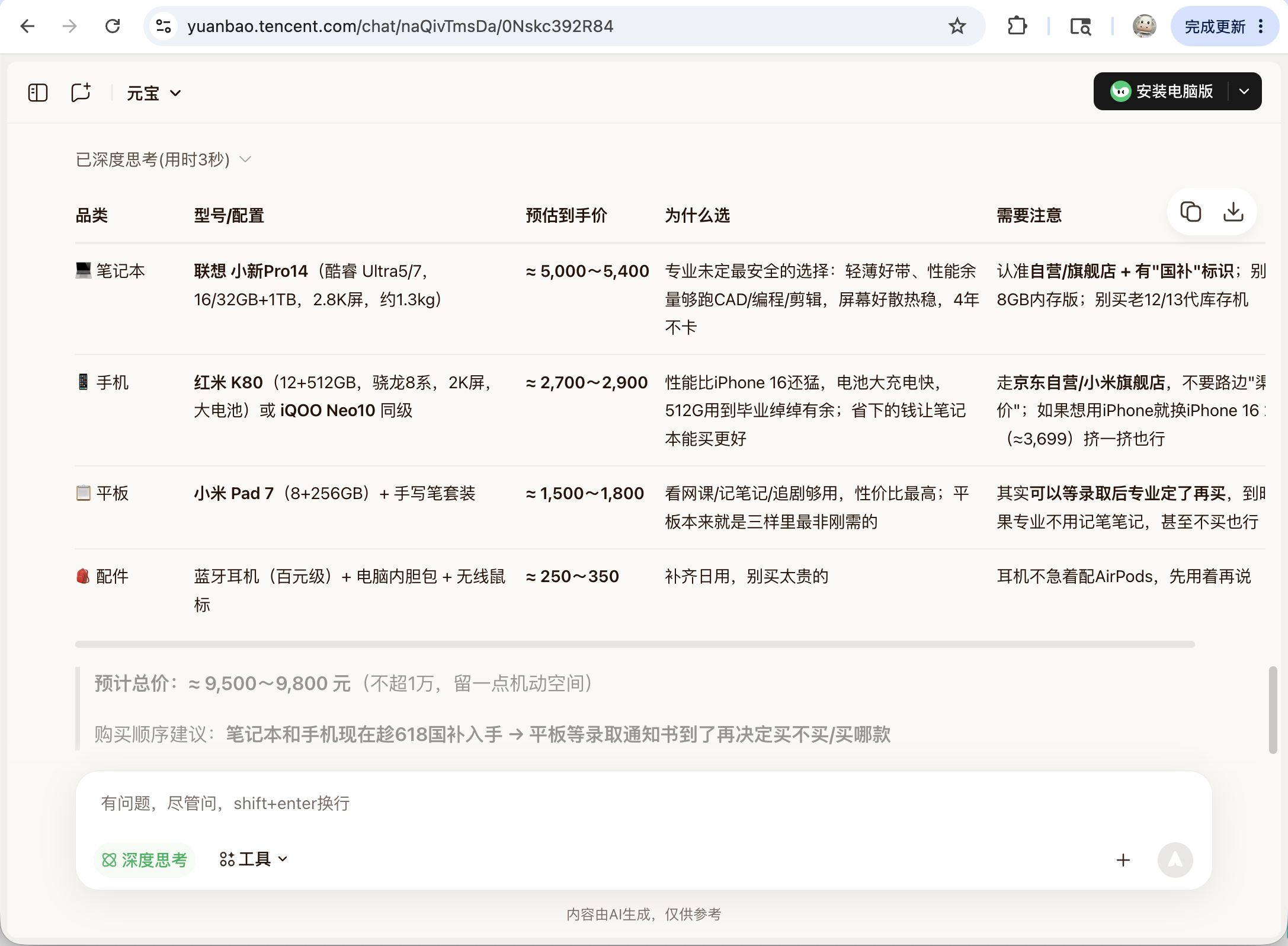
(Image source: Yuanbao)
More importantly, Yuanbao offered a purchasing timeline suggestion: buy the laptop and smartphone during the 618 national subsidies while waiting for the college admission notice before deciding on the tablet. This is highly clever, as the tablet is indeed the most dispensable item among the trio and can be directly forgone if the budget is insufficient. Only Yuanbao recognized this essence.
However, Yuanbao's issue lies in its somewhat outdated selections; both the Redmi K80 and iQOO Neo10 are 2024 models, and it should have noted that these are clearance choices for older models. Additionally, whether the Xiaoxin Pro 14 can be stably purchased for 5,000-5,400 yuan with 32GB+1TB is questionable; JD.com currently lists this configuration at 6,111 yuan, exceeding the budget.
Overall, while the plans recommended by these five AI tools all offer reference value, especially in terms of budget calculations (which are more convenient than manually checking prices), they also have many flaws. Yuanbao and Kimi tend to recommend older products, Doubao and DeepSeek misreport prices, and Qianwen surreptitiously exceeds the budget. None can be considered perfect.
Lesson Learned: AI Needs to Be "Grilled" to Tell the Truth
The most obvious flaw in the initial round of questioning was that, except for Yuanbao and Kimi, the other AI tools underestimated college students' computer needs, especially in the current era of AI agents. The computers they recommended might struggle to run some AI agents in a couple of years. Therefore, we posed follow-up questions, hoping they would update their computer recommendations based on more realistic needs of college students.
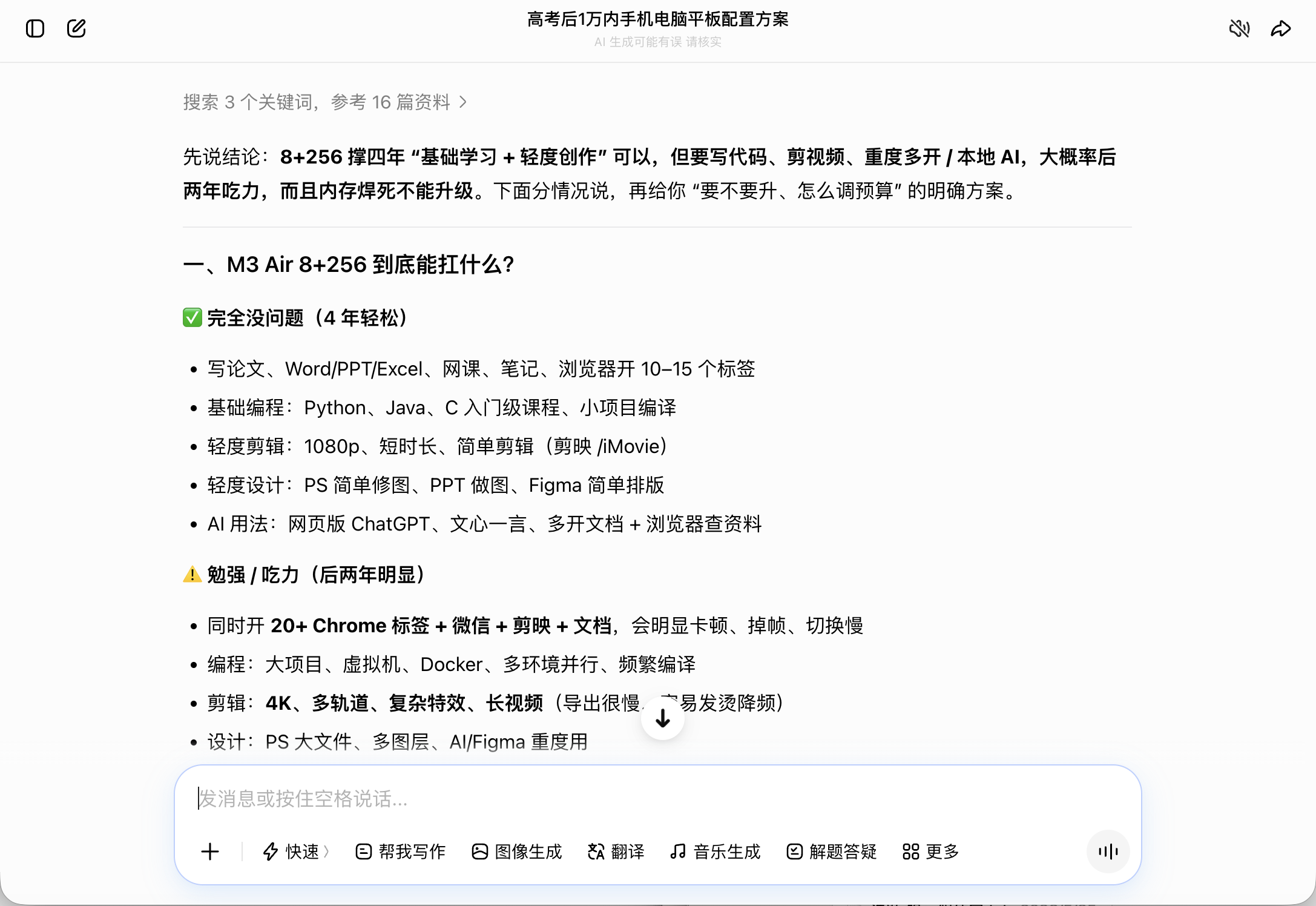
Doubao admitted that 8GB of RAM is a bottleneck but immediately presented a new price fabrication, listing the MacBook Air M3 16+256GB at 2,900 yuan. While the configuration suffices, the price remains fictional.
(Image source: Doubao)
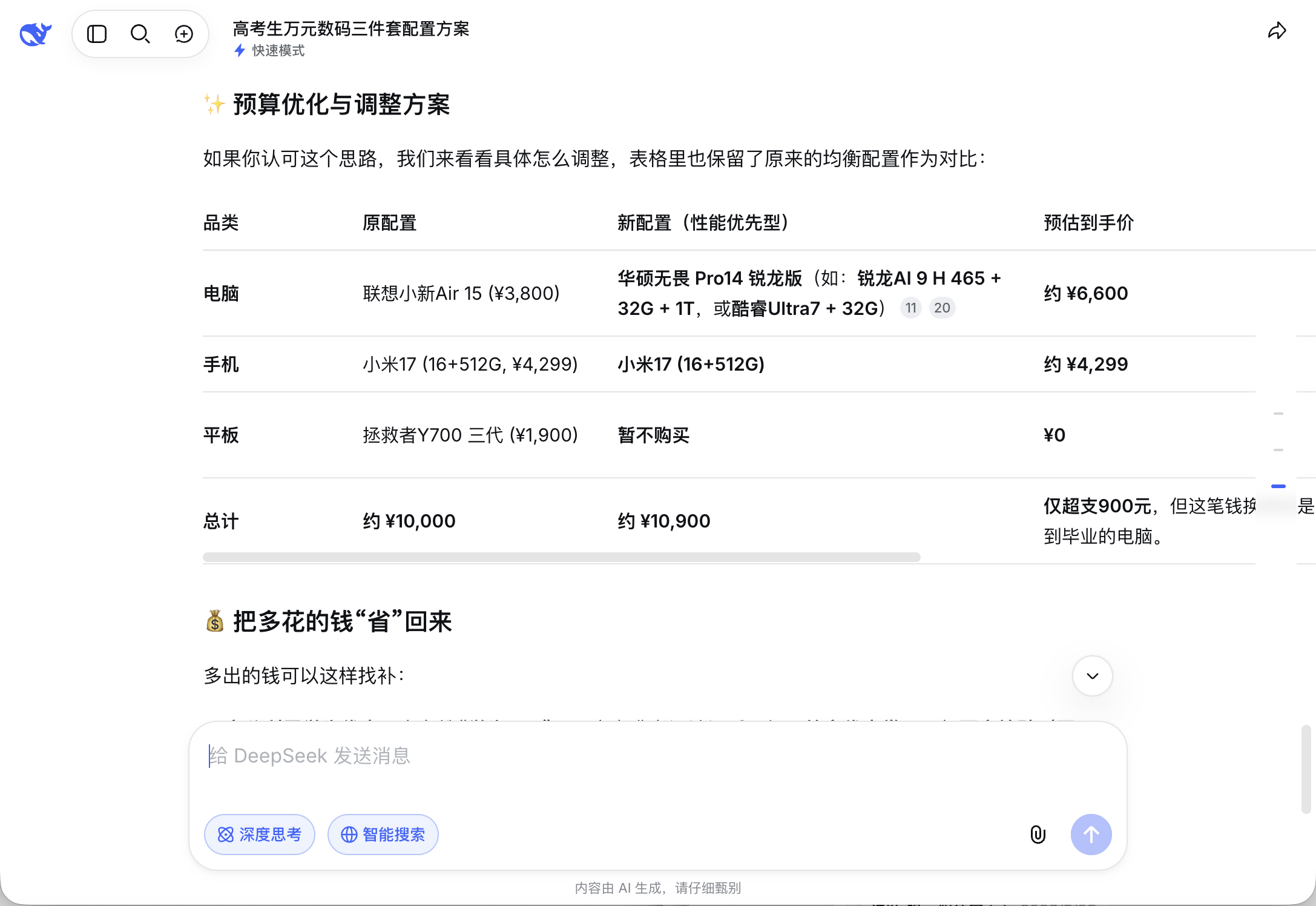
DeepSeek made more significant corrections, acknowledging that the Xiaoxin Air 15 would struggle with coding, video editing, and AI multitasking, suggesting a computer budget of 5,500-6,500 yuan for a high-performance processor and 32GB of RAM, while recommending to forgo the tablet temporarily. While the direction is correct, it stubbornly refused to replace the 4,299-yuan Xiaomi 17, resulting in a total of around 10,900 yuan after adjustments, again breaching the user's "maximum 10,000 yuan" constraint. Perhaps in DeepSeek's view, the Xiaomi 17 is indeed the best smartphone for college students.
(Image source: DeepSeek)
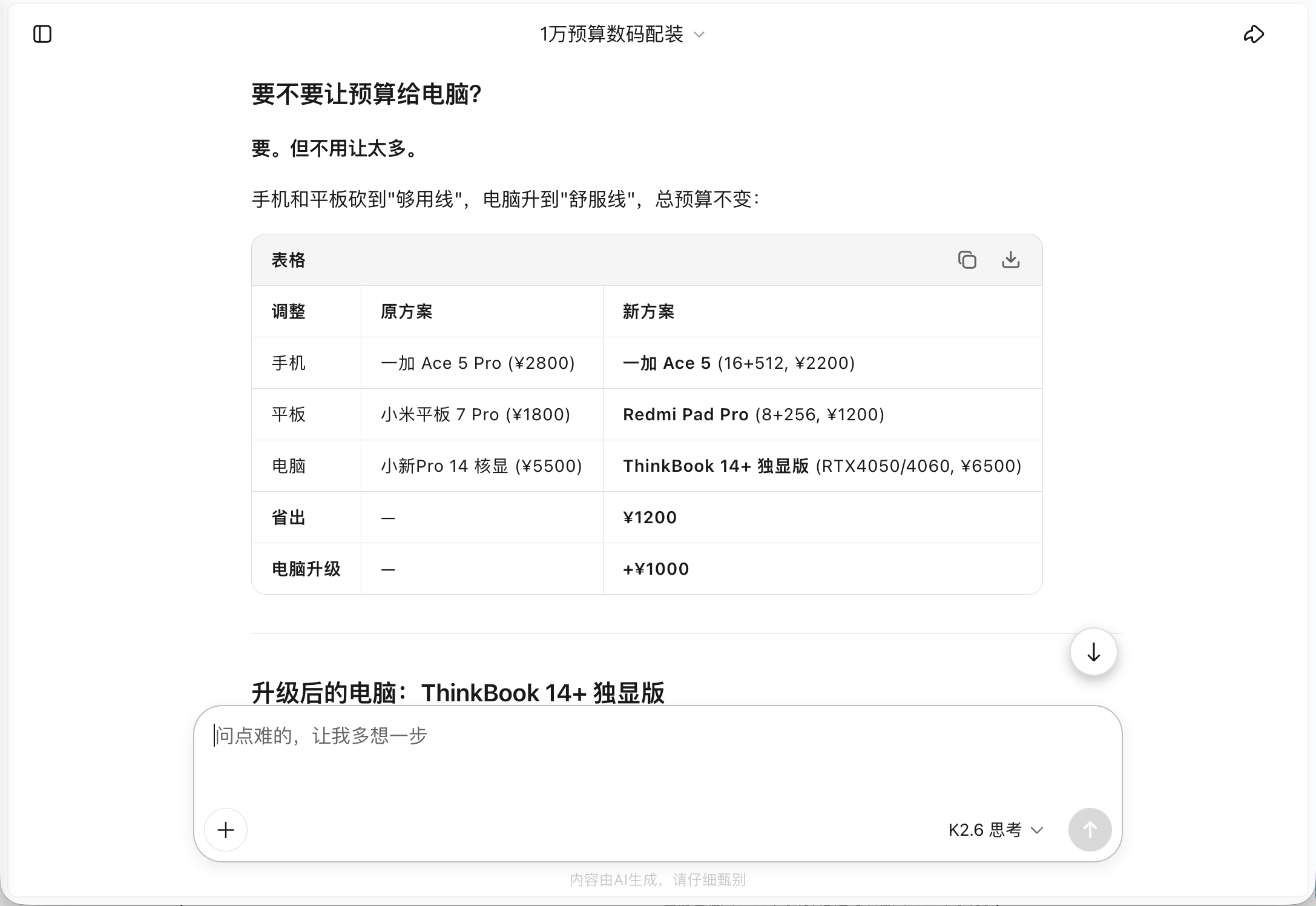
Kimi directly allocated the entire budget to the computer, acknowledging that while the Xiaoxin Pro 14 can last four years, it would feel constrained. It broke down the bottlenecks in detail: 32GB of RAM is sufficient for coding and multitasking with multiple browser tabs, but video editing would be slow to export, design work would lag with many layers, and local AI and Stable Diffusion would barely run, all pointing to the lack of discrete GPU acceleration. Its adjustments were also the most thorough: downgrading from the Ace 5 Pro to the Ace 5 saved 600 yuan, replacing the Xiaomi Pad 7 Pro with the Redmi Pad Pro saved another 600 yuan, and upgrading the computer to the ThinkBook 14+ with discrete GPU resulted in a total of around 9,900 yuan after adjustments.
(Image source: Kimi)
Qianwen admitted that 16GB of RAM would be a bottleneck for multitasking and AI applications, and 512GB would not suffice for video footage and professional software, recommending an upgrade to 32GB+1TB while downgrading the smartphone and tablet to prioritize the computer. While its theoretical judgment is correct, it failed to calculate the new plan's prices item by item, leaving only the statement "the overall budget can still be controlled at around 10,000 yuan" without
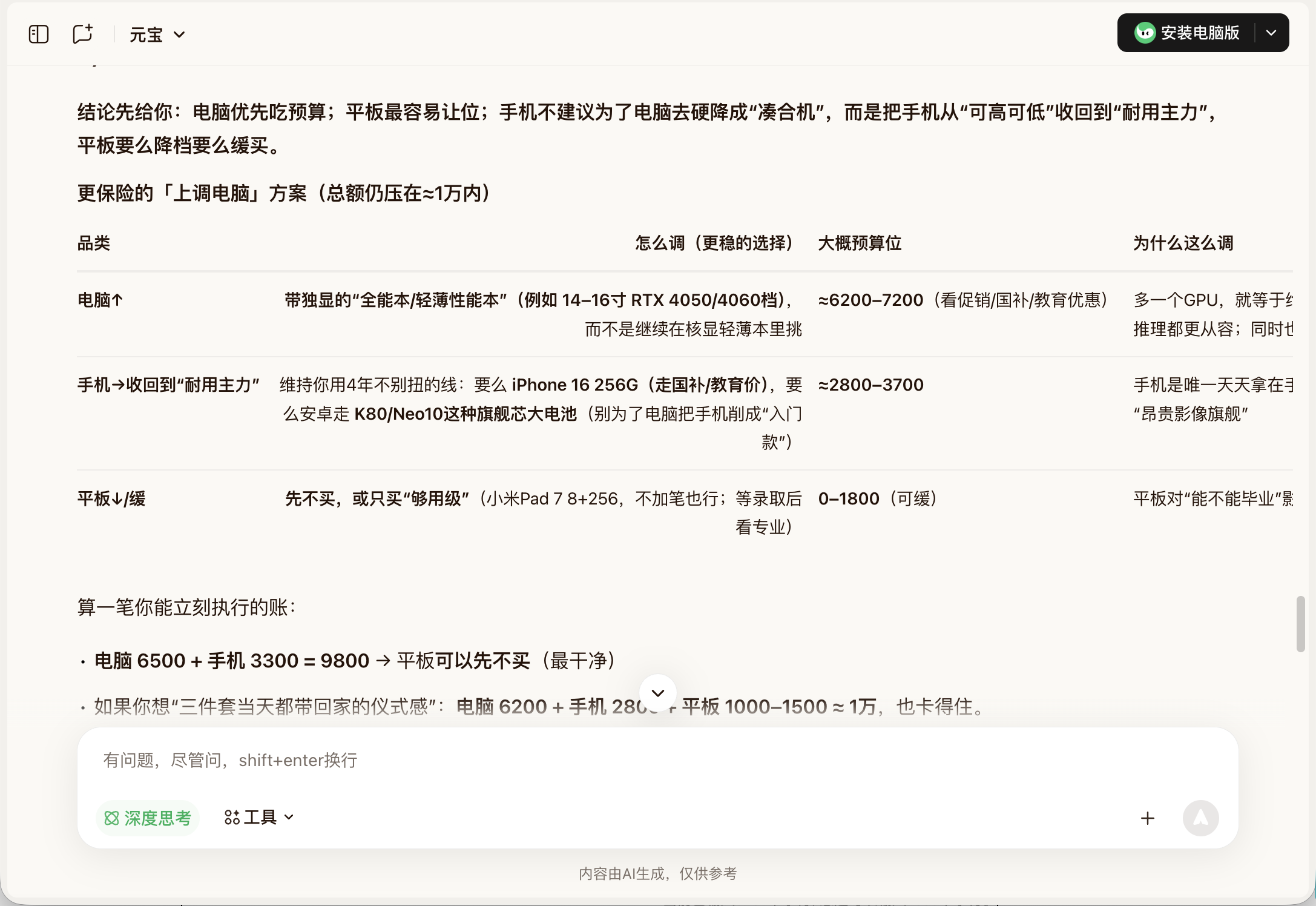
Among the five AI options evaluated, Yuanbao delivered the most nuanced and well-considered response. It dissected the question, "Is it enough?" into two distinct scenarios: Firstly, for tasks like coding, multitasking across multiple browser tabs, writing academic papers, performing light photo editing, handling CapCut 1080p video editing, or even engaging in light 4K video editing, a laptop with integrated graphics and 32GB of RAM can suffice for up to four years. Secondly, for more demanding tasks such as heavy Premiere Pro editing, After Effects work, 3D modeling, running large models exceeding 30 billion parameters locally, or utilizing engineering design software that relies on CUDA ecosystems, a laptop equipped with a dedicated GPU becomes essential. Most notably, Yuanbao made a clear distinction between web-based AI and local AI applications. The average student, when utilizing AI, primarily depends on web and cloud-based tools, negating the need for high local computing power. This differentiation carries far more weight than simply listing technical specifications. In terms of budget allocation, Yuanbao presented two viable options: one involves spending 6,500 yuan on a computer and 3,300 yuan on a phone, totaling 9,800 yuan, while forgoing a tablet for the time being. The alternative option maintains a three-device setup, with 6,200 yuan allocated to a computer, 2,800 yuan to a phone, and 1,000-1,500 yuan to a tablet.
(Image source: Yuanbao)
Of course, beyond providing direct recommendations, Doubao went the extra mile by inserting product images directly beside its suggestions, offering parents the best visual experience to instantly grasp the recommended items. Qianwen's page, on the other hand, boasted the richest array of materials, including source cards, image-and-text thumbnails, and short video content, enabling users to delve deeper into the subject matter. DeepSeek listed numerous source links from reputable tech websites such as PChome, ZOL, and SMZDM. In contrast, Kimi and Yuanbao opted for pure text displays, which might make it less convenient for users to simply view product appearances without additional navigation.
AI Falls Far Short of Being a 'Consumer Advisor'
When comparing the results of the two rounds of testing, the overall ranking of the five AI tools placed Qianwen at the top, followed by DeepSeek, Kimi, Yuanbao, and Doubao at the bottom. However, it must be acknowledged that achieving a "perfect" solution within a 10,000 yuan budget is inherently challenging, especially as the prices of phones, computers, and tablets continue to rise, making it virtually impossible to attain absolute perfection.
Yet, many decisions can be guided by common sense. For instance, with a 10,000 yuan budget, the computer should serve as the primary productivity tool throughout four years of university, with phones and tablets playing secondary roles. Yuanbao and Kimi adhered to this principle from the outset, while DeepSeek and Qianwen only acknowledged it after persistent questioning. Doubao, on the other hand, consistently avoided addressing this crucial aspect.
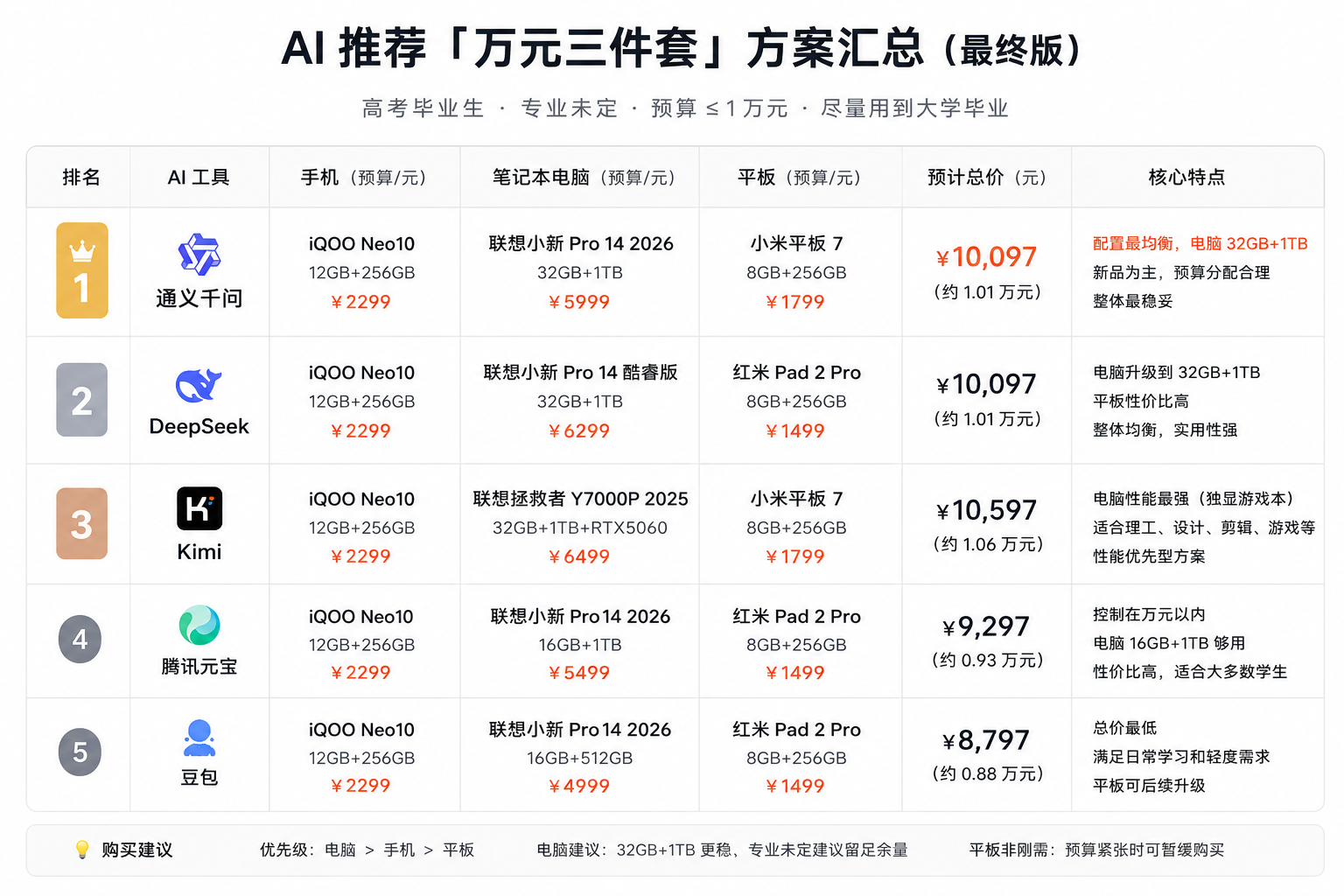
Another area where some AI tools fell short was in adhering to rigid budget constraints. When users specify a maximum budget of 10,000 yuan, it implies that proposals priced at 10,900 or 11,000 yuan should be eliminated in the first round, regardless of how appealing the models may seem. In this test, only Yuanbao and Kimi consistently stayed within the 10,000 yuan limit across both rounds. Additionally, recommending older 2024 models is not inherently wrong—especially if their low prices make them attractive—but AI must proactively disclose that these are previous-generation products, allowing users to make informed decisions. All five AI tools failed to score points in this regard.
(Image source: Leikeji Infographics)
More alarmingly, price illusions emerged during the testing process. Doubao listed the MacBook Air M3 at 2,550 yuan—a blatant error that any tech editor would spot immediately but could potentially mislead parents who are not well-versed in technology. There's a fundamental difference between AI chatbots and AI shopping guides: mistakes in casual chat can be overlooked or laughed off, but errors in shopping advice can lead to real financial losses. From this perspective, the reliability threshold for AI in high-stakes consumer decisions should be far higher than for everyday Q&A sessions. Yet, most products currently on the market treat this threshold lightly, which is a cause for concern.
Returning to the initial question: Can AI serve as a "half-decent consumer advisor"? Based on this test, AI tools can already perform initial screenings, list potential models, explain discounts, and create comparison tables. Yuanbao and Kimi even provided configuration judgments that approached professional standards. However, when it comes to accurately reflecting real prices, clearly labeling new versus old models, and adhering to strict budget limits, illusions and a lack of control become apparent.
In other words, AI can assist you in figuring out how to allocate your budget—prioritizing the purchase of the right computer first, then deciding how expensive a phone to buy, and whether to purchase a tablet at this time. However, the final price comparison before placing an order still ultimately relies on your own judgment and research.
Doubao, Qianwen, DeepSeek, Yuanbao, Kimi
Source: Leikeji
All images in this article come from: 123RF Licensed Image Library Source: Leikeji
-
Who Can Challenge SpaceX: Global Commercial Rockets Enter a New Phase of Differentiation
-
![]()
Could BYD Achieve the Title of 'World's Largest Automaker' by 2030?
-
![]()
Tencent Backs Another Robot IPO Despite Over 1 Billion Yuan in Cumulative Losses
-
![]()
AI Leads the Way, Cars Follow Suit: How AIVA's Visionary Slogan Unlocks New Horizons
-
![]()
Final Verdict: 2026 China Automotive Chongqing Forum Takes a High-End Stance and Highlights Core Issues
-
![]()
DingTalk Leadership Overhaul: Wu Zhao's 'Triumphs and Trials,' Chen Yusen's 'Challenge'
-
Challenges Loom for Amazon and Meta's Free Cash Flow: Is There an AI Bubble?
-
![]()
With Zhang Xiaolong Leading the Charge, Can WeChat’s AI Agent Secure Another Win?