DingTalk Leadership Overhaul: Wu Zhao's 'Triumphs and Trials,' Chen Yusen's 'Challenge'
 06/15 2026
 447
447
By Dou Wensxue
Edited by Ziye
On June 11, after two lengthy posts from ex-employees sparked widespread debate and Alibaba's Partnership Committee issued a critical statement, DingTalk's management underwent significant changes.
According to 36Kr, Alibaba announced a reshuffle in DingTalk's leadership, with Wu Zhao stepping down as CEO. Chen Yusen, a tech enthusiast born in 1992, assumed the role, becoming Alibaba's youngest business unit CEO to date.
This appointment brought an end to a series of public controversies and marked the official end of DingTalk's 'founder era.'
From its inception, Wu Zhao was dubbed 'the Madman' due to his rigorous and demanding work ethic. Under his leadership, DingTalk amassed over 600,000 enterprise users within just 160 days of its launch.
Undoubtedly, beyond external factors, Wu Zhao's relentless drive played a pivotal role in DingTalk's success. More than a decade later, this 'DingTalk founder,' who had left Alibaba to start his own venture before being rehired, remained as passionate as ever.
Since his return in 2025, he led his team in analyzing 1,850 user needs and addressing 574 user feedback issues in just four months, revamping over 20 product lines. Within eight months, DingTalk underwent three major updates, releasing AI DingTalk 1.0, 1.1, and 2.0 in August and December 2025, and March of the following year, respectively.
Behind this rapid product release pace was Wu Zhao's ambition to make another significant impact. In his view, amid the rapid advancement of AI technology, his return was akin to embarking on a new venture. He aimed to recapture the intense, pioneering spirit of incubating DingTalk at Lakeside Gardens.
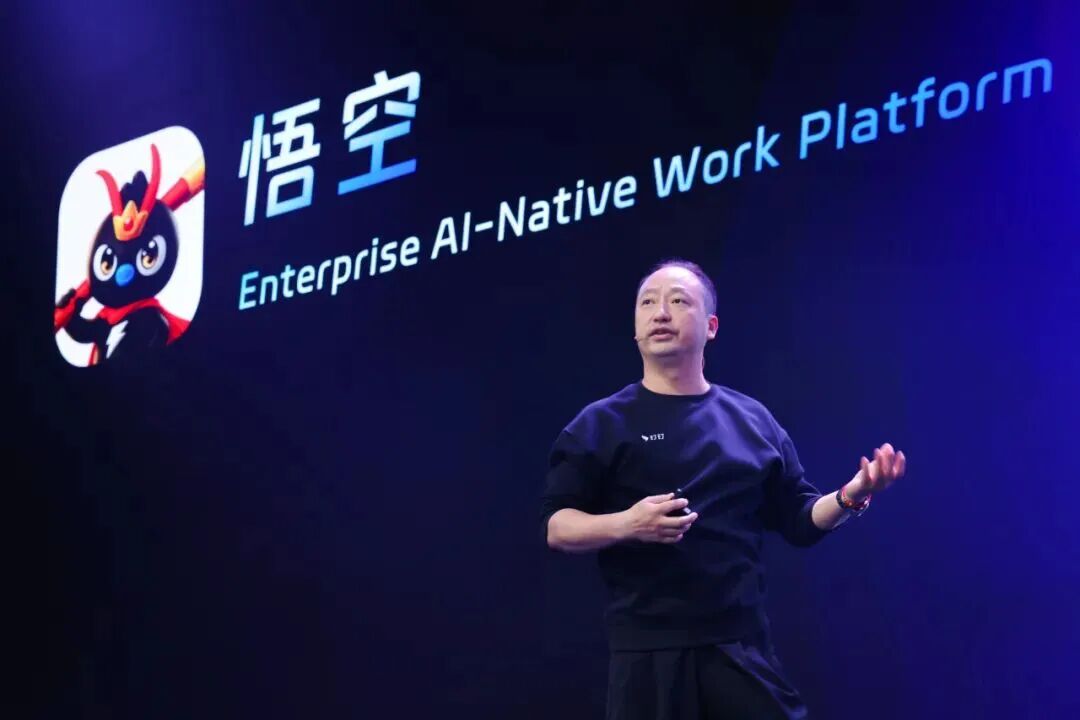
DingTalk founder Wu Zhao. Image source: DingTalk's official WeChat account.
However, this 'madness' increasingly placed pressure on employees.
As early as August of the previous year, reports surfaced of Wu Zhao inspecting workstations past midnight and questioning employees about early departures the next day. Subsequently, social media posts about employees leaving DingTalk began circulating.
Recently, former DingTalk product manager You Su and ex-vice president Ma Ruila published articles titled 'Inside DingTalk' and 'Outside DingTalk,' respectively, exposing the high-pressure environment within DingTalk. 'Inside DingTalk,' in particular, shed light on multiple factors leading to the replacement of DingTalk's earlier ONE project.
Subsequently, Alibaba's Partnership Committee posted an article titled 'Emotion, Integrity, and Growth Define Alibaba's Culture' on the internal network, criticizing DingTalk's management style as 'not representative of Alibaba's culture.' Ultimately, Wu Zhao, at the center of the controversy, stepped down.
For Wu Zhao, rebuilding DingTalk with AI was imperative; delay could allow competitors to gain ground.
However, in the AI era, talent remains crucial to tech companies' operations. His outdated management methods were out of step with the times and were also being phased out by Alibaba, which is striving to keep pace.
Now, the 'challenge' of DingTalk's AI transformation battle has shifted to Chen Yusen.
1. Problems Exposed in 'Inside DingTalk' Led to Wu Zhao's Resignation.
After the August 2025 'midnight inspection' incident, media interviews with Wu Zhao revealed that he did not deny the event and viewed his approach as a form of screening.
'This is about being an entrepreneur or just a worker. It's a mutual choice; entrepreneurs choose to be with entrepreneurs,' Wu Zhao stated.
Screening employees with entrepreneurial potential may have been Wu Zhao's management goal upon his return to DingTalk.
You Su, who joined DingTalk's closed ONE project, described a detail in 'Inside DingTalk.'
She recounted being asked to complete an assignment before her DingTalk interview: 'Build a family tree on DingTalk.' The task required inviting family members onto DingTalk, establishing a family tree organization of over six people, having them engage in real activities, and providing product insights based on the experience.
You Su explained that her family was small, with few genuine DingTalk users, failing to meet the 'six-person family organization' requirement. She interpreted the assignment's purpose as assessing employees' product insight and agile response capabilities. Thus, she completed the task by researching family trees, surveying related industries, and inviting friends to form a communication group.
This assignment setup revealed Wu Zhao's search for 'entrepreneurs' willing to invest time in promoting the product and offering insights.
However, You Su claimed that during the interview, Wu Zhao repeatedly questioned why she couldn't complete it, inquiring about relatives on both her father's and mother's sides, whether her grandparents were alive, and if she truly couldn't find six family members for DingTalk.
If true, Wu Zhao's questions seemed more like reprimands for subordinates' failure to strictly execute the assignment rather than concerns about their lack of 'entrepreneurial' thinking.
Moreover, both You Su's 'Inside DingTalk' and Ma Ruila's 'Outside DingTalk' revealed the intense workload at DingTalk.
You Su stated that during the ONE project's closed development, her workdays typically spanned from 9 AM to after 11:30 PM, with fixed Sunday work and occasional Saturdays. 'My craziest month, I only took one and a half days off,' she recalled.

Image source: DingTalk's official website.
Additionally, You Su disclosed that taking leave affected performance evaluations. She once took one and a half days off around Qingming Festival and received performance deductions for two consecutive weeks. 'I confirmed repeatedly that the SM (team leader) stated the deduction was solely for leave, not work errors,' she said.
Ma Ruila, in 'Outside DingTalk,' revealed that he once worked seven days a week, starting at 9 AM and returning home at 2 AM, sleeping only five hours.
Wu Zhao's fondness for 'inspections' was also evident in 'Inside DingTalk.' You Su recalled a colleague caught 'playing' on WeChat at 1:30 PM, just after lunch. The colleague's SM was required to write a self-criticism post and share it in the group.
Attendance and performance systems vary by company or project importance; hard work is sometimes expected. However, what resonated with many workers was the senselessness of much of the overtime and hardship revealed by You Su and Ma Ruila.
Furthermore, inefficient internal communication reduced the value of overtime.
For instance, DingTalk's strict confidentiality measures applied not only externally but also internally. You Su recalled only knowing she was part of a confidential 'O Project' upon joining, with most external parties aware only of a secret project's existence, not its specifics.
This led to severe communication inefficiencies when internal members requested development resources from external teams. Internal personnel could only make vague requests, like 'a small interface demand requiring three rounds of discussion and involving many people. Everyone cooperated and worked hard, but information loss at each layer turned many communications into guesswork.'
Ma Ruila's 'Outside DingTalk' confirmed this sense of helplessness. He repeatedly emphasized 'heartache,' stating, 'I know that high pressure, that effort without results, that cycle of frequent reporting, rapid iteration, and no improvement.'
Regarding the meaningfulness of his work, Ma Ruila also expressed doubt: 'I increasingly struggle to confirm whether I'm creating products or just exhausting my body to chase a constantly moving target.'
An even more absurd story illustrated this avoidable senselessness. You Su mentioned the 'Wangshu Operation,' actually targeting 'Feishu' (Lark). On the night of April 2, 2026, she suddenly received a notice: all SMs and PDs were not allowed to leave before 12 AM to observe when the Feishu building's lights would turn off.
The company's request stemmed from an analysis report, allegedly written by a Feishu supplier, comparing Feishu Aily and DingTalk Wukong.
Currently, both You Su and Ma Ruila have left DingTalk. Their successive revelations confirmed management issues at DingTalk.
Subsequently, on June 10, Alibaba's Partnership Committee posted an article titled 'Emotion, Integrity, and Growth Define Alibaba's Culture' on the internal network. The sternly worded article directly stated, 'This is not what Alibaba's culture stands for,' emphasizing that 'under no circumstances, no matter how urgent the task,' DingTalk's management style should not occur.
Image source: Alibaba's official website.
Alibaba's Partnership Committee believes that 'mutual respect, treating people as people, with emotion and integrity' defines Alibaba's cultural foundation. DingTalk's high-pressure management style had crossed Alibaba's cultural bottom line.
More critically, Alibaba was mobilizing resources from Qianwen, Alibaba Cloud, and others to form a united front in AI to B. However, DingTalk still relied on 'high pressure and mechanical execution' for innovation, an approach that could suppress personnel mobility and creativity, further causing DingTalk to fall behind in this sprint.
This may explain why Alibaba's Partnership Committee rarely spoke out; the high-pressure environment at DingTalk indeed needed change.
2. Wu Zhao's Anxiety: DingTalk ONE Failed to Impress, Wukong Has Big Ambitions.
Wu Zhao, at the center of the controversy, has not publicly responded to the current situation.
On April 1 of the previous year, he ended his four-year entrepreneurial journey and returned to DingTalk with AI-era visions. He once told the media that he suddenly realized his possibly unique opportunity to change global work methods was arriving with the AI wave.
Wu Zhao's judgment was not exaggerated. Office work and programming are among the broadest AI application scenarios. According to his initial vision, in the AI era, DingTalk should handle message processing, information and knowledge acquisition, and spreadsheet access without human intervention.
Achieving this vision is difficult, akin to starting a new venture. Wu Zhao faced a different environment than in 2014 when he founded DingTalk; the industry was no longer a blue ocean, with Feishu and WeCom as major competitors.
The GPU costs for training models were beyond a startup's capacity, prompting his return to Alibaba and DingTalk. Upon returning, he immediately entered battle mode.
According to 36Kr, during his first week back, he led a team to visit clients in Beijing, Guangdong, and East China without the frontline team, not fully adopting the client list provided by the business department. A DingTalk employee said frontline leaders panicked, inquiring about Wu Zhao's visits and client feedback.
More direct pressure fell on the product line. Wu Zhao conducted one-on-one reviews with over 150 product managers, allocating ten minutes each to randomly selected function module explanations. Few passed. His diagnosis: DingTalk wasn't lacking AI features but 'failed to define the future.'
DingTalk's ONE project was Wu Zhao's key battle upon his return.
ONE debuted in August 2025, defined by Wu Zhao as an AI work information flow product that 'brings tasks to people.' It used AI to extract work information scattered across chats, documents, calendars, etc., generating card-based information flows pushed proactively based on priority. Users no longer needed to navigate through messages, approvals, and to-dos.
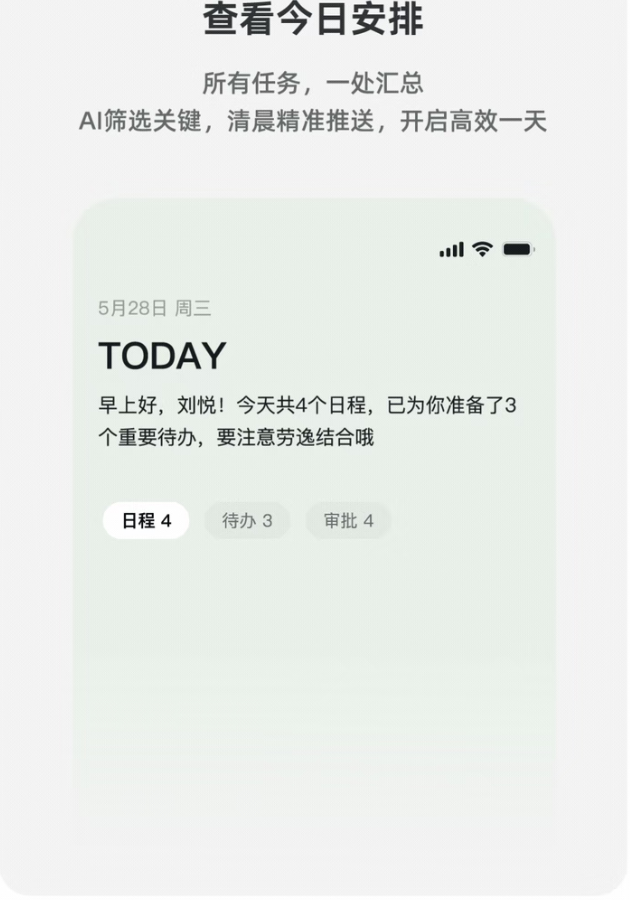
DingTalk ONE's AI filtering feature. Image source: DingTalk's official WeChat account.
At its peak, ONE had around 3 million DAUs (daily active users). While decent for an AI startup product, it fell short for a strategic project bearing the mission of 'DingTalk's new AI homepage.'
The issue lay not in technology but in the product itself.
'Inside DingTalk's' retrospective revealed a harsh truth: ONE was burdened with too many conflicting goals from the start—to reduce ordinary employees' workload, serve as DingTalk's AI upgrade face, boost organizational morale, and explore commercialization.
Each goal had its legitimacy, but bundling them into the same delivery cycle caused ONE's core positioning confusion.
Especially, two core logics collided within ONE. From its inception, DingTalk was closer to senders, with features like read/unread status, DING, and approvals addressing managers' anxieties. However, ONE's external narrative was about 'a super secretary filtering noise for recipients.'
This 'both-and' top-level logic led to a contradictory interaction layer in the product.
ONE adopted a Feed stream card design similar to short videos, allowing users to browse information summaries quickly. However, once users viewed message summaries in ONE's homepage card flow, the system automatically marked them as 'read' in the original conversation.
This meant ordinary employees were forced to reveal their status before ready to handle messages.
'Inside DingTalk' also disclosed that the product team proposed a compromise: 'previews not counting as read, only marking as read upon entering the original conversation.' However, this was directly rejected by higher-ups, who argued, 'it cannot harm the sender's (manager's) rights.'
This sender-first underlying gene conflicted with DingTalk ONE's 'tasks find people' AI work information flow positioning, instead imposing greater pressure on ordinary users. Consequently, many ordinary users chose to block or reduce ONE usage to avoid this 'read terrorism.'
Wu Zhao had no time to mourn ONE's underperformance; he swiftly changed direction.
In March 2026, DingTalk released a new product, 'Wukong,' after which ONE's entry point was replaced by Wukong and moved to the negative first screen.
As a standalone application, Wukong has taken a completely different technical route from ONE. Positioned as an enterprise-level AI-native work platform, it prioritizes multi-agent collaboration and cross-platform integration, with plans to incorporate external tools such as WeChat, Slack, and Microsoft Teams in the future.
Concurrently, 'One-Person Team' (OPT) industry solutions were unveiled, spanning ten sectors including e-commerce, cross-border e-commerce, design, and manufacturing. These solutions aim to facilitate one-click deployment of AI workflows for various scenarios, such as store management, e-commerce inventory, knowledge-based blogging, and small development teams.
'We've dismantled DingTalk and reconstructed it with AI to create Wukong. In the past, people used DingTalk for work; in the future, AI will leverage DingTalk for work,' Wu Zhao declared at Wukong's launch event.
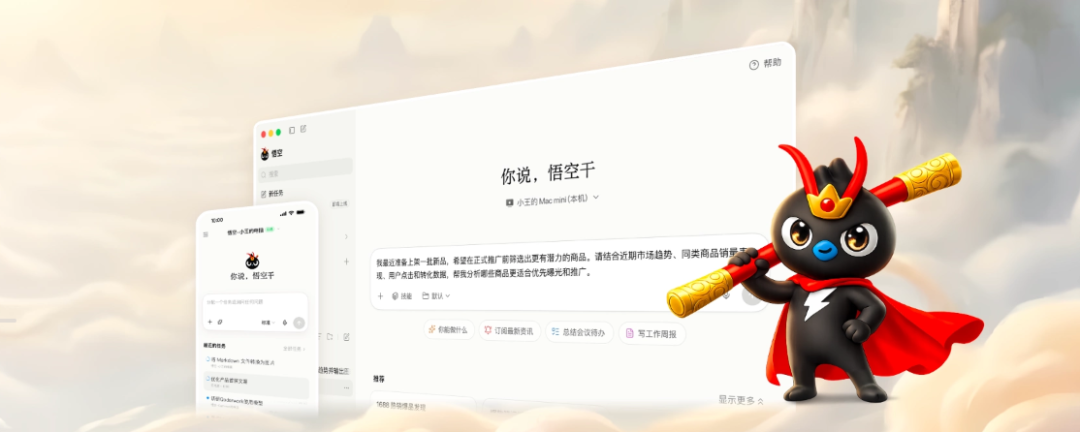
Image source: DingTalk's official website
Although Wukong, as a "lobster" product, has addressed one of the major pain points of data leakage and uncontrollability in OpenClaw, its commercialization progress is also evident from some reports. For instance, DingTalk previously signed a cooperation agreement with Shagang Group, with DingTalk Wukong and a series of AI products at its core.
However, it's undeniable that Wukong has not yet achieved phenomenal success. Now, with a change in DingTalk's leadership, Wukong's future trajectory remains uncertain. One thing is certain:
DingTalk must chart a new course.
3. Next up, Chen Yusen takes the helm to lead DingTalk in the AI transformation battle.
In fact, Wu Zhao's return last year was driven not only by his fresh insights and ambitions regarding AI in office applications but also by Alibaba's strategic focus on AI for business-to-business (B2B) operations.
Shortly before Wu Zhao's return, DingTalk was designated as a key entry point for Alibaba's B-side AI strategy.
At that time, Alibaba Group CEO Wu Yongming envisioned future enterprise internal systems as dynamic networks of interconnected and callable AI agents (AI Agent), rather than isolated functional modules.
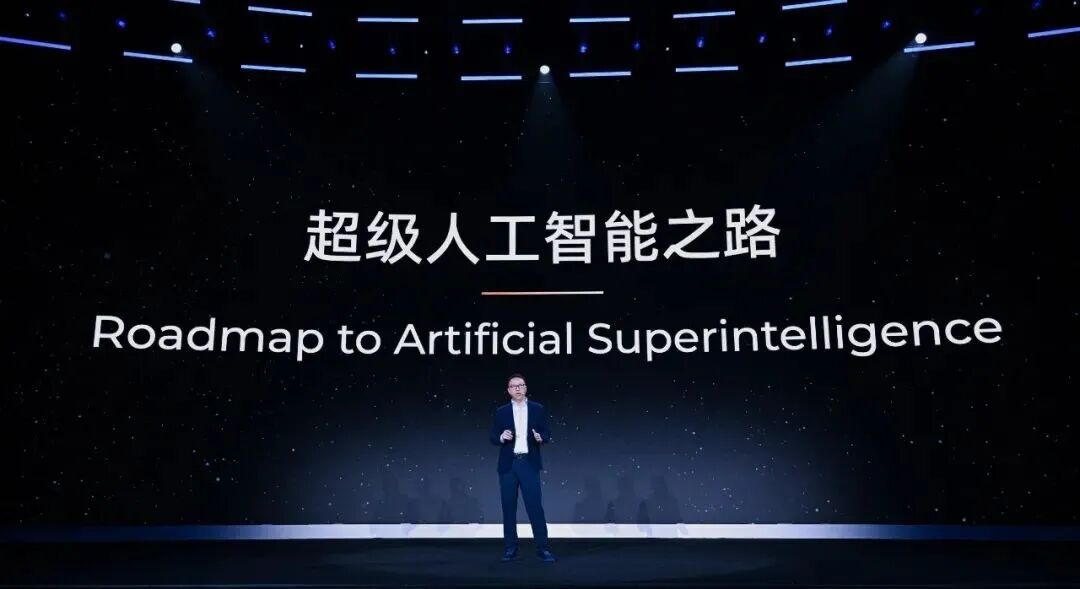
Alibaba Group CEO Wu Yongming. Image source: Alibaba Group's official WeChat public account.
As a super entry point with 700 million users and 26 million enterprise organizations, DingTalk is being repositioned as a "natural language-interactive enterprise intelligence hub."
A horizontal comparison with another entry-level application underscores DingTalk's significance in Alibaba's strategy—Alibaba's defined C-side entry point is the Qianwen APP, which just launched in November 2025.
Recently, Alibaba has entered a critical phase of "intense battles." In March, April, and June of this year, Alibaba successively established the Alibaba Token Hub (ATH) business group, set up a new group technology committee, upgraded the Tongyi Large Model business unit, and the Token Foundry business unit.
Among these, ATH serves as a business coordination hub; the group technology committee is responsible for top-level design, unified scheduling, and coordination of AI technologies across the entire group; Token Foundry focuses on basic large model research and development, enhancing model capabilities, and providing cutting-edge AI foundations for the group and the industry.
All three business groups are directly overseen by Wu Yongming, indicating Alibaba's strategy of centralizing AI capabilities through enhanced organizational operational efficiency.
Alibaba has demonstrated immense commitment and resource allocation to this endeavor, with capital expenditures reaching 86 billion yuan in fiscal year 2025, nearly tripling from 32.1 billion yuan in the previous fiscal year. Subsequently, Wu Yongming announced an additional 380 billion yuan investment over the next three years, surpassing its total investment in related fields over the past decade.
Alibaba may not have the luxury of time to wait for DingTalk to undergo an adjustment period, as DingTalk should have been at the forefront of this "intense battle."
Now, Wu Zhao has officially stepped down as CEO of DingTalk, and Chen Yusen, a post-90s entrepreneur, has taken over.
Chen Yusen is a technical visionary. He has clinched multiple championships in top computer competitions both domestically and internationally. At the age of 22, he founded Changting Technology, a cybersecurity company, which was acquired by Alibaba Cloud in 2019.
In 2023, Chen Yusen joined Alibaba and spearheaded the construction of Alibaba Cloud's Nanmei region from scratch. Over the past year, he has served as an internal entrepreneur at Alibaba Cloud, leading the team to develop the AI Agent product MuleRun.
Not long ago, Chen Yusen attended the Alibaba Cloud Summit as the Vice President of Alibaba Cloud, delivering a keynote speech centered around MuleRun. This product is a comprehensive AI-native intelligent workspace and also a global AI Agent trading market, often dubbed the "Taobao of the AI world" or "App Store."
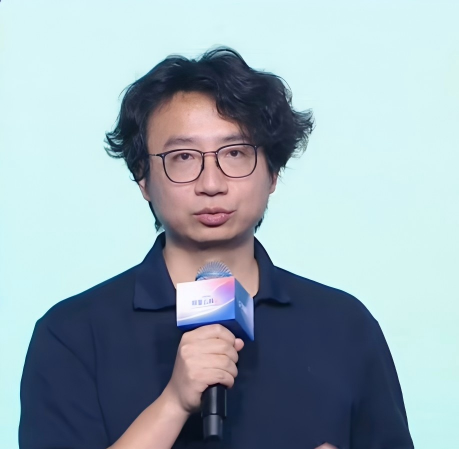
DingTalk CEO Chen Yusen. Image source: Alibaba Cloud's official video account.
From past interviews with Chen Yusen, we can glean his insights into the industry and the objectives of enterprise and team research and development.
He once stated that 2026 will be a pivotal year for realizing the value of AI applications. Global AI investment has soared, and the industry demands more tangible results. Currently, while large model capabilities continue to advance, most users still primarily utilize them for chatbot scenarios, and truly large-scale AI-native applications have yet to emerge.
He also expressed the view that enterprise AI utilization can be divided into two stages: the Copilot stage, where AI acts as a co-pilot, aiding employees in accelerating tasks; and the AI Native stage, where work is reorganized with AI at its core, and humans assume the roles of standard setters and result inspectors.
Both his industry observations and his entrepreneurial experience, along with his involvement in developing MuleRun, position him well to lead DingTalk's future development.
Today, DingTalk still holds an advantage in monthly active user data. At the end of 2025, QuestMobile data indicated that DingTalk ranked first with approximately 200 million monthly active users.
However, in the current collaborative office market, the competitive focus among enterprises has shifted. Whether a platform can deliver a smoother and more precise intelligent experience in high-frequency scenarios such as daily communication, process management, knowledge accumulation, and intelligent decision-making, and whether it can cultivate a rich Skill ecosystem and Agent market, has become the key determinant of success.
Wu Zhao's previous concept of "things finding people" and enabling AI to utilize DingTalk actually aligns with the current industry needs and competitive focus, and he was eager to lead DingTalk to reclaim its former glory.
However, acting too hastily can backfire. Today, DingTalk is no longer in its solo entrepreneurial phase; collaboration with Alibaba Group is paramount.
Judging from the background of the new leader, Chen Yusen, his experience in internal entrepreneurship at Alibaba Cloud suggests that the DingTalk under his leadership may find it easier to collaborate with other Alibaba business groups. Nevertheless, this is no easy feat. Aligning goals, smoothly scheduling computing power, and securely connecting data links are challenges that cannot be overcome by individual will alone. Chen Yusen shoulders a heavy burden.
From ONE to Wukong, DingTalk has been continuously experimenting and adjusting its direction in the AI arena. With the change in leadership, DingTalk must persist in completing this AI transformation battle. How Chen Yusen will lead DingTalk to collaborate with the group and develop truly valuable AI office products will be the focus of future external attention.
(The header image of this article is sourced from DingTalk's official Weibo.)
-
![]()
Proposed to Raise 955 Million Yuan through Private Placement! Huicheng Vacuum Boosts Localization of Ultra-Precision Optical Coating Equipment
-
![]()
Cash Flow Soars 13-Fold! What Major Strategic Move is Wuhan Five Square Optoelectronics Planning?
-
![]()
Leaked Design of vivo X500: Reverts to Circular Camera Module in Top-Left Corner, Pays Homage to Classic X90 Aesthetic
-
![]()
DeepSeek Shows Signs of Foraying into Code Agents, Launches WeChat Official Account Focused on Harness
-
![]()
Auto Companies Deny Claims That ‘Cooperation with Huawei Is Non-Essential’, as Huawei Transforms into a ‘Public Platform’
-
![]()
Starship to Independently 'Return to the Launch Tower': SpaceX's Ambitions Extend Beyond Rocket Building to Dominating Space Transportation
-
![]()
Starship Set to Independently 'Return to the Launch Tower': SpaceX is Revolutionizing Space Transportation, Not Just Building Rockets
-
![]()
Anthropic and OpenAI Face Off Against Deepseek