Two Departments Jointly Announce the 2026 Special Initiative for Practical Training of Humanoid Robots and Embodied AI
 06/15 2026
 394
394
This is the 71st original article from the Think AI Society.
Approximately 1458 words, with an estimated reading time of 5 minutes.
On June 8, the Ministry of Industry and Information Technology (MIIT) and the State-owned Assets Supervision and Administration Commission (SASAC) jointly released a document (MIIT Office Joint Science Letter [2026] No. 256), officially launching the 2026 Special Initiative for Practical Training of Humanoid Robots and Embodied AI.

Link: https://www.miit.gov.cn/jgsj/kjs/wjfb/art/2026/art_cd666691abf8471fb8553d463aa416e3.html
The joint announcement by the two departments, with the participation of the SASAC, underscores that this is not merely a technological policy—it is backed by central enterprise scenarios and orders.
For practitioners, the most significant aspect of this initiative is the fundamental shift from 'demonstration mode' to 'operational mode.'
The policy focuses not on technical indicators, but on real-world workstations.
The main challenge for humanoid robots in recent years has been their impressive performance in demonstrations—such as flipping and dancing—only to falter when deployed in actual factories.
The issue is not the lack of intelligence in algorithms, but rather the challenges posed by real factories, such as varying lighting conditions, inconsistent item placement, and worker movement—situations not encountered in laboratories, leading to difficulties in 'deployment and practical application.'
The core logic of this initiative is simple: since the problem lies in the scenarios, training must take place in real-world settings.
The announcement specifies that each province should select no fewer than 20 scenario units, and each central enterprise no fewer than 10, covering areas such as production and manufacturing, maintenance, warehousing and logistics, healthcare and wellness, safety production, and emergency rescue.
The criteria for scenario selection are 'clear working conditions, high standardization, and economic feasibility'—not the most glamorous, but the most practical for validation.
What does this mean for practitioners? There is now a relatively unified validation standard for product effectiveness, eliminating the ambiguity of self-proclaimed capabilities.
After running through these scenarios, the data will reveal which robots can truly operate stably in real workstations.
Industrial Logic Behind the Ten-Thousand-Unit Scale
The initiative sets a goal: by the end of 2026, drive the formation of a ten-thousand-unit deployment capability.
While ten thousand units may not seem significant in the broader manufacturing context, what does it represent for the humanoid robot industry?
2025 is considered the first year of mass production, with overall industry shipments still hovering around the thousand-unit level. Ten thousand units represent a tenfold increase.
More noteworthy is the mechanism design behind this figure.
Provincial regions and central enterprises must submit their work plans by June 30, 2026, with less than six months to complete scenario selection, consortium formation, and validation—indicating that this initiative comes with 'tasks in hand,' prioritizing scope definition over pilot testing.
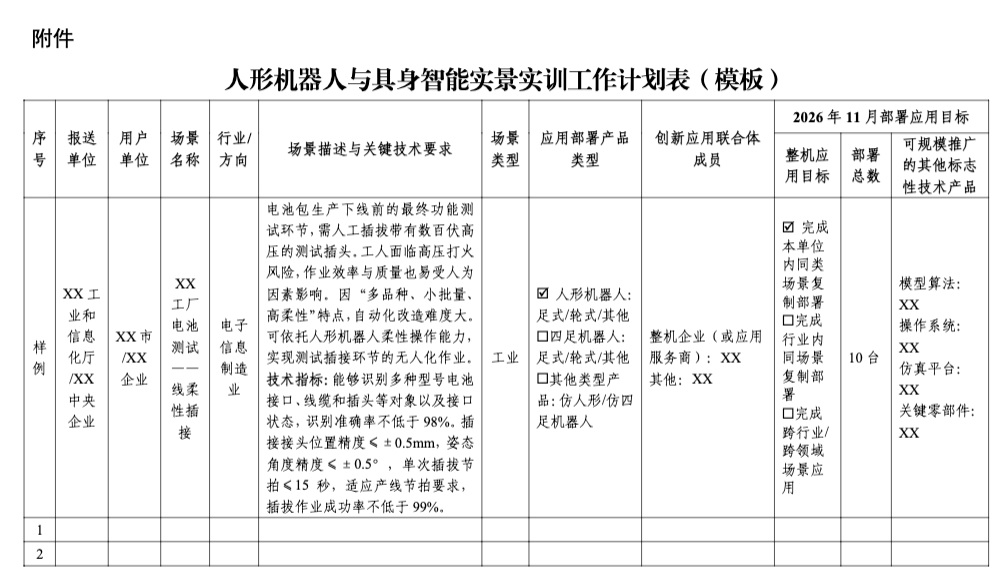
More critically, the involvement of central enterprises led by the SASAC is the key differentiator of this initiative from previous policy documents—opening factories, setting targets, and determining procurement volumes to form a quadruple consortium of 'scenario users + complete machine manufacturers + supply chains + research institutes.'
Scenario providers serve as both demanders and validators, ensuring that progress will be much faster than purely market-driven exploration.
Three Core Variables
After discussing the macro logic, what does this initiative mean for those developing products, integrations, and supply chains?
First, the speed of the data feedback loop.
The initiative explicitly calls for the construction of high-quality real-world datasets, including full-dimensional information such as whole-body motion trajectories, force-position control curves, and operational execution sequences, encouraging open sharing in national-level open-source communities.
Data is the core fuel for embodied AI iteration. With the state organizing high-quality data collection and sharing, the rules of the game have changed—whoever can achieve good results with this data will gain an early advantage in the next generation of products.
Second, the shift from 'selling machines' to 'selling services.'
The announcement specifically encourages exploring the 'humanoid robots as a service' model, with pay-per-use and operational leasing.
If this path succeeds, it means the industry is not just selling hardware but ongoing service capabilities.
For integrators and operators, the iteration of business models will reshape the competitive landscape faster than hardware advancements.
Third, the implementation of insurance mechanisms.
The announcement mentions that provinces should 'explore policies for humanoid robot insurance.'
Admittedly, this is still in the 'exploration' phase, but once mature insurance products emerge, it will signify the establishment of an objective risk control standard for the industry—what can be insured, what cannot, and how much users are willing to buy will be answered by insurance companies' actuarial logic. These answers may carry more weight than policy documents.
Indeed, the humanoid robot sector has never lacked hype.
New companies emerge frequently, new technologies go viral, and new videos capture attention.
However, what truly determines the industry's trajectory are not those flashy moments but the workstations in factories—unfilmed, yet operating stably every day.
Whether this initiative can truly bridge this last mile remains to be seen over the next six months.
But one thing is certain: the shift from 'demonstration' to 'operation,' from 'prototypes' to 'mass production,' the validation data from every real workstation during this window will be the building blocks of the industry's maturity.

All content is sourced from publicly available information and organized for sharing.
Written casually in my spare time, representing only my personal views.
-
![]()
Racing Against Time: Chinese Automakers Take Over European Factories
-
![]()
US$60 Billion Deal: Musk’s SpaceX Acquires Parent Company of ‘Cursor’!
-
![]()
Visual China’s Hong Kong IPO: Can the Capital Story Sustained by Tens of Thousands of Lawsuits Endure?
-
![]()
In-depth | Survival Transformation of 38 Million Freight Drivers: How Platformization Defines the Next Decade?
-
![]()
Why Have ‘Computing Power Rental’ Companies Emerged as the Biggest Winners in the AI Era Amid Soaring Chip Prices?
-
![]()
DeepSeek's Financing Details Revealed! How Liang Wenfeng Secured Control
-
![]()
Valued at 210 Billion Yuan, Generating 42 Billion Yuan in Annual Revenue, Xiaohongshu May Proceed with IPO
-
![]()
Three Straight Months of Growth in Heavy Truck Sales: Both New and Veteran Players Are on the Same Wavelength!