US$60 Billion Deal: Musk’s SpaceX Acquires Parent Company of ‘Cursor’!
 06/17 2026
 502
502

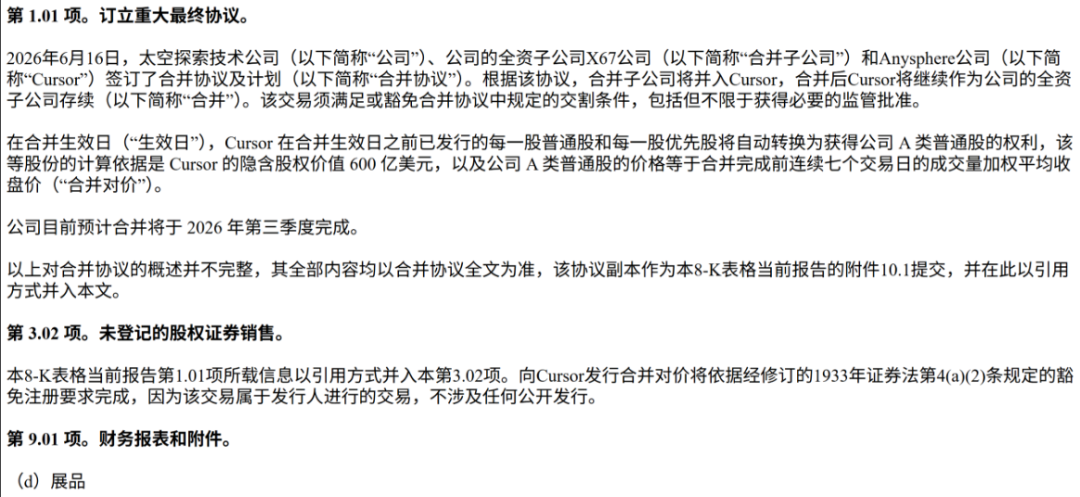
On June 16th, Embodied Emergence reported that Space Exploration Technologies Corp. (SpaceX) has officially announced the acquisition of Anysphere, the parent company of the AI programming tool Cursor, through an all-equity deal, valuing Cursor at an impressive US$60 billion.
The two entities have signed a formal merger agreement, pending relevant regulatory approvals, with the deal expected to close in the third quarter of 2026. Upon completion, Cursor will become a wholly-owned subsidiary of SpaceX. This major acquisition bridges the four pivotal domains of aerospace, supercomputing, AI large models, and intelligent programming, significantly disrupting the existing competitive landscape of Silicon Valley's AI industry.
01
Is the US$60 Billion Acquisition More Than Just a Tool Purchase?
This acquisition transcends a mere corporate merger; it represents a full-scale integration encompassing computing power, large models, and developer ecosystems, fundamentally altering the competitive dynamics of the global AI programming industry.
Currently, the global AI programming sector is in a multi-party stalemate: Microsoft has tightly integrated its ecosystem with GitHub Copilot, while OpenAI and Anthropic have successively introduced native code tools like Codex and Claude Code. As an independent third-party product, Cursor has attracted a vast developer base due to its neutrality. With SpaceX completing this acquisition, Musk’s camp will officially establish a complete industrial closed loop of 'supercomputing center + self-developed large model + AI programming tool,' emerging as a new core force capable of rivaling the Microsoft ecosystem.
SpaceX has charted a development path distinct from traditional tech firms: leveraging the top-tier computing power accumulated from its aerospace business as the hardware foundation, the Grok large model under xAI as the technological core, and Cursor as the front-end traffic entry point and data source. This model disrupts the industry norm of 'model vendors developing tools downward and tool vendors purchasing computing power upward.' Furthermore, SpaceX currently holds annual computing power leasing partnerships worth approximately US$26 billion, involving partners like Google and Anthropic, with agreements including 90-day termination clauses. This grants SpaceX significant autonomy in computing power allocation, enhancing its influence in the global AI industry chain.
From an industry perspective, this acquisition will also spur the transformation and upgrading of the AI programming sector. Previously, most intelligent programming tools merely served as application carriers for general-purpose large models, with their profitability and development constrained by upstream vendors. However, with the deep integration of computing power, models, and tools, the entire industry will accelerate its shift from superficial application models to in-depth R&D stages featuring 'self-trained large models + self-developed programming tools.' AI programming tools will also evolve from mere office assistance software into core data sources driving the iterative upgrading of large models.
02
How Did Cursor, Founded Just Four Years Ago, Achieve a US$60 Billion Valuation?
Founded in 2022, Cursor is a young AI startup. Its ability to secure a US$60 billion valuation is attributed to its robust technical capabilities and impressive operational data; its decision to be acquired ultimately represents a mutually beneficial choice given its development challenges.
From an operational and data standpoint, Cursor's growth rate leads the industry. The company's annualized B2B business revenue has reached US$2.6 billion, with enterprise sales maintaining rapid growth. Previously, Cursor was in the process of securing a US$2 billion financing round co-led by a16z and NVIDIA, with the market offering a post-money valuation of approximately US$50 billion. SpaceX's US$60 billion acquisition price surpasses previous capital market expectations.
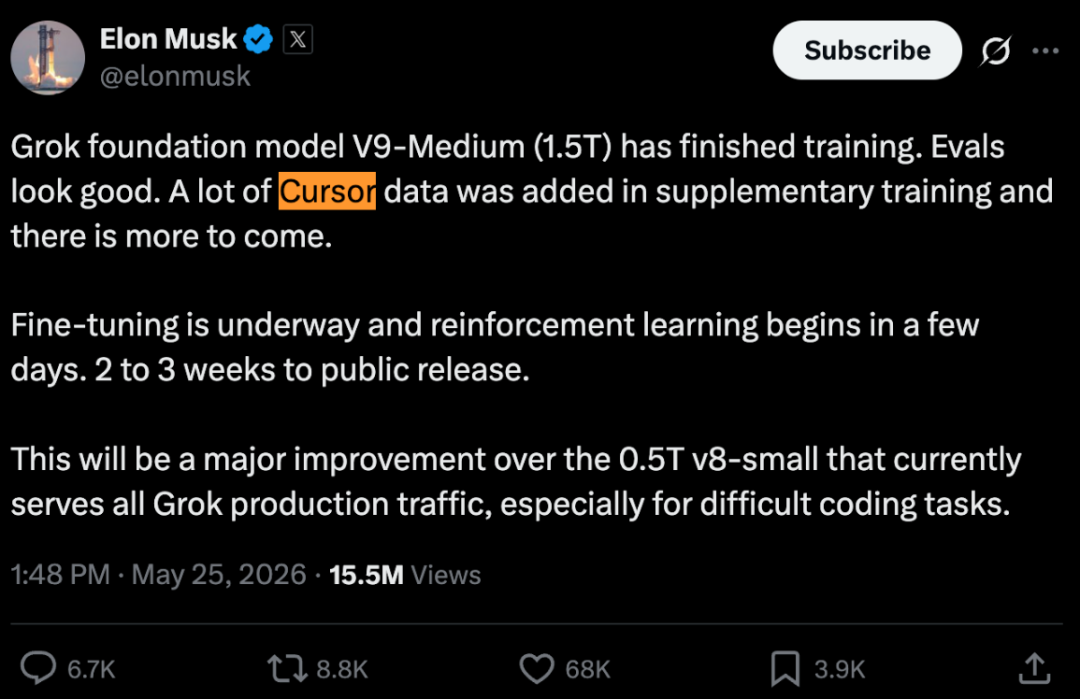
Technologically, Cursor possesses a rare core asset in the industry—real developer behavior data. Musk has publicly stated that the Grok V9-Medium large model extensively incorporated Cursor's user data during its supplementary training phase and will continue to expand relevant data sources. This data, derived from programmers' daily tasks, including coding, debugging, bug fixing, and version iterations, fully restores human programming logic. It serves as a valuable resource for optimizing code-related large models, precisely addressing the programming capability shortcomings of xAI's Grok series models.
Choosing to merge with SpaceX also represents a pragmatic decision for Cursor to resolve its survival crisis. Cursor's core functionalities heavily rely on external model vendors OpenAI and Anthropic, posing its greatest development risk. Currently, these two giants are launching their self-developed code tools, directly seizing market share while squeezing third-party products' profit margins through interface adjustments and pricing strategies. Cursor faces dual risks of technological supply disruption and shrinking profits.
However, with SpaceX's backing, Cursor can directly access xAI's Colossus supercomputing center in Memphis, gaining sufficient computing power support to transition from the application layer and independently develop flagship code large models, completely eliminating reliance on external vendors.
03
Beyond the Merger's Surface, What New Industry Trends Does This Transaction Unveil?
Setting aside the conventional perspective of a major company acquiring a startup and considering the current development status of the AI industry, this transaction reflects three novel and long-term valuable industry trends.
Firstly, real behavior data in vertical scenarios has officially become a core strategic resource for leading AI enterprises. Previously, industry competition primarily focused on comparing large model parameter scales and general-scenario performance. However, Cursor's case demonstrates that real behavior data in vertical fields like programming is the key to differentiating product capabilities. In the future, competition among major tech companies for high-quality data in niche scenarios will intensify.
Secondly, an integrated layout of 'computing power - large models - practical applications' will become the mainstream development model for AI enterprises. Previously, many companies chose to focus on single points or engage in superficial collaborations, resulting in weak risk resistance. SpaceX's layout model validates the advantages of full industry chain integration: it enables autonomous control over technological rhythms, reduces comprehensive costs, and constructs robust ecological barriers. Integrated development will become the common choice for leading players.
Thirdly, cross-border giants are continuously breaking the original boundaries of the AI sector. SpaceX, originally deeply involved in the aerospace field, has now transformed its business and listed on NASDAQ, with its current market value reaching US$2.5 trillion. Leveraging its engineering capabilities and computing power assets accumulated in the aerospace sector to enter the AI field, it signifies that AI is no longer exclusive to pure internet or pure AI teams. The continuous entry of cross-border players with heavy assets and strong engineering capabilities will diversify the competitive landscape of the entire market.
For global developers, this acquisition will not alter the user experience of Cursor in the short term but will accelerate the technological iteration of AI programming tools in the long run. Benign competition among multiple forces will ultimately produce more feature-rich and adaptable products, continuously benefiting developers worldwide.
-
![]()
The Supernatural Episodes of Claude Opus 4.8
-
![]()
"After Six Years of Selling A00-Class Cars, I Find Myself at a Crossroads"
-
![]()
Racing Against Time: Chinese Automakers Take Over European Factories
-
![]()
US$60 Billion Deal: Musk’s SpaceX Acquires Parent Company of ‘Cursor’!
-
![]()
Visual China’s Hong Kong IPO: Can the Capital Story Sustained by Tens of Thousands of Lawsuits Endure?
-
![]()
In-depth | Survival Transformation of 38 Million Freight Drivers: How Platformization Defines the Next Decade?
-
![]()
Why Have ‘Computing Power Rental’ Companies Emerged as the Biggest Winners in the AI Era Amid Soaring Chip Prices?
-
![]()
DeepSeek's Financing Details Revealed! How Liang Wenfeng Secured Control