SpaceX Market Value Surpasses $2 Trillion: Who is Supporting Musk's Space Dreams?
 06/15 2026
 479
479
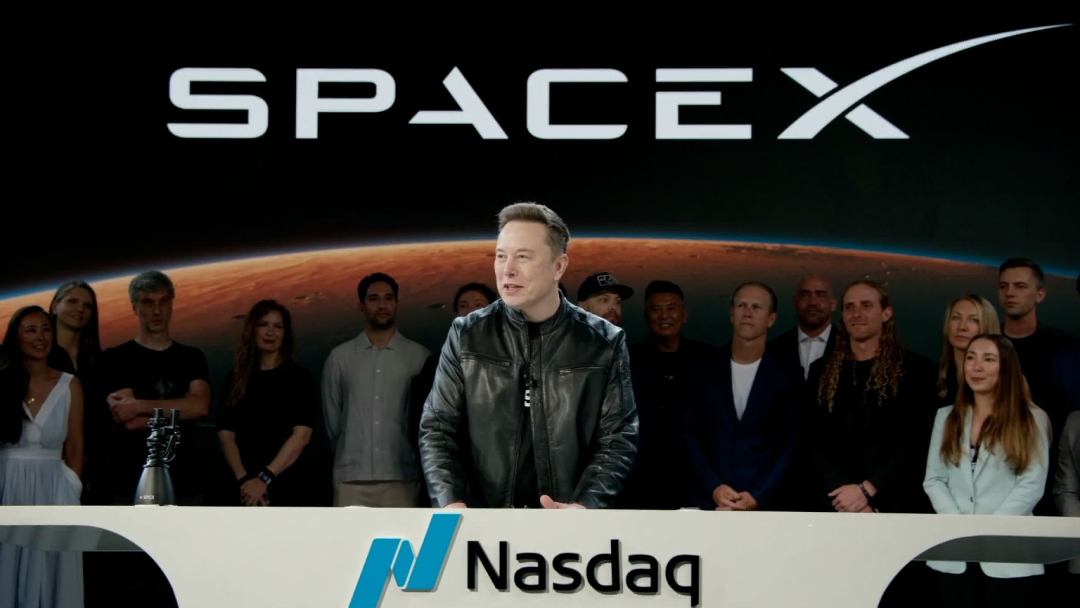
On June 12, SpaceX was listed on Nasdaq with an issue price of $135. It closed up 19.3% at $160.95 on the first day, with a market value exceeding $2.10 trillion, making it the largest IPO in human history.
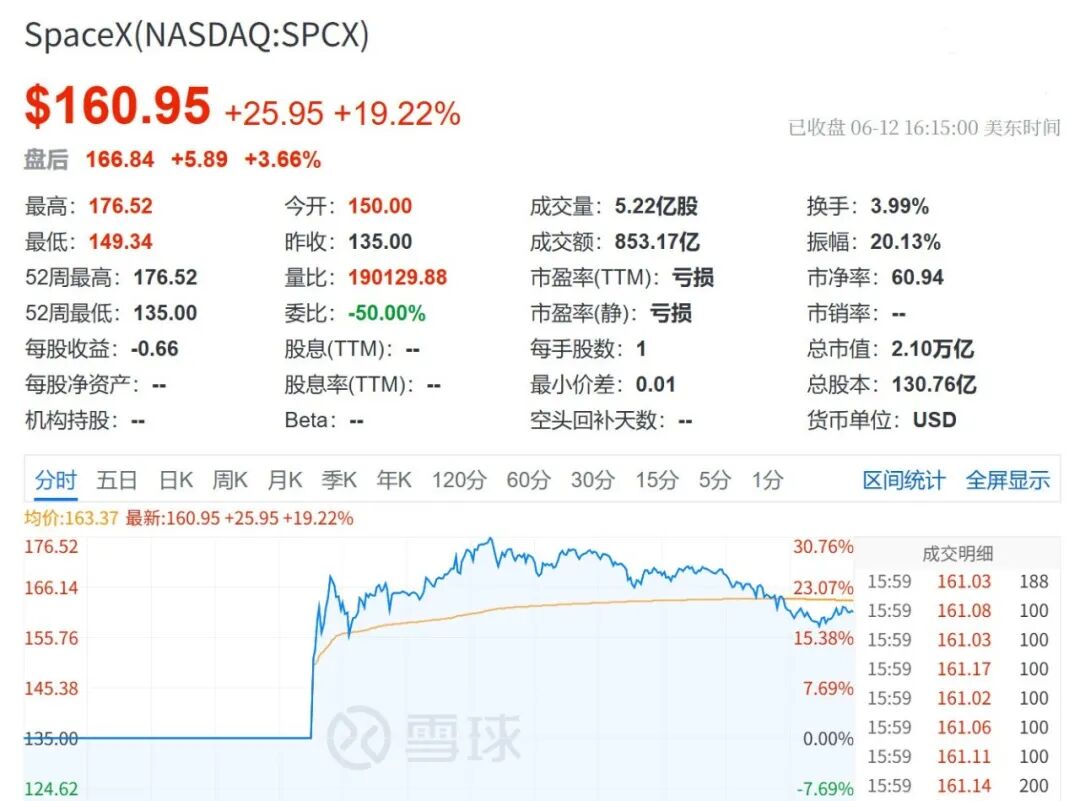
Image source: Xueqiu
However, behind this "increase" is not just market sentiment or Musk becoming the richest person in the world, but rather a financial engineering game of "passive funds being forced to buy"—only, the first day of this game is far from over.
01 First-Day Trading Data: A Textbook-Level IPO Debut
Issue Price: $135 per share, Opening Price: $150 per share (11.1% higher), Intraday High: $176.52 per share, Closing Price: $160.95 per share (up 19.3%), First-Day Amplitude: 26.5%.
At the closing price, SpaceX's market value was approximately $2.10 trillion—surpassing Saudi Aramco and entering the "$2 trillion club" alongside Apple, Microsoft, and Nvidia.
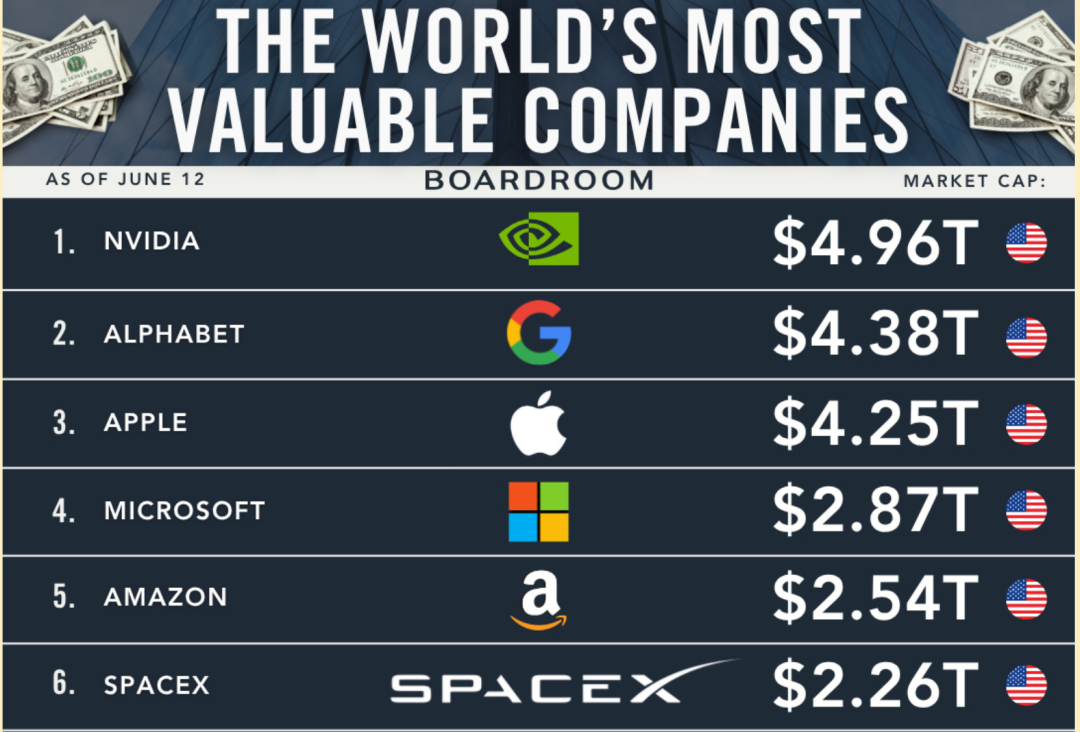
Image source: Internet
Musk's personal stake value has risen accordingly, with his total personal wealth surpassing $1 trillion. Wealth has truly become just a number for Musk.
But today's focus is not on Musk's wealth story, but rather on another overlooked detail—the relationship between the first-day increase and the potential future "forced buying."
02 Which Funds Are Buying SpaceX?
The main contributors to the 19.3% first-day increase were four types of players:
1. IPO placement institutions (underwriting syndicate including Goldman Sachs, Morgan Stanley, etc.)
2. Active management funds (buying based on research judgments)
3. Retail investors (snapping up shares through compliant channels)
4. A small number of thematic ETFs (such as Tema Space Innovators, etc., specifically designed for SpaceX, allowing for faster position building—but with limited scale, far from sufficient to support a $2 trillion market value)
ETF.com reported that a fund called Tema Space Innovators ETF (NASA) was issued at the end of March and surpassed $1 billion in scale within 37 trading days—its original design purpose was to "prepare for SpaceX's listing."
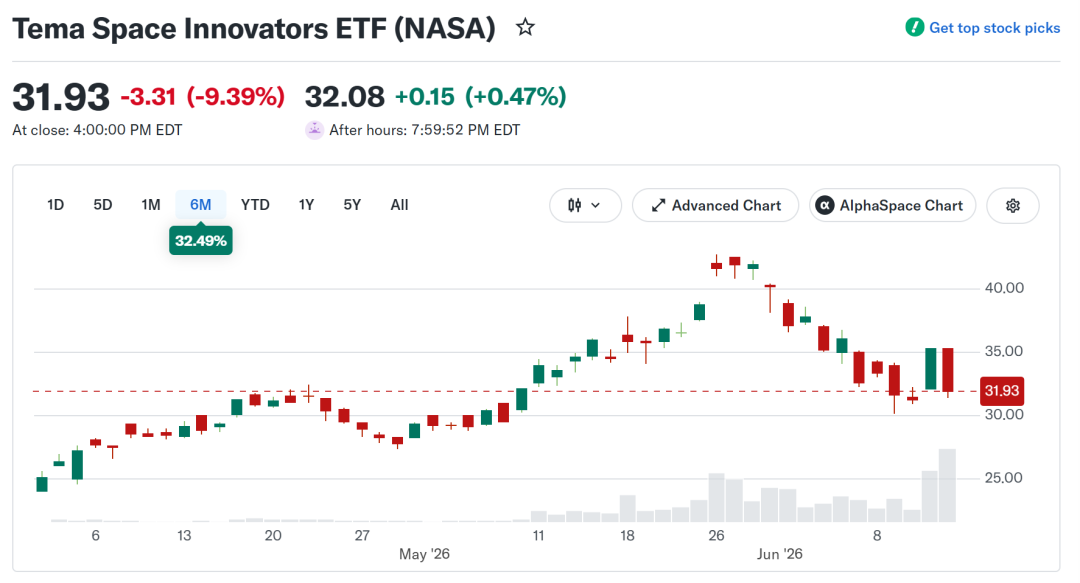
Image source: Internet
However, the real "fast inclusion in indices" will occur from mid-to-late July to early August—when "forced buying" will truly take effect.
03 What Is the "Fast Inclusion in Indices" Game?
The details of this matter are more complex than many people imagine.
First, SpaceX is one of the largest IPOs in history with the "smallest free float." The 555.6 million Class A shares publicly offered account for only 4.25% of the total share capital (approximately 13.08 billion shares), far lower than the 15-20% typical for large IPOs. This means that most shares are held by internal shareholders like Musk, with very few actually circulating in the market.
Second, SpaceX adopts a dual-class share structure—but the power asymmetry is even more severe than the circulation asymmetry.
Class A: 1 vote per share, circulating in the open market
Class B: 10 votes per share, mainly held by Musk and other insiders, not circulating in the open market
Although Musk holds less than about 50% of the shares (including both Class A and B, with certain proportions in each class), with the 10x voting power of Class B, he controls about 85%-90% of the voting rights.
Image source: Internet
What does this mean?
Even if external investors buy up all the circulating Class A shares, they cannot change Musk's absolute control over SpaceX. The "voting power" of the capital market over SpaceX is basically symbolic. This is a company where "voting with your feet" is ineffective—its long-term direction is firmly in Musk's hands alone.
Third, some indices have temporarily modified their rules for SpaceX.
Nasdaq: New rules effective from May 1, 2026, significantly shorten the waiting period for new listings to be included in the Nasdaq 100 Index from at least 3 calendar months to just 15 trading days. If the new stock's market value can rank in the top 40 of the index's existing constituents and meets other eligibility criteria, it can be quickly included. Additionally, the hard requirement for "at least 10% floating shares" has been removed, replaced by a reduced weighting for companies with low float.
FTSE Russell: Introduced a "fast inclusion mechanism" for IPOs, compressing the waiting time to just 5 trading days after listing. As long as the investable market value exceeds the threshold (e.g., set at $13.5 billion for the FTSE Global Equity Index Series), it can be immediately included in relevant U.S. and global indices without waiting for the annual review.
S&P Dow Jones: Refused to modify rules. Maintained the original "12-month maturity period," profitability requirements, and floating share ratio standards. Therefore, SpaceX cannot be included in the S&P 500 Index for at least one year after listing unless it meets strict profitability and other conditions in the future.
MSCI: Continues to implement existing fast inclusion rules for large IPOs. SpaceX is expected to be included in the MSCI Global Standard Index system approximately 10 trading days after listing.
It can be seen that the fast inclusion speeds of the Nasdaq 100 and MSCI are very aggressive. Some reports indicate that SpaceX may be included in the Nasdaq 100 Index around 15 trading days after listing.
Image source: Internet
What do these mechanisms combined mean?
They mean that all passive funds tracking the Nasdaq 100, MSCI indices, and Russell 1000 will be forced to "buy" SpaceX shares in the coming weeks—whether they want to or not, regardless of the price or whether the valuation is reasonable. This is the so-called "forced buying."
04 How Large Is the Volume of ETF Funds?
The total scale of U.S. passive index funds exceeds $8 trillion. If indices such as the Nasdaq 100, Russell 1000, and MSCI all include SpaceX, conservative estimates suggest that hundreds of billions of dollars in passive funds will flood in. In other words, even if you are an ordinary person who does not buy SpaceX shares, you will passively become a SpaceX shareholder.
The "forced buying" by passive funds will be concentrated from mid-to-late July to early August. SpaceX will face two distinct tests:
First day and first week: Dominated by "active funds + retail investors," driven by market sentiment; After mid-to-late July: Dominated by "passive funds," driven by rules.
Image source: Internet
After the combination of these two forces, whether SpaceX can stabilize its $2 trillion market value will be the biggest suspense in the capital markets in 2026.
05 Connection to SpaceX's Business Essence: A "Trinity" of Rockets + Starlink + Computing Power
Of course, market structure is just a tool for short-term gaming. SpaceX's own business is the real foundation supporting its long-term stock price. The financial structure disclosed in the S-1 filing reveals several key synergies in SpaceX's business:
First, rockets are the gateway. Falcon 9 has reduced the launch cost per kilogram from $60,000 in the Space Shuttle era to $2,700. Once the Starship is fully operational, the target is below $200. This decline in the "cost curve" is the physical foundation for the feasibility of the space economy.
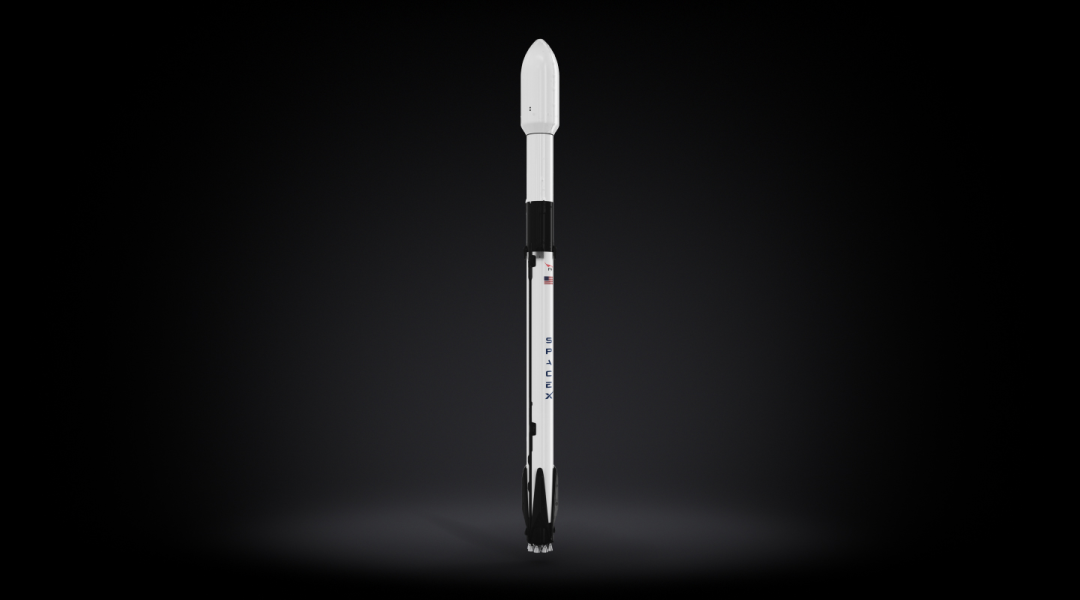
Image source: Internet
Second, Starlink is the cash flow. In 2025, Starlink generated $11.387 billion in revenue and $4.423 billion in operating profit, with 10.3 million users—this is SpaceX's largest profit source and the cash cow of the entire business empire.
Third, AI computing power is the future. The S-1 shows that AI-related capital expenditures in 2025 were $7.7 billion, the largest single item in SpaceX's R&D. Space data centers (orbital computing) are moving from concept to reality—vacuum cooling + 24-hour solar power + Starlink communication solve three constraints at once.
Fourth, ITAR moat. SpaceX's Falcon, Dragon, Starlink, and Starship all involve technologies regulated by the International Traffic in Arms Regulations—meaning its identity as a "defense contractor."
SpaceX's revealed strategic layout can be summarized in one sentence:
Use the cash flow from the rocket business to support Starlink, use Starlink's subscription revenue to support data centers, and use the computing power services of the data centers to redefine the value boundaries of AI.
This is not three independent companies but a vertical closed loop of "launch → communication → computing → training AI or providing AI services."
Rockets provide the gateway, Starlink provides communication and users, and data centers provide computing power and new revenue sources. The three business lines share the same R&D system, the same group of engineers, and the same supply chain—this is SpaceX's deepest moat.
06 SpaceX Is a Great Company, But Reading Financial Statements Is Still a Must for Every Investor
The market looks to the future, while financial statements tell the present.
A $2.10 trillion market value corresponds to annualized revenue of less than $20 billion, with a price-to-sales (P/S) ratio exceeding 100x—the company is in a loss-making state: a $4.94 billion loss in 2025, with a price-to-earnings (P/E) ratio not applicable.
Very excellent tech companies like Apple and Google have P/S ratios around 10-20x, rarely exceeding 30x. Therefore, SpaceX's current P/S ratio is astonishing by comparison—it can be said to be equivalent to a "dream ratio."
These numbers mean that SpaceX is not a company where you "buy the present with present money" but rather one where you "buy the future with present money." The key milestones for future realization include: full reusability of the Starship, commercialization of space data centers, and Mars cargo missions.
Image source: Internet
Any delay in these milestones could cause the market's "faith premium" for SpaceX to evaporate instantly.
Based on risk control, our chief has his own method for evaluating SpaceX's current enterprise value. Through calculations, the resulting figure is significantly lower than $1.7 trillion. If you are interested, welcome to join our paid investment research group (see the end of the article for details). We will send you the relevant analysis materials for learning and reference.
Conclusion
The 19.3% first-day increase for SpaceX was mainly driven by institutional placements + active funds + retail investors, with passive index funds yet to make an appearance. Behind the $2.10 trillion market value stands an entire system of passive funds and index rules—and above the rules lies SpaceX's real business scope: rockets, Starlink, and space computing power, each a foundational infrastructure for the next stage of human civilization.
But no matter how good the narrative is, it still needs time to deliver. The $4.94 billion annual loss and the 100x P/S ratio remind us that those buying SpaceX are not buying current profitability but rather the long-term belief in "humanity's journey to space" and absolute trust in Musk.
Image source: Internet
Whether this belief will be realized, no one can be certain at present. But one thing is certain—the index fund vote in mid-to-late July will be the first real test of SpaceX's valuation.
So, distinguished chief investors, will you consider buying a ticket on board? Welcome to discuss in the comments section!
- END -
-
AI Asset Spin-offs at Tech Giants: Is Kling Paving the Way for ByteDance and Alibaba?
-
![]()
Why Zhang Xue? Why HONOR?
-
![]()
Exclusive! Tencent’s ‘Tencent Drive’ with AI-Powered Asset Backup in the Works—A Game-Changing Move
-
![]()
Internal Upheaval in Initial Listing Days: SpaceX's AI Division Faces Accelerated Talent Loss, with 50+ R&D Staff Exiting in 2026
-
![]()
Price War Fails, Chinese Automakers Have No Retreat
-
![]()
Still in the Red but Outpacing Tesla: What Lies Behind SpaceX's $2.1 Trillion Valuation?
-
![]()
Humanoid Robots Go Global: From 'Actors' to 'Workers'
-
![]()
Still Incurring Losses Yet Outpacing Tesla: What Does SpaceX's $2.1 Trillion Valuation Signify?