Internal Upheaval in Initial Listing Days: SpaceX's AI Division Faces Accelerated Talent Loss, with 50+ R&D Staff Exiting in 2026
 06/15 2026
 376
376
 AI Capital Bureau, Shi Tao, June 15
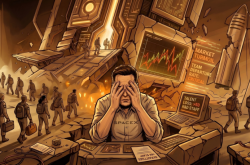
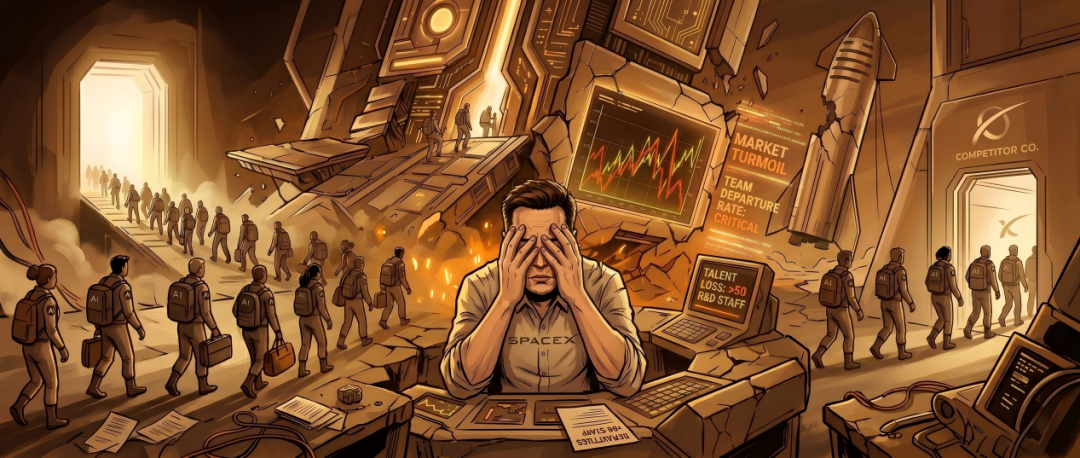
Barely three trading days after its debut on the Nasdaq, space technology behemoth SpaceX finds itself entangled in internal team turmoil. According to exclusive reports from authoritative sources such as The Information and Sina Finance, since the consolidation and establishment of SpaceX's AI division from xAI in February 2026, over 50 AI R&D professionals have left the team through voluntary resignations, layoffs, and dismissals. The core pre-training team has experienced a significant reduction in staff, halting business development and posing a substantial threat to the growth potential of its AI sector's valuation post-listing.
Unraveling the Team Turmoil: The Aftermath of xAI's Merger
The current talent exodus is not an abrupt development; internal organizational conflicts have been steadily surfacing since SpaceX finalized its acquisition of xAI. In early February 2026, SpaceX completed the acquisition of xAI through an all-stock deal, with the merged entity's valuation soaring above $1.25 trillion, setting a global benchmark for tech industry mergers and acquisitions. At the time, Musk publicly assured that the merged xAI would continue to operate independently, with no immediate changes to team structure or business direction.
However, the actual integration process far outpaced market expectations. SpaceX promptly restructured xAI, officially rebranding it as SpaceX AI and integrating it into the company's listed asset portfolio, while simultaneously taking charge of the two core businesses: Starlink orbital computing power and Grok large model R&D. This aggressive organizational reshuffle directly triggered a mass exodus of the founding team. Data reveals that by the end of March 2026, all 11 original co-founders of xAI, excluding Musk himself, had resigned, spanning all core business sectors such as model pre-training, code generation, image reasoning, and voice interaction. 
The upper-echelon turmoil soon permeated the grassroots R&D teams. By mid-May, SpaceX AI's core pre-training team, responsible for training the Grok series of large models, was left with only a skeletal crew of basic R&D personnel, effectively losing the capacity to independently develop new large models. After nearly four months of continuous attrition, the cumulative number of departed R&D staff exceeded 50, including several senior algorithm engineers, computing power architects, and large model pre-training leads.
Multiple Factors Contribute to Talent Drain, Hardcore Management Sparks Resistance
Feedback from multiple departed employees indicates that this large-scale talent exodus resulted from a confluence of factors. Primarily, management style conflicts emerged as the key incentive. SpaceX has long adhered to a high-intensity, militarized management culture, which was fully enforced in the AI division post-merger. The extended working hours, stringent performance evaluations, and frequent business adjustments clashed with the relaxed and innovative R&D environment typical of the AI industry, making it challenging for many technical personnel to adapt.
Secondly, the frequent fluctuations in business strategy left the team's development direction uncertain. During the IPO preparation phase, SpaceX's management repeatedly shifted the positioning of its AI business, oscillating between 'delving deeper into general-purpose large models' and 'focusing on space-specific AI.' This instability in R&D resource allocation directly eroded the core team's R&D confidence. Furthermore, the company heavily prioritized the Starship rocket and Starlink internet businesses, with the AI sector consistently playing a secondary role.
Lastly, disparities in equity incentives exacerbated the talent drain. Compared to native AI companies like OpenAI and Anthropic, employees in SpaceX's AI division held a smaller proportion of company shares. Additionally, the post-listing equity lock-up period extended to 18 months, limiting short-term gains compared to startups in the same sector and making it difficult to retain top AI talent.
Clear Talent Flow: Meta and Thinking Machines Lead the Recruitment
Industry data reveals that most of the over 50 departed R&D personnel are seasoned experts in large models, computing power scheduling, and world models. Upon leaving, they were swiftly absorbed by leading industry players. Meta emerged as the primary beneficiary, establishing a dedicated recruitment team to specifically target SpaceX AI's pre-training and code model-related talent, strengthening its own Llama series large model R&D team.
Moreover, computing power and AI startups such as Thinking Machines Lab and CoreWeave, with their attractive equity incentives and flexible business models, lured a significant number of computing power architecture and underlying optimization talents. A handful of Chinese core experts returned to Asia, joining leading domestic large model manufacturers and computing power infrastructure companies.
AI Narrative Under Scrutiny, Stock Price Faces Post-Listing Pressure
As one of the core growth narratives of this IPO, the AI business serves as a vital pillar supporting SpaceX's pursuit of an ultra-high valuation. The company had previously outlined plans to leverage the Starlink orbital data center + Grok large model to create a globally unique space AI ecosystem, tapping into the trillion-dollar orbital computing power market. On its debut day on June 12, SpaceX's stock price closed up 19.22% at $160.95, with a total market capitalization reaching $2.1 trillion. Growth expectations for the AI business were a significant driver behind the valuation surge. 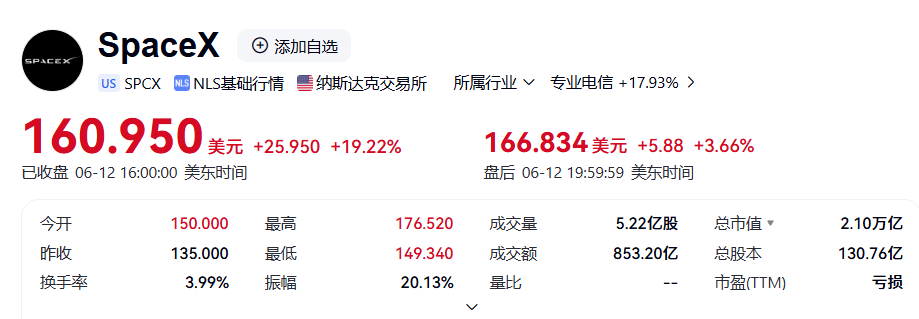
AI Capital Bureau believes that the current large-scale exodus of the core team may directly undermine capital market confidence in SpaceX's AI business. On one hand, the iteration pace of the Grok large model will be forced to decelerate, making it challenging to compete directly with GPT and Claude in the near term. On the other hand, the stagnation in supporting R&D for the orbital AI data center may significantly delay the commercialization timeline for space AI. Coupled with recent setbacks such as the failed Starship test flight and the suspension of its test flight qualifications by the FAA, these multiple negative factors may trigger a reassessment of the company's long-term growth prospects in the secondary market, amplifying stock price volatility risks.
To mitigate the talent crisis, SpaceX has urgently implemented remedial measures, appointing a senior Starlink executive as the president of the AI division and planning to acquire AI programming startup Cursor to address technical shortcomings. However, these efforts are unlikely to bridge the core talent gap in the short term.
As of press time, SpaceX has not issued an official response to the talent exodus incident. 
AI Capital Bureau is a professional platform dedicated to observing and analyzing capital market dynamics in the artificial intelligence sector. We closely monitor capital operations such as financing, listings, and mergers and acquisitions of AI and embodied intelligence-related companies, conducting in-depth analyses of industry trends and enterprise development trajectories to provide valuable insights for industry participants. We are committed to bridging the gap between AI innovation and the capital market, facilitating value discovery and growth for China's hard tech companies.
Risk Warning and Disclaimer: The market carries inherent risks, and investment decisions should be made with caution. This article does not constitute investment advice and should not be used as a basis for actual operations. Trading risks are borne by the investor.
-
AI Asset Spin-offs at Tech Giants: Is Kling Paving the Way for ByteDance and Alibaba?
-
![]()
Why Zhang Xue? Why HONOR?
-
![]()
Exclusive! Tencent’s ‘Tencent Drive’ with AI-Powered Asset Backup in the Works—A Game-Changing Move
-
![]()
Internal Upheaval in Initial Listing Days: SpaceX's AI Division Faces Accelerated Talent Loss, with 50+ R&D Staff Exiting in 2026
-
![]()
Price War Fails, Chinese Automakers Have No Retreat
-
![]()
Still in the Red but Outpacing Tesla: What Lies Behind SpaceX's $2.1 Trillion Valuation?
-
![]()
Humanoid Robots Go Global: From 'Actors' to 'Workers'
-
![]()
Still Incurring Losses Yet Outpacing Tesla: What Does SpaceX's $2.1 Trillion Valuation Signify?