Still Incurring Losses Yet Outpacing Tesla: What Does SpaceX's $2.1 Trillion Valuation Signify?
 06/15 2026
 448
448
Author | Shuyan
For more financial insights | BT Financial Data Pass
The full text comprises 28,632 characters, with an estimated reading time of 9 minutes.
A company that continues to sustain substantial losses commands a market valuation surpassing that of Tesla.
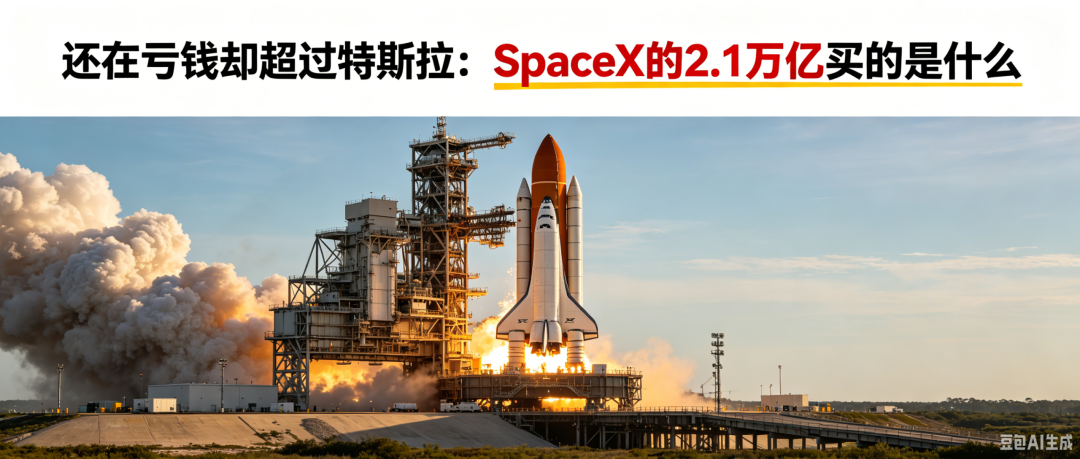
On June 12, 2026, Elon Musk's SpaceX made its public debut on NASDAQ under the ticker symbol SPCX. The stock surged 29% at the opening and closed up 19.22% at $160.95, propelling its market capitalization to approximately $2.1 trillion, placing it among the top ten globally, ahead of Broadcom and Tesla (Source: Securities Times, Cailian Press, June 12-13). On the same day, Musk's personal net worth officially exceeded $1 trillion (Source: Cailian Press, June 13).
Most reports zeroed in on one key point: the largest initial public offering (IPO) in history had emerged, raising approximately $75 billion, more than double the previous record of $29.4 billion set by Saudi Aramco in 2019, with retail investor subscriptions surpassing $100 billion (Source: Sina Finance, Securities Times, June 12).
However, I believe the most intriguing aspect isn't these record-breaking figures themselves, but rather another question: Who stands to benefit from this $2.1 trillion valuation, and who is footing the bill?
Because a closer look at its prospectus reveals a fact that seems incongruous with the "$2.1 trillion" valuation.
This isn't a triumph for an aerospace company but rather a price set by capital for a monopoly that has yet to materialize.
1 Let's first delve into the company's financials.

Let's crunch the numbers.
According to data from the prospectus cited by the Securities Times: SpaceX's revenue for the full year 2025 was $18.67 billion, up 33% year-on-year; its revenue for the first quarter of 2026 was $4.69 billion, up 15% year-on-year. Revenue is indeed on the rise—that much is clear.
But equally noteworthy is another figure: a net loss of $4.28 billion in the first quarter of 2026 and $4.94 billion for the full year 2025. Since its inception in 2002, the company has racked up losses totaling approximately $41.3 billion. The company itself cautions investors in the prospectus that it may not achieve overall profitability in the foreseeable future (Source: Securities Times, June 12).
When you juxtapose these two sets of numbers, the picture becomes stark: a company that has lost over $40 billion over two decades and admits it may continue to incur losses is valued at $2.1 trillion on its first day of trading.
What does this imply? Companies like TSMC and Broadcom, which consistently generate profits and positive cash flow, have market valuations in this range. In other words, the market is valuing SpaceX not based on its past earnings but on its potential to "secure" future earnings.
So what exactly is the market paying for?
2 The $2.1 trillion buys not rockets but a stake in the "space tollbooth"
In simpler terms: Investors aren't betting on the number of rockets SpaceX launches today but on its ability to dominate three largely inaccessible domains simultaneously.
The first is launches. Reusable rockets have driven unit launch costs to levels unattainable by the industry, effectively monopolizing most global commercial launch capacity. Anyone wishing to send satellites into space cannot bypass SpaceX.
The second is Starlink. This is where the real revenue lies. PitchBook estimates that Starlink's 2025 EBITDA (earnings before interest, taxes, depreciation, and amortization) was approximately $5.8 billion, with a profit margin of around 54%, mirroring the profit structure of a software service company (Source: Guancha.cn citing PitchBook, June 13). Orbital resources for low-Earth orbit satellite internet are finite—whoever deploys satellites first secures the airwaves and orbits in the sky.
The third is the oft-repeated narrative of Mars colonization and space-based computing power. This segment has yet to generate revenue but fuels the "imagination" behind its valuation.
When you combine these three elements, what capital is purchasing is a judgment: All future human needs for space travel—cargo transport, internet access, even the construction of data centers in space—will have to pass through this company's gateway. It's akin to a tollbooth that hasn't been fully constructed yet but already controls the sole entrance. The $2.1 trillion buys the anticipated toll-collecting rights of this booth for decades to come.
Once you grasp this, the fact that SpaceX is "still incurring losses" becomes logically coherent: Current losses are the "tolls" paid to secure this dominant position; profitability can be pursued later. Whether this logic holds water is another matter, but that's how the market is pricing it at present.
3 On its debut day, its peers felt the pinch
If the above answers "who is paying," there's another group whose fortunes were directly impacted by this IPO.
The most obvious are U.S.-listed space stocks. On SpaceX's debut, almost all aerospace stocks in the same sector plummeted: Virgin Galactic fell 25.1%, Rocket Lab dropped 8.8%, Intuitive Machines fell 10.3%, Planet Labs dropped 7.8%, and Redwire fell 10% (Source: Securities Times, June 12).
This is what "direct interests" entails: When a behemoth enters the fray, capital doesn't materialize out of thin air—it's drawn from other companies in the same sector. The more SpaceX is pursued and admired, the more smaller, less compelling aerospace companies are overlooked, and their valuations compressed. For investors holding these stocks, this translates to tangible losses.
Expanding the scope, there's the A-share commercial space sector. China's commercial space industry has been a hotbed for capital in recent years, with numerous companies operating in rockets, satellites, and ground stations. SpaceX's record-breaking IPO will bolster short-term market sentiment that "commercial space is a major trend," adding fuel to A-share concepts; but in the long run, it sets a sobering benchmark: SpaceX is a mature giant with over $10 billion in revenue and Starlink nearing software-like profitability, while most Chinese companies are still in the early investment stages. Sentiment can be ridden, but the gap must be acknowledged.
Further afield, there are ordinary people who may seem unrelated. If your broad-based index fund or retirement target-date fund includes overseas tech assets, then sharp fluctuations in mega-cap stocks like SpaceX will quietly trickle down to your account's net value through the index. You may never pay attention to rockets, but your money might already be indirectly along for the ride.
4 Final question: Will this fire scorch China's commercial space industry?
Ultimately, what does SpaceX's $2.1 trillion valuation mean for China?
The following is speculation for readers' reference.
On the positive side, it proves in the most straightforward capital market manner that "commercial space can be a lucrative business." This will encourage more patient capital to enter China's rocket and satellite sectors, shortening the industry's early loss-bearing phase. Starlink's profitability demonstrates that low-Earth orbit satellite internet can be profitable, serving as a business model endorsement for China's ongoing satellite internet projects.
But the more critical warning lies on the flip side: Orbits and frequencies are globally scarce resources—first come, first served. With $2.1 trillion in capital at its disposal, SpaceX will accelerate its "land grab" in the sky. The orbital windows left for latecomers are narrowing. This is not a race that can be taken at a leisurely pace.
So, back to the original question: Who stands to benefit from this $2.1 trillion valuation?
It's for Wall Street, proving that Musk's narratives can still captivate investors; it's for peers, declaring a winner-takes-all era; and it's for all latecomers still gazing at the sky, reminding them: Tickets to space are being priced, and they're getting more expensive.
A company still incurring losses commands a market valuation surpassing that of Tesla. The market isn't buying how many rockets it launches today but how many tomorrows it can secure.
References
Securities Times, "History's Largest IPO: SpaceX Opens 29% Higher, U.S. Space Stocks Plunge Across the Board" (June 12, 2026); Cailian Press reports on SpaceX's debut closing and Musk's net worth (June 13, 2026); Sina Finance, Beijing Business Today reports on SpaceX's IPO and fundraising scale (June 12, 2026); Guancha.cn citing PitchBook on Starlink's profitability data (June 13, 2026).
This article is intended solely for information sharing and industry analysis and does not constitute any investment advice, investment analysis opinions, or trading solicitations. The market carries risks, and investments must be made cautiously. Anyone making investment decisions based on this article bears the risks and gains or losses themselves; the author and publishing platform assume no legal liability. Content marked as "speculation" represents the author's logical deductions from public information and does not represent official positions.
This article is original to BT Finance and may not be used, reproduced, disseminated, or adapted without permission. Infringement will result in legal action.

The views expressed in this article are the author's own. For questions or feedback, leave a comment directly in the comment section.
-
AI Asset Spin-offs at Tech Giants: Is Kling Paving the Way for ByteDance and Alibaba?
-
![]()
Why Zhang Xue? Why HONOR?
-
![]()
Exclusive! Tencent’s ‘Tencent Drive’ with AI-Powered Asset Backup in the Works—A Game-Changing Move
-
![]()
Internal Upheaval in Initial Listing Days: SpaceX's AI Division Faces Accelerated Talent Loss, with 50+ R&D Staff Exiting in 2026
-
![]()
Price War Fails, Chinese Automakers Have No Retreat
-
![]()
Still in the Red but Outpacing Tesla: What Lies Behind SpaceX's $2.1 Trillion Valuation?
-
![]()
Humanoid Robots Go Global: From 'Actors' to 'Workers'
-
![]()
Still Incurring Losses Yet Outpacing Tesla: What Does SpaceX's $2.1 Trillion Valuation Signify?