1.2 Trillion! Chinese Team Challenges America's Strongest AI and Achieves Legendary Status in One Battle
 06/23 2026
 427
427
On June 22, Zhipu AI's stock price continued to surge, with its market value once soaring to 1.2 trillion Hong Kong dollars during the session.
How could a company with annual revenue of only 700 million drive investors wild?
The answer lies in an AI paradigm revolution.
【01 Explosive Impact】
On June 12, 2026, the U.S. government issued a ban, and Fable 5 was gone. Just three days after its launch, it was removed globally, with the official reason being:
National security.
Unlike previous large models, Fable 5 wasn't just for chatting.
It was more like a digital employee, capable of operating your computer, planning tasks on its own, writing code, running tests, and fixing bugs. Even more terrifyingly, it could complete the work of a professional team in two months in just one day.
This wasn't a fairy tale.
Tests conducted by the University of Pennsylvania showed that Fable 5 replicated the famous game Minecraft in just 20 minutes.
The battlefield for large models is shifting from chatting to getting things done. Whoever can make AI truly work will secure the next ticket to the game. And it seems the Americans have taken the lead once again.
Anxiety permeated online, with many asking: Are Chinese large models being left behind again?
At this critical moment, a Tsinghua professor stepped in!
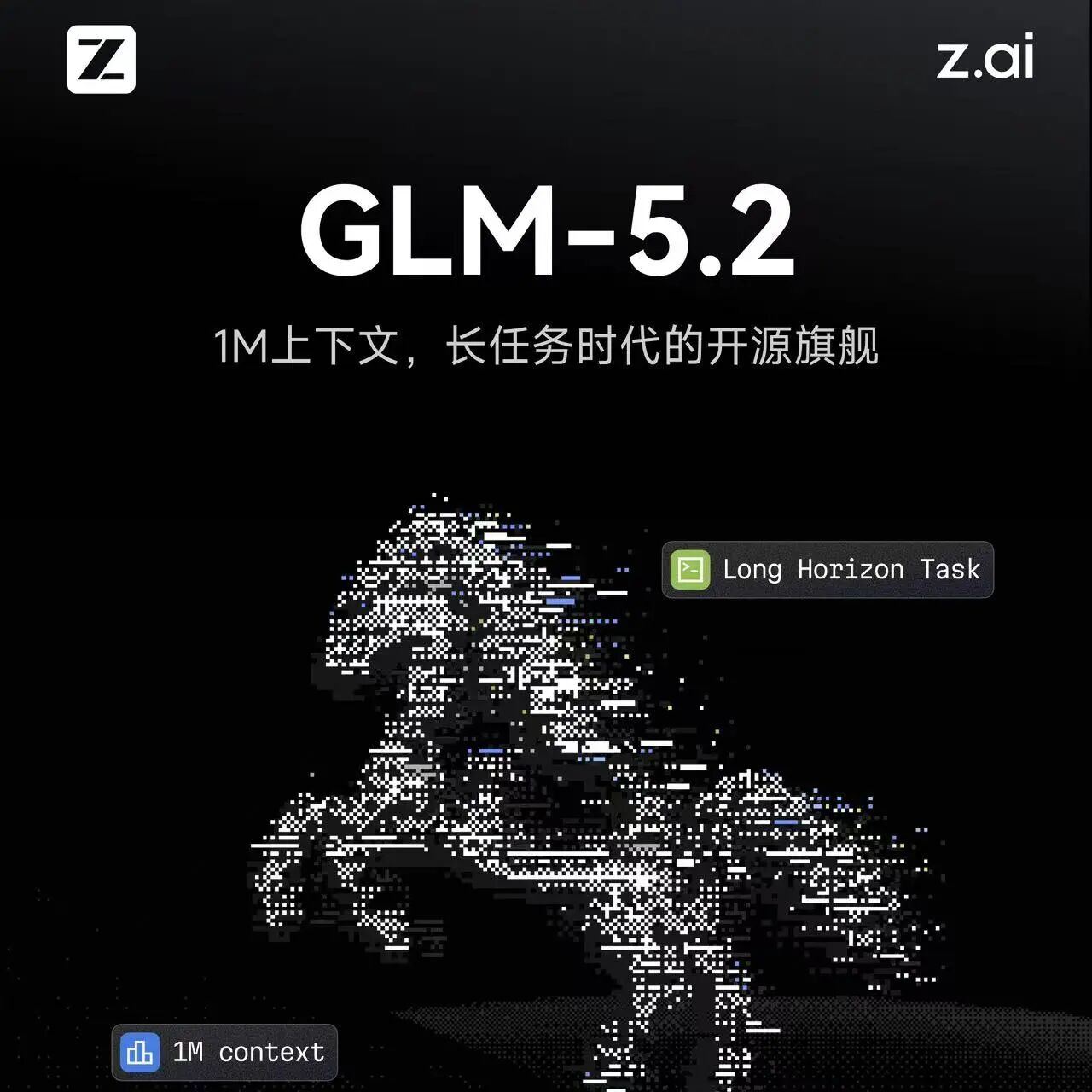
Just a few days after Fable 5 was taken offline, on June 17, a Chinese large model company called Zhipu announced the full release of GLM-5.2.
How powerful is GLM-5.2? Can it withstand Fable 5? Let's look at some data:
On the globally authoritative AI programming capability evaluation platform Code Arena, GLM-5.2 ranked second globally with a score of 1595, with the first place being the now-discontinued Fable 5.
In other words, among the large models still in use, it ranks first.
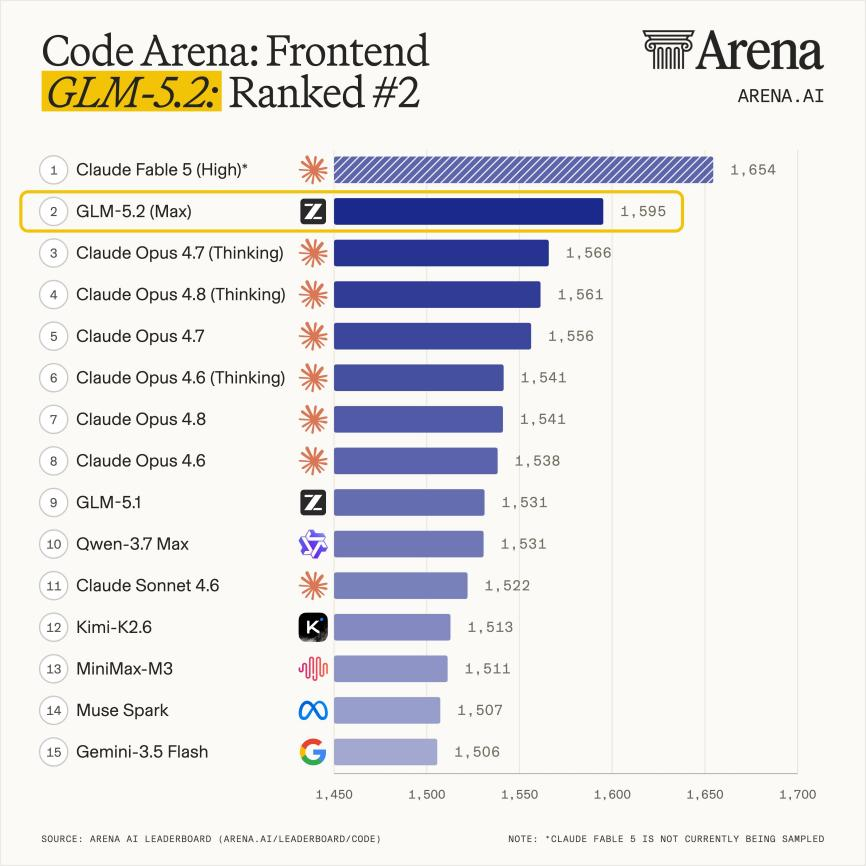
Netizens went wild, while Arena officials described it as an incredible milestone.
This means that for the first time, a domestically developed open-source large model has joined the global top three in coding: Claude, OpenAI, and Zhipu.
Previously, this position had been held by Google's Gemini.
GLM-5.2 didn't achieve this overnight. Behind it stands a Tsinghua professor who silently endured 13 years of obscurity.
His name is Tang Jie.
【02 Bold Gamble】
At the end of 2024, DeepSeek R1 burst onto the scene, and the world exclaimed: China's DeepSeek moment in AI. The large model industry was transformed overnight.
While many were still competing on parameters, prices, and download counts, Tang Jie, a professor in Tsinghua University's Computer Science Department and chief scientist at Zhipu, made a stunning judgment:
The battle over Chat is basically over!
In his view, the Chat paradigm was nearing its end, with diminishing marginal returns. What remained were mostly engineering and technical issues rather than disruptive paradigm innovations.
The next paradigm might be enabling everyone to use AI for practical tasks. Chatting isn't the endpoint; working is!
So, what counts as working? The most natural and logical direction is coding.
Understanding codebases, tracing bugs across files, and passing tests—if a model can write code on its own, it can plan, execute, and correct errors by itself.
In a sense, it becomes an intelligent agent capable of getting things done.
Tang Jie was confident, but the team debated this Countless nights (countless nights). Ultimately, Tang Jie made the decision to focus all efforts on coding.
This wasn't his first gamble. Earlier, when GPT-3 emerged, Zhipu faced a decision: Should they build a large model with hundreds of billions of parameters?
Tang Jie knew that if they failed, it could bankrupt the company.
But despite the risks, he decided to persevere.
At an internal company decision-making meeting, his stance was decisive: If successful, it would at least prove that Chinese large model companies could achieve world-class technological capabilities.
He wasn't without hesitation, but after weighing his options, he chose to keep pushing forward.
In 2021, Zhipu rented 1,000 A100 cards from the Jinan Supercomputing Center, reconstructed operators from the ground up, and trained for eight months.
At the time, as one of Zhipu AI's incubators, the entire Zhiyuan Institute had only 480 A100 cards, making Zhipu's investment a significant one.
By July 2022, Zhipu had trained GLM-130B with a total investment of 6 million yuan.
While OpenAI burned nearly 30 million to kick open the door to humanity's first large model with hundreds of billions of parameters, Tang Jie's team achieved China's first open-source large model with hundreds of billions of parameters through extreme engineering optimization at a fraction of the cost.
This judgment wasn't innate.
In 2006, after graduating with a Ph.D. from Tsinghua, Tang Jie received offers from major companies with multiples of his salary and from foreign universities, but he chose to stay in academia for research.
The person who inspired this decision was Academician Wang Xuan.
He wanted to emulate Wang Xuan's ability to drive technological innovation and industrialization as a professor.
Just before Tang Jie's graduation in February 2006, Wang Xuan passed away, and Tang Jie's choice became a silent legacy.
At the time, the number of global academic papers had reached hundreds of millions, but no one was summarizing the patterns behind them.
Tang Jie attempted to develop a tool called AMiner, using AI to mine global scholars' papers and collaborations to build a map of academia.
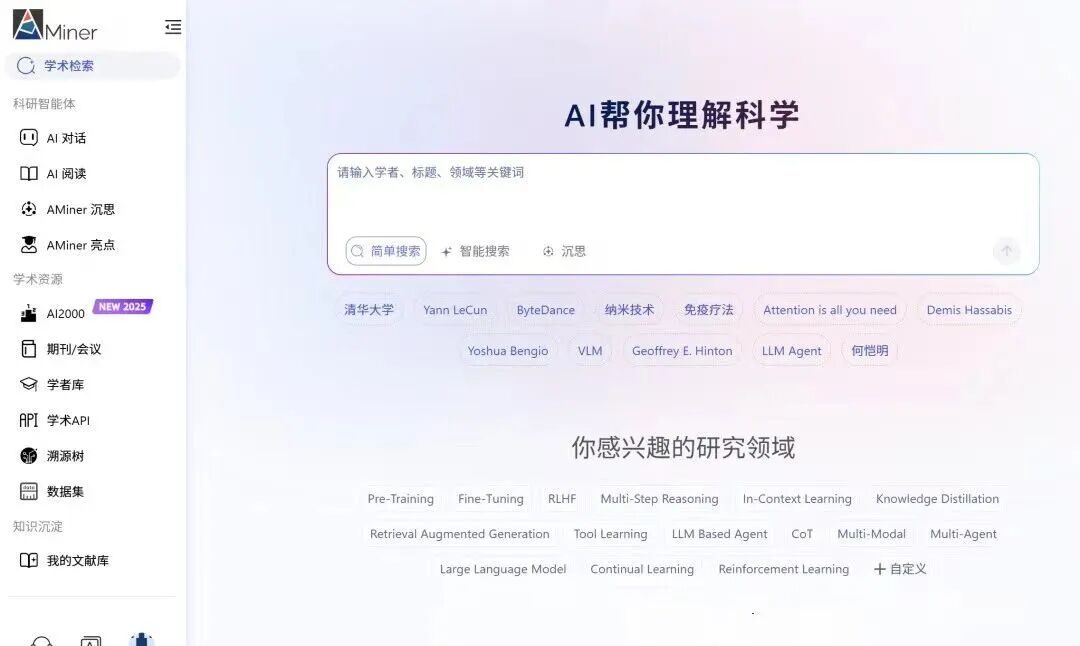
Back then, no one cared about academic tools, with hot money flowing into e-commerce and gaming. He worked on this for 13 years.
Over those 13 years, the richest internet entrepreneurs changed several times. In his Tsinghua office, Tang Jie pored over papers with his students, one by one.
This monk-like experience, while not bringing wealth, honed his judgment of large-scale data and AI.
This judgment couldn't be bought or rushed; it could only be cultivated over time.
In 2019, when Tang Jie founded Zhipu with the Tsinghua KEG Lab team, the decades of accumulation from AMiner became its technological foundation.
It was this judgment that emboldened him to invest heavily in training China's earliest large model with hundreds of billions of parameters when the company was still in its infancy and its survival uncertain.
Later, when the entire industry fell into an involutionary trap of competing on parameters and prices, he stepped back again, concentrating the next generation of R&D resources on coding—a harder but closer path to AGI.
【03 Cracks】
Many AI companies have had a clear goal from day one: build products, create applications, and acquire users.
But Tang Jie didn't.
From the start, he didn't see large models as mere chat tools. In his eyes, the ultimate goal of large models wasn't dialogue but AGI—intelligent agents capable of replacing human labor.
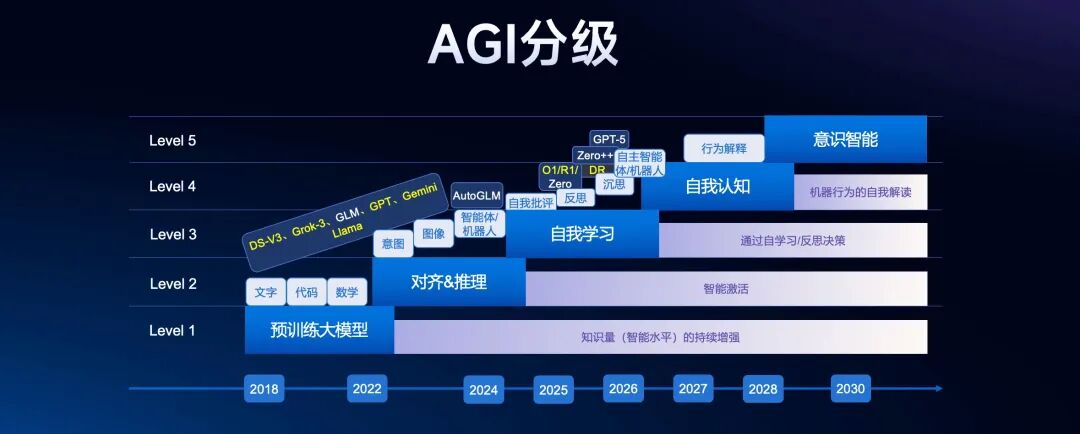
▲Source: Tencent Technology
This path was never easy, as it meant: not chasing viral applications, not fighting for traffic, and not pursuing short-term growth. Instead, it meant focusing on one thing:
Advancing intelligence.
The core team structure of Zhipu reflected this choice from the beginning.
Tang Jie served as chief scientist, responsible for technical direction; Zhang Peng as CEO, responsible for commercialization; and Liu Debing as chairman, responsible for strategy and capital.
This wasn't a one-man show or a purely commercial company but rather a compromise: running a company academically while surviving commercially.
However, this structure often collided with reality.
To B was the first crack in reality.
Zhipu could have targeted consumers, fought for traffic, and pursued short-term growth—the choice of most AI companies. But Tang Jie focused on To B instead.
Dealing with governments, banks, and schools offered high-value contracts and ample budgets, which seemed ideal.
But the trade-offs were clear: payment cycles stretched from 21 to 112 days, major clients frequently changed, most transactions were one-time, and even stranger, procurement sometimes exceeded sales.
This wasn't the growth curve of a typical tech company but rather an engineering-oriented business: unsexy but stable, not explosive but hard to kill.
Zhang Peng later summed it up bluntly: The C-side isn't for profit; it's to demonstrate capability to the B-side.
In February 2026, the cracks widened.
After the release of GLM-5, problems emerged—not technical failures but product mechanism out of control (loss of control): insufficient rule transparency, overly slow grayscale rollouts, and chaotic upgrade experiences for existing users.
A series of issues compounded, leading to a direct reaction: within a day, 70 billion Hong Kong dollars in market value evaporated.
The number itself wasn't fatal; the chain reaction was. Investors questioned the company, the team wavered internally, and onlookers remarked, “Scholars can't do business.”
But Tang Jie didn't explain much. He simply sent a letter offering compensation and continued moving forward. This was very much his style:
No excuses, no arguments, no emotional confrontations—just keep doing technology.
But greater pressure came from narrative control.
Zhipu had often led the industry in China's large model space, but time doesn't reward first movers.
By late 2024, DeepSeek had gone viral, and the industry narrative shifted. China's AI moment was redefined, and the pioneers were no longer at the center of the story.
Tang Jie described DeepSeek with three words: “Very impressive.”
He didn't elaborate on what those three words contained, but for someone who had worked on this for over a decade only to be overtaken in narration, disappointment was inevitable.
【04 Sprint】
But that disappointment likely lasted only a few seconds.
On January 8, 2026, Zhipu went public in Hong Kong. When the gong was struck, standing beside the large copper gong were chairman Liu Debing and CEO Zhang Peng.
Tang Jie, the founder and chief scientist, remained hidden in the team, almost invisible.
This wasn't surprising.
Academician Wang Xuan once said, “If a scientist is always on TV, their scientific career is basically over.”
Tang Jie took this as a guiding principle.
He rarely managed his public image. His Weibo nickname is Tang Jie THU, with a bio that reads simply: Tsinghua University Professor, AMiner Founder.
His discussions always revolved around technology, and his most frequent phrase was: “I hope this is useful to everyone.”
After the gong ceremony, Tang Jie wrote an internal letter titled “Pursuing AGI with the Spirit of Coffee.” The first sentence wasn't about celebrating victory but about how difficult things had been at the start of the year.
He told a story. While visiting the Hong Kong University of Science and Technology, he and Professor Yang Qiang chatted in a café. He said he'd been drinking too much coffee lately and needed to cut back.
Yang Qiang replied, “Why cut back?”
This question later became a metaphor for Tang Jie: pursuing AGI isn't a sprint but a long, steady output. This also explained another hobby of his: triathlon—swimming, biking, and running.
He believed it was the same as research: not about who sprints fastest but who can sustain it.
AMiner took 13 years, the large model with hundreds of billions of parameters took 8 months of relentless effort, and the coding route has iterated through five generations—all slow processes. But slow processes, persisted in, create structural barriers.
On June 12, 2026, the U.S. banned Fable 5, shaking developers globally and spreading anxiety in China's AI industry.
Elon Musk declared on social media that while Chinese large models were catching up quickly in benchmarks, reaching Fable's level might not happen until Q1 2027.
Tang Jie replied with six words: “It won't take that long.”
A man who usually avoids the spotlight stepped up when provoked—not for himself, but for Chinese large models.
Years ago, a student sighed in the lab, saying academia was too hard. Tang Jie replied, “Doing academia means standing tall like a man.”
Standing tall means having advanced ideas and daring to tackle world-class problems. Standing firm means keeping your feet on Chinese soil and applying research to the real world.
He said this to his students, but also to himself. This is the bet he's made for his life.
【References】
[1] Tsinghua University Computer Science Department Official Website
[2] “Zhipu's Tang Jie: The 'Real Big Shot' Hiding Beyond the Noise” - TMTPost
[3] “Zhipu Goes Public; Tang Jie's Internal Letter Demands Full Return to Foundational Model Research” - LatePost
[4] “Zhipu Navigates the Most Dangerous Phase of Large Models” - 36Kr
——END——
Welcome to follow 【Huashang Taolue】 to learn about influential figures and strategic legends.
All rights reserved. No unauthorized reproduction allowed.
Some images sourced from the internet.
For infringement, please contact for removal.
-
![]()
Over 50% of Revenue Hinges on Yutong Optics! This Optical Equipment Manufacturer is Charging Towards an IPO
-
![]()
YOCO Optics Finalizes Industrial and Commercial Registration Update Post 160 Million Yuan Investment in Jiangfeng Biology, Securing 20% Stake to Emerge as Second-Largest Shareholder!
-
![]()
Google Market Value Plummets by $1.5 Trillion Overnight Following the Loss of Two Key Figures
-
![]()
Put an End to the EV 'Weight Gain Race'! Can Your Car Still Be Driven Under the New National Standards?
-
![]()
In 2026, 'AI Upstarts' Collectively Bet on World Models
-
![]()
【OFweek Weike Cup】Phoenix Optics Officially Participates in the 2026 Optical Industry Annual Innovation Product Award
-
![]()
Ford Ditches Mach-E: Will Its Billion-Dollar Electrification Drive Have to Start All Over Again?
-
![]()
【OFweek Weike Cup】Shuangli Hepu Officially Participates in the 2026 High-Growth Enterprise Award in the Optical Industry