Put an End to the EV 'Weight Gain Race'! Can Your Car Still Be Driven Under the New National Standards?
 06/23 2026
 546
546
Author | EV
Editor | Dexin
A battery pack with 100 kWh of capacity weighs over 600 kilograms. To support this battery, the vehicle body must be reinforced, and the chassis must be strengthened. As a result, cars have become increasingly heavy, leading to higher energy consumption and the need for even larger batteries—this is not a joke but a real 'weight gain race' in the EV industry over the past few years.
The world's first mandatory national standard for electric vehicle energy consumption elevates energy efficiency indicators to the same level as safety regulations. Models that exceed the limits will not be included in the directory for new energy vehicle purchase tax exemptions, directly increasing Purchase cost (vehicle purchase costs) for consumers.
Industry estimates suggest that nearly 40% of currently available models do not meet the standards, and it is expected that about 10% of technologically backward models will be phased out after the grace period ends in 2028.
In fact, many people have not noticed that with the implementation of the first mandatory national standard for electric vehicle energy consumption (GB 36980.1—2025) in January this year, the prolonged 'weight race' in the EV industry has been put on pause.
For a 200,000-yuan-class electric vehicle, this means that the vehicle purchase cost for consumers will directly increase by over 10,000 yuan, which is almost a 'deal-breaker' for price-sensitive users.
Before 2026, even if vehicles do not meet the indicators, they can still be produced and sold, but they will not be eligible for energy efficiency-related financial subsidies and dual credits. The new national standard gives energy efficiency indicators the same legal status as vehicle safety indicators.
Why has the regulation suddenly become so strict? The data behind it is alarming.
Over more than 100 years of automotive industry development, from wooden bodies to steel bodies, from cast-iron engines to aluminum alloy chassis, every technological advancement has pointed in the same direction: lightweighting and reducing energy consumption.
However, in recent years, new energy vehicles have taken a strange path.
To enhance 'comfort,' such as thickened seats, multi-layer soundproof glass, onboard refrigerators, rear-seat large screens, and larger batteries, the overall vehicle weight has soared.
In 2012, the average curb weight of passenger vehicles in China was only 1,312 kilograms; by 2024, this figure had surged to 1,704 kilograms. Over 12 years, the weight increased by nearly 400 kilograms, a 30.5% increase.
More notably, the weight increase from 2020 to 2024 exceeded the total increase from 2012 to 2020. The rate of weight gain is accelerating, not slowing down.
By 2025, the average curb weight of new energy passenger vehicles has exceeded 2 tons, with 12 models on the market reaching 3 tons or more, including the Yangwang U8L at 3,639 kg, Tengshi N9 at 3,130 kg, and NIO ES9 at 2,845 kg. The curb weights of some models even exceed those of light trucks.
The essence of a car is a means of transportation, with the core mission of safely and efficiently transporting people from point A to point B.
Adding a few more screens or an extra layer of soundproof cotton, making a car so heavy that it affects braking, accelerates tire wear, increases energy consumption, and even threatens public road safety—this has deviated from the original purpose of car manufacturing. Is this not putting the cart before the horse?
Unlike the old standard's 'stepped management by weight segments' (where energy consumption limits jump to a higher level once vehicle weight crosses a certain threshold), the new national standard sets red lines based on weight and introduces a continuous linear calculation formula that is highly sensitive to weight: Energy consumption limit = 0.00556 × (vehicle mass - 1,780) + 13.92.
This means that for every 100 kilograms increase or decrease in vehicle weight, the energy consumption limit will increase or decrease by 0.556 kWh—eliminating the opportunity for automakers to 'gain leniency by increasing weight.'
The energy consumption limits for different weight segments are as follows:
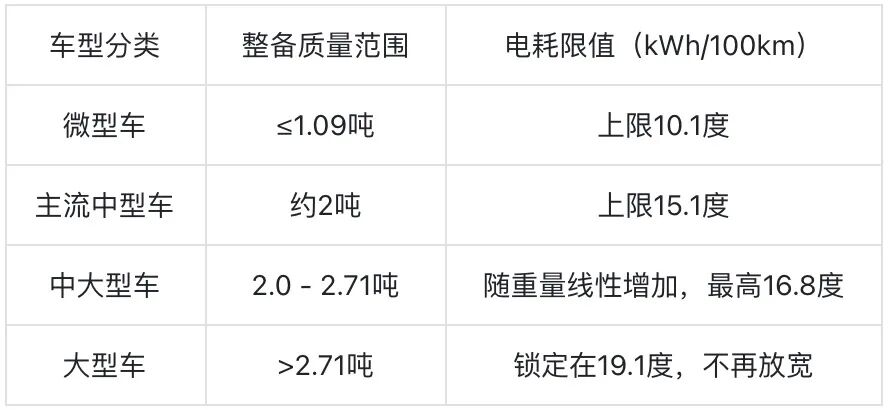
For mid-to-large-sized vehicles (2.0 - 2.71 tons), the energy consumption limit increases linearly with weight, up to a maximum of 16.8 kWh/100km; for large vehicles (>2.71 tons), the energy consumption limit is capped at 19.1 kWh/100km and does not increase further with vehicle weight.
For three-row-seat SUVs, MPVs, or four-wheel-drive models, the new national standard allows only a 3% relaxation in energy consumption limits; moreover, the weightings for three-row seats and four-wheel drive cannot be stacked—a four-wheel-drive seven-seat SUV can only enjoy a 3% relaxation once and cannot obtain more lenient indicators by stacking configurations.
According to industry estimates, nearly 40% of current models on the market cannot meet the requirements of the new standard. The National Standards Committee also predicts that after considering conservative potential for energy savings, about 10% of technologically backward models will be forced out of the market due to non-compliance.
Looking at the compliance rates by weight segment, data from the China Passenger Car Association for the third quarter of 2025 shows significant differentiation:
Microcars (≤1.09 tons): 100% compliant; Mainstream models (1.09 - 2.71 tons): 84% compliant; Large pure electric vehicles (2.71 tons): Only 55% compliant, with nearly half failing to meet the standards;
For the industry, 'GB 36980.1—2025' is not a 'suggestion for optimization' but a life-or-death threshold that must be crossed.
Don't panic. The national standard stipulates that January 1, 2028, is the deadline for the grace period for existing models, so there is still time.
However, it is essential to start now and systematically promote weight reduction from three levels:
Materials: Replace traditional components with lighter materials; hot-formed steel, aluminum alloys, magnesium alloys, and carbon fiber—the lighter, the better. Structure: Reduce the number of parts and redundant weight through integrated design; one-piece casting and multi-part integration can turn dozens of parts into one. Systems: Optimize electrical architecture and improve the efficiency of electric drive systems; 800V high-voltage platforms, silicon carbide power modules, and domain controller integration—these are not just technological gimmicks but effective means of weight reduction.
Which components will see the most weight reduction?
First is the body-in-white (BIW), which is the heaviest and sees the most significant reduction. The BIW accounts for a large proportion of the vehicle's weight. Hot-formed steel + aluminum alloys are currently the most mature solution, with hot-formed steel reducing weight by over 20% compared to traditional steel while offering higher strength. An all-aluminum body can reduce weight by about 40%.
However, the cost is indeed high. This is a trend and a barrier. Whoever takes the lead in layout (layout) will gain a competitive edge in the next-generation platform.
William Li of NIO recently mentioned in an interview that for new energy vehicles, every kilogram of weight reduction increases total costs by approximately 1,000 yuan, and the cost rises even higher as weight reduction continues.
Second is the battery, which is heavy but also has the most room for optimization.
The battery accounts for 30% - 40% of the vehicle's weight, making every kilogram of weight reduction highly valuable. Currently, the battery capacity of mainstream pure electric models generally reaches 100 kWh, with a lithium iron phosphate battery pack weighing about 600 kg.
CTC (cell-to-chassis) and CTP (cell-to-pack) are the mainstream directions—eliminating the battery pack's upper cover and module structure, directly integrating the cells into the chassis or battery pack, reducing system weight by 10% - 15%.
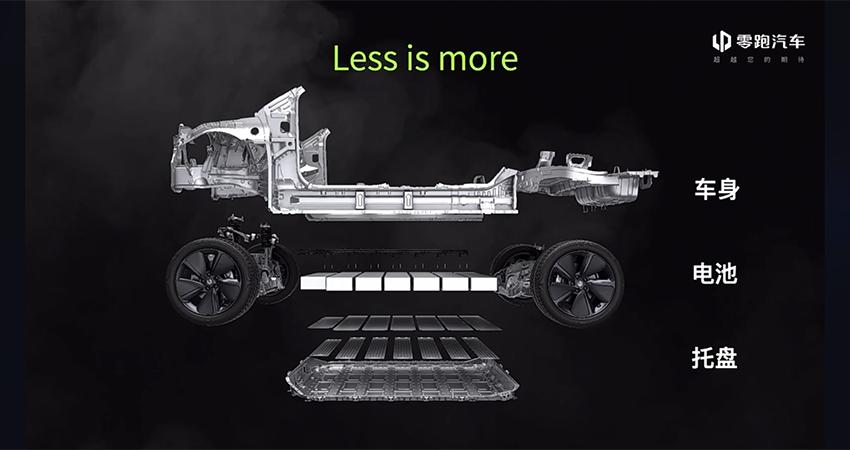
This also requires long-term R&D investment, but the returns are extremely significant.
Next are the electric drive and high-voltage accessories—small parts with big potential.
High-voltage cables: Weight reduction means cost reduction. Optimize wiring, shorten lengths, and use lightweight materials; silicon carbide (SiC): Efficient electric drive systems developed by companies like Huawei achieve over 87% efficiency, saving 8% to 12% more electricity than older models; 48V vehicle architecture: Compared to traditional 12V systems, the wiring harness alone can reduce weight by over 10 kg.
Other areas include the chassis and suspension.
Material substitution with aluminum: Aluminum alloy steering knuckles can reduce weight by 1.8 kg per piece; Process upgrades: One-piece cast rear floors reduce weight by 10% - 15%; Magnesium alloy breakthroughs: With a density only two-thirds that of aluminum alloys, magnesium alloys are moving from non-load-bearing parts to core structural components.
Electronic and electrical architecture. Tesla's approach is clear: domain controller integration + wiring harness simplification. A mainstream platform achieved a 40% increase in domain controller integration and a 30% reduction in wiring harness length through software-hardware co-design (collaborative design), reducing weight, costs, and electromagnetic interference.
Smart cockpit. Refrigerators, large TVs, comfortable sofas, multi-layer soundproof glass—these configurations do enhance the experience, but they also add significant weight. During the research and development phase, these can be appropriately streamlined or offered as modular options, reserving weight for truly core components.
Benefits of lightweighting: The data behind a 100 kg weight reduction
Industry estimates show that for every 100 kg of weight reduction, energy consumption per 100 kilometers can decrease by about 7.5%. For a model with an 800-kilometer range and an 800 kg battery pack, if lightweight materials reduce the battery pack's weight by 30%, the corresponding energy consumption optimization space is about 1.8 kWh/100km, leading to a significant reduction in lifecycle operating costs.
Weight reduction can also reduce battery costs.
According to industry estimates, a 100 kg weight reduction can reduce battery costs by 3,200 - 15,000 yuan, with the premium for lightweight materials mostly offset by battery cost savings. This means that lightweighting is not just 'spending more money' but a calculable investment.
For every 100 kg of weight reduction, energy consumption per 100 kilometers can decrease by about 7.5%. With battery capacity unchanged, 2-ton-class models can achieve an average range increase of about 7% through technological upgrades—a 500-kilometer range vehicle can easily exceed 535 kilometers.
Tires become more durable. Reduced vehicle weight means less tire wear, extending tire replacement intervals and lowering vehicle usage costs.
Braking becomes safer. A lighter body means shorter braking distances and better handling response. Emergency obstacle avoidance capabilities are enhanced, and overall active safety performance improves.
Compliance with regulations and policy benefits. Only compliant models can continue to enjoy purchase tax exemptions. Non-compliant models cannot even enter the tax exemption directory. For a 200,000-yuan-class electric vehicle, the vehicle purchase cost will increase by over 10,000 yuan.
Enhanced competitiveness. This is the most crucial aspect. Companies that proactively invest in lightweighting can not only shorten product launch cycles but also gain the initiative in the next industry shakeout. Technological leadership is the true moat.
Just explaining the principles is not intuitive enough.
To see which models the new national standard 'penalizes' and which it 'rewards,' a comparison of specific model data makes it clear.
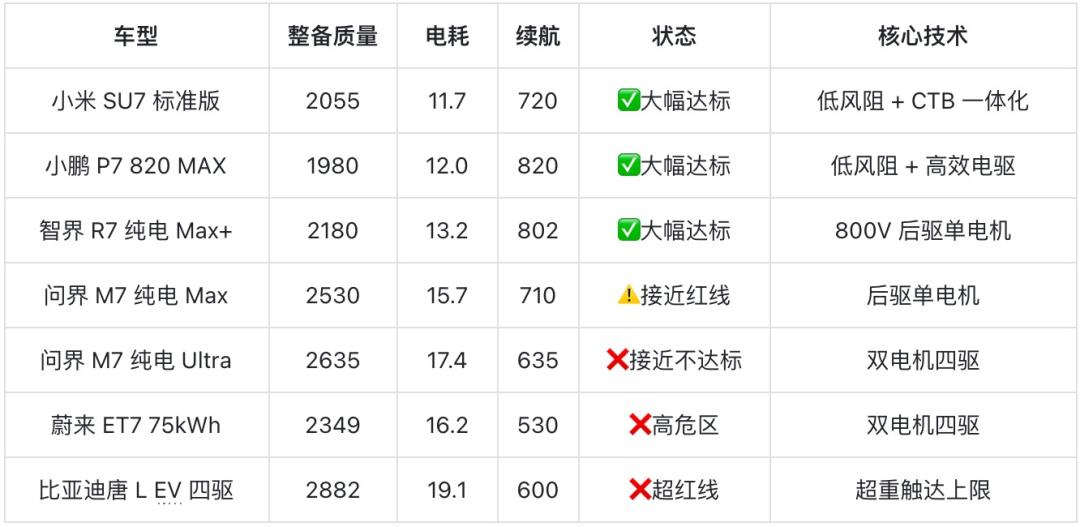 Comparison Table of Compliance Status for Typical Models
CLTC official data may have deviations, as actual energy consumption under winter and highway conditions is generally 3 - 5 kWh higher than the labeled values. Many models that appear compliant on paper may still exceed the limits in real-world usage.
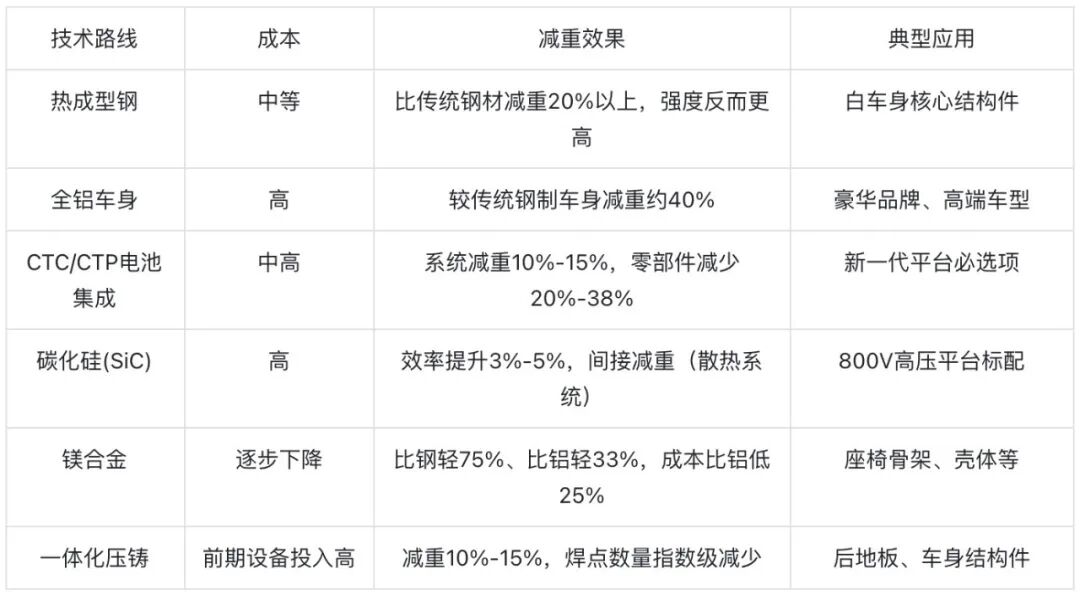 Cost-Benefit Comparison of Weight Reduction Technologies
Magnesium alloys are 75% lighter than steel and 33% lighter than aluminum, with costs 25% lower than aluminum. In February 2026, the magnesium-to-aluminum price ratio hit a 20-year low, making magnesium more cost-effective.
The common logic of top performers
The Xiaomi SU7 standard version has a curb weight of 2,055 kg and an energy consumption of only 11.7 kWh, benefiting from an ultra-low drag coefficient of 0.195Cd + CTB (cell-to-body) technology. The energy consumption for all three configurations is 12.3, 12.9, and 13.7 kWh, respectively, well below the 15.1 kWh red line for 2-ton-class vehicles.
The Zhijie R7 pure electric Max+ has a curb weight of 2,180 kg and an energy consumption of only 13.2 kWh, with a range of 802 kilometers. Its advantage comes from Huawei's DriveONE 800V high-voltage silicon carbide platform and the efficient layout of a rear-wheel-drive single motor.
Even within the same brand, there are significant differences
The Aito M7 shows a huge divergence within the same brand: the rear-wheel-drive long-range version (curb weight 2,530 kg, energy consumption 15.7 kWh) meets the standards, while the dual-motor four-wheel-drive version (curb weight 2,635 kg, energy consumption 17.4 kWh) is close to the red line. This shows that the four-wheel-drive configuration significantly penalizes energy consumption, and the 3% weighting is far from sufficient to cover the actual energy consumption increase.
Common weaknesses of models in the danger zone
The BYD Tang L EV four-wheel-drive version has a curb weight of 2,882 kg and an energy consumption of 19.1 kWh/100km—already touching the 19.1 kWh upper limit for large vehicles (>2.71 tons), with a high risk of non-compliance.
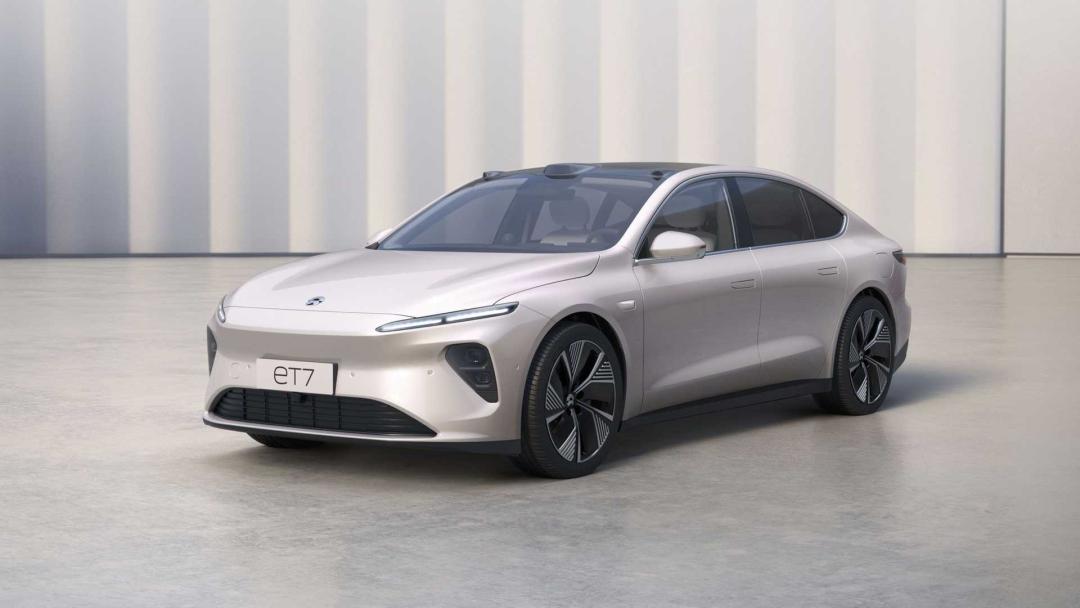
The NIO ET7 has an energy consumption of 16.2 kWh/100km. According to the linear formula, a curb weight of about 2,390 kg corresponds to a limit of approximately 16.0-16.2 kWh, placing it in a 'high-risk' zone.
The common shortcomings of these models are excessive reliance on large batteries for range, lack of 800V high-voltage platforms, and poor aerodynamic design. Their common predicament is that they must complete technological upgrades or facelifts before the end of the transition period in 2028; otherwise, they will not be salable.
In conclusion, GB 36980.1—2025 is not here to 'restrict' but to 'correct.' It ends the Extensive gameplay (rough approach) of 'stacking batteries for range' and initiates a refined competition of 'lightweighting + high efficiency.' It also reminds the entire industry: Don't forget the original purpose of cars as a means of transportation in the arms race for comfort configurations.
Once the industry returns to the right track, the outdated logic of 'weight equals sincerity' will give way to the new rule of 'efficiency equals strength.' Companies that invest heavily in energy efficiency optimization will go further than those who only know how to 'stack materials.'
For consumers, this means more energy-efficient, safer, and better-driving electric vehicles; for the industry, this is a long-overdue but necessary shakeout.
The countdown to 2028 has already begun. Are you ready?
Data sources for this article: MIIT announcements, GB 36980.1—2025 standard text, China Passenger Car Association statistics, and DCD data statistics.
-
![]()
Over 50% of Revenue Hinges on Yutong Optics! This Optical Equipment Manufacturer is Charging Towards an IPO
-
![]()
YOCO Optics Finalizes Industrial and Commercial Registration Update Post 160 Million Yuan Investment in Jiangfeng Biology, Securing 20% Stake to Emerge as Second-Largest Shareholder!
-
![]()
Google Market Value Plummets by $1.5 Trillion Overnight Following the Loss of Two Key Figures
-
![]()
Put an End to the EV 'Weight Gain Race'! Can Your Car Still Be Driven Under the New National Standards?
-
![]()
In 2026, 'AI Upstarts' Collectively Bet on World Models
-
![]()
【OFweek Weike Cup】Phoenix Optics Officially Participates in the 2026 Optical Industry Annual Innovation Product Award
-
![]()
Ford Ditches Mach-E: Will Its Billion-Dollar Electrification Drive Have to Start All Over Again?
-
![]()
【OFweek Weike Cup】Shuangli Hepu Officially Participates in the 2026 High-Growth Enterprise Award in the Optical Industry