The Complete Blueprint of Tsinghua-Affiliated Embodied AI 'Startup Dream Team': 7 Companies, 25 Billion in Funding, and the Dawn of an Era
 06/24 2026
 363
363
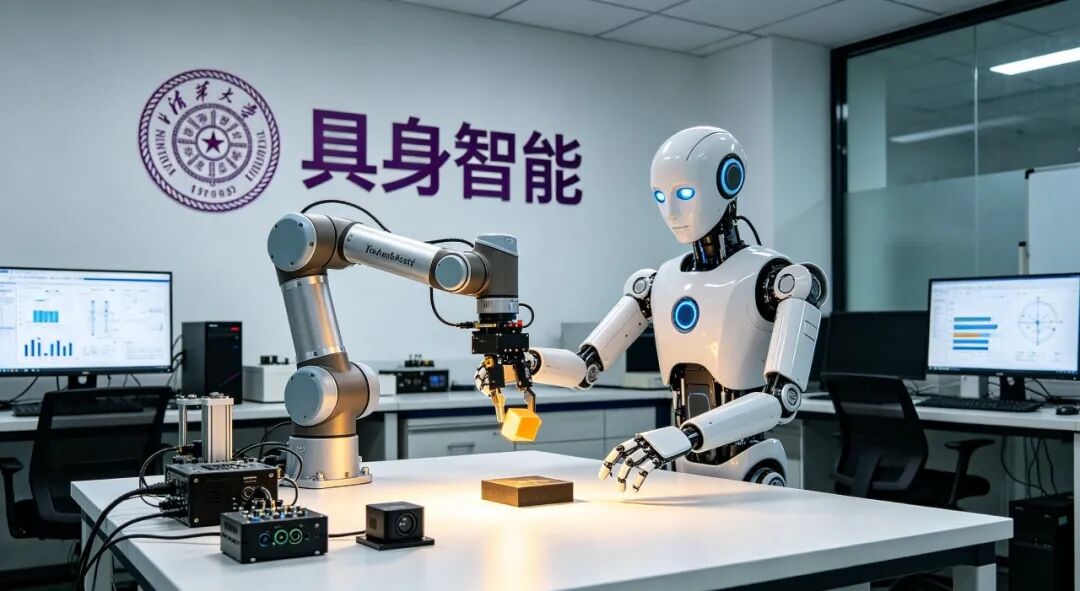
In China's embodied AI landscape, you can hardly bypass the Tsinghua-affiliated ecosystem.
In just two years from 2025 to 2026, Tsinghua-backed embodied AI startups have amassed over 25 billion yuan in cumulative funding. Xinghaitu raised nearly 2 billion yuan in its Series B+ round, Xingdong Jiyuan secured 300 million yuan in its Pre-A round, AtomBite.AI exceeded 500 million yuan in its Pre-A round, and ZeroPower Robotics landed mass production orders worth tens of millions—the density of Tsinghua-affiliated success stories is staggering.
From full-stack humanoid robots to 'robot brains,' and from restaurant kitchens to industrial production lines, Tsinghua entrepreneurs are collectively conquering every corner of the embodied AI space. Nearly every one of them has secured massive funding far exceeding industry averages.
Why Tsinghua? Why now? What does this mean for other entrepreneurs?
We've created a panoramic map—dissecting seven core companies one by one to reveal the complete landscape of Tsinghua's dominance in the embodied AI sector.
01 Dissecting the Seven Companies
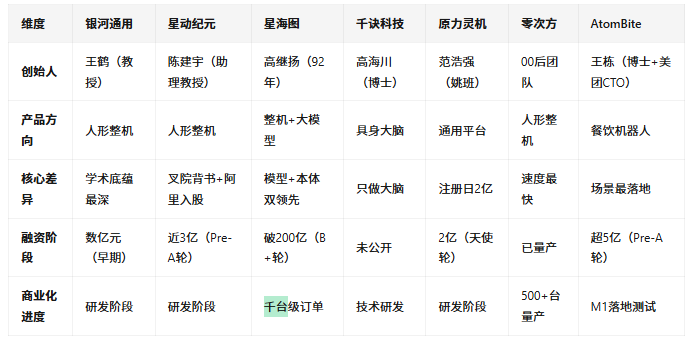
1. Galaxy General (Galbot) – The 'Academic Vanguard' Led by a Professor
Founder: Wang He, Tsinghua University professor and head of the Tsinghua Intelligent Robotics Lab.
Founded in 2023, Galaxy General is one of the pioneers in Tsinghua-affiliated embodied AI entrepreneurship. Professor Wang He's academic team has deep roots in robotics research, following a classic 'academia → technology → product' pathway. The company focuses on general-purpose humanoid robots and secured hundreds of millions of yuan in funding shortly after its inception.
Galaxy General boasts the deepest academic pedigree among all Tsinghua-affiliated companies, but general-purpose humanoid robots represent the most technologically complex and commercially uncertain direction in embodied AI. The journey from laboratory prototypes to commercial products capable of stable operation in complex real-world environments is a long and challenging engineering feat—a 'gauntlet' all academic-origin companies must overcome. The technology convergence timeline for this track (translation note: 'sàidào' meaning 'sector' or 'track') remains unclear. With over 50 global companies racing, the uncertainty of who will cross the finish line first is extremely high.
2. Xingdong Jiyuan (Robot Era) – The 'Prodigy Child' of Tsinghua's Institute for Interdisciplinary Information Sciences (IIIS)
Founder: Chen Jianyu, assistant professor at Tsinghua's Institute for Interdisciplinary Information Sciences.
Xingdong Jiyuan is the only humanoid robot company with direct equity ownership by Tsinghua University. Business registration information shows Tsinghua indirectly holds over 6% through Huakong Technology Transfer Co., Ltd.—an endorsement harder than any other.
Incubated by the IIIS founded by Turing Award winner Professor Yao Qizhi (also known as 'Yao Class'—China's academic Mecca for computer science), Chen Jianyu graduated from Tsinghua's Precision Instrumentation Department in 2015—one of China's earliest pioneers in bipedal humanoid robot research. Technologically, Xingdong Jiyuan developed ERA-42, an end-to-end native robot large model with multimodal perception and dynamic task planning capabilities, and launched the STAR1 humanoid robot. Its modular dexterous hand features 12 independently driven modules with high-resolution tactile and visual sensors. While boasting the highest density of algorithm talent among Tsinghua-affiliated companies, the core assumption that 'humanoids are the most effective carrier (translation note: 'zàitǐ' meaning 'vehicle' or 'platform') for achieving general AI' remains to be validated by the market.
Funding History: Angel round exceeding 100 million yuan (led by Legend Star) → Pre-A round nearing 300 million yuan (led by Alibaba, followed by Ceyuan Capital). Alibaba's entry is particularly noteworthy—signaling that industrial capital is betting real money on the commercialization prospects of humanoid robots.
3. Xinghaitu (AI Ocean) – The 'Fundraising Juggernaut' Valued at 20 Billion
Founder: Gao Jiyang, born in 1992, Tsinghua recommended student, PhD in Computer Vision from University of Southern California.
Xinghaitu holds the highest valuation and most aggressive funding trajectory among Tsinghua-affiliated embodied AI companies. With 1 billion yuan in Series B and nearly 2 billion yuan in Series B+—just 45 days apart—its valuation soared from 10 billion to 20 billion yuan.
Why is it worth this much?
Three keywords: 'Full-stack + Intelligent' dual-drive strategy.
From inception, Gao Jiyang established a clear strategy: 'No pure software, no pure hardware—full-stack integration with large models.' Three years later, on June 16, 2026, Xinghaitu unveiled its bipedal humanoid robot at its Global Developer Conference, officially closing the loop on this strategy—becoming China's only company with both top-tier models and top-tier robotic bodies. Xinghaitu is Tsinghua's 'top player' in embodied AI—leading in both models and hardware.
Technological highlights:
• Pioneered the global 'Fast-Slow Dual-System' VLA model architecture • Released the world's fastest world model, Fast-WAM (now open-source) • 3 VLA models with over 600,000 global downloads, powering NVIDIA, Ant Group, and other elite enterprises • Plans to build the world's largest real-world embodied dataset in 2026
Commercialization Progress: Focused on five vertical scenarios—material handling, grasping/placing, packaging, fabric folding, and equipment interconnection—with validation of thousand-unit order fulfillment.
Investor Lineup: Industrial capital (Walden International, Lens Technology, Xixin Investment) + Long-term funds (Xiuyuan Capital, Hongzhang Investment) + State-backed players (Financial Street Capital, Beijing Tech Innovation)—a 'sweepstakes' funding list.
4. Qianjue Technology – 'Brains Only, No Body'
Founder: Gao Haichuan, PhD in Automation from Tsinghua University.
While all other Tsinghua-affiliated companies rush toward full-stack humanoid robots, Qianjue Technology takes a radically different path—'no robot body, only robot brain.'
This positioning seems counterintuitive: If full-stack robots are the hottest trend, why not follow the crowd?
Qianjue's logic: The core bottleneck in embodied AI isn't hardware—it's the brain. If all startups build full-stack robots, then 'brains' themselves become the scarce commodity. They employ a brain-inspired partitioned architecture, mimicking the collaborative division of labor in different human brain regions to provide a universal intelligent operating system for robots.
While everyone else competes in full-stack hardware, Qianjue chose differentiation—'the operating system for embodied AI.' This path offers extremely high ceilings if successful, but could also be disrupted by advancing foundational model capabilities.
5. Yuanli Lingji – '200 Million on Registration Day' by a Yao Class Genius
Founder: Fan Haoqiang, Tsinghua Yao Class graduate and former core member of Megvii Technology.
Yuanli Lingji has a widely circulated funding story in the industry: On its registration day in 2024, the company secured 200 million yuan in angel round funding—without a perfect business plan or polished pitch decks. Investors bet on the founder's track record alone. Securing 200 million on registration day reflects both recognition of Fan Haoqiang's personal capabilities and the premium valuation capital places on 'Yao Class AI entrepreneurs.' For Yuanli Lingji, securing funding is just the first step—finding its differentiated ecological niche among giants and peers is the true challenge.
Fan Haoqiang represents the 'third generation' of Yao Class AI entrepreneurs: First generation—Yin Qi's Megvii (face recognition/AI 1.0); Third generation—Fan Haoqiang's Yuanli Lingji (embodied AI/AI 3.0). This lineage also includes Lou Tiancheng's Pony.ai (autonomous driving/AI 2.0), forming a clear generational inheritance (translation note: 'chuánchéng' meaning 'inheritance' or 'legacy') of Yao Class AI entrepreneurship.
6. ZeroPower Robotics – The Post-00s Youth Storm
Founder: Min Yuheng, born in 2000, graduated from Chongqing University's Mingyue Technology Innovation Experimental Class, then pursued a master's in AI at Tsinghua University. During his undergraduate robotics engineering studies, he built 20-30 robots before leading a team from Tsinghua's AI & Robot Lab to establish Hefei ZeroPower Robotics Co., Ltd., jointly incubated by Tsinghua University and the Jianghuai Frontier Technology Collaboration Innovation Center.
Founded in January 2025, ZeroPower achieved mass production by 2026—a timeline that screams speed. Focusing on full-stack humanoid robots, the company uses 'speed' as its core competitive strategy. With a young team, rapid decision-making, and strong execution, ZeroPower reached mass production within 18 months, producing over 500 units annually and securing tens-of-millions-yuan orders.
Speed is the post-00s team's greatest weapon, but humanoid robots ultimately compete on engineering capabilities and supply chain management—whether this young team can master these 'industrial lessons' will determine if they can evolve from 'small and fast' to 'big and strong.'
7. AtomBite.AI (Yuanjie Intelligence) – The Most Pragmatic Scene-Driven Player
Founder: Wang Dong, Tsinghua PhD in Computer Science and former CTO of Meituan Dianping. A protégé of Professor Zhang Bo, China's AI pioneer at Tsinghua University.
Among all Tsinghua-affiliated companies, AtomBite.AI's entrepreneurial path offers the starkest contrast. While others talk about 'changing the world with general-purpose humanoid robots,' Wang Dong returned to embodied AI from Meituan with a first focus on—takeout packaging robots. Among Tsinghua companies, AtomBite has the most 'hybrid' founder background (academia + industry), clearest commercial path, and most specific product definition. It represents a 'from industry, to industry' Tsinghua entrepreneurial style.
Less glamorous but logically impeccable: Food delivery packaging suffers from acute labor shortages and efficiency pain points. As former Meituan CTO, Wang Dong knows this industry inside out.
Clear product roadmap unlike any startup:
• M1: Takeout packaging robot (addressing core scene needs) • M2: Automated frying workstation (scene expansion) • M3: Kitchen command system (from single device to system) • Ultimate goal: Universal embodied robots for restaurant scenes
Pragmatic technology strategy: 'Large models handle edge cases, small models optimize high-frequency tasks,' using standardized tools to simplify complex physical operations. Flexible business model: Robotics-as-a-Service (RaaS) to lower adoption barriers.
Latest Progress: Pre-A round exceeding 500 million yuan, with a luxury team—data lead Dr. Li Tao, commercialization lead Li Haozhe, and a Tsinghua Computer Science postdoc as advisor.
02 Why Tsinghua?
A single university spawning so many high-valuation startups is no coincidence. It results from the simultaneous resonance of four chains.
Chain 1: Talent Pipeline – IIIS + Yao Class Talent Funnel
The Institute for Interdisciplinary Information Sciences (IIIS) and Yao Class founded by Professor Yao Qizhi represent China's densest concentration of AI talent. More critically, a culture of 'seniors mentoring juniors' exists—when Yao Class graduates succeed as entrepreneurs, later cohorts see 'this path works' and follow suit. The generational progression from Megvii to Pony.ai to Yuanli Lingji is crystal clear.
Chain 2: Technology Pipeline – Tsinghua's Robotics Academic Legacy
Tsinghua's Precision Instrumentation Department was among China's earliest bipedal humanoid robot researchers (Chen Jianyu graduated from here), while the Intelligent Robotics Lab (Wang He's team) serves as the academic wellspring for general-purpose humanoid robots. The Automation Department provides algorithmic support for 'robot brains.' From hardware to software to algorithms, Tsinghua covers nearly every technological link in embodied AI.
Chain 3: Capital Pipeline – Alumni Network Trust Premium
Tsinghua entrepreneurs secure funding more easily—not because they're necessarily smarter, but because investment institutions, alumni LPs, and industrial capital within the Tsinghua ecosystem form a natural trust network. Xingdong Jiyuan's funding rounds saw continuous follow-on investments from Tsinghua Holdings Tiancheng (a Tsinghua investment platform)—no accident.
Chain 4: Policy Pipeline – Beijing + Suzhou Dual-City Ecosystem
Beijing's Zhongguancun and Tsinghua Science Park provide talent and early-stage ecosystem support, while Xinghaitu's Suzhou landing taps into the Yangtze River Delta's embodied AI industrial cluster for supply chain and policy advantages. Tsinghua startups essentially leverage 'Beijing brains + Suzhou bodies' synergy.
The resonance of these four chains created Tsinghua's unprecedented concentrated outbreak (translation note: 'bàofā' meaning 'outbreak' or 'boom') in the embodied AI sector.
03 Implications for Entrepreneurs
After examining this landscape, the key question isn't 'How impressive is Tsinghua?' but 'Where are my opportunities here?'
First, The Sector Is Far From Saturated
Hundreds of companies worldwide pursue humanoid robots—a large number, but analogous to the 'hundred-startup battle' phase in new energy vehicles (NEVs), where the real shakeout hasn't begun. The current humanoid robot market resembles NEVs in 2014: Everyone knows the direction is right, but no one knows who will prevail. For entrepreneurs, this represents the best entry window.
Second, The Biggest Opportunities Lie in the Supply Chain, Not Full-Stack Hardware
A valuable analogy: In NEVs, the most profitable companies aren't automakers but CATL. Where is embodied AI's 'CATL'? Potential candidates include high-precision dexterous hands, joint modules, simulation platforms, or specialized sensors.
While Tsinghua companies dominate full-stack hardware in branding and funding, the supply chain—motors, reducers, sensors, AI chips, simulation software—offers massive opportunities for domestic substitution and product innovation at every link.
Third, What If You're Not Tsinghua-Affiliated?
Two viable paths:
• Follow AtomBite's model – Dominate vertical scenes. Wang Dong chose food delivery because he understands this domain better than anyone. You needn't compete head-on with Tsinghua in general-purpose humanoids; instead, redefine efficiency in your decade-deep industry using AI and robotics.
• Follow Qianjue's model – Deeply specialize in a technological link. Not everyone needs to build full-stack robots. If you can establish technological barriers in 'robot brains' or 'dexterous hands,' full-stack manufacturers become your clients.
Avoid head-to-head competition with Tsinghua in humanoid robot full-stack hardware—this isn't about courage, but resource allocation efficiency.
The collective emergence of Tsinghua's 'startup dream team' marks a historic milestone in China's embodied AI industrialization. Seven companies, 25 billion in funding, parallel exploration of multiple technological routes—this represents the most thrilling phase of a sector's growth from 0 to 1.
But beneath the prosperity lie undercurrents: How many of these companies will survive to IPO? When capital ebbs, who will be swimming naked? The 'hundred-startup battle' will ultimately favor those who 'make friends with time.'


-
![]()
China’s Palantir-like Firm Launches IPO, Spearheading the Enterprise Large-Model Decision Intelligence Sector
-
![]()
Insta360 Takes on DJI in Intense Head-to-Head Duel
-
![]()
Monthly Report | Online Market of Home Surveillance Cameras in May: Declining Sales Volume, Rising Prices, and Structural Upgrades Dominate
-
![]()
2026 618 Refrigerator and Washing Machine Market Review: Freezers Lead with Strong Growth, Refrigerators Face Slight Pressure, Washing Machines Demonstrate Strongest Resilience
-
Wang Aimin: In-Depth Analyses on Artificial Intelligence
-
![]()
France-Italy Micro Four-Wheeler Electrification Boom: A New Opportunity for China's Supply Chain to Go Global?
-
The Four Little Dragons of GPUs Enter the Scene, Cambricon is No Longer Alone
-
Why is CATL Partnering with Octopus Energy to Build a Battery-Swapping Network for Heavy-Duty Trucks in the UK?