Wang Aimin: In-Depth Analyses on Artificial Intelligence
 06/24 2026
 413
413
The contemporary landscape is saturated with references to AI; overlooking it seems to connote a lack of sophistication, and disengaging from it appears to suggest technological stagnation. This is a prevalent trend, so let's delve into it.
Firstly, let's consider intelligent manufacturing. Were our previous manufacturing systems devoid of intelligence? Certainly not; they primarily depended on human intellect to accomplish tasks. The intelligence we aim for in intelligent manufacturing, however, places greater emphasis on machine intelligence.
Next, let's explore machine intelligence. Artificial intelligence is undoubtedly a specific facet of machine intelligence, but it does not encompass its entirety. The capacity to distill human experience and knowledge and embody it in some form or medium within actual manufacturing processes, leading to automated reasoning and computational outcomes, is fundamentally a form of machine intelligence, or at least an expression of intelligence. The modeling and simulation we've developed across various academic disciplines, along with the diverse algorithms involved, are all concrete manifestations of machine intelligence.
Thirdly, let's discuss artificial intelligence itself. From a literal or broad standpoint, any intelligence that substitutes human labor should not be strictly defined as artificial intelligence. However, the current discourse surrounding artificial intelligence is quite narrow, often necessitating large models, machine learning, or intelligent agents. The author posits that these can be components of it, but they do not constitute its whole meaning.
Fourthly, let's examine industrial intelligence. In the industrial realm, technology should not be pursued for its own sake; all technologies are intended to address problems. Nevertheless, due to the infusion of narrow or constrained perspectives on artificial intelligence, the essence of many endeavors seems to be shifting. For instance, why must business challenges that can be resolved with traditional algorithms or methods be tackled using narrowly defined artificial intelligence approaches? Of course, I am not opposed to the technical methods and means of narrowly defined artificial intelligence; I have personally incorporated techniques such as reinforcement learning and multi-agent systems in my technical domain, such as APS. However, this necessitates a cost-benefit analysis, and greater attention should be directed towards business problems that traditional methods cannot adequately resolve. This should be the starting point.
Fifthly, let's talk about practical strategies. When companies of a certain scale undertake projects, the majority still rely on traditional methods. If they execute well, they have already undergone the rigorous testing and validation of real-world industrial business. Although these companies are also exploring technologies related to artificial intelligence, they have not fundamentally achieved transformative outcomes. Conversely, start-ups or small companies may advocate for 'switching lanes to overtake,' aspiring for disruptive growth. While the aspiration is certainly commendable, success in introducing and leveraging new artificial intelligence technologies is more probable if there is a substantial amount of experience and understanding accumulated and practiced in addressing real business challenges. Right? One cannot conquer the world without first tidying up one's own space. Can one simply label something as artificial intelligence without amassing and comprehending traditional methods?
………………………
That concludes our discussion for now. From my vantage point, I have consistently pursued artificial intelligence, including the narrowly defined technical methods and means mentioned earlier. However, there must be a hierarchy. Confronting real business problems in the industrial manufacturing sector or planning the hierarchical gradient of one's own scientific research development demands meticulous integration or synthesis.
These are merely my personal opinions, for reference only!
Author Information: Wang Aimin has long dedicated himself to technical research, system development, and implementation applications in areas such as APS and adaptive intelligent machining.
Author's Public Account: Intelligent Manufacturing Essays, feel free to follow.
-
![]()
Total Investment Hits Nearly 3.28 Billion! Goertek Launches Mass Production of 12-Inch Transparent Substrate Wafer for AR Glasses’ Micro-Nano Optical Components
-
![]()
Why Is This Precision Optical Film Leader Worth Reevaluating with a Tens of Millions Procurement?
-
![]()
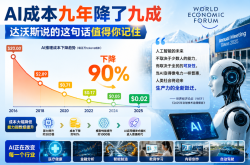
AI Costs Plummet by 90% Over Nine Years: Key Insights from Davos You Shouldn’t Miss
-
Doubao, Your Late-Night AI Companion, Now Eyes Profitability
-
![]()
SRC Empowers SEER Intelligence to Reach a Market Cap of Tens of Billions, Yet Fails to Sustain Profitability
-
![]()
China’s Embodied AI Industry Faces Fierce Domestic Competition, Making Overseas Expansion Essential for Survival
-
![]()
32.8 Billion Yuan Investment! Goertek’s 12-Inch AR Glasses Optical Wafer Base in Lingang Begins Operations
-
![]()
How Far is the All-New Li Auto L8 from Being the Best Five-Seat SUV with In-House Full-Stack Development?