AI Costs Plummet by 90% Over Nine Years: Key Insights from Davos You Shouldn’t Miss
 06/24 2026
 456
456
Author | Jiang Xu Dive Deeper into Financial Trends | BT Finance Data Insights
Main Text: 2,335 Characters | Estimated Reading Time: 9 Minutes
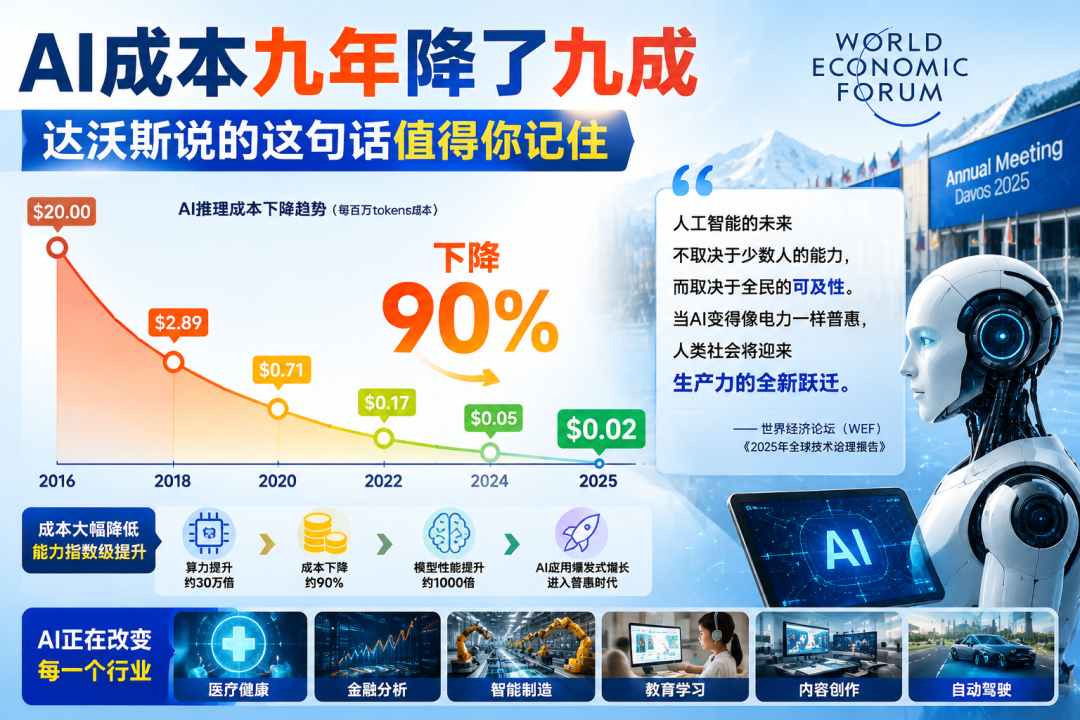
AI Costs Plummet by 90%
On June 23, 2026, the 17th Annual Meeting of the New Champions of the World Economic Forum wrapped up in Dalian. While the summit sparked a multitude of discussions, one particular statement stands out—far more than any policy declaration.
Guests at the meeting highlighted: Over the past few years, AI inference costs have plummeted by approximately 90%. (Source: Sina Finance, June 23, 2026)
Ninety percent.
You might dismiss this as mere tech news, irrelevant to your daily life.
However, if you’re involved in AI-related sectors within the A-share market or closely monitoring this field, this statement represents one of the most critical signals influencing your decisions to date—it’s just that few have explained its implications clearly.
As always, my goal is to help you grasp this topic comprehensively in a single read.
1. What Does Davos Mean by “AI Costs Have Dropped by 90%”?

Let’s start with a fundamental clarification.
Here, “AI costs” primarily refer to inference costs: the computational expenses incurred each time an AI model is activated to complete a task.
Around 2017, invoking an early large language model once cost roughly $20 per million characters. By 2026, the cost for the same scale of invocation had dropped to under $2 or even lower—a reduction of about 90%, marking a significant shift. (Source: Public industry estimates, synthesized from multiple institutional reports)
In simpler terms: In 2017, using AI to help you write an article would cost 20 yuan in computational power. By 2026, the same task would cost less than 2 yuan.
What does this change signify?
2. The Cost Curve Has Dropped, But Where Is the Real Barrier?
A guest at Davos made a statement I believe is the most precise judgment from this forum: AI costs have dropped by 90%, but the real barrier is no longer technical.
This statement warrants deeper analysis.
When the cost of a technology drops from “only giants can afford it” to “SMEs can give it a try,” the competitive focus of the entire industry shifts.
Initially, scarcity lay in “who has computing power,” so computing power suppliers and foundational model companies were the most profitable.
After costs dropped, scarcity shifted to “who has scenarios” and “who has data.” Computing power became infrastructure akin to water and electricity, with differentiation occurring at another level.
Over the past two years, AI computing power chains in the A-share market (optical modules, liquid-cooled servers, high-computing-power chips) have led in gains, driven by the logic of “who supplies infrastructure.”
But if Davos’s judgment is correct—that costs have largely stabilized and the next stage is about implementation—then the valuation logic for computing power chains will begin to diverge.
3. What Does This Mean for Asset Allocation?
The following is speculative reasoning for readers’ reference.
This doesn’t mean computing power chains will collapse; rather, their valuation premiums will shift from “scarcity premiums” to “performance delivery premiums.” Companies that secure sustained orders and visible revenue will continue to enjoy high valuations, while those whose logic no longer holds will begin to regress to the mean.
Meanwhile, the logic of the AI application layer will gradually emerge.
Which industries are first to perceive this “significant drop in AI costs”?
First Category: Content Production and Media. The cost of generating text, images, and videos has plummeted, rewriting the cost structures of content companies.
Second Category: Financial Services. AI substitution costs for insurance underwriting, credit risk control, and investment research reports have dropped to the threshold of commercial viability.
Third Category: AI in Manufacturing. Factory inspection, equipment predictive maintenance, and quality control—scenarios that were previously uneconomical due to high inference costs—now support commercial deployment.
The 2026 Top 10 Emerging Technologies released by Davos also validate this judgment: Out of 10 technologies, 8 directly act on physical systems: power grids, medicine, food, and robotics. AI is moving from screens to the physical world. (Source: Sina Finance, June 23, 2026)
4. A Framework You Can Take Away
I divide the decline in AI industry cost curves into three stages, corresponding to three asset pricing logics:
Stage 1: Scarcity (2020–2023). Computing power is scarce; the investment logic is “who produces computing power.” During this stage, computing power supply chains and foundational model companies enjoy the highest valuation premiums.
Stage 2: Penetration (2024–2026). Cost reductions enable more enterprises to adopt AI; the investment logic shifts from “supply-side” to “who has scenarios and data.” During this stage, large model companies begin to differentiate, and industry application companies emerge.
Stage 3: Infrastructure (post-2027, speculative). AI inference costs drop to near-zero levels; computing power becomes a hidden cost like electricity, and the investment logic fully shifts to “who can use AI to create products or services others cannot.”
We are currently around the transition from the end of Stage 1 to Stage 2.
Davos’s statement that “costs have dropped by 90%” refers to Stage 1 winding down.
5. Three Direct Impacts on A-Share Investors
Direct Audience: Investors holding AI computing power chain positions.
The question to revisit is: Are the revenue sources of the companies you hold derived from “enjoying scarcity-period dividends” or “have they established sustainable scenario barriers”? The former’s logic will weaken after the cost curve inflection point; the latter will remain valid.
Extended Audience: Investors holding manufacturing, financial, or healthcare stocks.
AI penetration in these industries is accelerating. Lower costs mean AI projects in these sectors are shifting from “pilots” to “large-scale deployment,” bringing not just conceptual valuations but real cost reductions and efficiency gains reflected in profit statements, not just PowerPoints.
Unexpected Expanded Audience: Investors focused on consumer internet.
Short video, e-commerce, and gaming industries have long used AI for content generation and personalized recommendations, but AI-generated video costs remained high until 2025. A 90% cost drop means these platforms’ content supply costs will compress further, enhancing their bargaining power with advertisers.
6. One Final Point
Davos is not an oracle; it describes a trend already underway, not a promise for the future.
AI costs dropping by 90% is a real numerical change. But whether it translates into corporate profits or asset prices depends on many variables: who finds truly commercially valuable scenarios, who can maintain profit margins amid cost competition, and who can survive before regulatory frameworks clarify.
This is a turning point from a “technology scarcity period” to a “scenario competition period.”
During scarcity, you buy infrastructure suppliers. During competition, you buy the successful implementers.
These two asset types may now both be in your watchlist, but they face entirely different logics going forward.
This isn’t a message to make you anxious. It’s an opportunity to rethink “which type you’re buying.”
Disclaimer: This article is for information sharing and industry analysis only and does not constitute any investment advice, investment analysis opinions, or trading solicitations. The market carries risks; invest cautiously. Anyone making investment decisions based on this article’s content bears the risks and gains or losses themselves; the author and publishing platform assume no legal liability. Content marked as “speculative” represents the author’s logical deductions from public information and does not represent official positions.
Copyright Notice: This article is an original piece by BT Finance and may not be used, reproduced, disseminated, or adapted without permission. Infringement will result in legal liability.


-
![]()
Total Investment Hits Nearly 3.28 Billion! Goertek Launches Mass Production of 12-Inch Transparent Substrate Wafer for AR Glasses’ Micro-Nano Optical Components
-
![]()
Why Is This Precision Optical Film Leader Worth Reevaluating with a Tens of Millions Procurement?
-
![]()
AI Costs Plummet by 90% Over Nine Years: Key Insights from Davos You Shouldn’t Miss
-
Doubao, Your Late-Night AI Companion, Now Eyes Profitability
-
![]()
SRC Empowers SEER Intelligence to Reach a Market Cap of Tens of Billions, Yet Fails to Sustain Profitability
-
![]()
China’s Embodied AI Industry Faces Fierce Domestic Competition, Making Overseas Expansion Essential for Survival
-
![]()
32.8 Billion Yuan Investment! Goertek’s 12-Inch AR Glasses Optical Wafer Base in Lingang Begins Operations
-
![]()
How Far is the All-New Li Auto L8 from Being the Best Five-Seat SUV with In-House Full-Stack Development?