Trillion-Yuan Zhipu: A Capital Illusion Built on a 2.67% Free Float
 06/25 2026
 393
393
Produced by | AIoT Island
On June 22, Zhipu (02513.HK) hit an intraday high of HK$2,980, briefly pushing its market cap to a record HK$1.33 trillion. Since its IPO at HK$116.2 on January 8, the stock has surged over 2,400% in less than six and a half months.
Contrasting with its trillion-yuan market cap are stark figures: 2025 revenue of RMB 724 million, a net loss of RMB 4.718 billion (6.5 yuan lost for every 1 yuan earned), R&D spending of RMB 3.18 billion (4.4x revenue), and an operating cash flow of -RMB 2.246 billion.
A company losing RMB 4.7 billion annually with just RMB 700 million in revenue now exceeds the combined market caps of Meituan, Xiaomi, JD.com, and Baidu. Is this a premature pricing of a technological revolution or a capital game driven by an extreme share structure?
I. The Domino Effect of the Capital Game
To understand Zhipu's trillion-yuan valuation, we must start with its share structure—the first domino in this capital game.
Zhipu's IPO issued 37.4195 million H-shares, representing ~8.4% of total shares. Of these, 11 cornerstone investors subscribed to 25.68 million shares (~5.76% of total), subject to a six-month lock-up.
Only 11.7379 million H-shares (~2.67% of total) were freely tradable in the secondary market within six months of listing.
At the IPO price of HK$116.2, the tradable float on listing day was worth just HK$1.36–1.5 billion. By June 22, daily turnover reached ~HK$9.3 billion, implying a turnover rate exceeding 600%—meaning minimal buying pressure could trigger extreme volatility in a trillion-yuan market cap.
Multiple market observers likened this to a "pump-and-dump" scheme.
Some analysts argue Zhipu's float is fully controlled by manipulators. A manipulator with ~HK$5 billion could crash its valuation by 99% or double it again within the trillion-yuan range—a standard publicity stunt (speculative) model for Hong Kong-listed stocks in recent years.
An ultra-low float, combined with multiple catalysts, created a perfect storm for the stock's surge.
Catalyst 1: Technological Breakthroughs and Geopolitical Shifts.
On June 12, the U.S. Department of Commerce cited "national security" to bar foreign nationals from accessing Anthropic's Claude Fable 5 and Mythos 5, affecting overseas users, foreign workers in the U.S., and even non-American engineers on Anthropic's own R&D team. Developers worldwide faced sudden disruptions.
Almost immediately, Zhipu announced GLM-5.2 on June 13, which officially launched and went open-source on June 17.
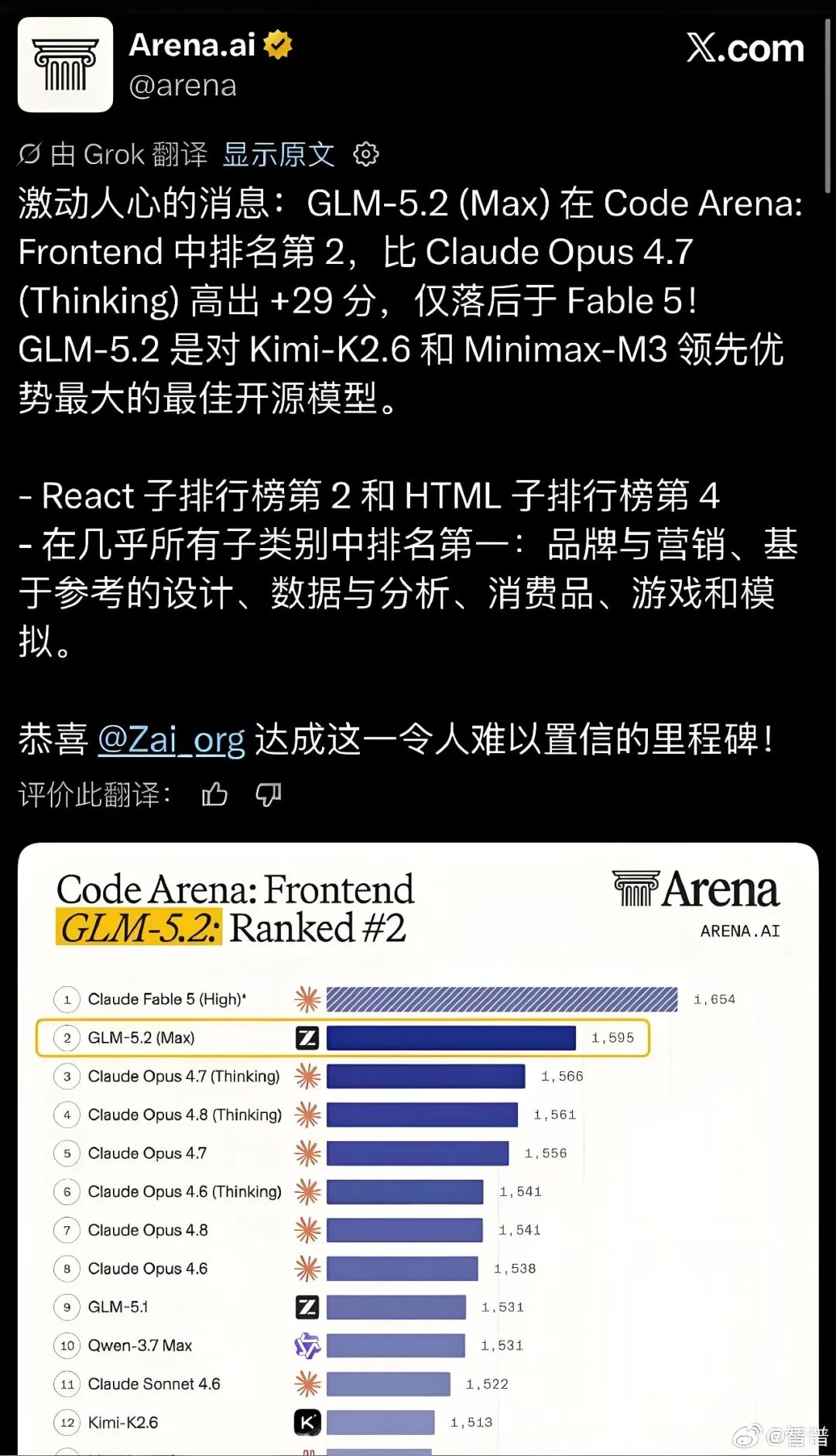
On Code Arena, GLM-5.2 scored 1,595, ranking second overall and first among globally available models. In the FrontierSWE long-form programming benchmark, it scored 74.4, trailing Anthropic Opus 4.8 by just 1 percentage point. On Design Arena, it ranked first globally.
Catalyst 2: Index Inclusion and Southbound Capital Inflows.
On June 8, Zhipu was added to the Hang Seng Tech Index and Stock Connect, opening doors to passive index funds and mainland investors.
Catalyst 3: Social Media Frenzy.
Elon Musk commented on X that China's large language models might "catch up to top-tier levels by Q1 2027." Zhipu founder Tang Jie quickly responded, "It won't take that long."
This exchange went viral, stamping Zhipu as a "first-tier contender" in global AI leadership discourse.
The biggest variable in this game is lock-up expiration.
On July 8, 25.68 million cornerstone shares will become tradable, expanding the free float from <3% to ~8%. At the June 22 intraday high, these shares were worth ~HK$73.4 billion. By January 8, 2027, ~40% of shares will be unlocked.
Jefferies warned in a report: Arbitrage flows and the July 8 lock-up expiration (~6% of shares) could trigger volatility. Declining programming benchmark scores reveal fragile competitive moats. The firm maintained a "Hold" rating with a target price of HK$912.55 (~40% below current levels).
History rarely repeats, but it often rhymes.
On June 30, 2022, SenseTime's stock plummeted 46.77% on lock-up expiration, erasing HK$90 billion in market cap in a single day. Like Zhipu, SenseTime faced a "high valuation + low float + massive lock-up release" structure. Zhipu risks following the same path.
On June 24, Bloomberg reported that Zhipu is considering a Hong Kong share placement to raise billions of dollars, far exceeding its IPO proceeds of US$558 million. The placement could occur as early as July, right after the July 8 lock-up expiration.
Raising capital at a 2,000% stock surge aligns with "quasi-manipulator" tactics: exploiting scarcity premiums to maximize fundraising at peak market sentiment, leaving retail investors holding the bag.
Admittedly, this capital frenzy has created China's largest AI wealth boom.
Founder Tang Jie's direct 26.8353 million shares are worth ~RMB 56 billion at a trillion-yuan valuation. Zhipu's market cap is 17x SenseTime's, equivalent to the combined latest valuations of DeepSeek, Moonshot AI, and two Step-by-Step AI startups.
As of late June 2025, Zhipu employed 883 staff, with 452 (51.2%) holding shares.
Two employee share platforms, Huihui and Zhideng, own 7.53% and 5.18% of the company, respectively, worth over HK$80 billion and HK$55 billion. Assuming Huihui holds 9.8% via 426 employees, average paper wealth nears RMB 200 million per person.
However, these are just paper gains. Many of the 452 employee shareholders hold locked-up shares.
II. Why Traditional Valuations Fail
Zhipu's trillion-yuan valuation defies all traditional frameworks—all three major tools have collapsed.
P/E Ratio: With a 2025 net loss of RMB 4.718 billion, the P/E is negative and meaningless.
P/S Ratio: At RMB 724 million in revenue, the P/S exceeds 1,200x. Even using optimistic 2026 revenue forecasts (~US$640 million), the P/S remains >1,280x—compared to OpenAI's ~56x.
Applying OpenAI's multiple, Zhipu's "reasonable" valuation would be US$4–8 billion (~3–6% of current levels).
DCF Valuation: For an unprofitable, cash-flow-negative company, any future cash flow assumptions are speculative.
Yet the market assigns a trillion-yuan valuation using a new coordinate system:
1. P/ARR (Market Cap / Annualized Recurring Revenue): The mainstream (mainstream) metric for LLM firms.
As of March 2026, Zhipu's MaaS platform had an ARR of ~RMB 1.7 billion (~US$250 million). At a trillion-yuan valuation, the P/ARR is ~94–120x. Anthropic's P/ARR is just ~20x.
The market bets Zhipu's ARR growth will justify this premium.
2. Forward P/S: Banks value Zhipu using projected revenue years ahead. Bloomberg consensus expects 2026–2028 revenue to reach RMB 3.072 billion, RMB 7.214 billion, and RMB 17.379 billion.
3. Benchmarking Narrative: The market directly compares Zhipu to Anthropic, valued at US$965 billion with an ARR of ~US$47 billion.
However, this requires extreme growth. Back-calculating from Anthropic's P/ARR, Zhipu's trillion-yuan valuation implies an ARR of ~US$4 billion, requiring a 150% monthly growth rate from March to June—highly unrealistic.
Under the "First Chinese AGI Stock + Scarce Float + Capital Concentration" narrative, Zhipu can trade at a trillion yuan because this is not normal valuation—it's bubble/option valuation.
The market is betting not on Zhipu's present, but on whether it can become China's core AI infrastructure gateway.
Multiple brokers note that scarcity underpins 2026 LLM valuations.
The trifecta of scarce global LLM listings, pre-lock-up expiration, and low liquidity justifies Zhipu's narrative. But scarcity premiums are the most fragile. Once lock-ups end, competitors list, and global AI super-IPOs (Anthropic, OpenAI, etc.) emerge, Zhipu's "uniqueness" will vanish.
III. The AI Ownership Crisis for Internet Giants
The most disruptive aspect of Zhipu's valuation is not its own size, but the shadow it casts.
On June 22, Tencent's market cap was ~HK$3.94 trillion, Alibaba's ~HK$1.97 trillion, Xiaomi's ~HK$612.9 billion, Meituan's ~HK$444.5 billion, and JD.com's ~HK$302.9 billion.
A company with RMB 700 million in annual revenue and losses now equals ~60% of Alibaba's valuation and exceeds Xiaomi, Meituan, and JD.com combined.
Internet giants face an existential dilemma: Who owns AI?
LLMs shift interaction logic from "connection" to "agency." Users no longer open mini-programs or browse official accounts—they tell AI assistants to book flights, making AI the intermediary layer.
Tencent's connector value dilutes; Alibaba's e-commerce empire risks having its "search-compare-purchase" chain bypassed; ByteDance's recommendation algorithms may lose their moat to semantic understanding.
Fortunately, big tech's AI businesses haven't collapsed—just diluted. Their AI assets are drowned in giant conglomerates.
For example, Tencent's AI capabilities are strong, but its P/E is <15x because the market values "Tencent," not "Tencent AI."
This reveals Zhipu's greatest paradox: Internet giants' AI businesses dwarf Zhipu in scale and profitability but lack its valuation premium because they're not pure-play LLM stocks.
Thus, an "AI spin-off boom" is underway.
Kuaishou's Kling AI launched a spin-off with a pre-money valuation of US$18 billion (~67% of its parent's market cap); ByteDance introduced a "Doubao Independent Equity Incentive Plan"; Alibaba established Token Foundry; Baidu's Kunlunxin filed for a Hong Kong IPO.
Big tech admits through actions: AI assets only unlock full value after independence.
Once these spin-offs complete, Zhipu will face direct competition from big tech's AI subsidiaries. Its "uniqueness" will face unprecedented challenges.
More concerning are unlisted AI players also challenging Zhipu's "uniqueness."
DeepSeek's Series A valuation exceeds US$50 billion; Moonshot AI (Kimi) raised >US$3.9 billion in six months, soaring to a US$30 billion valuation.
Zhipu's trillion-yuan valuation, in a way, probes the ceiling for China's AI industry. The higher the ceiling, the more financing (fundraising) space later entrants have.
IV. Bubble or New Paradigm?
Zhipu is not alone. The entire AI sector is experiencing similar valuation inflation, with clear bubble traits.
Cambricon's A-share market cap nears RMB 1 trillion; DeepSeek's Series A valuation exceeds US$50 billion; Moonshot AI's valuation surged to US$30 billion (6x in six months); Kuaishou's Kling spin-off is valued at US$18 billion.
Chen Yuetian, Partner at Hurricane Capital, analyzed: "Now is not the time for financial models... The entire AI sector is overvalued. It depends on whether later market participants will pay these premiums."
If the market shifts from valuing tech stocks as growth plays to utility plays, a sharp revaluation will follow.
However, bubbles don't imply no real demand.
After Zhipu's API prices rose 83% in Q1 2026, usage still grew 400%. Its MaaS platform ARR surged from RMB 28 million to RMB 1.7 billion in 12 months (60x growth). Nine of China's top 10 internet firms use GLM models.
The question is: Can real demand translate to sustainable profits?
Zhipu's cloud API gross margin is just 18.9%, with an overall gross margin of 41%. If it can't convert technical advantages into high-margin revenue, the trillion-yuan valuation will collapse.
Some developers, using self-built model usage trackers, found that GLM-5.2 Max consumes several times more tokens and duration than peer models for similar task success rates, indicating inefficiency in "figuring out what to do."
Zhipu's valuation essentially bets on a low-probability event: It can sustain first-tier status in global AI competition and convert technical edges into sustainable commercial returns.
The stakes couldn't be higher.
V. Conclusion
Zhipu's trillion-yuan valuation results from four resonance (resonating) factors: technological breakthroughs, geopolitical windows, market narratives, and extreme capital structures.
It reflects both a genuine technological leap and a capital frenzy amplified by low liquidity and sentiment.
"Fundamentally, it may not be worth it, but strategically, it absolutely is," summarized Xiong Weiming, Founding Partner at China Growth Capital, aptly capturing Zhipu's dilemma.
As Keynes wrote in *The General Theory* (1936): "Stock markets are not about judging 'who is the prettiest,' but 'who most people think is the prettiest.'"
The market trades not truth, but the story most believe.
Whether Zhipu emerges as the final winner may take years to clarify. But the validation process begins on July 8, the first day of lock-up expiration.
Cover Source: *The Goldfinger*
Header Image Source: Zhipu Official Weibo
 Copyright AIoT Island. Unauthorized reproduction prohibited.
-
![]()
Expert Interpretation of New Policy Combination: Activating the Trillion-Dollar Automotive Aftermarket
-
![]()
Doubao Goes 'Professional', Volcano Rolls the Snowball
-
AI: No Sign of a Bubble!
-
![]()
NVIDIA-Backed AI Unicorn Secures $1.5 Billion Funding: Revenue Soars 2000%
-
![]()
Doubao Pro is Here: How Can Seed 2.1 Be Integrated into Real Processes?
-
"PCB Juice" Sees Four Consecutive Declines: Even Computing Power Material Suppliers Can't Lift This "Old Stock"
-
![]()
Potential 'Seismic Shift' in the U.S. TV Industry: Competition Shifts from Hardware Sales to Traffic Entry Points
-
![]()
Audi A6L's Defense in the Luxury C-Class Market: Following Huawei's Smart Driving Integration, Is Large-Battery HEV the Next Move?