Audi A6L's Defense in the Luxury C-Class Market: Following Huawei's Smart Driving Integration, Is Large-Battery HEV the Next Move?
 06/25 2026
 339
339
Despite a shrinking market, luxury fuel-powered vehicles remain a crucial segment. For BBA (BMW, Benz, Audi), reclaiming ground in this traditionally advantageous market is vital. Now, by collaborating with Huawei, the Audi A6L has taken the lead in launching a strategic defense in the luxury C-class vehicle market.
The luxury C-class vehicle market holds significant importance for BBA. For an extended period, the German trio of Audi A6L, Mercedes-Benz E-Class, and BMW 5 Series, collectively known as the "56E" Legion, have firmly dominated the top tier of domestic luxury C-class sedans, serving as benchmark products in this segment. Among them, the Audi A6L reached its sales zenith in 2023, with a total of 181,800 units delivered throughout the year, firmly establishing itself at the forefront of the segment. From 2024 to 2025, despite a decline in overall sales due to shifts in the industry landscape, annual delivery volumes have remained stable at over 170,000 units.
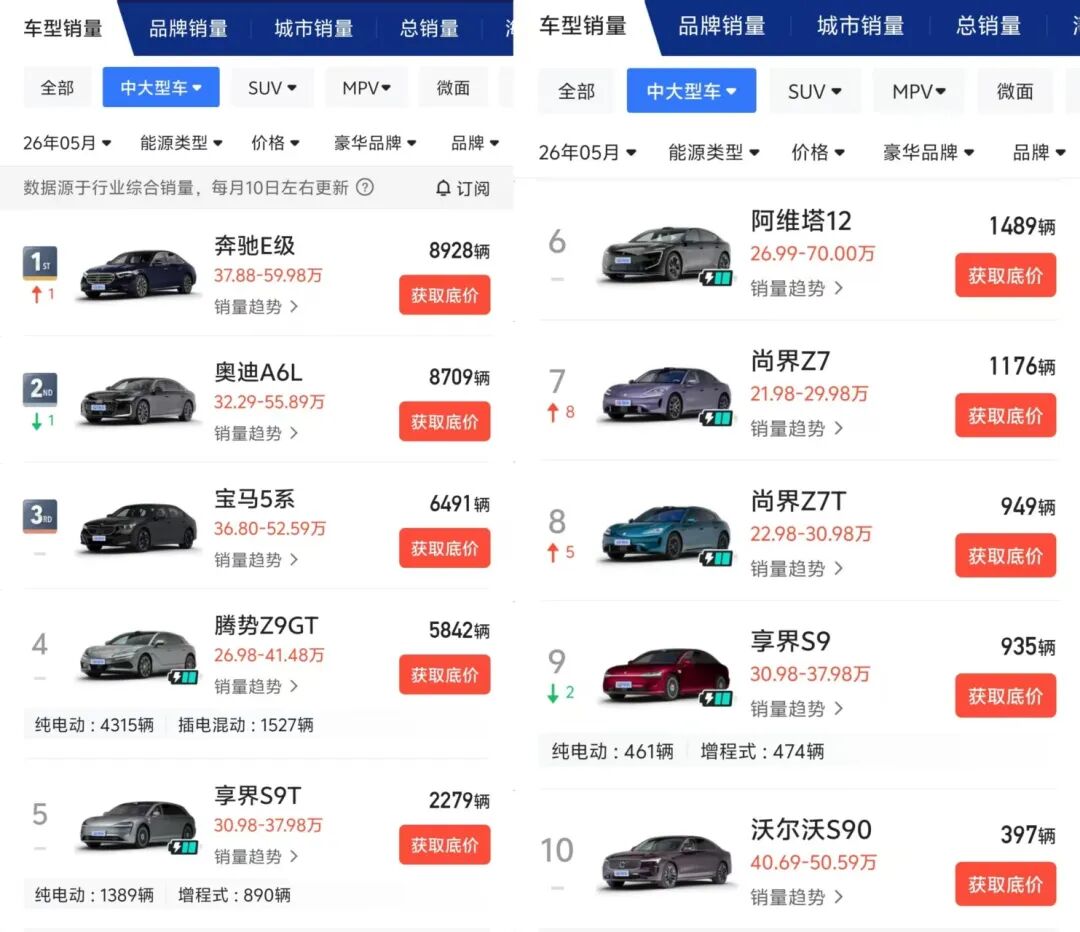
Even in the face of sustained pressure from high-end new energy models like the Denza Z9 GT, Xiangjie S9, and Avita 12, the 56E models have consistently maintained their positions in the top three in segment sales, boasting a solid user base. This resilience is underpinned by years of luxury brand recognition, a user base in the tens of millions, market-proven mechanical quality, and a mature nationwide after-sales maintenance system—all formidable barriers that new energy brands are unlikely to surmount in the short term.
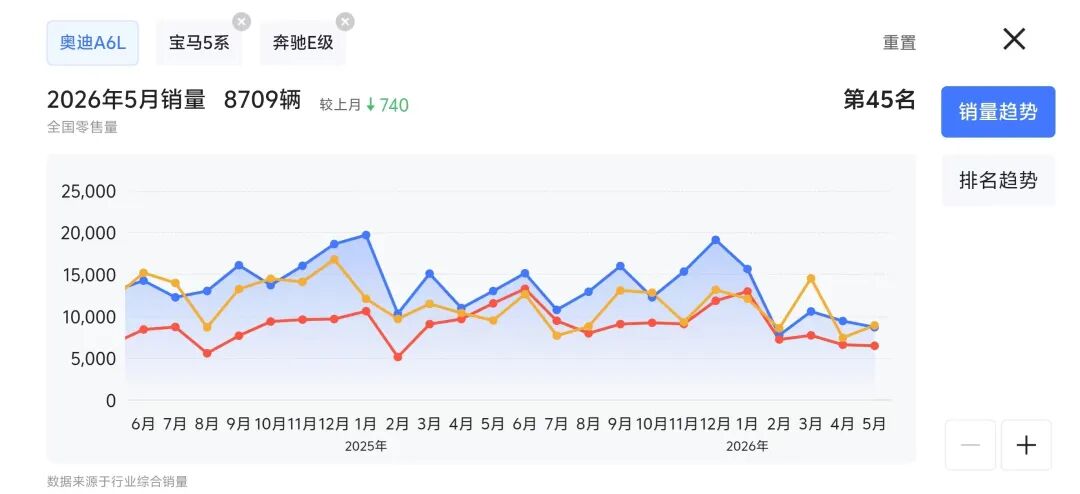
However, looking at the market longitudinally, the appeal of the "56E" has significantly waned. Data indicates that in May of this year, the Audi A6L sold only 8,709 units, marking a year-on-year decline of 33.15%. From January to May, cumulative sales reached 52,158 units, a year-on-year decrease of 24.6%, with an average monthly sales volume of just over 10,000 units, a substantial drop from the peak monthly average of 15,000 units in 2023. The A6L is not alone in facing this pressure; its peers, the Mercedes-Benz E-Class and BMW 5 Series, also failed to surpass the 10,000-unit mark in May, with sales of 8,928 and 6,491 units, respectively. Traditional luxury C-class vehicles as a whole are experiencing downward pressure.
The core reason for the sales decline is that, with the deepening of the automotive electrification transformation, domestic consumers' definition of "luxury" has evolved. In the fuel vehicle era, criteria for evaluating luxury included brand heritage, handling quality, interior materials, spatial comfort, and driving quietness. However, in the intelligent electric era, sincere pricing, seamless intelligent cockpit experiences, and comprehensive advanced intelligent driving capabilities have also been incorporated into the core evaluation system for luxury vehicles, even becoming "basic must-haves" for many tech-savvy users when purchasing a car.
In terms of intelligence, the gap between traditional luxury fuel vehicles and leading new energy brands is almost generational. Limitations in the underlying electronic architecture, slow functional iteration speeds, and a lack of localized scenario adaptation have caused the intelligent experiences of traditional luxury vehicles to gradually fall out of sync with the needs of domestic users.
01 Huawei's Smart Driving System Joins the Fray! Audi A6L Seeks "External Support" to Defend Its Position
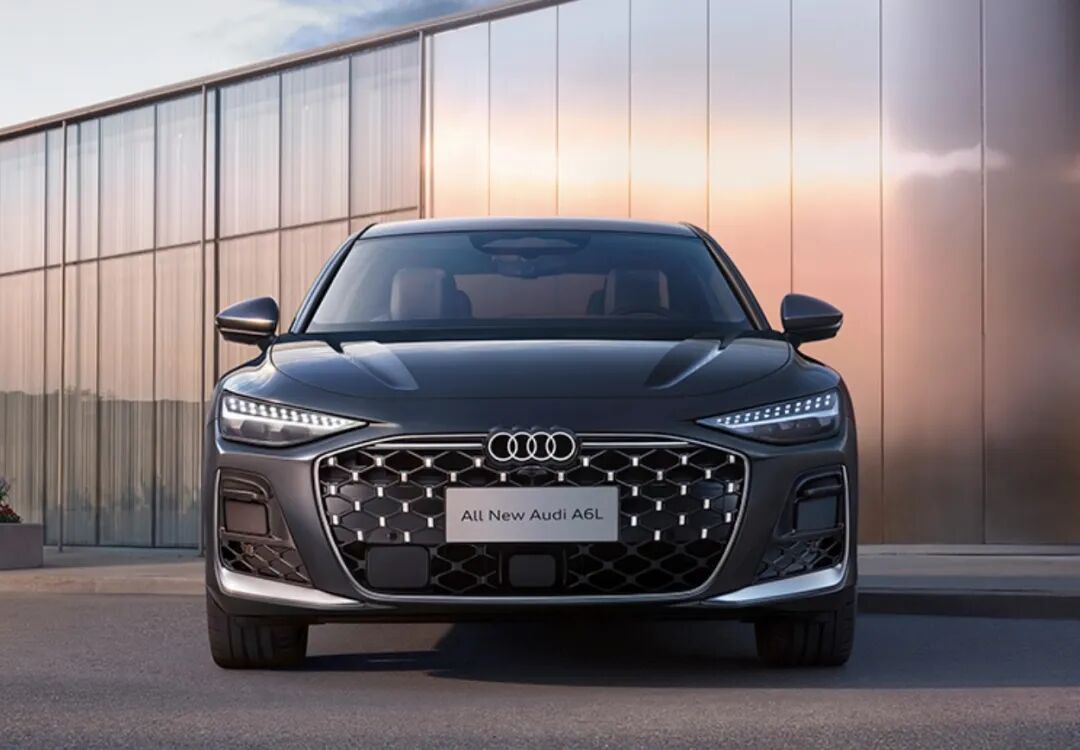
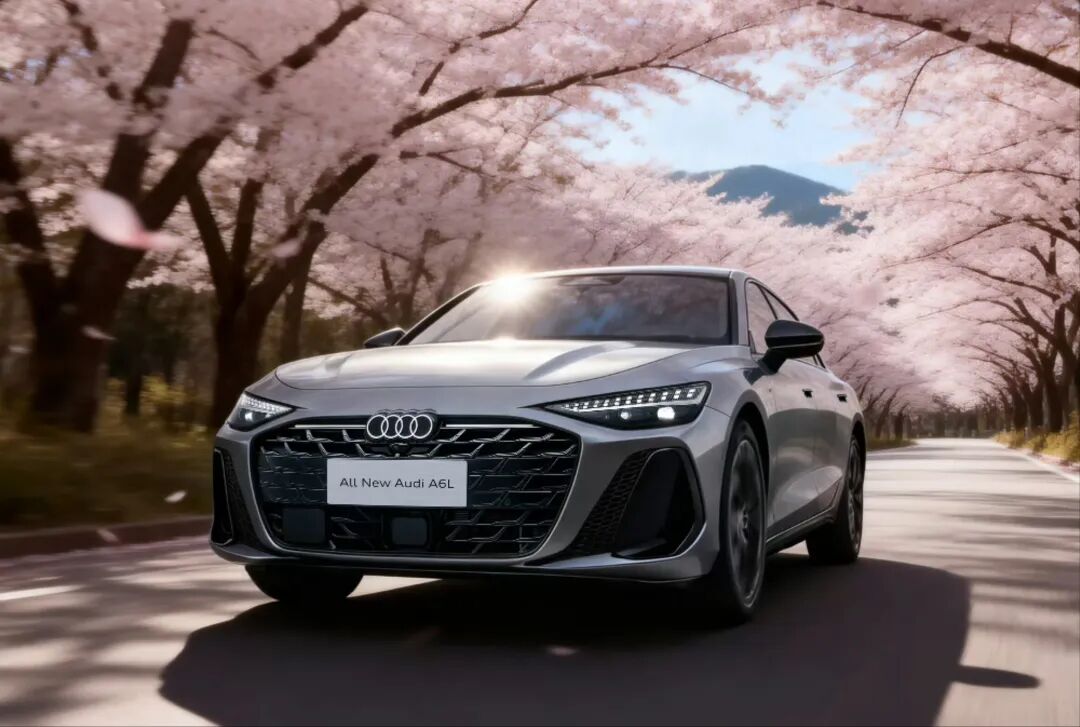
As the definition of luxury is being redefined, how can traditional luxury fuel vehicles maintain their appeal? The Audi A6L exemplifies BBA's latest strategy. In late March of this year, the all-new Audi A6L, built on Audi's new PPC fuel vehicle platform, was officially launched. The vehicle completely overhauled its original pricing logic, starting at 322,900 yuan, representing a significant price reduction compared to the previous model.
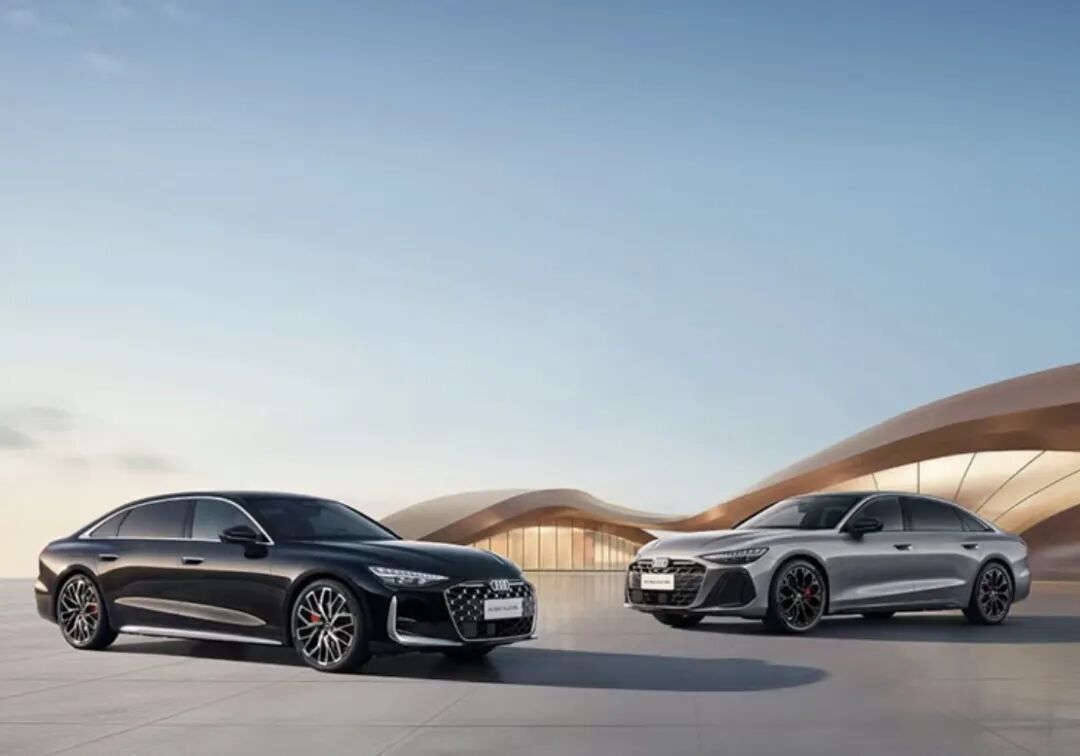
Secondly, in terms of product offerings, the vehicle's space has been further enhanced, and it provides three powertrain options, including a low-power 2.0T engine, a high-power 2.0T engine, and a premium 3.0T V6 engine, to cater to different users' needs for power performance while preserving the driving texture advantages of fuel vehicles. Finally, there is an intelligence upgrade, with Huawei's Qiankun Smart Driving system coming on board. The vehicle is equipped with dual 192-line LiDAR, six millimeter-wave radars, twelve ultrasonic radars, and thirteen cameras, supporting full-scenario smart driving functions such as highway NOA, urban NOA without maps, 3-kilometer cross-layer memory parking, 120-meter tracked reversing, and remote parking. The optional price for this system is 26,800 yuan.
As the first BBA brand to integrate Huawei's advanced smart driving technology into its main fuel vehicle model, Audi has adopted a pragmatic approach of "collaboration for speed" in catching up on intelligence, directly introducing the most mature and user-recognized smart driving solution in the Chinese market to swiftly narrow the experience gap with new energy models. Prior to the A6L, Audi also offered Huawei Qiankun Smart Driving versions of the A5L and A5L Sportback.
Clearly, Audi believes that providing a smart driving experience on fuel vehicles that is on par with that of new energy vehicles is key to regaining market recognition. However, is this sufficient for fuel vehicles? We believe that the combination of fuel vehicles and smart driving can only delay the situation, not truly reverse it.
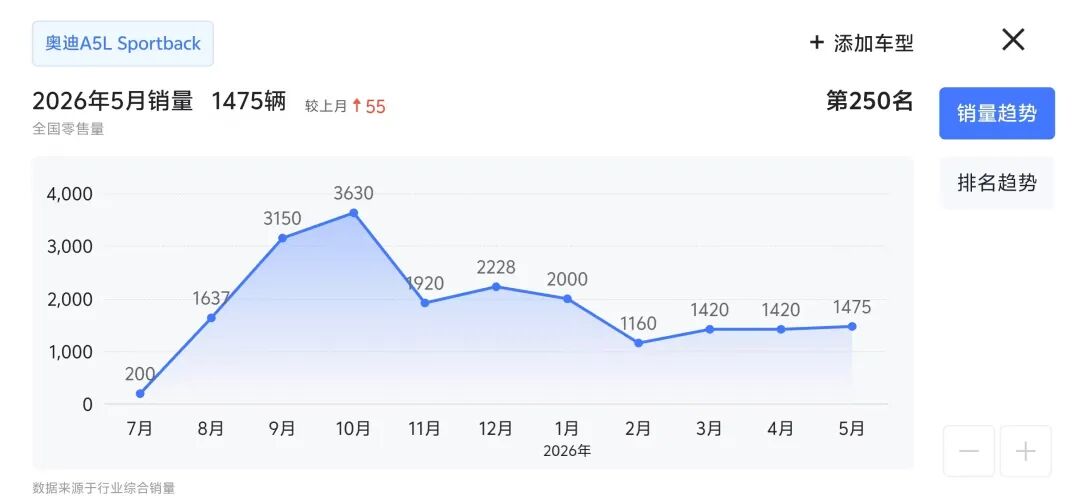
We can examine the sales performance of several already-launched "intelligent fuel vehicles" for reference. The first is the Audi A5L Sportback, whose Intelligent Leader and Intelligent Glory models (including quattro versions) are equipped with Huawei Qiankun Smart Driving. The model was launched in early August last year, with over 8,000 orders secured within 12 hours of launch, showcasing strong initial order performance. It reached a peak monthly sales volume of 3,630 units in October last year but has gradually declined since then, currently stabilizing at a monthly sales volume of 1,500-3,000 units. The "smart driving" feature in the top tier has not driven phenomenal sales growth.
In addition, over the past two years, Volkswagen has introduced the "smartest fuel vehicles," with several models from FAW-Volkswagen and SAIC-Volkswagen, such as the Passat, Magotan, Tiguan, and Tayron, equipped with advanced driver-assistance systems jointly developed by Volkswagen and Zoyu Technology. However, from terminal sales data, the impact of intelligence upgrades on driving new sales growth has been limited.
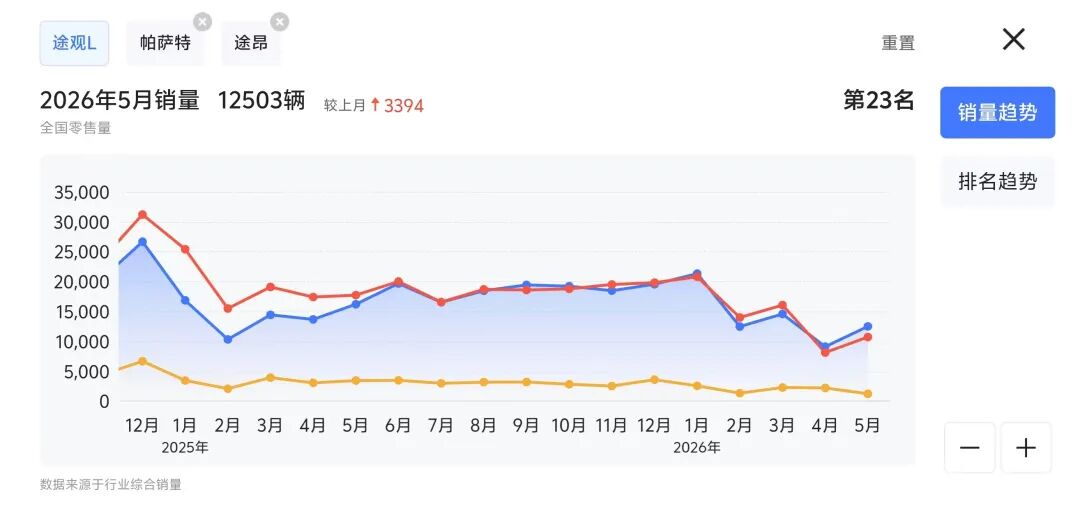
The sales performance of these intelligent fuel vehicles indicates, to a certain extent, that the core value of intelligence in fuel vehicles is merely to fill the intelligence gap, retaining potential users who were originally inclined to purchase but switched to new energy vehicles due to insufficient smart driving experiences. It delays the loss of existing users and buys more time for their own electrification transformation, but it cannot completely reverse the market trend.
02 Is Large-Battery HEV the New Direction for Luxury Fuel Vehicles?
The reasons behind this are straightforward. The integration of smart driving and intelligent cockpits has filled the generational gap in intelligent experiences for fuel vehicles. However, the experience gap between fuel vehicles and pure electric vehicles extends beyond intelligence. Intelligent fuel vehicles and intelligent electric vehicles differ in multiple dimensions: smoothness at low speeds, convenience of parking electricity usage, operating costs, and scenario expansion capabilities, all of which are inherent shortcomings of fuel vehicles. To bridge these gaps, fuel vehicles must have new evolutionary solutions. Currently, large-battery HEVs are seen as a promising direction.
Since this year, independent automakers such as Geely, Chery, and Great Wall have all launched large-battery HEV solutions. Unlike traditional small-battery HEVs (with battery capacities generally ranging from 1-2kWh), large-battery HEVs have mainstream battery capacities in the 4.8kWh-5.5kWh range—some automakers even position battery capacities at 7kWh. This battery capacity setting brings three intuitive benefits:
First, HEVs do not require charging and can simultaneously offer an electric vehicle experience, including significantly improved smoothness and reduced fuel consumption, and can even support external discharge functions. With a 5kWh battery setting, a typical product can have a pure electric range of 20-30km. Secondly, this amount of electricity fully supports the power needs of advanced intelligence, achieving true parity with new energy vehicles in terms of intelligence. Thirdly, safety is improved. A small 5kWh battery reduces the risk of spontaneous combustion due to collisions, making it a very good choice for conservative customers.
Current BBA fuel vehicle models generally come equipped with 48V mild hybrid systems, with battery capacities of only 0.5kWh-1kWh, which can only assist with starting and coasting start-stop functions, providing limited improvements to the driving experience. At the same time, due to their higher cost, they also have poor maintenance economy, making them difficult to promote on a large scale. Subsequent efforts to promote the popularization of large-battery HEVs will also face such challenges.
From a policy environment perspective, the path of large-battery HEVs also has certain feasibility. On the one hand, new energy vehicle purchase tax subsidies are gradually being phased out, narrowing the cost gap between fuel vehicles and new energy vehicles, providing some benefit to the fuel vehicle market. On the other hand, recent discussions in mainstream media about "vehicle overweight" issues have led to widespread speculation that relevant tax policies linked to vehicle weight may be introduced in the future. Compared to pure electric models and large-battery extended-range models, large-battery HEVs have a smaller increase in body weight while offering significant experience improvements, achieving a better balance between policy and user experience.
-
![]()
Can Computers, Despite Daily Price Hikes, Still Be a Viable Purchase?
-
![]()
January-June Auto Stocks' 'Resilience Ranking': Geely Alone Posts Gains, Six Plummet Over 40%, One Tumbles 54.5% | Mirror Pro
-
![]()
China’s Public Charging Market: Didi Charging, Teld, and Yunkuai Take the Lead
-
![]()
The First Year of AI-Native Mid-Year Shopping Festival: Technology Reconstructs Human-Product Matching for 618
-
![]()
Micron has released its financial report, showing revenues of $41.5 billion, a 74% increase quarter-over-quarter, with a gross margin of 84.6%. The company provided both short-term and long-term guida
-
![]()
Expert Interpretation of New Policy Combination: Activating the Trillion-Dollar Automotive Aftermarket
-
![]()
Doubao Goes 'Professional', Volcano Rolls the Snowball
-
AI: No Sign of a Bubble!