Doubao Pro is Here: How Can Seed 2.1 Be Integrated into Real Processes?
 06/25 2026
 339
339

Author: Lin Yi Editor: Zhongdian Jun
Just now, Doubao Pro was officially launched.
One notable change is the addition of an office task mode within Doubao:
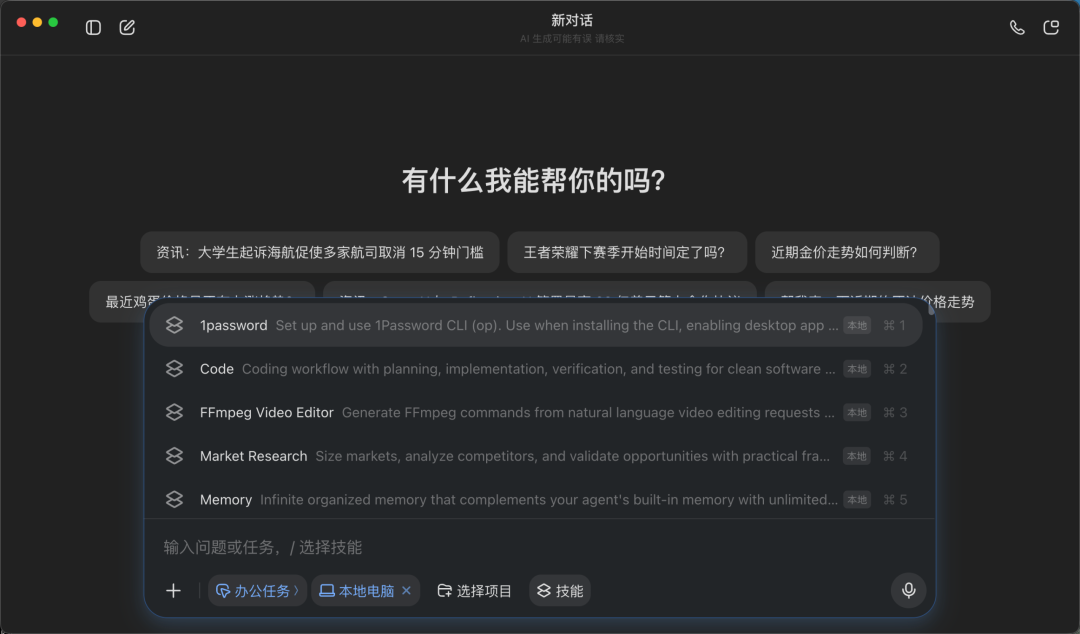
From the interface, a new "Local Computer" entry has been added next to the input box, along with a Skills menu. Users can connect it to their local computers and select different skills based on tasks, such as coding, market research, video processing, and memory management.
This setup is somewhat similar to Harness for general users.
The model is responsible for understanding goals, breaking down tasks, and generating solutions; the office task mode connects to local computers, browsers, local files, and Skills, encapsulating the model's capabilities into executable workflows.
However, beyond just adding a feature, this move signifies that "Doubao's subscription model" has finally been settled. The question now shifts to: when prices are truly on the table, what will users be willing to pay for?
According to Doubao's announced pricing, there are currently three tiers: Standard Plan at RMB 68/month for continuous subscription, Enhanced Plan at RMB 200/month for continuous subscription, and Premium Plan at RMB 500/month for continuous subscription.
Of course, benefits are tiered accordingly. For example, the Standard Plan includes all benefits of the free version, access to the 2.1 Pro model, and over five times the usage quotas for office tasks and expert modes compared to the free version; the Enhanced Plan offers four times the quotas of the Standard Plan; the Premium Plan provides ten times the quotas of the Standard Plan; free users can still experience the office task mode with access to the 2.1 Turbo model.
When we combine these pieces of information, the profile of Doubao Pro becomes clearer. The free version continues to cover most daily needs, while the Pro version targets higher-frequency, more intensive, and more complex productivity scenarios, bundling the 2.1 Pro model, higher quotas, and office task mode together.
However, regarding whether "Seed 2.1 is worth the price," we cannot just look at the monthly fee and model rankings. A user-centric judgment standard should be whether it can handle complex tasks, save users several hours, and advance a workflow that originally required switching between files, browsers, spreadsheets, code, and PPTs to a deliverable result.
Because if Doubao Pro only sells "more usage," the RMB 500 tier would have limited appeal. If it corresponds to a stronger model, higher quotas, more tool integrations, and an office environment capable of running tasks, it enters the framework of productivity tools.
At this point, "worth it or not" is no longer just a matter of model parameters. What users are paying for is not just the 2.1 Pro model and higher quotas but a task execution environment that can mobilize tools, invoke skills, process local files, and generate visual results.
Three Practical Tests to Assess Its Delivery Capability
To verify the usability of Doubao Pro, we designed three types of tests:
The first type involves e-commerce business data analysis to see if it can transform a raw transaction table into a business briefing readable by management.
The second type is urban traffic data visualization to see if it can break down a vague requirement into coding tasks and deliver a runnable tool.
The third type is NVIDIA's annual report analysis to see if it can extract facts, organize structures, and distinguish between company statements and media judgments from a long PDF.
These three tasks correspond to three things professional users care more about: understanding data, writing tools, and processing complex materials.
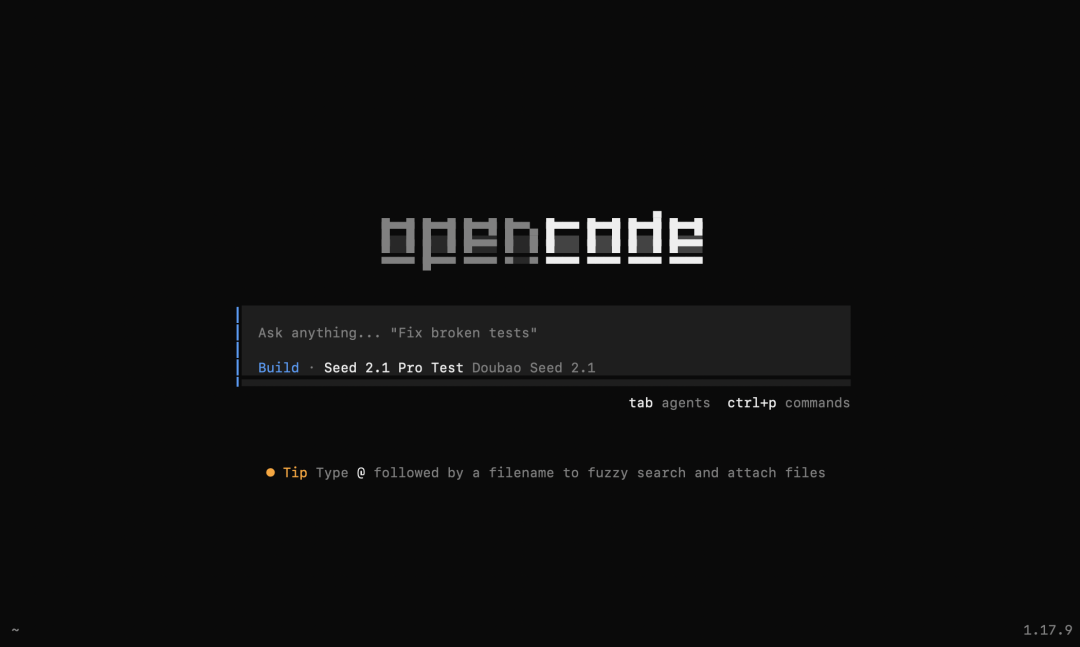
For the first two cases, we used the Seed 2.1 Pro API in OpenCode to complete the tests. For the third case, we used the 2.1 Turbo model in Doubao's desktop office task mode, which is also available to free users.
Test 1: Can E-commerce Data Be Transformed into a Business Briefing?
For the first task, we provided Seed 2.1 Pro with a publicly available Online Retail e-commerce transaction dataset and asked it to start with data quality checks and complete GMV, order count, average order value, repeat customer, country distribution, product ranking, and RFM customer segmentation analyses.
The prompt was as follows:
Plain Text You are an e-commerce business analyst. Based on the Online Retail transaction data I uploaded, complete a business analysis briefing for management. Requirements: 1. First, check data quality, including missing values, outliers, return orders, negative quantities, and abnormal unit prices; 2. Calculate overall GMV, order count, average order value, number of purchasing customers, and number of repeat customers; 3. Analyze GMV trends by month, identify months with significant growth or decline, and attempt to explain possible reasons; 4. Analyze sales contributions by country and identify high-potential markets outside the UK; 5. Analyze Top 20 sales and Top 20 volume products by commodity and explain the differences; 6. Perform a simple RFM customer segmentation, dividing customers into high-value, potential, dormant, and low-value customers; 7. Based on the analysis results, provide five actionable business recommendations; 8. Finally, summarize in 300 words: If you were the head of this e-commerce company, what are the top three things you should prioritize next month? Note: - All conclusions must be data-driven; - Do not conflate correlation with causation; - If the data is insufficient to support a judgment, clearly state so.
The challenge of this task lies not in calculating a few metrics but in the model's awareness that the data is not clean.

From the output, Seed 2.1 Pro provided a relatively complete visual business analysis report, containing not only key metric cards but also data quality overviews, monthly GMV trends, customer segmentation, Top product analyses, country and market distributions, and final action recommendations.
Moreover, it did not stop at summarizing data. For example, in the data cleaning section, it highlighted issues like returns, missing values, and outliers separately; in customer analysis, it segmented customers into different tiers and further provided operational recommendations; in product analysis, it distinguished between top sales and top volume products to avoid conflating "selling more" with "selling expensive."
This type of output already has a clear sense of delivery. It may not directly replace a business analyst, but for operations, marketing, or managers who frequently use AI, it can already link "data cleaning—metric calculation—business judgment" into a complete chain.
Test 2: Can New York Taxi Data Be Used to Create a Runnable Tool?
The second task is closer to AI Coding.
We asked Seed 2.1 Pro to generate a locally runnable data analysis tool based on New York Yellow Taxi trip data. It needed to read data, clean outliers, generate charts, summarize them into an HTML report, and provide running methods and test cases.
The prompt was as follows:
Markdown Please help me create a locally runnable data analysis tool based on the uploaded New York Yellow Taxi trip data. Requirements: 1. Implement in Python; 2. Read the CSV or Parquet file I uploaded; 3. Automatically complete basic data cleaning, including: - Deleting data where pickup time is later than dropoff time; - Deleting trips with distance ≤ 0; - Deleting fares < 0; - Deleting obviously abnormal ultra-long trips; 4. Output the following analysis results: - Hourly order volume changes; - Hourly average fare changes; - Order share by payment method; - Relationship between trip distance and fare; - Weekday vs. weekend order volume comparison; 5. Generate at least four visual charts; 6. Summarize results into an HTML report; 7. Include clear code comments; 8. First provide the implementation thought process (idea), then output the complete code; 9. Finally, provide running methods and dependency installation commands; 10. Design three test cases to check if the code can handle empty files, missing fields, and abnormal data. Note: - Do not assume fields are always complete; - If field names differ from expectations, first list the field names, then provide a compatibility solution; - The code should be as runnable as possible for non-professional programmers.
From the final output, Seed 2.1 Pro provided a "NYC Yellow Taxi Trips" visual report.
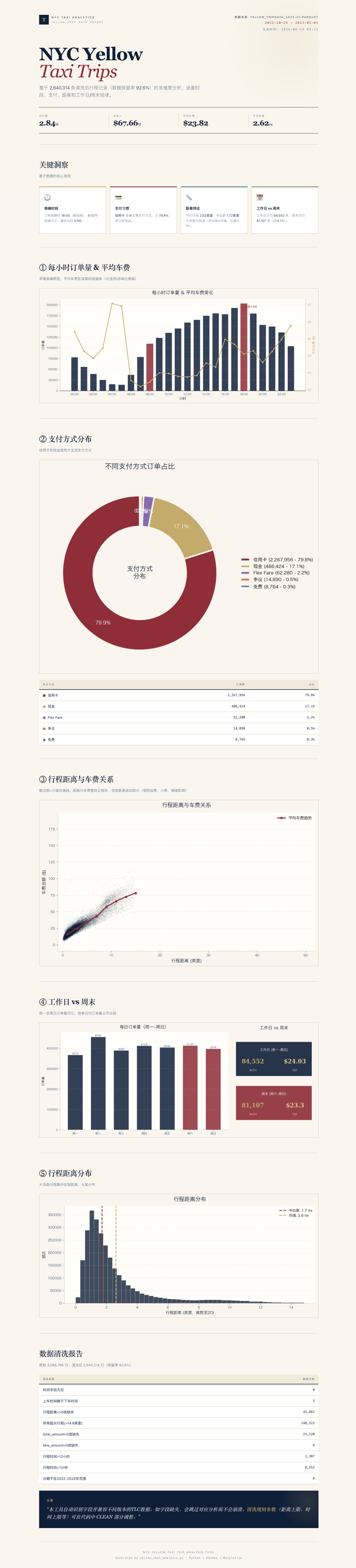
The report provided overview metrics at the top, including total trips, total revenue, average fare, and average trip distance; below, it expanded into different dimensional analyses, covering hourly order volume and average fare changes, payment method order shares, trip distance vs. fare relationships, weekday vs. weekend comparisons, trip distance distributions, and data cleaning records.
Notably, the payment method chart showed that card payments accounted for nearly 80%; in the weekday vs. weekend comparison, the report also broke down metrics like order volume and average fare. Most importantly, the report retained data cleaning explanations at the bottom, telling users which data was excluded and which abnormalities were handled.
Of course, such tools still require manual debugging. When real data fields are complex, field name adaptations, chart styles, and abnormal thresholds may need further adjustments. However, from this result, Seed 2.1 Pro has already pushed a vague requirement to the brink of usability.
This is precisely the type of problem the Pro version should solve. They are important but fragmented, common but not worth major efforts.
Test 3: Can NVIDIA's Annual Report Be Processed Through the Office Task Mode?
For the third task, we switched to Doubao's desktop office task mode and used 2.1 Turbo to process NVIDIA's 2025 Annual Report.
This time, we examined its ability to handle long PDFs, including extracting financial data, dissecting business segments, organizing risk factors, and generating a Chinese-language industry analysis briefing. We further asked it to output visual results and place them on the local desktop.
The prompt was as follows:
Plain Text You are a tech industry analyst. Based on the uploaded NVIDIA 2025 Annual Report, output an industry analysis briefing for Chinese readers. Requirements: 1. Summarize NVIDIA's core changes this fiscal year in 200 words; 2. Extract key financial metrics like revenue, gross margin, net profit, and R&D investment, and organize them into a table; 3. Analyze changes in major business segments like Data Center, Gaming, Professional Visualization, and Automotive; 4. Identify 3-5 core growth drivers mentioned in the report; 5. Identify 3-5 major risk factors mentioned in the report; 6. Analyze the impact of AI infrastructure demand on NVIDIA's business, combining annual report content; 7. Output a topic suggestion for "how to approach this if writing a Chinese tech media article"; 8. List at least five factual risk points to remind against overstating certain judgments; 9. Finally, write a 500-word Chinese summary with natural expression, not like a financial report translation. Note: - All numbers must come from the annual report Original text (original text); - If a certain data point is not found, write "not found in the document" and do not fabricate; - Do not add information outside the annual report; - Do not treat company statements as third-party conclusions directly.
The value of the office task mode is not just reflected in how well it answers in the dialog box but also in its ability to connect to local computers, read local files, and convert analysis results into deliverable files.
From the process, the office task mode first understands the requirements, plans to generate a desktop HTML or Markdown report, and then executes the save based on authorized local paths. This type of experience already approaches AI running an office workflow for the user.
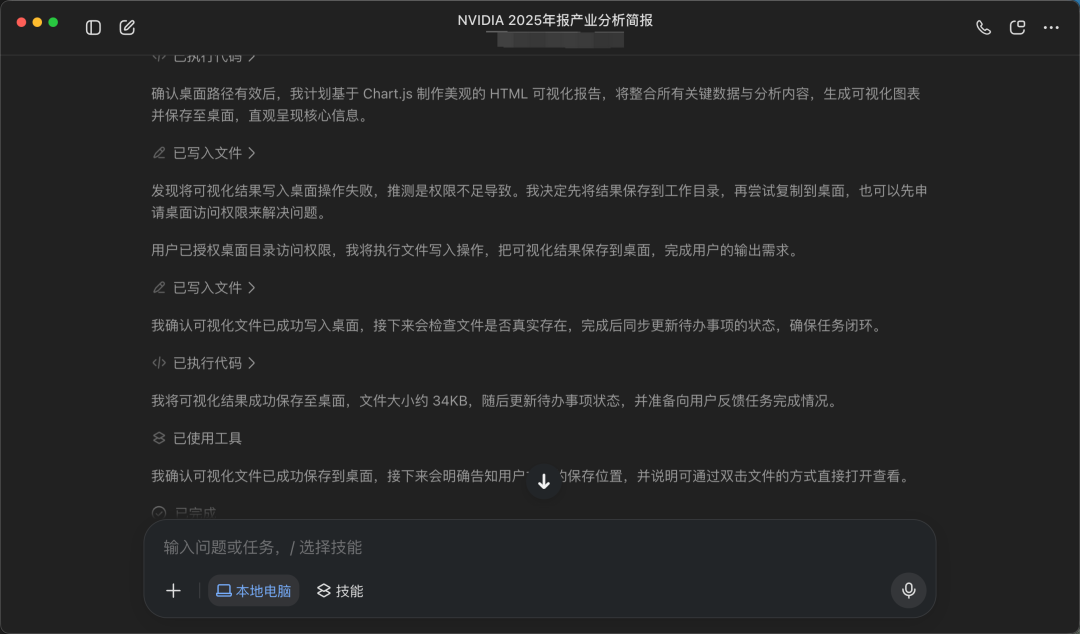
Ultimately, it output a report titled "NVIDIA 2025 Fiscal Year Industry Analysis Briefing."
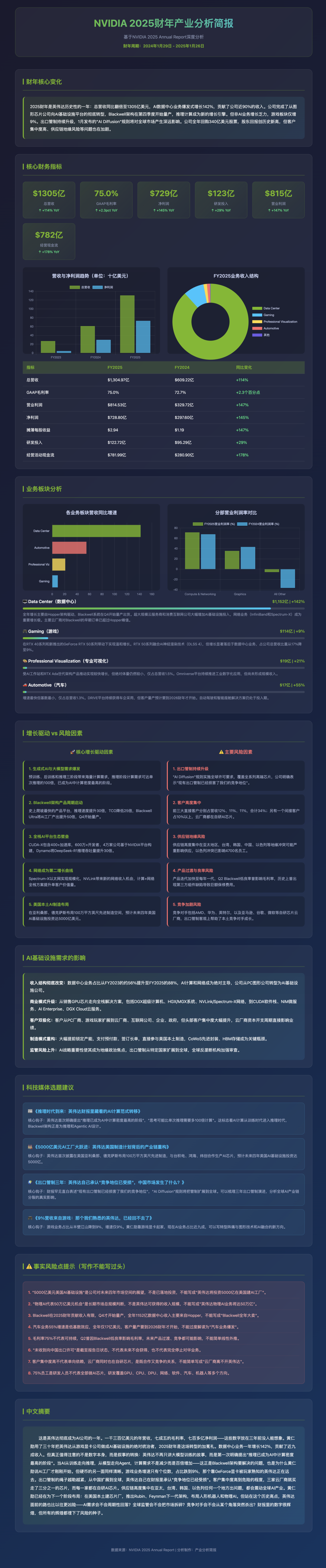
This result shows that 2.1 Turbo, within the office task mode, can already complete relatively complete information extraction and structural organization.
From a Pro version perspective, this result also provides a reference. Free users can experience the 2.1 Turbo office task mode, indicating that Doubao wants users to first perceive the value of AI running tasks. The true gap the Pro version aims to create should lie in stronger models, higher quotas, more complex multi-round tasks, more stable tool integrations, and cross-file processing capabilities.
Why Is Seed 2.1 Being Pushed to the Forefront?
This time, Volcano Engine has focused Seed 2.1 on three directions: Coding, Agent, and VLM. Coincidentally, these also more easily correspond to productivity subscriptions.
Let's talk about Coding first.
In the past, many people understood AI Coding primarily as getting a model to complete a code snippet, explain an error, or write a function. In the context of the Pro version, the value scope of Coding capabilities expands significantly.
It can assist developers in code modification, self-testing, and script generation, while also helping non-programmers turn a business idea into a functional tool. Examples include data dashboards, customer feedback forms, project management boards, and event registration systems—needs that many teams find valuable but not necessarily worth scheduling dedicated development time for.
The application generation direction in Doubao Pro aligns with this. The Office Task Mode can create, modify, and deploy web applications, supporting the development of online application systems with backend databases. Related capabilities will continue to roll out in phases.
Agent capabilities address another category of challenges.
They test whether a model can understand goals, break down tasks, invoke tools, adjust paths when encountering anomalies, and continuously push tasks toward delivering results.
The product design of Doubao's Office Task Mode places this capability directly within the desktop environment. It supports operating local computers and browsers, and with user authorization, can assist in using applications, browsers, and files on the computer to complete tasks such as organizing local data, categorizing files, processing documents, filling out forms, and cross-application collaboration.
Traditional chat models primarily provided answers. What Office Task Mode aims to do is enable AI to operate in the gaps between computers, files, web pages, and office software, taking over tasks that originally required users to constantly switch windows, copy and paste, and format data.
VLM and complex document understanding determine the upper limits of professional tasks.
Tasks assigned to AI by professional users are unlikely to be just a single sentence. They might involve a PDF, a spreadsheet, a set of screenshots, a video, a webpage, or a mix of several materials.
Improvements in Seed 2.1's multimodal capabilities determine whether it can handle such complex inputs. Beyond that, capabilities like Office applications, creative design, visualization Skills, and financial professional Skills encapsulate model capabilities into more specific workflows.
According to official benchmarks, Seed 2.1 ranks in the top tier in Coding-related evaluations such as Terminal Bench 2.1, SWE-Pro, SciCode, and NL2Repo-Bench. It also performs well in Agent and multimodal evaluations like OSWorld, MobileWorld, and MMMU-Pro.
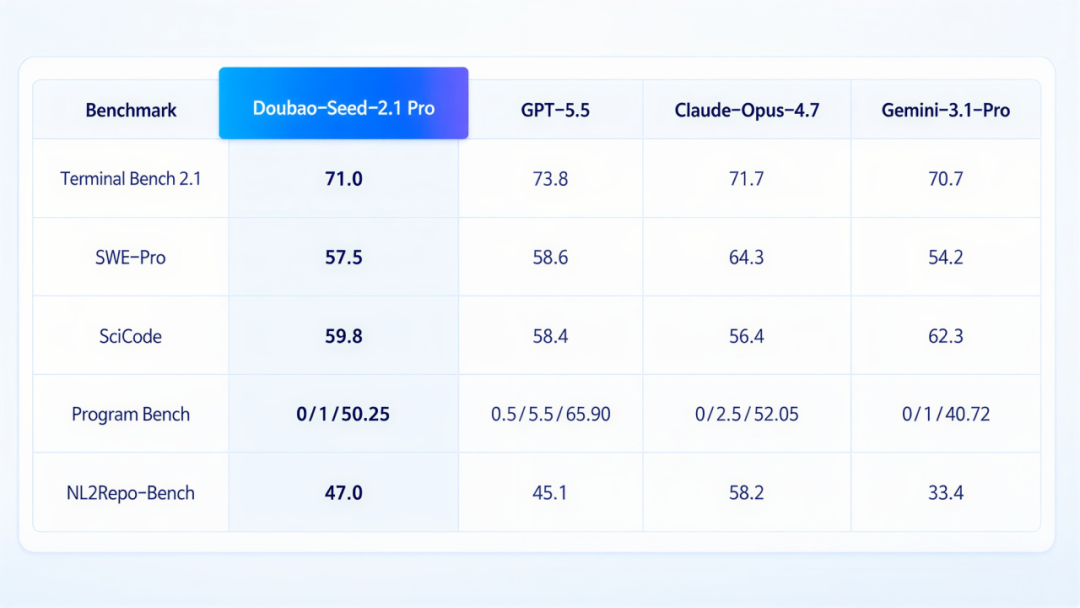
Of course, benchmarks don't make decisions for users, but they at least indicate that the direction of Seed 2.1's improvements aligns with the problems the Pro version aims to solve.
The launch event also featured a chip design RTL case. Seed 2.1 Pro ran continuously for nearly 18 hours, undergoing multiple iterations to complete the full process of simulation, testing, and synthesis checks, ultimately delivering functional code.
The key point of this case is that it provides a reference: the value of AI Coding is shifting from writing code snippets to running complete engineering workflows.
For the Pro version, this is precisely the kind of change users expect.
The turning point for productivity must ultimately manifest in real workflows.
After yesterday's launch event, Tan Dai, President of Volcano Engine, discussed model pricing in interviews with outlets like *Key Takeaways*. He said that evaluating model prices requires looking beyond just the price itself—it must be considered in conjunction with the value created. When models can do more and generate greater value, the value per Token also increases, improving cost-effectiveness.
This statement perfectly explains the pricing logic behind Doubao Pro: what users truly purchase is not the Tokens themselves but the tasks that can be accomplished through them.
Tan Dai repeatedly mentioned the concept of a "productivity turning point." Behind this idea lies a set of criteria: whether a model can integrate into real workflows, meet the requirements of existing industry processes, and ultimately prove itself through data and delivered results.
He cited the example of Seedance 2.0.
Before Seedance 2.0, video generation felt more like a UGC toy, with higher usage on weekends. After Seedance's release, workload and usage increased on weekdays, indicating its entry into scenarios like office work, production, and data synthesis. In other words, real change comes not just from improved generation quality but also from usage shifting from leisure to work.
The same logic applies to Seed 2.1. A simple demo doesn't qualify as production-grade. Only by running in real workflows, handling anomalies, and delivering results does it truly approach being a productivity tool.
This is why we care more about the sense of delivery in the three real-world tests mentioned earlier. In e-commerce data analysis, it processes dirty data, calculates metrics, and provides recommendations; in taxi data visualization, it writes code, creates charts, and generates HTML reports; in NVIDIA annual report analysis, it reads long PDFs, extracts numbers, and generates local visualization files.
These tasks may not be flashy, but they closely resemble the challenges professional users face daily. Ultimately, the viability of AI product pricing often hinges on performance in these areas.
Finally, returning to our initial question—is Seed 2.1 worth the price?
A more measured answer now is that it has provided a premise worth continuing to observe.
For users who only engage in light chat, occasional copywriting, or a few life-related questions, the free version is likely sufficient. Doubao officials also emphasize that the existing free features and quotas can meet most daily life scenarios.
However, for those frequently handling documents, spreadsheets, code, reports, and visualization tasks, the value of the Pro version becomes tangible.
Thus, after the official launch of Doubao Pro, pricing is no longer the suspense ( suspense , which means " suspense " or " Unresolved issues " in English, but here it means "major uncertainty"). What truly enters the testing phase is Seed 2.1 and the Office Task Mode.
If the Pro version merely offers higher quotas and fewer restrictions, users will easily compare it to regular memberships based on price. If, however, the Pro version is backed by the 2.1 Pro model's capabilities, plus Office Task Mode, local computer connectivity, file processing, Coding, Agent, Skills, and multimodal generation, it has the potential to become an AI productivity suite for power users.
Although the price has been announced, the answer ultimately depends on users. Because users are willing to pay for AI when it genuinely takes over part of their workload—
for a very simple reason: it actually handles some of their work.
-
![]()
Can Computers, Despite Daily Price Hikes, Still Be a Viable Purchase?
-
![]()
January-June Auto Stocks' 'Resilience Ranking': Geely Alone Posts Gains, Six Plummet Over 40%, One Tumbles 54.5% | Mirror Pro
-
![]()
China’s Public Charging Market: Didi Charging, Teld, and Yunkuai Take the Lead
-
![]()
The First Year of AI-Native Mid-Year Shopping Festival: Technology Reconstructs Human-Product Matching for 618
-
![]()
Micron has released its financial report, showing revenues of $41.5 billion, a 74% increase quarter-over-quarter, with a gross margin of 84.6%. The company provided both short-term and long-term guida
-
![]()
Expert Interpretation of New Policy Combination: Activating the Trillion-Dollar Automotive Aftermarket
-
![]()
Doubao Goes 'Professional', Volcano Rolls the Snowball
-
AI: No Sign of a Bubble!