The First Year of AI-Native Mid-Year Shopping Festival: Technology Reconstructs Human-Product Matching for 618
 06/25 2026
 476
476

Copywriting by Chen Cong | Produced by Shi Tianhao Observation
At 2 a.m., Lin Wei, an e-commerce seller in Hangzhou, has a digital human streamer still explaining sunscreen in her livestream room. It doesn't get tired, doesn't misstate selling points, and doesn't need breaks to eat.
Meanwhile, consumer Zhang Lei in the same city is asking Taobao's AI assistant, "Compare the 1.5-ton air conditioners from Xiaomi and Gree for energy efficiency, quietness, and good after-sales service."
This isn't a future scenario—it's a real slice of 618 in 2026. AI is no longer a marketing gimmick but an infrastructure deeply embedded across the entire retail supply chain.
This year's 618 saw 80,000 merchants on JD.com simultaneously launch digital human livestreams; 127 new brands (established for less than 5 years) on Tmall broke into the top 10 across industries through algorithmic recommendations, such as Maicong (mechanical keyboards) ranking Top 3 in computer peripherals.
According to official battle reports, Maicong's cumulative sales across all channels during the promotion exceeded 1.3 million units. Consumers started "locking in" orders with AI a month in advance, marking the first true "AI-native mid-year shopping festival."
01 Comprehensive Upgrade of Platform Technology Engines
1. Three Platforms, Three Paths, One Ambition By 2026, the AI hype bubble has burst, and the technology is now practically implemented. It's no longer just a demo in exhibition halls but a streamer in livestream rooms, a robotic arm in warehouses, and a pusher in shopping carts. The most significant change this 618 is AI moving from a backstage "support role" to the forefront, becoming the core engine of platform operations.
Data from Fudan Consumer Big Data Lab shows that Taobao & Tmall Group holds about 34% market share this 618, while JD.com accounts for 25%. The three platforms—Taobao & Tmall, JD.com, and Douyin—commanding nearly 80% market share, are also the heaviest AI investors, but with vastly different strategies. Taobao and Tmall integrate the Tongyi Qianwen large model into Taobao, attempting to shift users from search bars to dialogue boxes.
Consumers no longer type keywords and flip through pages but directly describe their needs to AI, which handles filtering, price comparisons, and recommendations. JD.com's approach is more aggressive. "Jingxiaotong" covers the entire link (Note: retained as is for industry-specific term) of shopping guides, digital human livestreaming, marketing, customer service, and logistics. The JoyStreamer digital human livestreaming platform alone serves over 80,000 merchants, with GMV from livestreamed sales increasing by 100% year-on-year. Douyin's "Qianchuan Chengfang" focuses on cost reduction, deploying billion-level computing resources into Feige Intelligent Customer Service and AIGC content tools to help small and medium-sized merchants lower customer service and production costs.
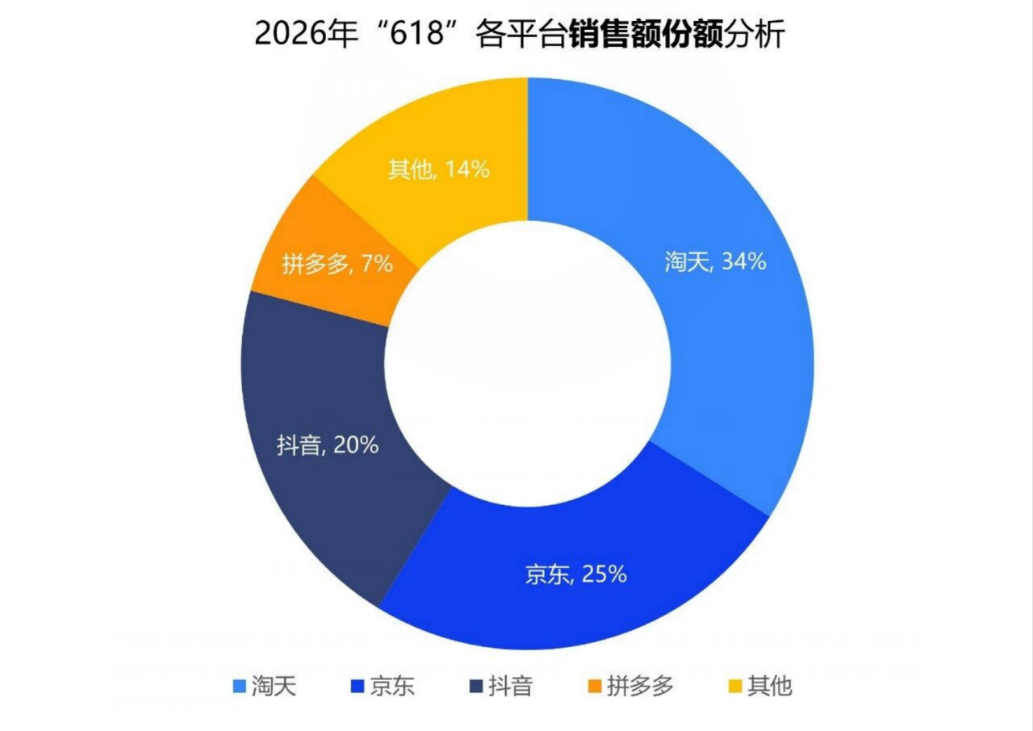
(Image source: Fudan Consumer Big Data Lab) (Statistics period: May 30-June 17, 2026)
The strategic divergence among the three platforms essentially reflects different interpretations of "human-product matching." Taobao & Tmall aim to shift from "search" to "dialogue," JD.com from "linkage" to "closure," and Douyin from "tools" to "lowered barriers." But they all point to the same goal: redefining matching efficiency with AI.
2. AI Is No Longer a Tool—It's "Infrastructure" While earlier AI applications were limited to surface-level functions like intelligent recommendations and auto-generated copy, this year's 618 AI has penetrated deep into the downstream industrial chain. JD.com's cases and data are more persuasive. Today, JD.com's AI covers over 3,000 business scenarios, including consumer experience, merchant operations, logistics fulfillment, and industrial procurement.
Consumers see intelligent shopping assistants but remain unaware of the "Yilang" industrial dexterous hand completing a grasp every 15 seconds in warehouses, the logistics superbrain model scheduling 320 million parcel pickups during 618, or the AI inventory diagnosis assistant improving merchant inventory turnover efficiency by 30%.
This penetration from "front-end" to "full- link " (Note: retained as is) is most visible in logistics. Nationwide, autonomous vehicles have transported 5.53 million parcels, and JD.com has launched 78 drone delivery routes to villages in Zizhong, Sichuan, boosting delivery efficiency by 4.4 times. In industrial procurement, JD.com's Gongpinhui AI procurement assistant increased daily ordering clients by 12.7 times compared to May, with corresponding transaction volume surging 56-fold.
AI is no longer just a tool plugin but has become a new type of infrastructure supporting the entire retail system. This marks the most iconic structural change of this 618: technology no longer merely supports marketing but is deeply embedded throughout the retail operation.
02 From Proactive Discovery to Precision Feeding
1. AI Shopping Guides Enable Proactive Decision-Making When AI gains the ability to deeply understand needs, integrate information, and provide suggestions, consumer shopping behavior naturally undergoes qualitative change. The power to make shopping decisions is shifting from humans to algorithms.
JD.com integrates Qianwen into its intelligent shopping assistant. If you want to buy a robot vacuum, there's no need to read a dozen reviews—AI provides parameter comparisons, aggregated user reviews, and historical price trends in seconds.
Taobao's AI Wanxiang Engine helps merchants mass-produce content, making the product recommendations you see increasingly precise.
When "product selection and price comparison" become effortless, consumers naturally complete all comparisons in advance. For them, 618 is no longer a day to "discover new things" but to buy at the biggest discounts. This editor cleverly used "Jingxiaotong" during 618 shopping to break information barriers and uncover hidden discounts. Unknown stacked discounts were discovered through AI queries and combined usage, saving time, effort, and money.
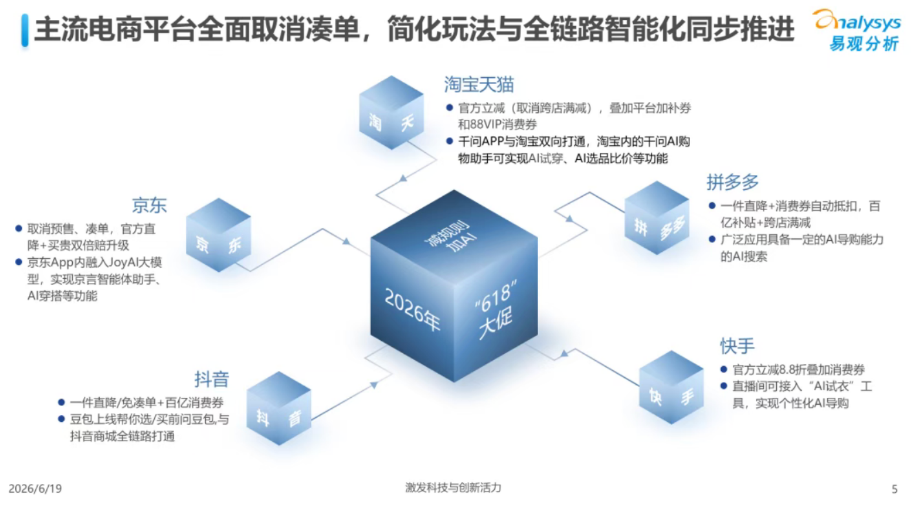
(Image source: Analysys)
Changes in consumer behavior have, in turn, prompted platforms to adjust their rules, which they have now understood. Taobao & Tmall offer discounts starting at 15% off without requiring combined purchases, Douyin promotes "direct price drops for single items," and JD.com stacks discounts on top of national subsidies. All major platforms are actively simplifying their promotion rules because when AI can calculate every cent of actual savings for consumers, complex discount tactics no longer work.
Analysys points out that during 618 in 2026, consumer decisions became more rational, shifting from impulsive stockpiling to precise fulfillment. The combination of AI shopping guides and simplified rules has made rational decision-making mainstream. Consumers start comparing prices and researching products 4-6 weeks in advance, locking in target items before promotions begin. 2. 618 Transforms from a "Burst Day" to a "Harvest Day" After decision-making is proactively completed, the role of 618 itself inevitably undergoes qualitative change.
This year's 618 is no longer a "burst day" where people wait in front of screens for midnight sales but more of a "harvest day" where consumers place orders after verification and research. Entering promotions with AI-generated price comparison lists and deeply researched product selections, 618 merely serves as the final confirmation step in a long-cycle shopping behavior. Syntun data confirms this judgment.
In 2026, total GMV across platforms during 618 reached RMB 934 billion, growing only 4% year-on-year, with growth slipping from double to single digits. In contrast, instant retail sales hit RMB 62.8 billion, surging 112.3% year-on-year. Consumers are shifting from "stockpiling for promotions" to "needing instant fulfillment." When AI enables anytime, anywhere price comparisons and research, consumers increasingly refuse to "wait for promotions" and demand immediate gratification.
03 Merchant Differentiation: Those Who Understand Algorithms Survive
1. Algorithms Become the "Gatekeepers" of Traffic Changes in consumer decision-making directly impact merchants, creating a new survival threshold. Whether a brand enters AI recommendation algorithms' priority pool determines its exposure opportunities. Tmall 618 data clearly shows the "filtering" effect of algorithms. The number of new products exceeding RMB 10 million in sales after launch grew by 60% year-on-year, with coverage expanding from 26 to 53 categories; 127 new brands rose from niche market champions to Tmall's industry top 10, demonstrating the "big brands emerging from small niches" trend in new consumption.
Evidently, AI algorithms favor innovative, high-quality supplies that meet niche demands over homogeneous, low-priced, featureless "white-label" products. Note that algorithm benefits are not equally distributed. Multiple top sellers report that while AI customer service is widespread, AI advertising tools suit only top players with monthly sales exceeding RMB 50 million; a Pinduoduo seller with billion-level sales admits, "Real product photos outperform retouched images, which in turn outperform AI-generated ones." Over-reliance on AI-generated content may even reduce conversion rates.
This means the key to algorithm favorability lies not in "using AI" but in understanding its matching logic and synchronously improving product innovation, content quality, and user operations. AI is not a panacea but a magnifying glass—amplifying high-quality supplies while accelerating the elimination of low-quality ones. Merchants failing to adapt risk losing even exposure opportunities.
2. Merchants Shift from "Price Wars" to "Innovation Wars" Changes in algorithm preferences, combined with macro policy shifts, are driving merchants to actively escape price wars. According to an expert memo, over 70% of brands now prioritize profit as their top KPI, abandoning GMV chasing. Taobao invests RMB 60 billion in traffic to boost super new products, while JD.com increases exposure for innovative brands through Aidol Creator Camp.
Platforms no longer subsidize prices but innovation. The "Internet Platform Pricing Behavior Rules" mandate curbing malignant (Note: retained as is for specific term) price competition, making "anti-price wars" an industry consensus from policy to platform level. The rise of niche markets further reflects this shift. 618 data shows light-customized wardrobe transactions multiplied 10-fold, trail running shoe sales doubled, and senior cat food cans grew over 300%. When brands identify and fulfill previously undersupplied niche demands, they gain pricing power without competing in homogeneous red oceans. Marubi Bio's chairman explicitly states, "All growth must be profit-driven," while Caoben Chuse's founder says, "We no longer pursue single-livestream bursts but seek sustained compound returns." AI technology, combined with "anti-price war" policies, is pushing e-commerce competition from "price wars" to "value wars."
The 2026 618 event marks a fundamental transformation in promotion formats. AI has become the infrastructure connecting platforms, merchants, and consumers. Future competition will no longer focus on price and scale but on data understanding, AI adaptation capabilities, and intelligent operation levels. In this AI-driven industrial reconstruction, brands that internalize technology into operational capabilities will gain an edge, while those stuck in traditional traffic thinking may face accelerated elimination in the next shakeout. The first AI-native mid-year shopping festival has proven that technology reconstructs not promotions but retail itself.
END
About the Author
Shi Tianhao is a columnist, co-founder of Beijing Wumiao Technology Co., Ltd., and an internet analyst with columns on multiple media platforms. He has published articles in traditional outlets such as Southern Metropolis Daily, Computer Application Digest, Business Review, and Communication Information News. Awards include 36Kr's 2022 High-Quality Content Award; Everyone Is a Product Manager's 2021/2020 Popular Author of the Year; Bird Note's 2021 Top 50 Creators; Baijiahao's Originality Plan Creator; Baijiahao's Kunpeng Plan Winner; Yidian Zixun's "Qinglang Plan" inaugural author; 2018 Kanchai Network Annual Author; 2017 Geek Network Annual Author; 2017 Most Explosive Self-Media; 2016 Most Explosive Self-Media Award. He has published over a thousand articles.
-
![]()
China Spearheads Formulation! World's Pioneering Global Technical Regulation for Automated Driving Systems Greenlit and Unveiled
-
![]()
Farewell to Pulsed Support Policies: Three Major Auto Policy Directions from Multiple Departments Take Effect on the Same Day
-
![]()
Embercore AI’s Accelerated Funding: The Robot Industry’s Shift Toward ‘Learning Systems’
-
Hao Jida, Apple Supply Chain Coil Supplier, Switches Brokerage and Revives IPO Amidst Customer Dependency and Compliance Challenges
-
![]()
Annual Advertising Expenditure of VOYAH with Yudeshui: A Deep Dive
-
![]()
Can Computers, Despite Daily Price Hikes, Still Be a Viable Purchase?
-
![]()
January-June Auto Stocks' 'Resilience Ranking': Geely Alone Posts Gains, Six Plummet Over 40%, One Tumbles 54.5% | Mirror Pro
-
![]()
China’s Public Charging Market: Didi Charging, Teld, and Yunkuai Take the Lead