January-June Auto Stocks' 'Resilience Ranking': Geely Alone Posts Gains, Six Plummet Over 40%, One Tumbles 54.5% | Mirror Pro
 06/25 2026
 400
400
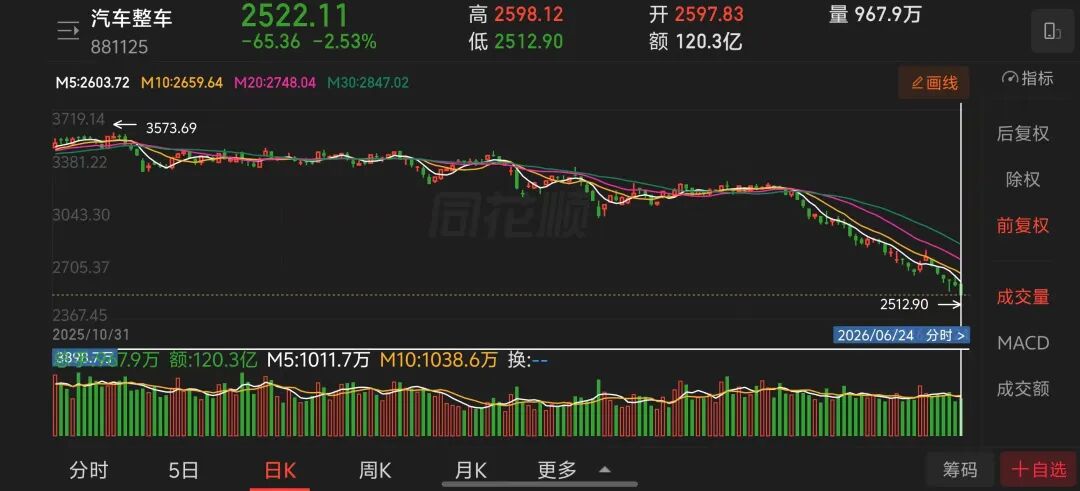
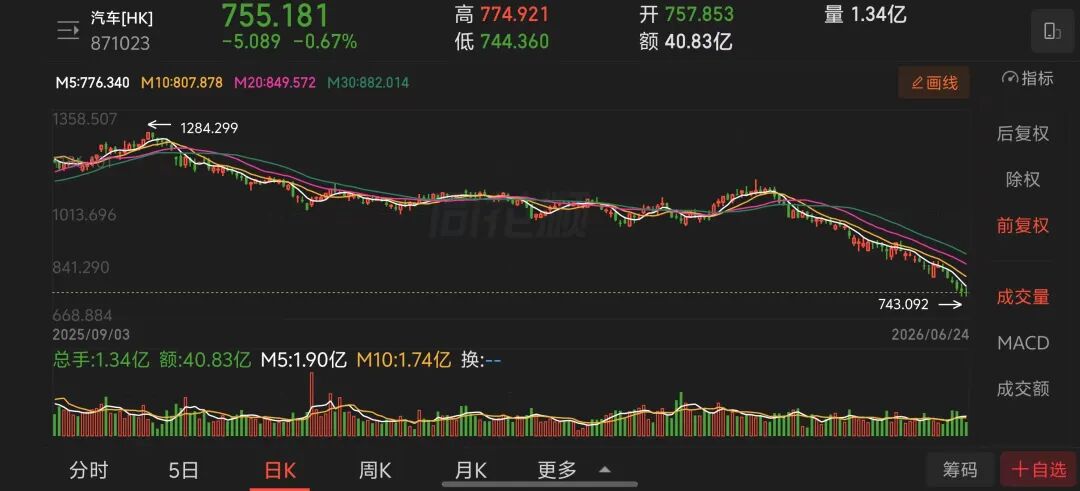
Investors in auto stocks have endured a truly disheartening and financially draining six months. Over the past month, the plight of trapped auto stock investors has become a recurring hot topic within the industry.
At BYD's shareholder meeting on June 11, a shareholder, visibly emotional, shared that he had invested solely in BYD stock and was now trapped, with his entire holding down by 26%. He expressed his deep sadness. In response to the shareholder's poignant query, BYD Chairman Wang Chuanfu urged patience, stating that over the next three to five years, BYD is poised for sustained growth and will "undoubtedly deliver better returns for shareholders." Wang even confidently predicted, "In five years, BYD will truly become the global leader in scale."
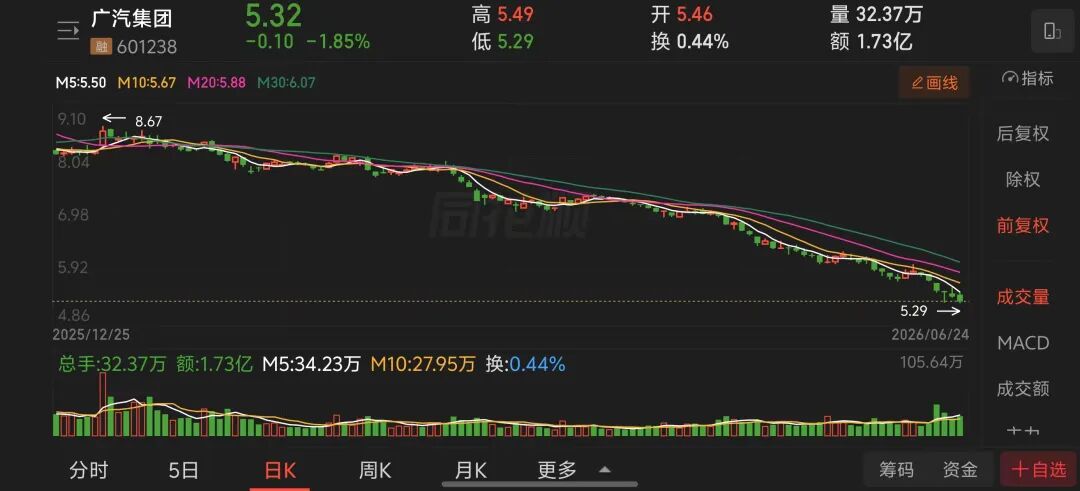
Subsequently, at GAC Group's shareholder meeting on June 16, a female shareholder questioned management on-site. She revealed that she had invested her life savings, along with her family's funds and business capital, totaling over 100 million yuan in GAC stock, only to find herself trapped with a loss exceeding 30%. She emotionally asked, "I'm truly heartbroken. When will GAC achieve the promised trillion-yuan market capitalization?" This incident went viral online, and the female investor was dubbed the unluckiest investor of the year.

Beyond shareholder meetings, investors have spontaneously initiated a "grilling" mechanism towards management. Starting in mid-June, on Xiaomi Group Chairman Lei Jun's Weibo, the top comments frequently highlighted Xiaomi's stock performance, urging Lei to "take charge." Upon closer inspection, many of these netizens were consistently posting under multiple Weibo entries by Lei. This trend emerged in the first week of June and has since become widespread.
Interestingly, these three automakers represent distinct segments of the current market: BYD as the leader in new energy vehicles, GAC Group as a traditional automaker, and Xiaomi Group as a new entrant in cross-border car manufacturing. These three automakers epitomize the current "three major forces" in the auto industry. From their stock performance in the first half of the year, all have experienced significant declines, albeit to varying degrees. For instance, BYD saw a -14.76% change in its Shenzhen Stock Exchange stock price from January to June this year (source: Wind), while GAC Group's stock price fell by 34.8%, and Xiaomi Group's by -41.58%.
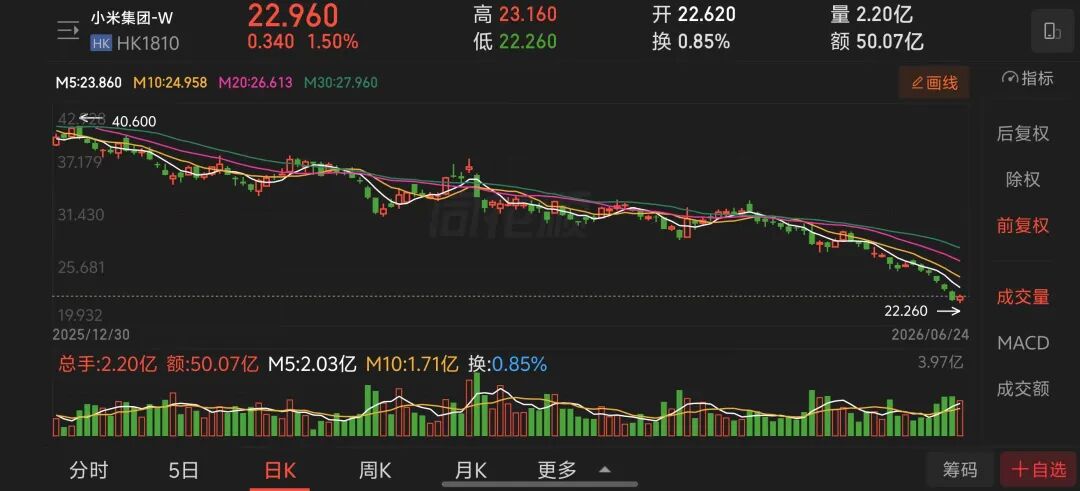
In reality, Xiaomi's investors should be the most disheartened, while BYD's investors might consider themselves fortunate for not incurring heavier losses. On social media, a recent post about a Xiaomi investor turning from a fan to being "heartbroken by the decline" sparked widespread discussion. However, Xiaomi did not experience the largest decline among all listed auto companies.
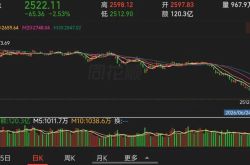
According to public Wind data, from January 1 to June 24 this year, among 17 listed passenger vehicle companies in the Hong Kong and A-share markets, three saw declines exceeding 50%, commonly referred to as "halving." Six companies saw declines over 40%. Thirteen saw declines over 20%, and fifteen saw declines over 10%. Only one company saw a stock price increase since the beginning of the year—Geely. It also emerged as the top performer in the resilience ranking—of course, this excludes several commercial vehicle listed companies.
01 Geely + NIO: The Resilient Duo
From a statistical perspective, Geely's stock price has risen by 0.7% since the beginning of the year, a slight increase but a notable achievement in the current market environment. Currently, Geely's market capitalization stands at HKD 189.377 billion. Additionally, despite a stock price decline in the Hong Kong market, NIO's decline was contained within 5%, making it, alongside Geely, the passenger vehicle listed company with the smallest decline this year. NIO's current market capitalization is HKD 97.9 billion, with its stock price down about 4.59% since the beginning of the year. Except for these two companies, other automakers' stock prices have declined by over 10%.
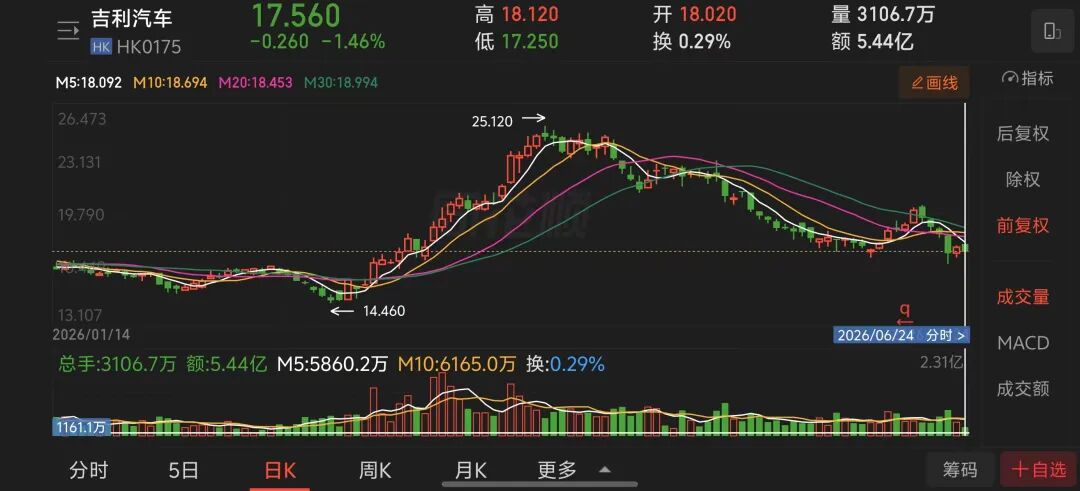
Geely and NIO's ability to "resist decline" in the current capital market primarily stems from their enhanced competitiveness and overall upward market performance. Take Geely, for instance: through strategic adjustments to "return to one Geely," the company has demonstrated strong growth. In 2024, Geely sold 2.177 million units, with revenue reaching RMB 275.91 billion, a 54% year-over-year (YoY) increase; the comprehensive gross margin was 15.9%; net profit attributable to shareholders was RMB 16.812 billion, with a net profit margin of 6.99%. In 2025, Geely's sales reached 3.0246 million units (+39% YoY), revenue reached RMB 345.232 billion, a 25% YoY increase; the gross margin slightly increased to 16.61%. Net profit attributable to shareholders was RMB 16.852 billion, up 0.2%; while core net profit attributable to shareholders was RMB 14.41 billion, a 36% YoY increase, indicating significant overall profitability growth.
From January to May this year, Geely accumulated sales of 1.1822 million units, a slight 0.8% increase in total volume but a qualitative change in sales structure, with explosive growth in high-end vehicles and overseas markets. In the domestic market, Geely's retail performance ranked first in the industry. Financially, Geely's revenue in the first quarter was RMB 83.776 billion, a 15% YoY increase; core net profit attributable to shareholders was RMB 4.561 billion, a 31% YoY increase, with a first-quarter gross margin of 17.5%, a recent single-quarter high. Thus, Geely's reform has yielded significant endogenous effects, and subsequent performance for 0175.HK looks promising.
Additionally, since the launch of the ES8 in 2025, NIO has emerged from critical conditions and achieved a historic single-quarter profit last year. The company achieved total revenue of RMB 25.53 billion in the first quarter, a 112.2% YoY increase; net loss was RMB 332 million, significantly narrowed from RMB 675 million in the same period last year; after non-GAAP adjustments, net profit turned positive, recording a profit of RMB 43.5 million—marking NIO's second consecutive quarter of adjusted net profit after the fourth quarter last year.
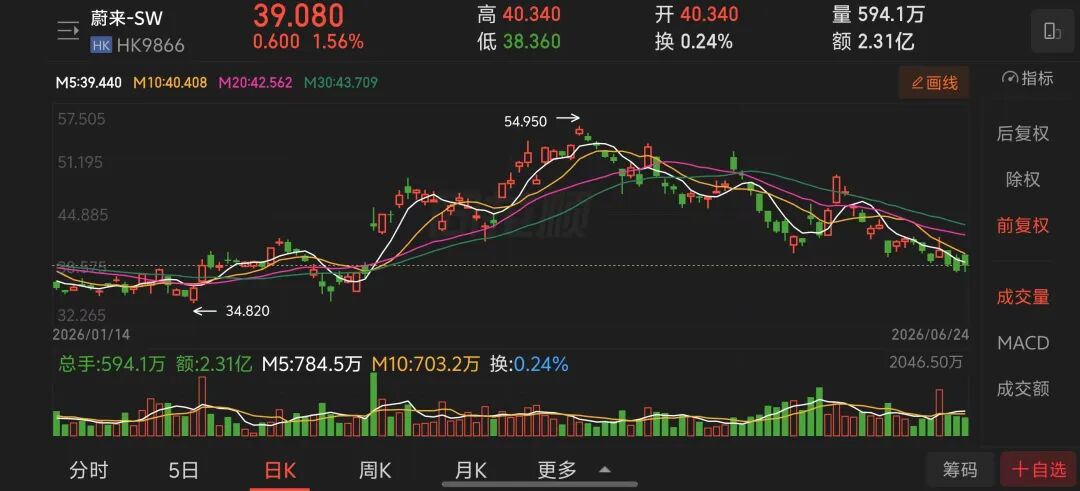
From a market perspective, in the first quarter this year, NIO delivered 83,500 new vehicles, a 98.3% YoY increase. Among them, the NIO brand delivered 58,543 new vehicles, maintaining its position as the sales champion in China's pure electric market with an average transaction price over RMB 300,000; the Lego brand delivered 13,339 new vehicles, continuously releasing growth potential; the Firefly brand delivered 11,583 new vehicles, ranking first in the high-end small car market. With the continued popularity of products like the ES8L90, NIO is expected to further improve its performance.
In the capital market, performance is the core factor supporting stock prices. No matter how many concepts or stories are touted, they pale in comparison to this indicator. For investors, this is also a more authentic basis for judging a company's future trajectory. No wonder Geely and NIO have managed to stand out amidst the collective decline.
02 Declines Over 40%: Each Has Its Story and Mishap
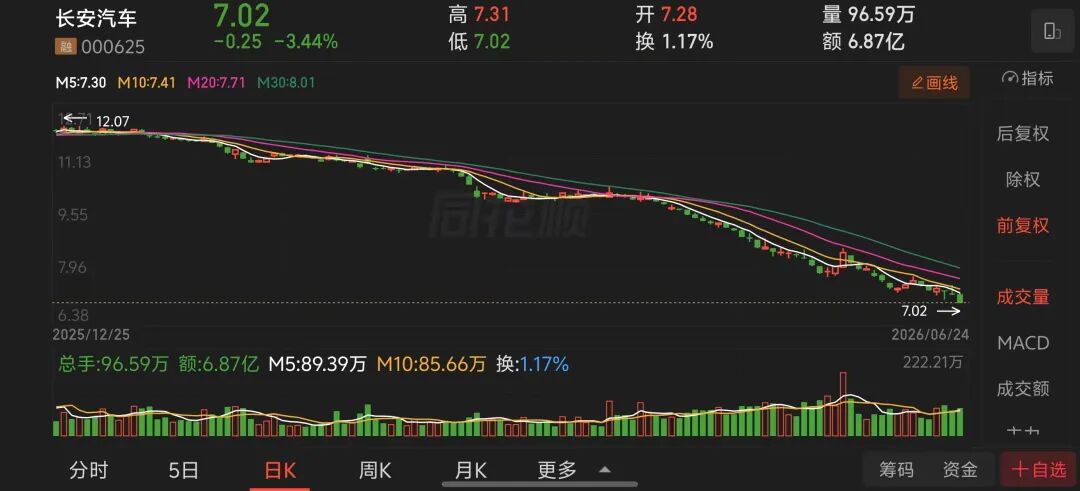
According to statistics, six automakers saw declines exceeding 40%, ranked by decline magnitude: VOYAH, Seres HK, Haima Automobile, Xiaomi Group, JAC Motors, and Changan Automobile. Their respective declines are: -54.50%, -53.66%, -51.96%, -41.58%, -41.47%, -40.87%. Among them, Seres and JAC Motors are concept stocks of Hongmeng Zhixing, both having experienced prolonged significant gains previously. Take Seres: its A-share has declined 48.41% since the beginning of the year, and its Hong Kong share has declined -53.66%, both exceeding 50% declines. However, Seres was once a darling of the stock market.
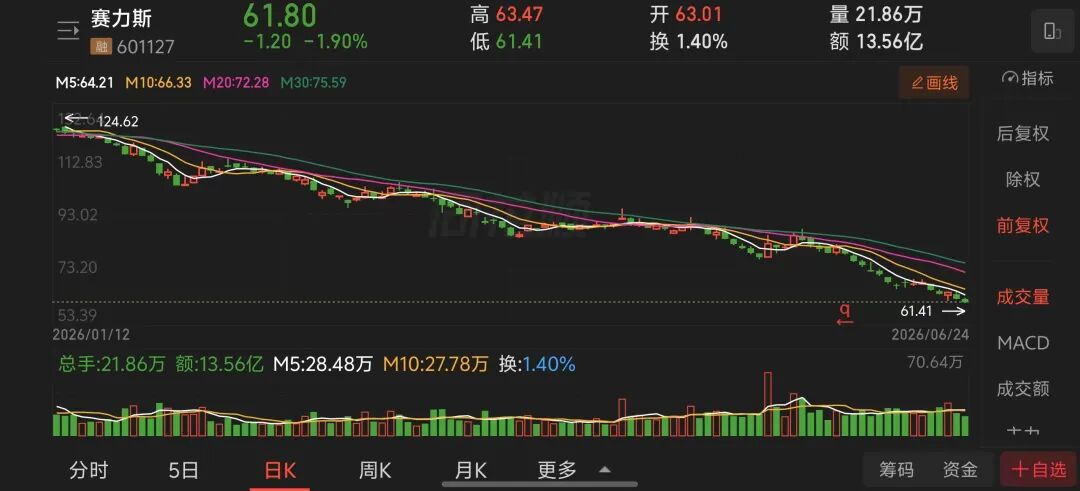
Seres' stock price began to soar in 2021, rising from around RMB 16 at the beginning of the year to nearly RMB 200. It peaked in October 2025 at RMB 172.63 per share, nearly tenfold. Currently, its stock price is still RMB 61.6 per share; subsequently, Seres listed in Hong Kong, with an initial stock price of HKD 108 per share. At its peak, Seres' market capitalization exceeded RMB 300 billion, becoming the most prominent existence among auto stocks. Currently, despite the stock price decline, its market capitalization remains in the hundreds of billions, far exceeding Changan Automobile, also based in Chongqing.
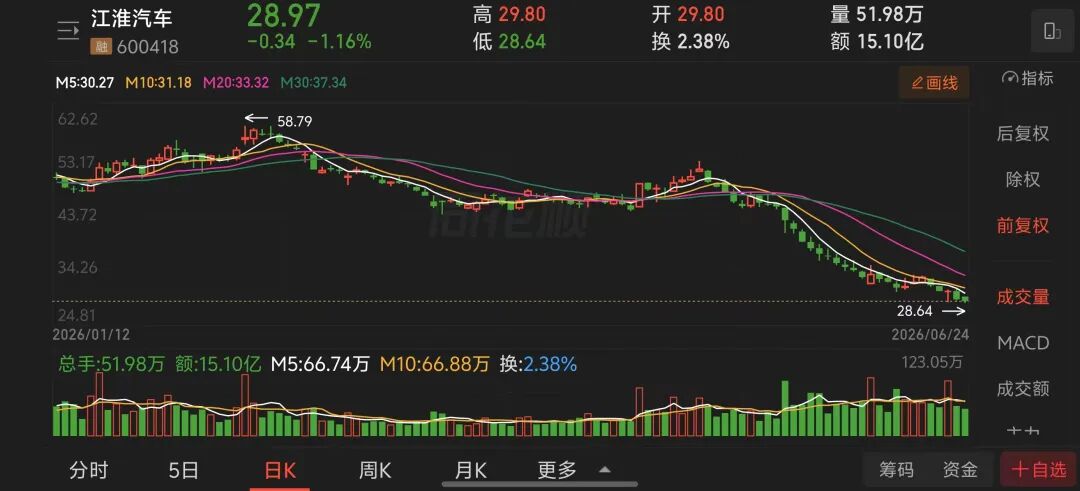
JAC Motors also took off as a Hongmeng Zhixing concept stock. After partnering with Huawei to create the Zunjie brand, JAC Motors' stock price soared from around RMB 15 in 2024 to over RMB 50 per share, a more than fourfold increase. Although JAC's current stock price has declined to RMB 28.97 per share, its overall market capitalization performance still exceeds past levels. These two Hongmeng Zhixing concept stocks, from takeoff to decline, have generally been affected by the dilution of Huawei's scarce resources and market challenges. Despite strong sales of the Zunjie brand, its overall scale is limited and cannot yet provide strong profit support for JAC.
Besides, Xiaomi Group has been impacted by weakening orders. The latest sales data shows that the once hard-to-find Xiaomi cars no longer face supply shortages, with YU7 model sales falling below the 10,000-unit mark. Additionally, discounted employee cars have appeared within Xiaomi—indicating the need to seek new orders at the retail level. Especially with automakers like Hongmeng Zhixing, BYD, and Geely entering Xiaomi's market segment, this poses challenges for its future development. Currently, Xiaomi is planning extended-range products, but future sales remain unpredictable. This pressure has translated into the capital market, reflecting in the stock price.
As for VOYAH, it completed its listing in March this year through a "cage-swapping" method. After listing, VOYAH faced market concerns about its growth sustainability. However, VOYAH has consistently proven its market expansion capabilities this year, represented by products like the Taishan X8. Currently, VOYAH has built a high-end product lineup with strong premium capabilities. In May 2026, VOYAH delivered 13,003 new vehicles, a 30% YoY increase. As subsequent deliveries progress, VOYAH's market capitalization recovery will depend on its market expansion speed and operating performance improvement. However, this doesn't mean VOYAH is without pressure. As the only listed high-end new energy brand under a central enterprise, especially in the race with Changan, VOYAH is a core pillar and trump card, constantly driving Dongfeng forward.
Surprisingly, Changan's decline is even higher than GAC's among major independent automakers, reaching 40.87%. We speculate that the core reasons for Changan's significant stock price decline are: high-end new energy performance falling short of expectations and operating performance declining more than expected. Reports show that in the first quarter of 2026, Changan Automobile's net profit attributable to shareholders was RMB 351 million, a 74.09% YoY decrease; net profit after non-recurring items was RMB 242 million, a 69.06% YoY decrease.
However, Changan currently appears relatively stable overall, with a stable market size and opportunities for stock price recovery as profit performance improves.
As for Haima, it is now considered a marginalized automaker and will not be discussed further. Besides the automakers' capabilities, this year's overall uncertainty in the auto market has intensified investors' wait-and-see attitude. For instance, the oil price surge due to Middle East conflicts has severely impacted the fuel vehicle market, while subsidy reductions and impending weight taxes have also affected market consumption. From June data, retail sales from June 1-21 were 913,000 units, a 23% YoY decrease but a 7% increase from the previous month; cumulative retail sales since the beginning of the year were 8.012 million units, a 20% YoY decrease. The entire auto market may face unprecedented pressure this year, which will also reflect in the capital market.
These signs indicate a harsh reality: the golden era for new energy vehicles in the capital market has passed.
-
![]()
China Spearheads Formulation! World's Pioneering Global Technical Regulation for Automated Driving Systems Greenlit and Unveiled
-
![]()
Farewell to Pulsed Support Policies: Three Major Auto Policy Directions from Multiple Departments Take Effect on the Same Day
-
![]()
Embercore AI’s Accelerated Funding: The Robot Industry’s Shift Toward ‘Learning Systems’
-
Hao Jida, Apple Supply Chain Coil Supplier, Switches Brokerage and Revives IPO Amidst Customer Dependency and Compliance Challenges
-
![]()
Annual Advertising Expenditure of VOYAH with Yudeshui: A Deep Dive
-
![]()
Can Computers, Despite Daily Price Hikes, Still Be a Viable Purchase?
-
![]()
January-June Auto Stocks' 'Resilience Ranking': Geely Alone Posts Gains, Six Plummet Over 40%, One Tumbles 54.5% | Mirror Pro
-
![]()
China’s Public Charging Market: Didi Charging, Teld, and Yunkuai Take the Lead