Blockbuster! Domestic storage takes the global double crown for the first time, from an AI company
 06/25 2026
 537
537
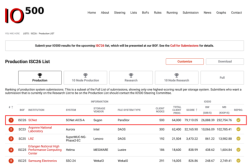
Recently, at the ISC 2026 conference, the Sugon ParaStor F9000 all-flash storage system made an appearance and clinched the top spots in both the IO500 production full-node and 10-node categories. This is the first time a Chinese storage vendor has stood at the highest position on this list, and it is also the only double crown winner on the IO500 production list to date.
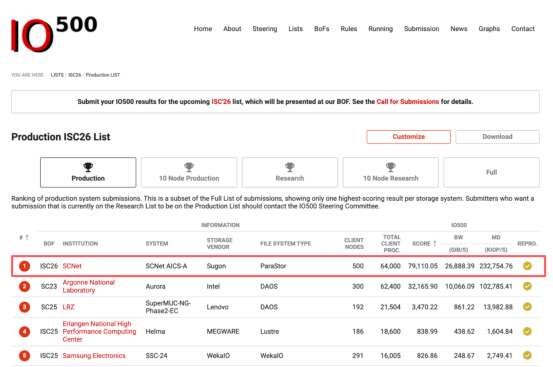
IO500 Production Full-Node First Place
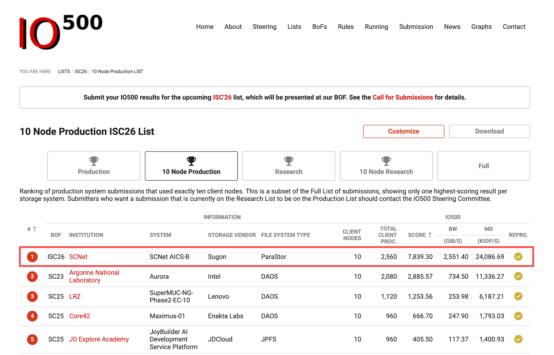
IO500 Production 10-Node First Place
The IO500 list is not easy to dominate. The production category of this list only considers real business workloads and rejects special tuning for test scenarios. It evaluates the system's comprehensive performance in mixed read-write operations, high-concurrency metadata, and large-scale clusters.
For many years, the top spots have been long dominated by international vendors such as Lustre-based systems and IBM, with few records of domestic storage making it to the forefront. Therefore, Sugon's ascent this time carries significant weight.
It is worth mentioning that the results submitted by ParaStor F9000 did not come from a specially constructed test environment but from a production system that has been stably operating in a tens-of-thousands-of-cards AI cluster for over a year. In other words, the IO500 benchmark scores highly overlap with the operational records of real-world businesses.
In the past two years, the status of the storage industry has risen due to structural reasons. After AI training scales entered the petabyte level, the bottleneck of computing power gradually shifted from the chips themselves to data supply. GPU idle time, training interruptions, and checkpoint recovery taking hours often stem not from the computing units but from the storage throughput capacity failing to keep up.
This shift in perception has redefined the role of storage in large-model infrastructure and made the IO500 production list an important reference for procurement decisions.
Sugon's ascent to the top this time is a public validation of its product capabilities and a concentrated release of the technical accumulation of domestic storage over many years within a specific time window.
-
![]()
Jitian Xingzhou: A Pioneer in Optical Payloads Secures Hundreds of Millions in Series B Funding!
-
![]()
Orders Secured Through to the Second Half of the Year! The Rationale Behind the 'Surge' in Demand for This Company’s Optical-Grade Base Films
-
![]()
Beyond Patents: The Retail Rivalry of Insta360 and DJI Unfolds
-
![]()
180 Billion Market Cap Vanished! How Did Seres Fall So Far?
-
![]()
Blockbuster! Domestic storage takes the global double crown for the first time, from an AI company
-
![]()
China Spearheads Formulation! World's Pioneering Global Technical Regulation for Automated Driving Systems Greenlit and Unveiled
-
![]()
Farewell to Pulsed Support Policies: Three Major Auto Policy Directions from Multiple Departments Take Effect on the Same Day
-
![]()
Embercore AI’s Accelerated Funding: The Robot Industry’s Shift Toward ‘Learning Systems’