Breaking News! Apple Implements Sharp Price Hikes in the Dead of Night, Scalpers Go on a Stockpiling Spree, iPhone 18 in Jeopardy
 06/26 2026
 402
402
Apple Becomes a Casualty of AI.
In the wee hours of June 25 (Beijing Time), Apple unexpectedly announced a global price increase for Macs, iPads, and home devices. According to Apple's official data, the starting price of the MacBook Neo surged from $599 to $699, the MacBook Air from $1,099 to $1,299, the 14-inch entry-level MacBook Pro from $1,699 to $1,999, the 11-inch iPad Pro from $999 to $1,199, and the iPad Air from $599 to $749. These price hikes are global, with iPhone prices remaining unchanged for the time being.
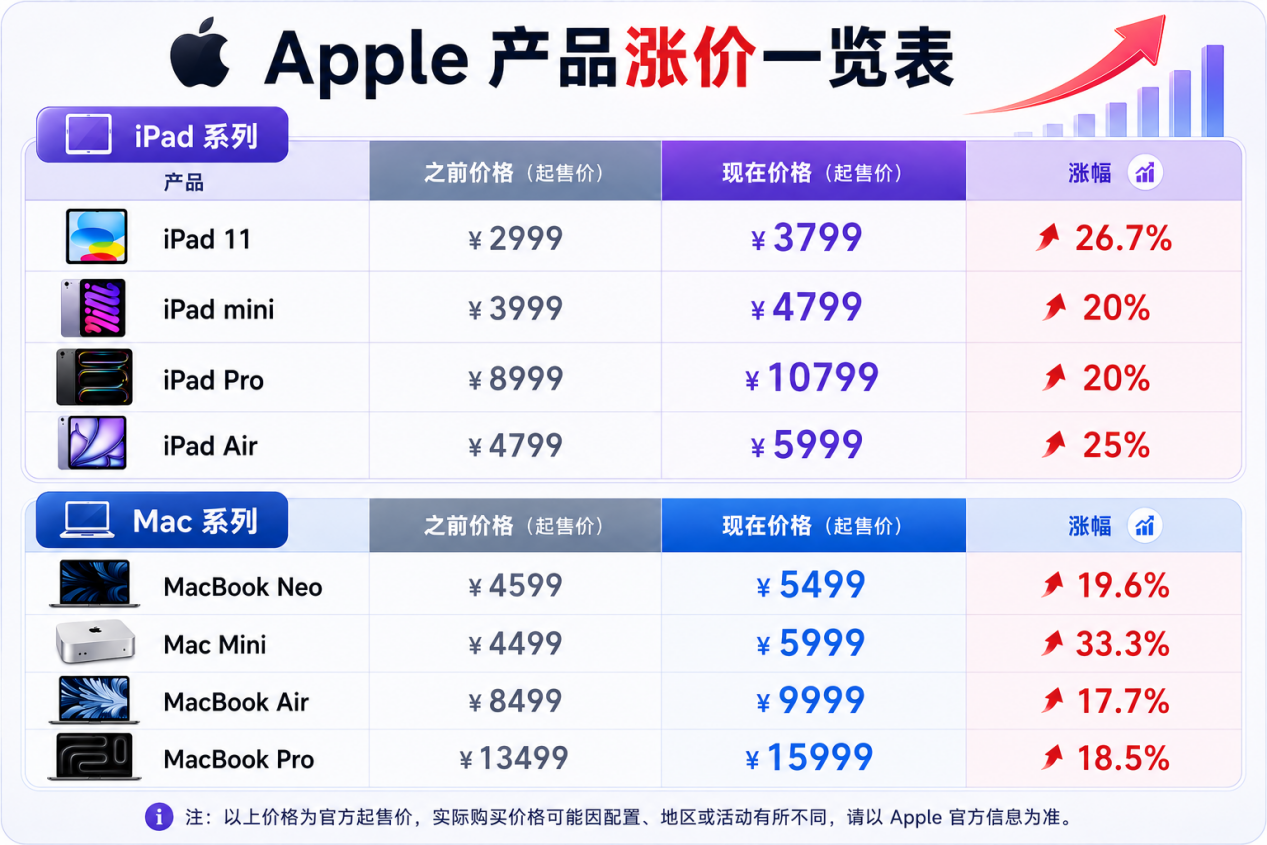
(Image Source: Leitech Graphics)
Leitech (ID: leitech) observed that simultaneously with Apple's official price increase announcement, the low-memory versions of Macs and iPads on e-commerce platforms were already out of stock. As of the press time, the lowest-priced MacBook Neo had been completely delisted on JD.com, Taobao, and Pinduoduo, with only a handful of stores selling at a premium or offering second-hand units. This double whammy of "price hikes + stock shortages" caught users off guard.
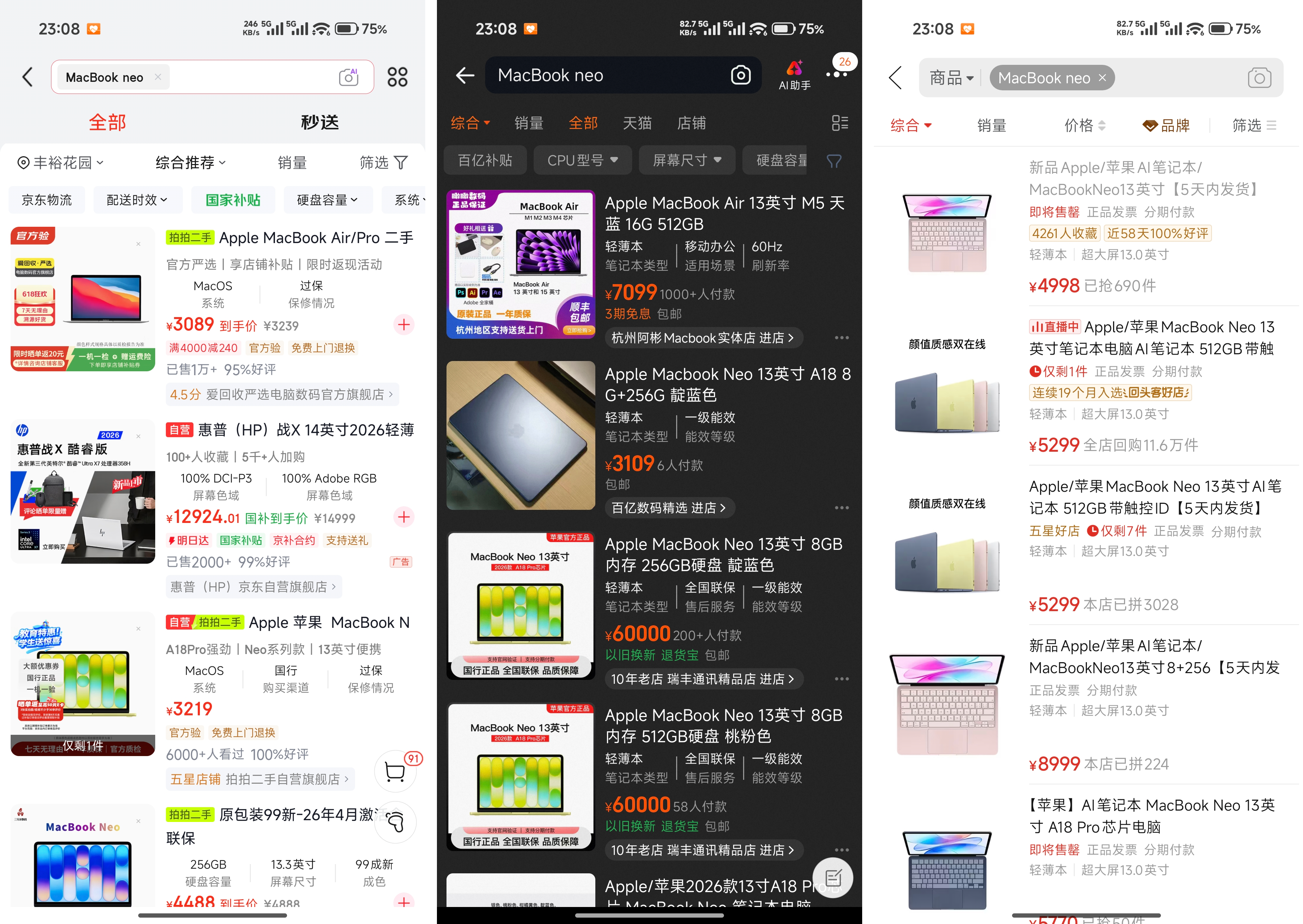
(Image Source: Leitech Graphics)
Why is Apple raising prices? Will the iPhone 18 series see price hikes in September? What impact will Apple's price adjustments have on the consumer electronics industry? Leitech (ID: leitech) has compiled its insights.
Apple hasn't merely stumbled in the AI race; it's become an "AI casualty." You heard that right—Apple has been adversely affected by AI.
Apple explained in its official statement: "The consumer electronics industry is facing unprecedented challenges. The rapid expansion of AI data centers has led to a surge in storage demand, and we have never witnessed component prices rise at such a magnitude and speed."
This isn't just an excuse from Apple; it's a storm the entire industry is weathering.
Since the AI boom in 2025, demand for AI computing power has skyrocketed. According to Micron Technology's latest earnings report, its mobile business gross profit margin has soared to 86%, up from just 15% a year ago. Taking DDR5 memory as an example, prices were around $3 per GB in early 2025, but by June 2026, they had surged to $8 per GB—a more than 160% increase. The situation is even more dire for NAND flash memory, with some models seeing price hikes exceeding 200%.
Memory manufacturers are reaping substantial profits, and these profits are coming directly out of the pockets of terminal brands.
Take a MacBook Air with 16GB of memory and 512GB of storage as an example. The cost of memory and storage alone has increased by about 1,000 RMB. This doesn't even include price hikes for other components.
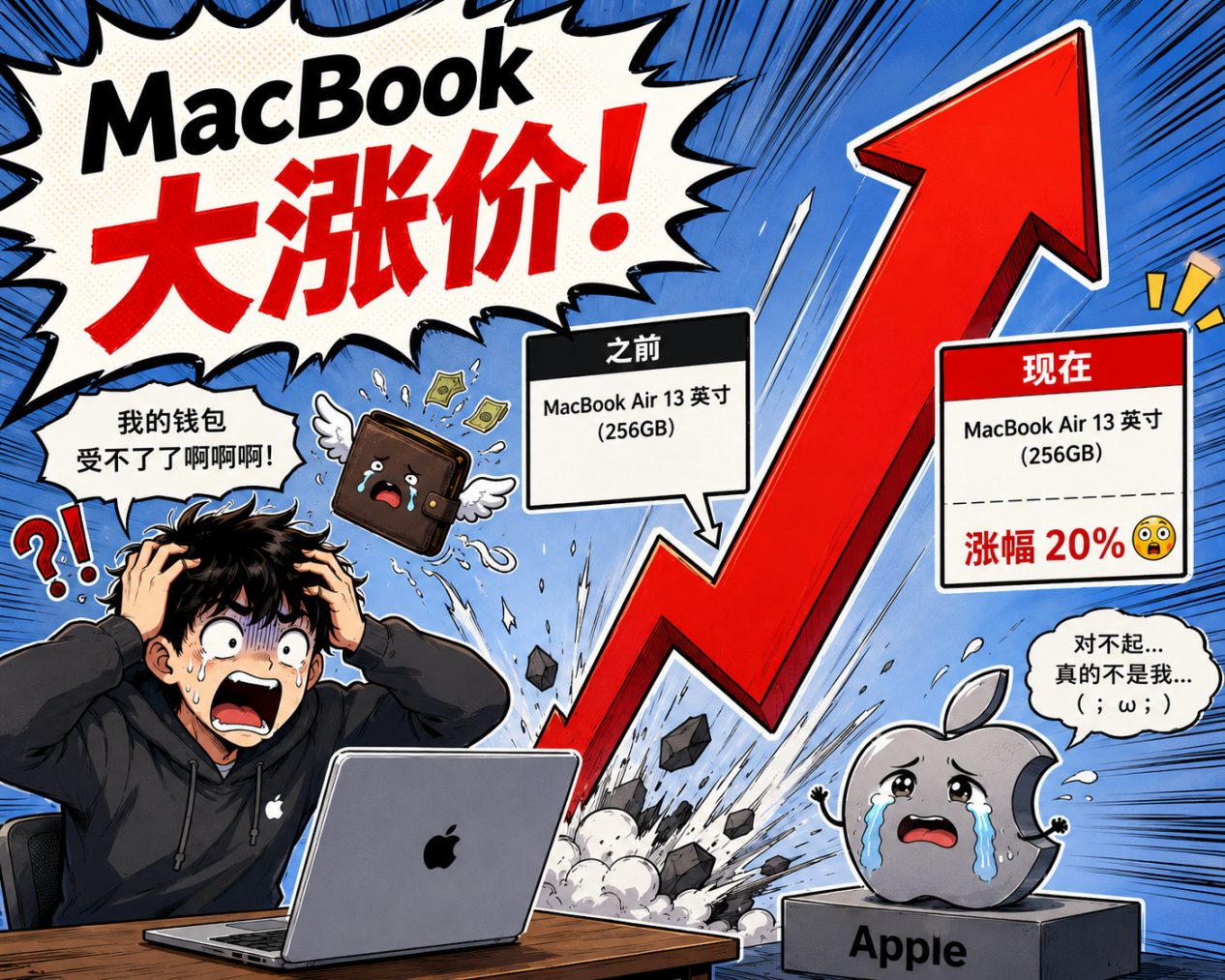
Apple CEO Tim Cook hinted at this early in the month. In an exclusive interview with The Wall Street Journal, he described the current storage supply-demand imbalance as a "flood of the century" and explicitly stated that Apple's pricing system could no longer be sustained.
(Image Source: AI-Generated)
In other words, the AI-driven storage shortage and subsequent price surge have proven too much for even Apple to handle.
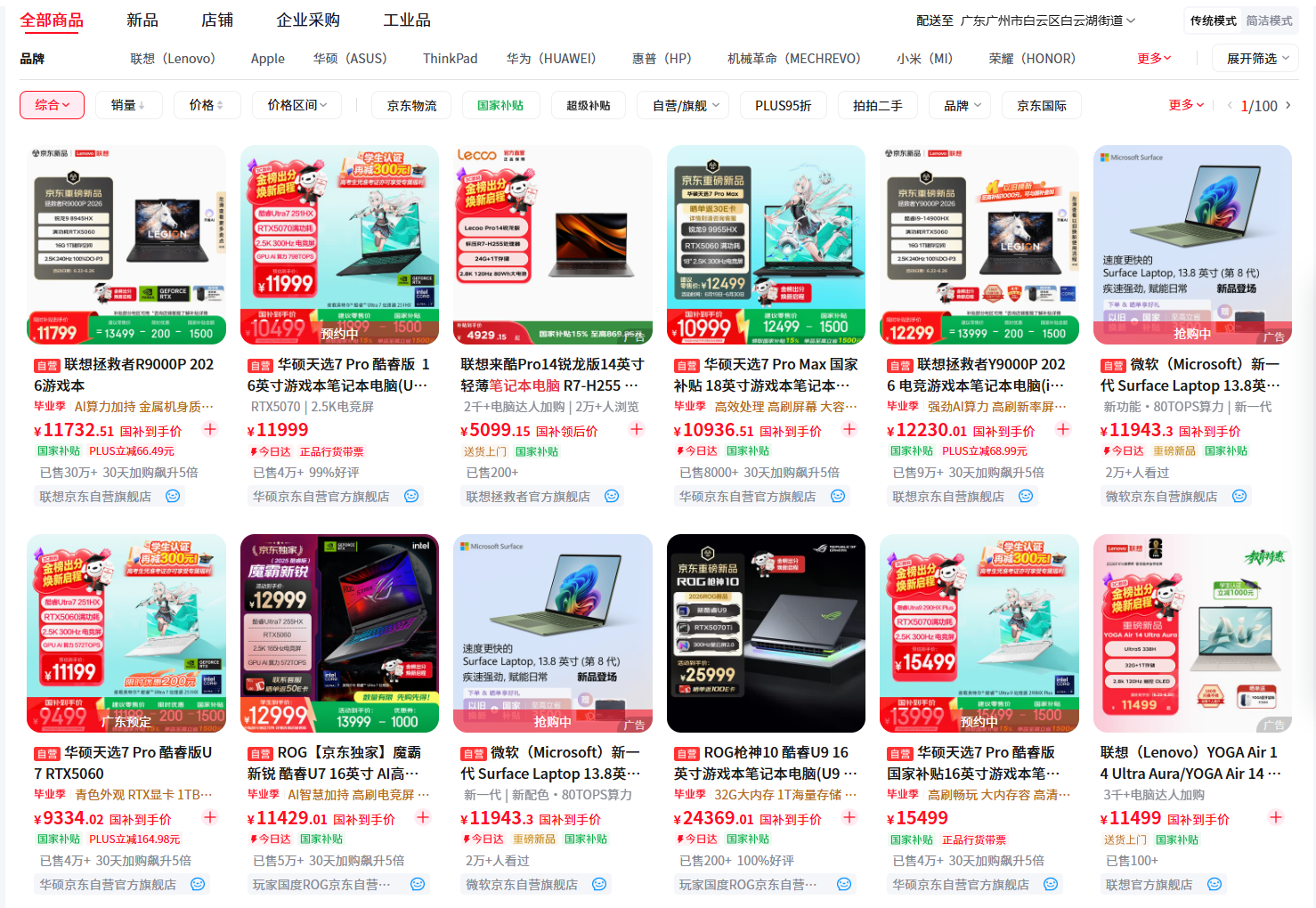
In fact, other consumer electronics brands started raising prices long ago. In the smartphone sector, OPPO, OnePlus, and vivo began adjusting prices across their entire product lines in March of this year. Xiaomi and Honor have also raised prices on several of their best-selling models, with replacement costs generally increasing by 300-2,000 RMB. Meizu, in a more drastic move, directly canceled the launch of the Meizu 22 Air, citing soaring memory chip prices that made pricing the new model unfeasible—and even if they did, no one would buy it.
The PC market is even more extreme. Dell has been raising computer prices across the board since last year, with increases ranging from 10% to 30%. Lenovo's Legion R9000P AI Edition (RTX 5070 Ti 16G + 1T) skyrocketed from its initial price of 13,699 RMB to 17,499 RMB in just four months—a 3,800 RMB increase. According to Sina Geek Frontline statistics, the average price of consumer-grade laptops has risen 12.7% since the beginning of the year and a staggering 21.3% year-over-year, with some models even seeing single-day price jumps of 1,100 RMB.
(Image Source: Leitech Graphics)
As an industry benchmark, Apple has long strived to maintain price stability. But faced with such immense cost pressures, it ultimately had to "follow the trend."
Now that Apple has raised prices by 20%, competitors will only become bolder. The logic is simple: Previously, Apple's strong supply chain influence allowed it to keep prices stable, deterring other brands from raising prices too aggressively—they feared users would switch to Apple if their products became too expensive. This phenomenon did occur, which is why the iPhone consistently dominates sales charts, not just due to its product strength (AI availability in China is irrelevant), but also because Android products become less attractive as they get more expensive.
But now? With Apple raising its own prices, what do other brands have to lose? As a result, you'll find it increasingly difficult to buy a "cheap" laptop or smartphone.
For ordinary consumers, the impact of this price hike is very real.
First, purchasing costs have risen sharply. Take the MacBook Air as an example: after the price increase, its starting price jumped from 8,499 RMB to 9,999 RMB—a 17.6% increase. For budget-conscious users, this may mean lowering configuration requirements or switching to other brands.
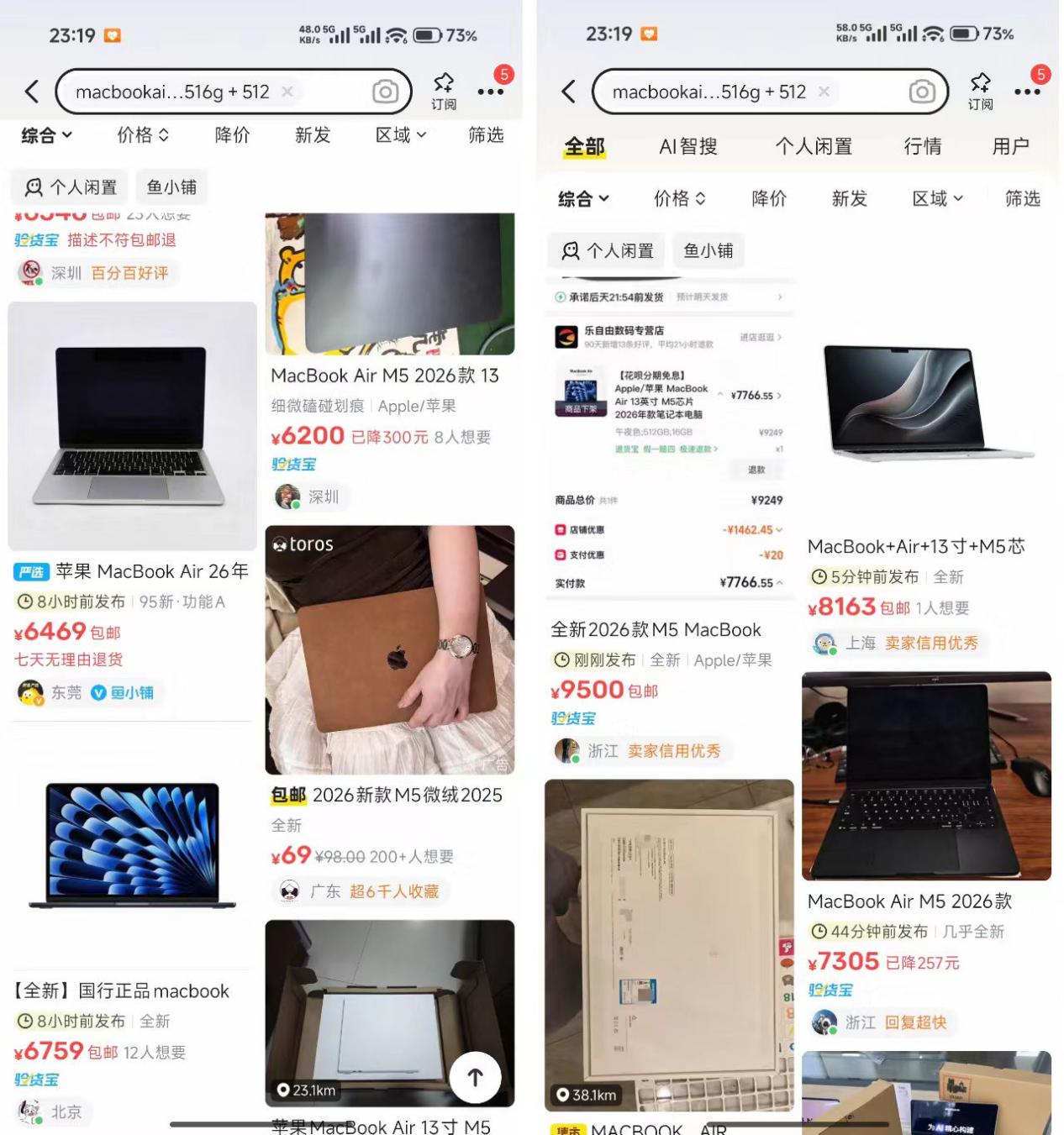
Thinking of snagging a deal on Xianyu (China's largest second-hand goods platform)? Don't count on it. Second-hand market prices will rise even faster and more aggressively... Due to the price hikes on new products, scalpers have flooded the market, sweeping up all inventory. Under these circumstances, prices for Macs and iPads on the second-hand market will naturally surge. Leitech found on Xianyu that the MacBook Air M5, which sold for about 6,000 RMB in the second-hand market before Apple's official price hike, now goes for 6,800 RMB for "like-new" units. Even more outrageously, some second-hand sellers are stockpiling devices, betting on further price increases.
(Image Source: Leitech Graphics)
This leaves users in an awkward dilemma: buy now or wait? Some think, "Buy now, enjoy now," and make the purchase while they still can. Others prefer to "wait and see," hoping prices will drop. But the reality is that consumers considering switching to Windows devices are finding that other brands are also raising prices, some even more aggressively than Apple.
This price hike is industry-wide—no one is immune.
Different groups are affected differently. Students, already on tight budgets, now have to spend an additional 1,000-2,000 RMB on laptops, equivalent to a month's living expenses. Creators, who need large memory and high-performance configurations for video editing and 3D rendering, face rising production costs. Enterprise users are the most troubled, as procurement costs are skyrocketing exponentially, and some companies may even consider delaying device replacement plans.
For users with urgent needs, buying now might still be the most cost-effective option. Memory chip prices are still rising, with another 40%-50% increase expected in the third quarter and a further 30%-40% in the fourth quarter. Waiting will only make it more expensive. For non-urgent users, it might be worth waiting a bit longer. But be prepared: significant price drops are unlikely; at best, the rate of increase may slow. If your budget is extremely tight, consider buying last-generation products or lower-configured versions.
Simply put, users now face a stark choice: accept the price hikes or forgo the purchase. There is no middle ground.
It's safe to say that this AI-triggered storage crisis will reshape the entire industry supply chain.
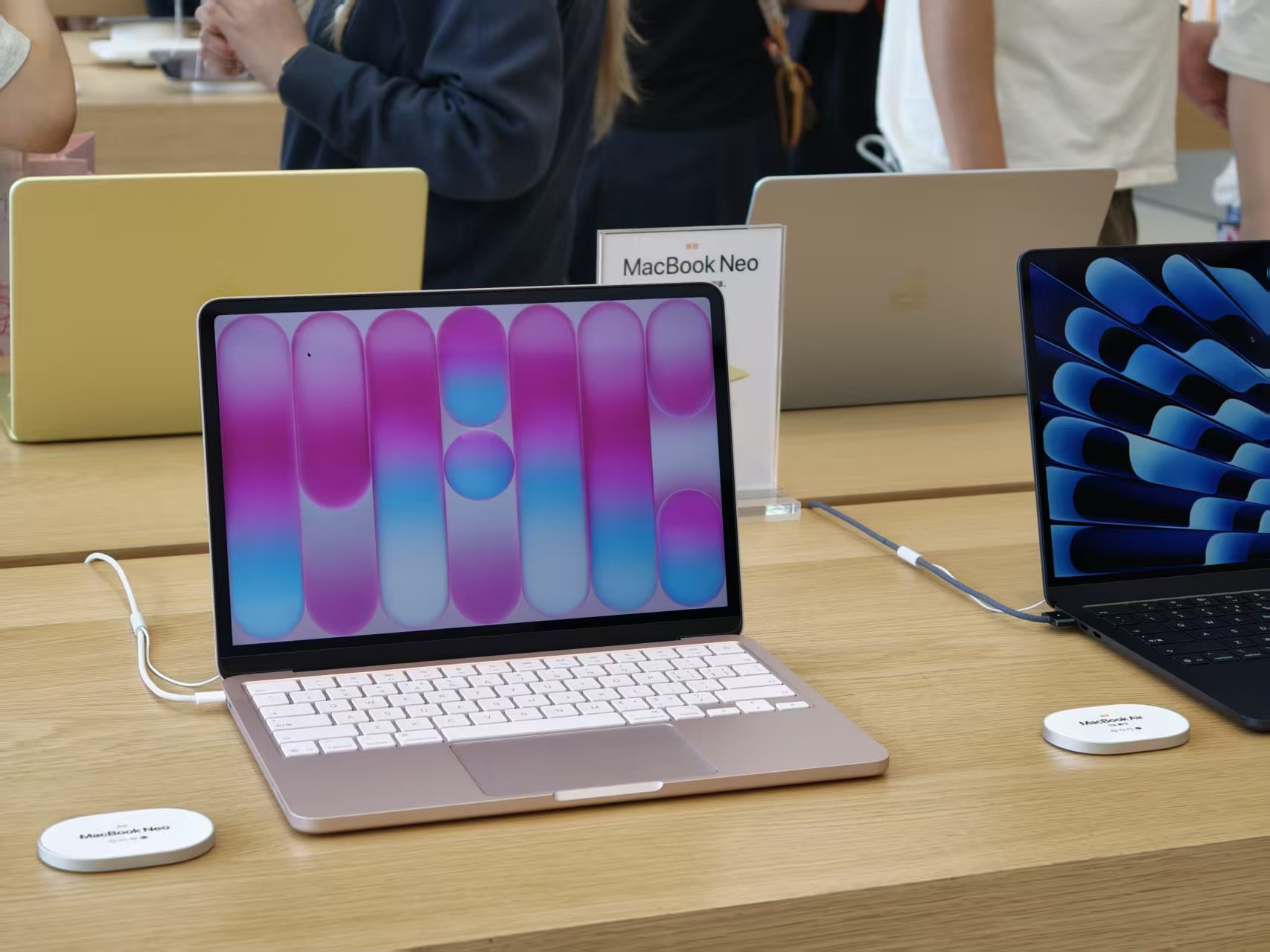
With storage manufacturers allocating most of their capacity to AI, the consumer electronics market is receiving a shrinking share of products, making price hikes inevitable.
(Image Source: Leitech Photography)
According to market research firm Sigmaintell, demand for AI infrastructure is expected to drive AI servers' share of global DRAM consumption to 50%-55% by 2028, including DDR, LPDDR, and high-bandwidth memory (HBM). In contrast, this share was just 24% in 2025—more than doubling in three years. This means consumer electronics will receive an increasingly smaller share of storage chips.
In the past, storage chip prices fluctuated based on supply and demand, but the overall market was relatively "healthy." Now, with AI data centers' demand seemingly limitless, storage manufacturers have overtaken consumer electronics brands in controlling industry pricing.
This shift is affecting the entire supply chain. Take Apple as an example: its gross profit margin has declined from 43% in 2024 to 40% in 2025 and is expected to drop further to 38% in 2026.
According to a research report by Jefferies, AI demand will continue to drive up global storage chip market prices, with a 40%-50% quarter-over-quarter increase expected in the third quarter of 2026 and a further 30%-40% rise in the fourth quarter. This trend may persist until the end of 2027.
Faced with these cost pressures, Apple may resort to "clever" configuration adjustments. For example, future base-model MacBook Airs might upgrade from 16GB to 24GB of memory. This enhances the user experience while making it easier for consumers to accept higher prices. After all, "more features at a higher price" is more palatable than "direct price hikes."
Additionally, Apple has made significant adjustments to its chip strategy. According to Bloomberg, Apple will skip the high-end versions of the M6 chip (i.e., cancel the Pro and Max versions) and plans to directly launch the M7 Pro and Max versions in 2027.
The reason is simple: with storage chip prices soaring, continuing to iterate high-end chips as planned would be financially unsustainable. Instead of spending heavily on M6 Pro/Max, Apple will jump straight to M7, integrating AI capabilities in one go to save costs and enhance competitiveness.
Unfortunately for those planning to buy a MacBook Pro this year, they may not get the product they want.
Other manufacturers are also taking action. Huawei is developing its own storage chips to reduce reliance on external suppliers, and Apple is considering investing in storage chip manufacturers to ensure supply chain stability. This storage crisis may accelerate industry consolidation.
While Apple has only raised prices for Macs and iPads so far, the iPhone has temporarily been spared. However, Leitech (ID: leitech) speculates that prices for new iPhones and other products may increase in the second half of the year, with users potentially footing the bill for AI development.
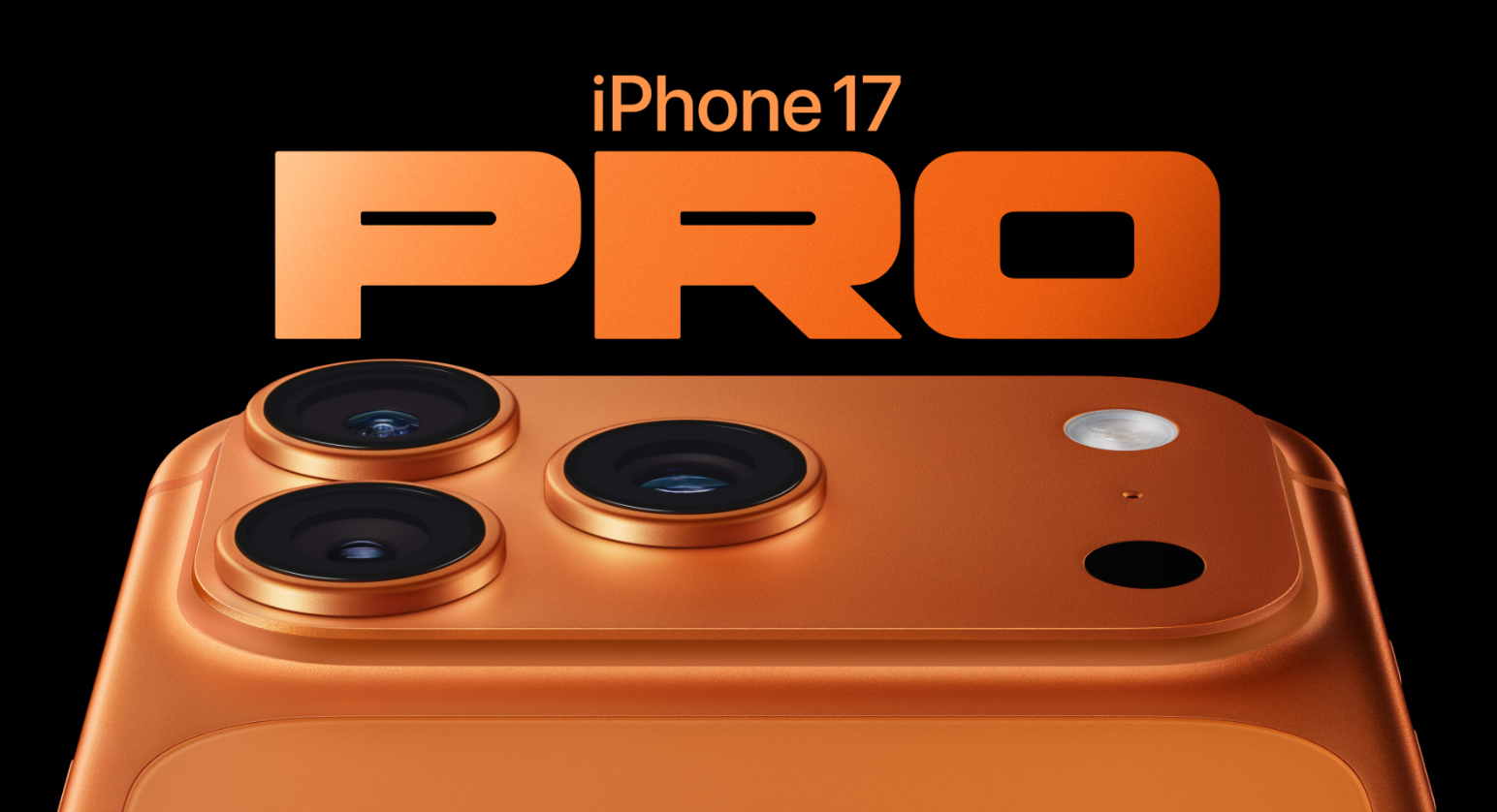
Given the current situation, iPhone price hikes seem almost inevitable. Apple's decision to only raise Mac and iPad prices this time was clearly calculated. The iPhone accounts for over half of Apple's total revenue, and raising its price amid intense market competition could impact overall sales.
But Apple's surprise move tonight has laid the groundwork for iPhone price hikes: test market reactions on a smaller scale first, then consider raising prices on core products like the iPhone if user acceptance is high. This strategy minimizes risk.
(Image Source: Apple Official)
From a supply chain perspective, iPhone price hikes face even greater pressure. iPhones generally have higher storage configurations than Macs and iPads, meaning cost increases could be even more significant. Take the iPhone 18 as an example: if storage costs rise by 20%, this could add 450-600 RMB in costs per unit.
How will the market react? That depends on Apple's pricing strategy and the magnitude of the hikes.
If Apple limits iPhone price increases to under 10%, consumers may grudgingly accept them. After all, loyal iPhone users are unlikely to switch to other brands overnight.
But if iPhone price hikes are too steep, users may consider Android alternatives. Samsung, Huawei, Xiaomi, and other brands offer comparable experiences to iPhones. However, these brands face similar cost pressures and are also raising prices, making it difficult for users to find truly "cheap" alternatives.
More critically, while price hikes can alleviate cost pressures, they may also damage brand image. If users perceive Apple as "no longer offering good value for money," they may switch to other brands.
Apple's price hikes this time boil down to "costs becoming unsustainable." AI development has diverted storage chips away from terminal brands, forcing them to raise prices. This is bad news for users. But from another perspective, AI is driving technological progress—it's just that the costs are now falling on consumers.
If you're planning to buy a Mac or iPad, we recommend acting soon. By the time the iPhone 18 series launches, prices across Apple's product lineup may climb even higher.
As AI technology continues to advance, storage crises may become the norm. Consumers need to plan their purchases more rationally, while terminal brands must adapt more flexibly to market changes.
This AI-triggered storage crisis is just beginning.
Apple, Mac, AI, iPhone, Memory
Source: Leitech
All images in this article are from the 123RF royalty-free image library. Source: Leitech
-
![]()
Profits Skyrocket! From Leasing to Construction: A Storage Enterprise with Hundred-Billion-Yuan Revenue Plans 1.175 Billion Yuan Investment in New Headquarters
-
![]()
Discounts Now on Offer: Is Xiaomi No Longer Grappling with Vehicle Shortages?
-
![]()
Samsung Doesn't Make Money the Hard Way
-
![]()
Japanese Media Acknowledges: China's Engine Technology Outstrips That of Japanese Firms
-
![]()
Japanese Media Concedes: China’s Engine Technology Outpaces Japanese Firms
-
![]()
Doubao Professional Version Unveiled! China Now Boasts Its Own National-Level Professional AI Agent
-
![]()
ByteDance and Alibaba Both Step Back from the Gaming Arena
-
Xiangeo International Clears BSE Review: Setting a Global Standard for the ‘Chinese Sound’ | A-Share Financing Brief